


Cosmetics Digital Transformation: Rebuilding the System Behind Growth

Psychology Center Digital Transformation: Website, SEO & Growth

Digital Marketing for Psychologists; One of the things I have learned from working across different digital transformation projects is that professional credibility and digital credibility do not automatically move together. Someone can be highly competent in their own field and still be represented online by a website that barely works, advertising accounts that cannot measure what is happening and social channels that communicate almost none of the trust they have built offline.
That gap becomes even more serious in psychology.
When someone is looking for psychological support, the decision to reach out is rarely impulsive. Before sending a message or booking a session, they may spend time trying to understand who the professional is, how they work, whether the environment feels trustworthy and whether taking the first step will be difficult. A broken website or confusing digital experience therefore creates more than a marketing problem. It can interrupt a trust decision before a conversation ever begins.
This project started from exactly that kind of situation.
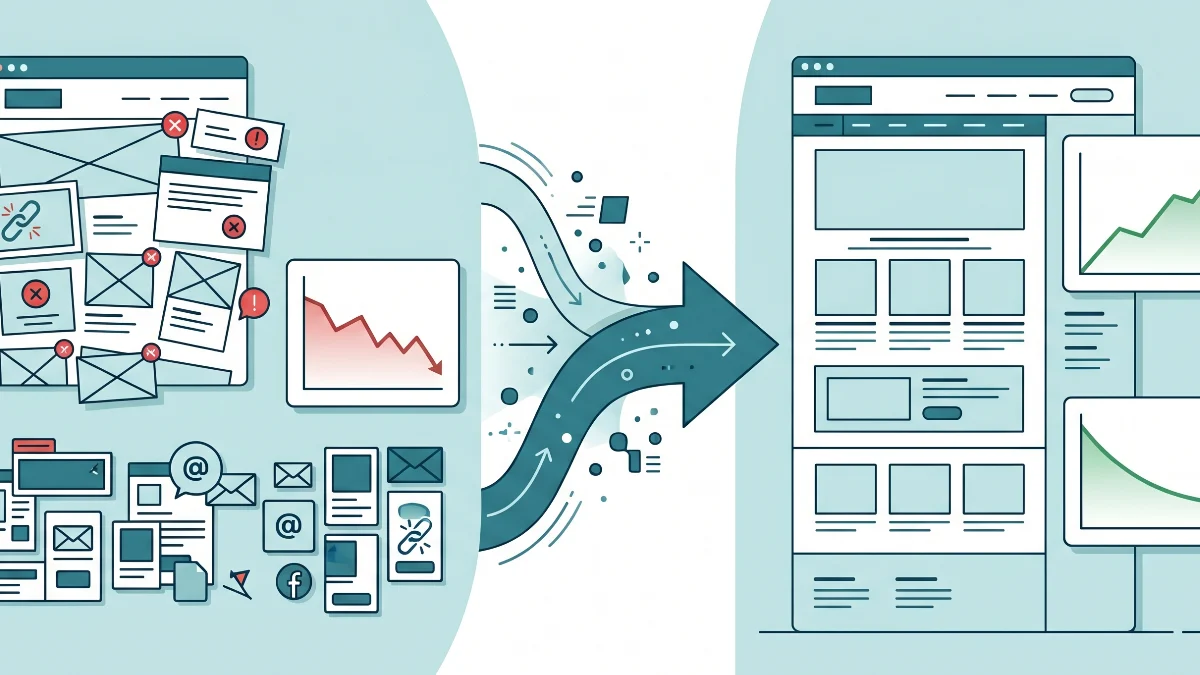
Several agencies and independent professionals had previously worked on the psychologist’s digital presence, but instead of creating a coherent system, their interventions had accumulated into a fragmented one. Parts of the website failed to load correctly, some pages were broken, tracking had been configured incorrectly and the advertising accounts contained conflicting campaign structures. Monthly advertising expenditure had reached approximately TRY 300,000–400,000, yet the system was producing very little useful visibility into where that money was going or why performance was weak. The social account had roughly 6,000 followers, but the overall identity, communication style and relationship between content, website and paid acquisition were still unclear.
My first decision was therefore not to launch another campaign.
It was to stop treating the symptoms and understand the system.
Digital Marketing for Psychologists Starts With Trust, Not Traffic
I began with a complete audit of the existing environment. The website, advertising accounts, tracking, search visibility, mobile experience and content structure were reviewed together rather than as separate problems.
The technical condition of the website made the situation particularly difficult. Different developers had made changes over time, leaving behind conflicting code and fixes whose original purpose was no longer always clear. There were broken links, slow pages, SSL-related problems and inconsistencies between desktop and mobile behavior. On the advertising side, Meta Pixel events had been configured incorrectly, some useful actions were not being recorded and campaign structures contained overlapping audiences and competing ad sets. Google Ads showed similar signs of years of disconnected intervention.
I documented those problems before rebuilding anything.
That may sound like an obvious step, but it changed the project significantly. When a digital environment has been modified by several people over a long period, immediately trying to “fix” visible problems can make the structure even harder to understand. The audit created a boundary between what could still be trusted and what needed to be rebuilt.
The conclusion was that repairing the existing site would create more risk than value.
So I replaced it.
Rebuilding the Psychologist Website Strategy From the Ground Up
The new website was developed as a custom PHP-based platform rather than continuing to patch the previous codebase. The decision was not about using custom code for prestige. It was simply the more maintainable option given the amount of conflicting work already embedded in the old system.
The Psychologist Website Strategy started with information architecture rather than visual design.
I mapped what someone looking for psychological support would actually need to understand before deciding whether to continue. The homepage, areas of practice, professional background, educational content and communication paths were reorganized so each page had a clear purpose instead of existing simply because a standard professional website was expected to have one.
That naturally changed the UX work as well.
A person looking for a psychologist may already be dealing with uncertainty before arriving on the site. The interface should not create additional friction through confusing navigation, overwhelming forms or unnecessary steps. Forms were simplified, mobile interaction received the same attention as desktop and information was organized around the questions a potential client was likely to have rather than around internal professional terminology.
The visual system followed the same logic. Typography, spacing, hierarchy and color were used to create a professional environment without making the site feel clinical or impersonal. The objective was not to turn psychology into a commercial product experience. It was to communicate expertise and accessibility without sacrificing the seriousness of the field.
The technical layer supported that experience in the background. The previous site had pages whose loading times could reach tens of seconds. The new implementation substantially reduced loading time while cleaning up the underlying PHP structure and removing unnecessary technical weight. Advertising landing pages were also considered during development rather than being attached to the site later as an afterthought. Tracking for relevant page and enquiry interactions was integrated and tested as part of the build.
This became an important principle throughout the project: the website, advertising and analytics systems could no longer be designed independently.
Building the Psychologist SEO Strategy Around Real Questions
Once the new technical foundation was stable, search became the next layer.
The Psychologist SEO Strategy was built around technical structure, search behavior and useful content rather than trying to rank for one broad term such as “psychologist.”
The technical foundation included clearer URL structures, canonical configuration, page metadata, crawlability, sitemap management and Search Console monitoring. Performance work continued alongside this because technical quality, accessibility and usability were part of the same user experience.
The more important work, however, happened in the search-intent analysis.
People looking for psychological support do not all search in the same way. Some searches are related to symptoms or situations. Others are about types of therapy, specific areas of professional support or location. Long-tail questions can reveal much more about what a person is trying to understand than a generic profession keyword.
The content system was built around those real questions.
Articles were planned according to areas of practice and meaningful search intent, but their purpose was not simply to create indexed pages. They also needed to help a reader understand the subject before making a decision about whether professional support was appropriate.
This created a useful overlap between SEO and trust.
The best-performing piece of content is not necessarily the one that repeats a search phrase most often. In a field like psychology, useful content should help someone understand a subject while also making the professional behind the site easier to evaluate.
Structured data was also incorporated where appropriate so search systems could understand the person, page type and relationships between content more clearly. The implementation was treated as machine-readable context, not as a shortcut to rankings.
That distinction matters to me today even more than it did then. Search optimization becomes much more durable when the website is useful independently of the search engine.
Fixing Measurement Before Fixing Advertising
The advertising accounts presented a different kind of problem.
There was already a significant budget, but the measurement system underneath it was unreliable. That meant increasing spend or changing creatives would have been premature because the platforms themselves were receiving weak or incorrect signals.
The first phase of Healthcare PPC Optimization was therefore mostly cleanup.
Incorrect campaign structures were removed or reorganized. Audience overlap was reduced. Tracking was rebuilt and tested so relevant actions could be measured correctly. Campaign architecture was then redesigned around clearer objectives and audience stages instead of allowing multiple ad sets to compete against one another without a coherent funnel.
This is one of the reasons I am careful when people describe advertising problems primarily in terms of creative quality or budget size.
A platform cannot optimize intelligently when the data it receives is wrong.
A bigger budget does not repair a broken measurement system. It simply allows the broken system to spend more money.
The objective was therefore not “how can we get more results from TRY 400,000?”
It was “how much of this expenditure is actually necessary once the system works correctly?”
That changed the economics of the account substantially.
According to the project’s records, monthly advertising expenditure eventually decreased from approximately TRY 300,000–400,000 to around TRY 40,000, while the number of potential clients reaching out increased during the same broader period.
That is close to a 90% reduction in expenditure.
I would not present that as a benchmark another psychology practice should expect to reproduce. The starting situation was unusually inefficient, which created unusually large room for improvement.
The number is useful because it shows what happens when the problem is not insufficient budget but structural waste.
Connecting UX With Acquisition
One of the reasons reducing advertising spend did not simply reduce enquiries was that the landing environment had changed as well.
The website was no longer asking paid traffic to compensate for a weak experience.
Service and practice-area pages were written in language closer to the questions people were actually asking. The interaction path was simplified and the communication form was designed to require as little unnecessary effort as possible. Visual hierarchy was reconsidered so the next action was understandable without turning every page into an aggressive conversion funnel.
This is especially important in professional services.
Ecommerce conversion optimization often tries to reduce the distance between interest and purchase. Psychology is different. The objective should not be to pressure someone into acting faster than they are comfortable with.
The job of the interface is to remove unnecessary friction while preserving the user’s control over the decision.
That is a very different design problem.
It also reinforced something I had already seen in other sectors: advertising efficiency cannot be separated from product experience. If the destination is weak, acquisition eventually becomes expensive because each additional visitor enters the same broken journey.
Rebuilding the Content and Social System
The social media account presented a different challenge.
It already had an audience of approximately 6,000 people, so the objective was not to create a presence from zero. The problem was that the account lacked a sufficiently consistent editorial system and a clear relationship with the wider professional identity.
The Psychologist Instagram Growth strategy therefore started with content architecture rather than follower targets.
Content was organized around recurring themes that balanced education, common questions, more human professional communication and service-related information. Publishing rhythm and timing were reviewed, formats were selected according to the type of information being communicated and traffic back to the owned website became easier to measure.
The account grew from roughly 6,000 to 14,400 followers during the project, with the project records attributing approximately 85% of that growth to organic content and limited promotional support.
Again, I do not see follower growth alone as proof that a strategy worked.
A larger audience can be meaningless if it is irrelevant or if the professional identity becomes distorted in order to attract it.
The more important part of this growth was that content, website and professional positioning began telling the same story.
That made the audience useful beyond the social platform itself.
Creating One Voice Across the Entire Digital Presence
Content work eventually extended beyond Instagram.
The psychologist needed a consistent way of communicating across the website, articles, social media and advertising. The same professional should not sound like four completely different organizations depending on where someone encounters them.
We therefore worked on voice and communication principles as part of the broader transformation.
The objective was to find the point where professional expertise and personality could coexist. Too much clinical distance would make the digital experience cold. Too much casual content could weaken professional credibility. Promotional language would be particularly damaging because the decision involved a sensitive professional service rather than an ordinary consumer product.
That balance influenced blog writing, social content and advertising language.
Strategic discussions also expanded into the structure of the practice itself: how services should be presented, how online sessions should be positioned digitally and which growth priorities deserved attention first.
This is the point where the project moved beyond conventional digital marketing.
The digital system began affecting how the professional practice itself was articulated.
Six Months Later
By the end of the six-month engagement, the most visible changes could be measured in traffic, advertising expenditure and audience growth, but those figures were consequences of a much broader rebuild.
The site had been redeveloped in PHP around a new information architecture and user journey. Technical SEO, content and structured-data work had been rebuilt around a clearer search strategy. Tracking and advertising infrastructure were repaired. Monthly advertising expenditure had fallen dramatically. Instagram had grown from approximately 6,000 to 14,400 followers, with most of that growth recorded as organic.
The project records also show approximately 1,460% growth in website traffic during the engagement.
That number is significant, but I would not compare it to generic “expected SEO growth” percentages as the original version of this case study did. The starting website was severely damaged, so the baseline itself was unusually weak. Recovering from that condition and then adding SEO, content, social traffic and advertising makes the percentage structurally different from normal year-over-year growth on a healthy website.
Context makes the result more credible, not less impressive.
The same principle applies to the advertising reduction. Moving from several hundred thousand lira per month to around forty thousand while increasing incoming enquiries does not mean a psychology practice “only needs TRY 40,000.” It means this specific account had accumulated an extraordinary amount of waste, and repairing the system made much of that expenditure unnecessary.
Those distinctions are important because an operational success story should explain what happened without turning one project’s numbers into promises for the next one.
What Digital Marketing for Psychologists Actually Means to Me
This project changed the way I think about Digital Marketing for Psychologists because it made one thing especially clear: the profession cannot be treated like a conventional ecommerce category.
The website matters because it is often part of the trust decision.
SEO matters because people frequently begin with questions rather than a professional’s name.
Advertising matters, but only if measurement is reliable and the destination experience deserves the traffic.
Content matters because expertise has to become understandable without turning a sensitive field into entertainment.
Social media can create visibility, but visibility is useful only when it reinforces the same professional identity someone will later encounter on the website.
And technology matters because all of those layers depend on infrastructure that users will probably never notice unless it fails.
The original situation looked like a collection of unrelated problems: a broken website, inefficient advertising, weak SEO, inconsistent content and an underperforming social presence.
It was actually one system problem.
Once those layers were rebuilt around the same professional identity and measurement structure, improvements began reinforcing one another instead of competing with one another.
That, more than any individual metric, is what made this project successful.
A stronger website made paid traffic more useful.
Better analytics made advertising decisions clearer.
Search content created durable discovery.
Social content built a larger relevant audience.
A more coherent professional identity increased trust across every channel.
Six months later, the digital presence was no longer something the psychologist had to work around.
It had become infrastructure the practice could actually use.