


Authorization Architecture: RBAC, ABAC, and Permissions

Product strategy trade-offs become visible when a team has several defensible opportunities but enough time and money to pursue only one. A roadmap can make those competing ideas look orderly. A budget can make them look measurable. Neither tells us what the organization is giving up by choosing one direction, what has to be true for that choice to work, or whether the commitment can be reversed before the cost becomes unacceptable.
I think the most useful strategic question is not simply, “Which initiative has the highest score?” It is, “What are we choosing not to do, what evidence makes that sacrifice reasonable, and what would convince us to change our minds?” Product strategy trade-offs are expressed through linked decisions. The choice of customer, problem, capability, investment sequence, and success condition shapes the options that remain available later.
This distinction matters to founders and product leaders because uncertainty does not disappear when an initiative receives an approved budget. A seemingly attractive feature can occupy the same engineers needed to reduce customer friction. A promising enterprise opportunity can create contractual obligations that a smaller experiment would not. An inexpensive prototype can reveal little if it tests a question that would never change the investment decision.
In this article, I develop a product strategy trade-offs framework that records opportunity cost, evidence confidence, decision reversibility, and the value of keeping strategic options open. I then apply it to a fictional B2B software product facing three plausible investment choices. The framework is a reasoned editorial synthesis supported by decision and strategy research, not a report of measured outcomes in a real customer portfolio.
Decision Brief: Make the Sacrifice and the Reversal Rule Explicit
The problem: Teams approve initiatives by comparing expected benefits but often fail to record the best alternative they are deferring, the weakest important assumption, and the conditions that would invalidate the choice.
The approach: Maintain a compact product decision record containing the selected bet, rejected or deferred alternatives, evidence quality, commitment exposure, learning checkpoints, and predefined reconsideration triggers.
The judgment: Invest deeply when the advantage requires commitment and the underlying case is sufficiently credible. Stage the investment when the uncertainty can be reduced through a meaningful, lower-cost learning step.
The limit: A structured record cannot manufacture evidence or guarantee a good outcome. Its value is in making disagreements, assumptions, and future corrections more visible before organizational momentum obscures them.
Product Strategy Is a Sequence of Choices, Not a Ranked Feature List
A feature list answers what a team might build. A strategy explains where it will compete, which customer problem deserves attention, why the chosen approach might succeed, and what the organization will deliberately leave outside its present commitments. Those choices have to reinforce one another. A product targeting cost-sensitive small businesses cannot casually adopt the same operating model, support commitments, and implementation complexity as a bespoke enterprise platform without confronting a strategic contradiction.
Roger Martin’s five questions of strategy connect aspirations, where to play, how to win, required capabilities, and management systems. I use that approach to test whether a proposed product initiative serves an actual strategic direction. A feature may sound valuable in isolation while moving the business toward a different customer, cost structure, or competitive position from the one it claims to support.
A Real Choice Includes an Exclusion
If the team says that onboarding, enterprise reporting, integrations, and an entirely new market are all equally important, it has listed desirable directions rather than explained an allocation decision. Resource constraints will eventually select among them anyway. The difference is whether leaders make that choice consciously or let meetings, escalations, and the loudest request determine the sequence.
For product strategy trade-offs, an exclusion should be specific and revisitable. “We are not prioritizing enterprise-specific reporting this quarter because our present strategic constraint is early activation” tells engineers, sales, and leadership much more than “reporting is low priority.” It also leaves open the possibility that new evidence or a material commercial obligation could change the ordering.
Strategy Before Scoring
Prioritization methods can help organize alternatives. They cannot decide, without a strategic premise, which customers the business wants to serve or what trade-offs are acceptable. A score built from reach, impact, confidence, and effort may still favor a large but irrelevant opportunity if the underlying estimates and eligibility criteria are poorly defined.
I would therefore separate two activities. First, establish the strategic boundary: target customer, desired outcome, competitive logic, and constraints. Then compare viable initiatives inside that boundary. If an option serves a completely different strategy, the decision is no longer simply a feature ranking; it is a choice between business directions. This distinction complements my published RICE sensitivity analysis, which tests how numerical rankings respond to uncertain estimates. Here the emphasis is on why a strategic choice is justified at all.
Opportunity Cost: The Best Alternative You Will Not Pursue
Opportunity cost is the value of the next-best alternative forgone when a choice is made, rather than the sum of every appealing possibility left behind. The OpenStax economics explanation makes this distinction clear. In product work, the scarce resource may be engineering capacity, executive attention, access to a distribution partner, the trust available for experimentation, or simply calendar time.
Suppose a team has enough capacity to improve first-use activation or to develop a specialized reporting module. The cost of the reporting module is not only its engineering budget. It also includes the value that improving activation might have created during the same period. Neither value is known precisely before a decision, which is why pretending to calculate an exact cost without credible estimates can be misleading.
Product strategy trade-offs become clearer when leaders name the next-best alternative in plain language. The decision record should state what that alternative would attempt to achieve, what capacity it would consume, and which assumptions prevent a confident comparison. “We could spend these six weeks addressing the first-use drop-off” is already more informative than attaching a decorative opportunity-cost number to a slide.
Calendar Time, Dependencies, and the Cost of Waiting
In product strategy trade-offs, the same investment can carry different opportunity costs depending on timing. Deferring a contractual requirement may put an existing relationship at risk. Delaying a market experiment may allow a competitor to establish distribution. Conversely, rushing an irreversible platform migration may create avoidable technical debt and operational exposure. These strategic trade-offs require comparing time-dependent consequences without implying they can all be reduced to an accurate single number.
I distinguish between the cost of doing something, the cost of not doing it, and the cost of losing the ability to do something later. The third category is easy to overlook. An exclusive partnership can make future channels harder to pursue; a proprietary integration can change switching costs; a commitment to a new audience can redirect the product’s entire support and pricing model.
Past Spending Does Not Justify the Next Commitment
A partially completed feature has already consumed resources, but those costs do not automatically make completion the best future choice. The St. Louis Fed discussion of the endowment effect distinguishes sunk costs from opportunity costs and describes why attachment to existing possessions or investments can influence decisions. For product leaders, the relevant comparison is between the remaining cost and expected value of completion and the alternatives now available.
Stopping work may still be wrong when finishing requires little additional effort and delivers genuine value. The discipline is not to abandon every initiative that loses momentum. It is to avoid treating effort already spent as proof that the next expenditure is justified.
Evidence Confidence: What Do We Actually Know About the Bet?
When a team discusses product strategy trade-offs, estimates are often presented beside observed facts in the same spreadsheet. A revenue projection from an internal model, a direct customer request, a usability observation, and a measured activation trend do not carry identical evidentiary weight. Each may be useful, but each supports a different kind of conclusion.
Herbert Simon’s work on decision-making under bounded rationality helps explain why organizations must act without complete knowledge. The answer is not to pretend uncertainty is absent. It is to identify which information is missing, whether obtaining it is practical, and whether the choice should be made differently if it turns out to be wrong.
An Evidence Ledger, Not a Decorative Confidence Percentage
I prefer an evidence ledger with four simple states: observed, supported but limited, plausible, and unknown. These are editorial labels rather than a statistically validated scale. They tell reviewers what kind of claim is being made and which additional evidence would matter. A small study may support a specific usability finding without proving how prevalent that issue is across the entire customer base.
| Evidence state | Meaning | Useful next action |
|---|---|---|
| Observed | Directly measured or documented under described conditions | Check population, instrumentation, and relevance |
| Supported but limited | Consistent evidence with material sampling or context limits | Test whether it generalizes to the decision population |
| Plausible | Reasonable hypothesis supported mainly by indirect signals | Design a targeted test of the critical assumption |
| Unknown | No adequate evidence for the proposed causal or commercial claim | Identify whether learning is feasible before commitment |
Evidence confidence is not the same as stakeholder certainty. A sales conversation can reveal a valuable enterprise need without proving its frequency. An analytics dashboard can show where a funnel narrows without demonstrating why users leave. A prototype test can disconfirm a usability hypothesis without proving that a full product launch will be commercially successful.
Assumption Testing: Identify the Claim That Could Change the Decision
Rita McGrath and Ian MacMillan’s discovery-driven planning approach asks decision-makers to expose critical assumptions instead of treating uncertain ventures like predictable operating plans. For software product bets, I would write the assumption in a form that could be wrong and then explain what evidence would change the allocation decision.
For example, “Enterprise customers want more reports” is not a useful enough assumption. A stronger version is: “A meaningful share of our target enterprise buyers cannot complete a required workflow without a particular reporting capability, and that gap is decisive in their purchase decision.” The team can then investigate procurement requirements, workflow needs, and competing solutions. It should not confuse a single stakeholder’s enthusiasm with market validation.
The UK Government Service Standard similarly emphasizes learning the user’s underlying problem and testing assumptions before building the wrong solution. The important methodological point is that the test must address an actual decision boundary. Learning that people like a proposed interface is of limited strategic value if the investment depends on procurement authorization or long-term willingness to pay.
Decision Reversibility: Can We Change Course Without Hiding the Cost?
Decision reversibility describes the practical ability to undo or redirect a commitment. Amazon’s 2016 shareholder letter describes the difference between choices that can be reversed relatively easily and choices whose consequences are difficult to unwind. The distinction is useful, but I would treat reversibility as a set of dimensions rather than a permanent label attached to an initiative.
Product strategy trade-offs change when a supposedly small decision triggers obligations beyond the development team. A pilot feature may be technically easy to remove but commercially difficult to withdraw after customers depend on it. A vendor contract may be inexpensive in its first month yet impose migration costs and data portability constraints later. A pricing experiment may require little engineering and still create expectations or trust damage that cannot simply be rolled back.
Five Kinds of Reversal Friction
| Dimension | Question before approval |
|---|---|
| Technical | Can we remove or change the implementation without breaking dependent systems or data? |
| Commercial | Have we created pricing, sales, procurement, or support commitments? |
| Customer trust | Would withdrawing the decision damage expectations, accessibility, or credibility? |
| Organizational | Does the bet require hiring, restructuring, or a new operating capability? |
| Strategic | Does it close markets, partners, distribution paths, or other valuable options? |
I would call a decision meaningfully reversible only when the organization has both the technical ability and the practical authority to reverse it at an acceptable cost. A database rollback is not a commercial rollback. Reversal also depends on timing: what is easy before an external launch may become expensive after customers adopt the feature.
When a Larger Commitment Is Rational
Reversibility is not an excuse to avoid difficult decisions. Some advantages depend on substantial commitment: regulatory readiness, a new distribution channel, migration away from a fragile dependency, or a capability customers cannot evaluate through a superficial prototype. A permanently tentative strategy can lose the opportunity it is trying to preserve.
For product strategy trade-offs, the right question is whether the consequences justify a stronger evidence threshold and more deliberate authorization. Where learning can be staged, do so. Where a meaningful test requires commitment, document the exposure, alternatives, safeguards, and conditions under which leaders would still proceed.
Strategic Options and Portfolio Allocation Under Uncertainty
Product strategy trade-offs cannot be evaluated as a collection of independent feature scores. Initiatives compete for shared engineering skills, customer attention, implementation windows, and leadership capacity. They may also create prerequisites for one another. Building an integration now could make a new distribution partnership possible later; replacing a brittle core dependency could reduce the risk of several future initiatives.
For product strategy trade-offs, I find it useful to distinguish commitments intended to strengthen a proven core, commitments intended to learn about a new opportunity, and commitments intended to reduce a material risk. This is a practical classification for discussion, not a formal universal portfolio model. Each class can have a different success measure, evidence requirement, and review cadence.
Strategic options are valuable because they preserve a feasible ability to act later. The discovery-driven growth approach describes staged commitments and assumption checkpoints as ways to learn and contain exposure. In digital products, a narrow pilot, a time-limited partner test, or an interface prototype can sometimes create information while leaving larger investments available.
An Option Is Valuable Only If Learning Can Change the Action
Not every experiment is worth running. If its result arrives after a contractual deadline, cannot reach the relevant customer population, or would not influence leadership’s choice, the experiment may create activity without useful option value. Learning has a cost; so does delaying a decision. I would ask what uncertainty the experiment resolves, whether the answer would change the commitment, and whether the resulting option can actually be exercised.
There is also a portfolio allocation problem: a team that protects every possible future opportunity may fail to finish anything. A meaningful strategy makes some options expire. It names the current focus, preserves specific alternatives when justified, and accepts that the best forgone opportunity is part of the price of commitment.
Worked Example: Three Product Bets, One Capacity Constraint
Consider a hypothetical B2B SaaS company with a fixed planning window and twelve available engineering-weeks of discretionary capacity. The numbers in this scenario are invented solely to demonstrate a decision process. They are not drawn from a client engagement, production system, or empirical benchmark. The team is choosing between improving first-use onboarding, building a specialized enterprise reporting module, and developing an external partner integration.
Each option has a plausible reason to exist. Onboarding could help existing prospects reach value earlier. Enterprise reporting could support a sales opportunity involving larger accounts. A partner integration could create a distribution path. Yet their possible benefits are not directly comparable without a shared view of customer strategy, evidence, and dependency costs.
| Proposed bet | Assumed initial effort | Current evidence, for illustration | Main unresolved risk |
|---|---|---|---|
| A — Enterprise reporting | 10 engineering-weeks | One interested sales prospect; no validated broader demand | May serve a narrow segment and create ongoing support obligations |
| B — First-use onboarding | 6 engineering-weeks | Hypothetical funnel concern; cause of friction not yet verified | Changes may fail to address the actual reason users do not activate |
| C — Partner integration | 8 engineering-weeks | Exploratory partnership discussion, terms not finalized | Distribution value and integration responsibilities remain uncertain |
Step One: Define the Actual Strategic Constraint
Assume the company has chosen to improve activation among the customers it already targets, rather than moving immediately toward large bespoke enterprise deals. Under that assumption, onboarding is the most directly aligned option. Without it, the company may increase acquisition efforts while continuing to lose users before they experience meaningful value.
That does not prove the onboarding project will work. It establishes why the option deserves attention. Before approving six engineering-weeks, I would begin with the problem definition described in my problem-framing research, then ask for funnel instrumentation quality, the tasks new customers try to complete, and evidence about why they fail or abandon those tasks. A product strategy trade-offs review should distinguish alignment with the goal from proof that a proposed solution will deliver it.
Step Two: Name the Best Forgone Alternative
If onboarding is selected, the company gives up or defers some combination of reporting and integration work. Which is the next-best alternative depends on the commercial constraints, evidence, and decision timing. In this illustration, the reporting initiative might be the strongest alternative if a credible enterprise opportunity has a defined purchase requirement and deadline. Otherwise the integration may be the better option, provided the partnership is real rather than aspirational.
I would record one next-best alternative and explain why it is second, while noting other material possibilities separately. This prevents leaders from claiming the opportunity cost is the sum of several mutually exclusive projects. It also creates an explicit reason for revisiting the choice when a key assumption changes.
Step Three: Stage a Commitment Without Pretending It Is Free
Instead of treating all six onboarding engineering-weeks as an unconditional allocation, the team could first validate whether the observed friction affects the target population and whether a narrower intervention can address it. That learning step consumes product, design, research, and engineering time. It is worthwhile only if its findings could lead the team to continue, narrow, or stop the larger investment.
Assume the fictional team authorizes a bounded discovery and prototype phase before a full onboarding implementation. It retains the remainder of its discretionary capacity temporarily, rather than silently promising those engineers to several projects at once. The team defines a review date, success signals, and the decision it will take if evidence contradicts the expected cause of friction.
This is not a claim that experiments always dominate execution. If a strong contractual opportunity expires during the discovery period, the cost of waiting may change the decision. The purpose of sequencing is to manage exposure while preserving a feasible ability to act, not to avoid accountability for choosing.
Step Four: Compare the Decision, Not Just the Feature Descriptions
| Criterion | Onboarding | Reporting | Integration |
|---|---|---|---|
| Strategic fit | Directly serves current activation objective | May shift toward specialized enterprise demand | Potential acquisition channel, indirect activation effect |
| Evidence gap | Cause of onboarding friction | Replicable demand beyond a single prospect | Partner commitment and actual distribution reach |
| Commitment exposure | Potentially staged through focused learning | Custom functionality and support expectations | Maintenance and commercial dependencies |
| Reason to reconsider | Evidence indicates onboarding is not the constraint | Verified enterprise demand materially changes opportunity | Signed partnership and validated channel economics |
In this fictional situation, I would provisionally favor onboarding only if activation is truly the agreed strategic bottleneck and the team can test the underlying mechanism in time to influence the investment. A product leader who instead chooses enterprise reporting could be making a defensible decision under different commercial constraints. The useful output is a transparent argument, not a universal winner produced by a table.
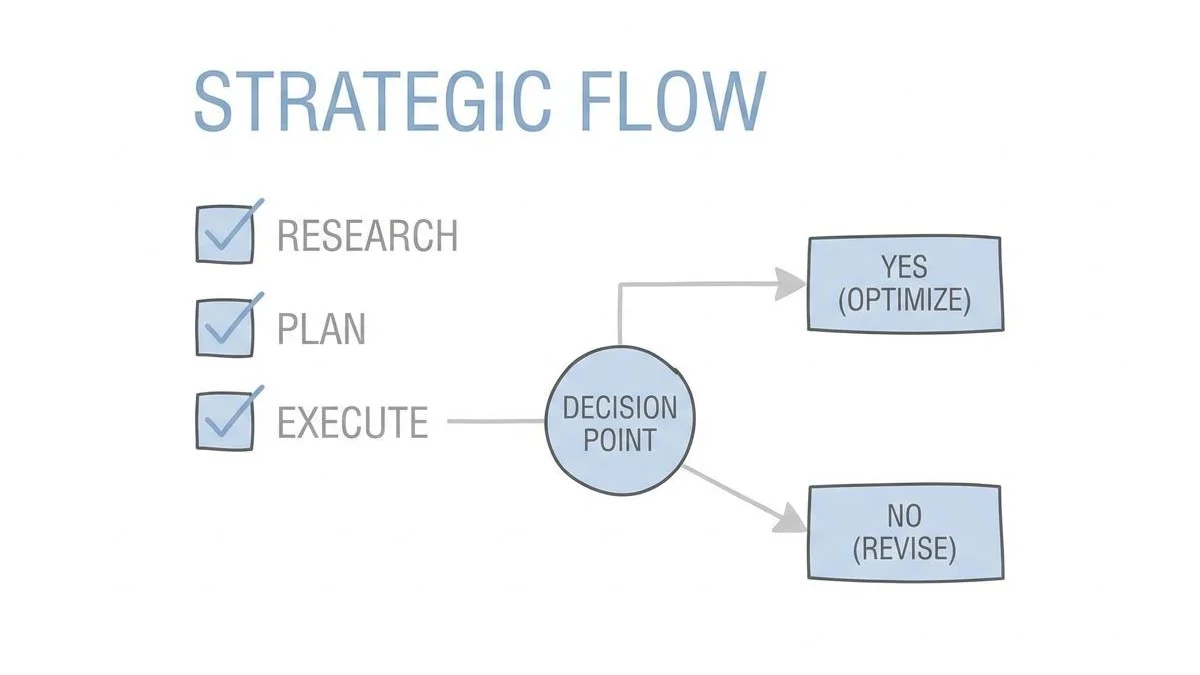
A Product Decision Record for Trade-Offs, Evidence, and Reversibility
The original contribution I want to add is a compact product decision record that carries the relevant trade-offs beyond the approval meeting. I call it a Product Bet Decision Record. It is a proposed editorial template, not a named industry standard. Unlike a generic feature score, it preserves the reasoning behind a commitment and the conditions that could legitimately change it.
For product strategy trade-offs, this record should remain short enough to maintain but complete enough for someone outside the original discussion to understand the choice. A leader should be able to revisit it months later and distinguish a failed assumption from a poorly executed plan, or a changed business context from a preference that merely became unpopular.
| Record field | Illustrative entry |
|---|---|
| Strategic objective | Improve first-use activation among the existing target customer segment |
| Decision and scope | Authorize bounded onboarding discovery before approving a larger implementation |
| Best forgone alternative | Enterprise reporting, conditional on credible deal evidence and timing |
| Critical assumption | A specific, remediable usability barrier materially contributes to lost activation |
| Evidence confidence | Plausible; instrumentation and user research still required |
| Reversal exposure | Low before broader rollout, potentially higher after workflow and messaging changes |
| Learning checkpoint | Review actual journey evidence and targeted task observations before implementation approval |
| Stop or revise trigger | Target users do not encounter the proposed barrier, or solving it cannot affect the desired outcome |
| Decision owner | Named accountable product owner, with engineering and commercial review as appropriate |
| Review event | Pre-agreed investment gate or a material change in enterprise demand or partner commitments |
Keep Decision Ownership and Evidence Ownership Distinct
The person accountable for allocating capacity should not be expected to manufacture proof of the opportunity. Product research, analytics, engineering feasibility, sales evidence, and financial constraints each have different owners and failure modes. The record should point to the relevant source for each important assumption, with the limitations stated plainly.
In product strategy trade-offs, I would keep the record separate from a delivery plan. Delivery tracks what the team is doing. The decision record explains why it is doing that work, which alternatives are being deferred, and what would justify changing course. One document can link to the other, but merging them into a task list tends to hide the underlying judgment.
Write Triggers Before the Results Arrive
A commitment is easier to defend when the conditions for revisiting it are specified before anyone becomes attached to the outcome. A trigger could be an invalidated customer assumption, an unexpected security or compliance constraint, a credible change in acquisition economics, or a partner requirement whose deadline changes the opportunity cost.
The review trigger must be connected to an action. “Review if metrics disappoint” is vague. “If the targeted onboarding barrier is not observed in the intended users, do not approve the planned implementation without a new explanation of the problem” states the decision that follows. This turns an abstract learning objective into a governance mechanism.
Learning Checkpoints: Continue, Redirect, Pause, or Stop
A product bet is not validated because a prototype can be built or because stakeholders like its presentation. The test has to address a real uncertainty affecting the choice. The UK Government guidance on alpha development recommends exploring alternative solutions and testing risky assumptions before committing to production-quality implementation. I see the same logic as useful in commercial products, with the important qualification that every learning activity has a cost.
For product strategy trade-offs, a checkpoint should include the evidence collected, how it compares with the predeclared expectation, what remains unknown, and the next commitment being authorized or withheld. It need not assign a percentage to every uncertain belief. An observed workflow failure, an unworkable technical dependency, or a withdrawn partner commitment can sometimes be more decisive than a modeled composite score.
Separate Delivery Evidence From Outcome Evidence
Shipping an onboarding change proves that the change was delivered. It does not prove that customer activation improved because of the change. Usage metrics may identify movement but require attention to cohort differences, seasonality, instrumentation, selection effects, and other concurrent product changes. A customer interview can explain behavior without estimating its population-wide prevalence.
Accordingly, I would keep at least three questions visible: Was the intended intervention delivered as specified? Did the relevant user behavior change in the direction predicted? Is there credible evidence that the change contributed to the strategic outcome? The organization may answer these questions at different times and with different levels of certainty.
Stopping Is a Decision, Not a Failure of Commitment
Teams should have permission to stop an initiative when its essential assumptions fail, but that permission should not be confused with changing priorities at every uncomfortable signal. The review should consider measurement quality, implementation defects, sample limitations, and whether there is a plausible alternative explanation. A weak early result may call for a narrower test rather than immediate abandonment.
The same standard applies in the opposite direction. Positive early feedback may justify the next learning step without proving that a full-scale product investment is warranted. Staged funding works when each stage releases a clearly defined additional commitment against an improvement in relevant evidence.
Where This Approach Can Fail
The first failure mode is excessive analysis. An inexpensive, reversible improvement may not justify an elaborate decision process. If the blast radius is limited, the team can undo the change, and the available evidence is adequate for the risk, speed may be more valuable than a formal review. The amount of documentation should reflect the cost of being wrong.
The second is mistaking reversibility for safety. A feature flag can turn off code but cannot automatically repair customer trust, undo a signed contract, restore leaked information, or reverse a market signal. Some product bets are operationally reversible and strategically sticky. Their authorization and communication deserve more scrutiny than a simple deployment rollback would suggest.
The third is confusing evidence quantity with relevance. A hundred low-quality observations about feature preferences may not resolve a single contractual or technical constraint. Evidence confidence must be specific to the claim: a survey about interest cannot prove willingness to pay, and a successful integration prototype cannot prove sustainable partner economics.
The fourth is pretending every alternative remains available. Some options decay while teams learn, especially when regulation, procurement, distribution, or customer commitments impose real deadlines. A staged strategy can be inferior to a decisive investment if the cost of delay exceeds the value of new information.
Finally, even a well-maintained product decision record can become political theater if leaders cannot change an approved bet. Governance needs a real path for revising decisions and an expectation that teams may surface disconfirming evidence without being punished for it. Otherwise the template records yesterday’s justification rather than supporting tomorrow’s judgment.
Evidence, Methodology, and Limitations
This article draws its underlying concepts from published strategy and decision research: Roger Martin’s interconnected strategic choices, economic descriptions of opportunity cost, Herbert Simon’s bounded rationality, McGrath and MacMillan’s discovery-driven planning, Amazon’s reversible-decision distinction, and government guidance on testing assumptions. These sources support the component ideas; they do not independently validate the particular decision-record template proposed here.
The Product Bet Decision Record, its evidence labels, and the twelve-engineering-week example are my editorial synthesis. The capacity figures, product options, hypothetical evidence, and recommended provisional choice are illustrative. I have not tested the framework with a controlled group, observed a real customer’s revenue outcome from it, or measured whether it outperforms another prioritization method.
Its practical value is therefore conditional. The record can make the reasoning inspectable, help expose unsupported assumptions, and give reviewers a method for revisiting bets, but its effectiveness still depends on the quality of the evidence and the authority of the people who use it. If your organization has real data and established decision processes, adapt the fields to that context rather than treating this example as a universal operating procedure.
Questions I Would Ask Before Approving a Major Product Bet
Before a substantial product decision, I would ask the sponsor to explain the choice without referring to a prioritization score. Which customer and outcome does it serve? What specific evidence suggests this is the binding constraint? What other investment could use the same capacity? What assumption, if wrong, would make the commitment difficult to defend?
Then I would ask what the decision closes. Does it create technical dependencies, operating costs, customer expectations, commercial obligations, or reduced freedom to invest elsewhere? Can we learn something important before making the expensive part of the commitment, and would that information genuinely change what we do?
These questions connect product strategy trade-offs to product discovery, delivery economics, and organizational accountability. My Product Discovery & Business Analysis resource provides related context on framing problems, validating assumptions, evaluating requirements, and documenting product decisions. The Product and Technology Expertise page gives a wider view of the disciplines involved; neither page is evidence that the hypothetical decision in this article occurred.
Frequently Asked Questions
What is the difference between opportunity cost and development cost?
Development cost describes resources used to execute an initiative. Opportunity cost describes the value of the best feasible alternative given up by choosing it. The two can be related, but they are not interchangeable, and the value of the forgone alternative may be uncertain.
Are reversible decisions always preferable?
No. Reversible decisions can support learning and contain exposure, but delay itself can be costly. Some competitive advantages require substantial commitment, and some apparently reversible product decisions create enduring customer or contractual obligations. The appropriate review process depends on the real cost of reversal.
Should product teams assign numerical confidence scores to every bet?
Not necessarily. Numerical confidence can be useful when clearly defined and supported by an appropriate estimation method. When it is only a subjective label presented as a precise percentage, it may make uncertainty harder to see. A concise description of the evidence source, limitations, and next test can be more honest.
Does this replace RICE or another prioritization framework?
No. Scoring tools can help compare initiatives within a defined strategic scope. This framework focuses on the reasoning surrounding the choice: forgone alternatives, assumptions, exposure, and review triggers. An initiative can have a high prioritization score and still conflict with the product’s strategic direction.
When should a product leader stop an initiative?
When credible evidence invalidates an essential assumption, an alternative becomes materially stronger, or the remaining investment can no longer be justified against the expected value and constraints. The conclusion should account for data quality and implementation problems; one ambiguous result is not automatically a reason to abandon the work.
Is a formal product decision record necessary for every feature?
No. The record is most useful for consequential choices that involve substantial opportunity cost, disputed evidence, meaningful reversal friction, or cross-functional commitments. Smaller reversible improvements may need only a short explanation and an observable outcome.
Conclusion: A Strategy Must Explain What It Refuses
The central lesson is that strategy gains meaning through exclusion. A product team can have several good ideas and still make a weak decision if it cannot explain why one deserves scarce capacity now, which alternative is being postponed, and what evidence supports the ordering. A well-formed choice does not eliminate uncertainty. It identifies the uncertainty that matters.
I would judge product strategy trade-offs by the quality of that reasoning over time. The decision should remain legible after the original meeting, when forecasts prove incomplete, relationships change, or a once-attractive investment becomes difficult to defend. A record of evidence, alternatives, commitment exposure, and reconsideration triggers makes it easier to correct course without rewriting the past.
The strongest strategy is not the one that never changes. It is one that commits where commitment creates value, learns where learning is useful, and can explain the consequences of each choice. Explore more research and analysis in the Product & Strategy Articles collection.
Connect and Explore My Work
I share my thinking on product strategy, engineering, UX, and digital work through LinkedIn, X, and Threads. You can also explore technical projects and experiments on GitHub and visual design work on Behance.