


Decision Rights: Why Product Managers Cannot Fix the System

Small UX Research Samples: What They Can and Cannot Tell You

An AI interface can return a factually correct answer, cite a relevant document, and finish a task within the expected time while still leaving the person using it unsure what happened. A source link might support only half the claim. A confident summary might conceal a consequential assumption. A button labeled Apply might silently cross from drafting into changing a real record. Technical correctness at the output layer does not settle whether an interaction is understandable, authorized, or recoverable.
I use AI interface to describe the entire user-facing experience around an AI capability: prompts, results, references, permissions, action states, confirmations, feedback, and failure handling. The AI interface is not just a chat bubble. It is the place where a probabilistic system makes promises a person must interpret and act on. My central argument is that trustworthiness requires a correct relationship between what the system did, what the user believes it did, and what the user can safely do next.
I propose an Evidence–Authority–Recovery Interface Contract, a conceptual product-design framework informed by human–AI interaction research. It is not a validated trust score, a report of participant results, or a claim that a particular interface pattern works universally. I will use concrete, explicitly hypothetical scenarios to make its requirements testable and distinguish measured system behavior from perceived trust.
Decision Brief: Make the Interface Earn Appropriate Reliance
The product decision is not whether an AI interface should look reassuring. It is whether the experience enables people to rely on a result when warranted, investigate when uncertain, and withhold permission when an action is not understood. This is a stronger goal than maximizing trust ratings. People can feel confident for the wrong reasons, and they can distrust a tool that would have helped them if its scope were explained accurately.
My default is to expose the material boundaries at the moment they matter: what content was used, which claims remain unverified, whether the system is preparing or performing an action, which authority has been granted, and what recovery is available. Low-stakes tasks should not become a maze of warnings. High-consequence actions should not be disguised as a seamless continuation of a conversation.
This is a product trade-off. Too little explanation invites overreliance. Too much indiscriminate explanation adds noise, weakens attention, and may imply certainty the product cannot justify. A reliable AI interface needs contextual disclosure and actionable controls, not permanent alarm banners. The success condition is appropriate reliance, judged against the actual task and its consequences.
A Correct Answer Can Still Produce an Incorrect User Belief
Separate factual correctness from interaction correctness
Imagine an AI interface that accurately summarizes a meeting decision. The summary is right. Yet the product presents a blue Done indicator, and a user reasonably assumes that stakeholders were notified. No message was sent. The model’s words are correct while the AI interface’s implied state is wrong. An output accuracy test will not detect the mismatch because it measures the answer, not the user’s understanding of the workflow.
A second AI interface returns a correct description of a policy but displays a reference to an outdated revision. The answer happens to remain valid, but the provenance cannot establish why the user should rely on it today. A third returns an accurate recommendation but implies that pressing Continue cannot change data, when it will modify a customer record. Each problem lives outside answer correctness.
I would distinguish four questions in every design review: Was the content correct? Did the AI interface represent its basis honestly? Did the user understand what would happen? Could the user recover from a mistaken interpretation? A system can pass the first and fail the others. These are deliberately independent questions, not four ingredients of a fabricated quality score.
Trust is calibrated behavior, not a reassuring sentiment
Research on human–AI interaction warns against equating user confidence with successful decisions. In a preregistered study published at FAccT 2024, participants answering medical questions responded differently to uncertainty expressions: first-person uncertainty language reduced agreement with the system and was associated with greater answer accuracy in that experimental setting. The result does not mean every AI interface should prefix answers with “I’m not sure”; the tasks, wording, and user population matter. The study offers evidence that presentation changes reliance behavior, which deserves testing in the actual product context. See the research abstract.
The distinction also explains why generic trust surveys can mislead. Automation bias is one relevant concern: a person may rate an assistant as trustworthy because it is friendly, familiar, fast, or consistent, or may accept an automated suggestion without adequate checking. None of those judgments proves that they can identify when to verify a source or withhold approval. I would pair perception measures with observed choices under known-correct and known-incorrect conditions.
Mental Models: What Users Think the AI Can Do
The AI interface creates a capability claim before any output
The name of a feature, its onboarding text, its default examples, and the shape of its controls teach users how it works. Calling an AI interface Research Assistant suggests a different capability from Draft Summary. Calling a generated synthesis Verified Answer implies a validation step that must actually exist. The AI interface tells a story about scope even when the team never writes a formal promise.
Google’s People + AI Guidebook chapter on mental models explicitly addresses mismatches between what people expect and what an AI product can deliver. I translate that guidance into a review question: can a new user say which parts are generation, retrieval, deterministic business rules, and authorized actions after one ordinary task? The product does not need to explain every implementation detail, but it must not hide differences that change a user’s decision.
An AI interface that saves a draft should say Draft saved, not Request completed. If the tool only searches an internal knowledge base, “Search completed in approved documents” is better than an unexplained “Verified.” If it generates possibilities from incomplete evidence, the result should not look identical to an independently checked answer.
Avoid replacing uncertainty with a human-like persona
Human-like language can make a system approachable, but a social persona is not an adequate explanation of capability. “I have checked everything” is a stronger claim than “I checked three documents available to this workspace.” If the product cannot substantiate the stronger statement, the AI interface should not use it, no matter how natural it sounds.
The right degree of warmth depends on the task. A casual creative exploration tool can be playful. A workflow affecting account access, financial information, or legal obligations needs a more explicit relationship between recommendation and authority. I would test whether the voice helps users interpret system boundaries instead of using emotional familiarity to substitute for evidence.
Keep Accuracy, Trust, Reliance, and Authorization Separate
A dependable AI interface does not need one universal “trust” meter. It needs different evidence for different questions. Mixing dimensions produces persuasive dashboards that can conceal the very risk they supposedly measure.
| Dimension | What it means | What it does not establish | Example evaluation |
|---|---|---|---|
| Answer accuracy | A result matches a task-specific reference or verified outcome | User understood the answer’s limits | Blindly reviewed task set with error categories |
| Perceived trust | A user’s reported confidence in the system | Confidence is justified | Survey with contextual follow-up questions |
| Appropriate reliance | A user accepts correct help and challenges incorrect help | Every accepted answer was safe to execute | Behavioral tasks with both correct and incorrect examples |
| Authorization | The person or system may perform the specific action | The proposed action is factually correct | Permission checks against actor, target, scope, and current state |
| Recoverability | Mistakes can be corrected, reconciled, or escalated | The original mistake was harmless | Recovery walkthroughs and observed outcomes |
A strong answer can still be unauthorized
Suppose an assistant correctly determines that a support account should be suspended under an internal policy. That does not authorize the AI interface to suspend the account. The result may be informational, while the action requires a separate identity, target, permission, and approval check. The model’s confidence cannot elevate a recommendation into consent. Meaningful human oversight depends on accurate previews and independent approval, not simply a person watching the model act.
This is related to—but distinct from—the execution architecture discussed in my article AI Agents Need Bounded Authority, Not More Autonomy. That article examines the technical enforcement boundary. Here I examine what the person sees and understands before, during, and after the boundary is crossed.
An AI interface must permit justified skepticism
In some situations, a user should decline an AI interface’s answer even if a benchmark would mark it correct. A decision may depend on documents that have changed, constraints the system cannot see, or information the user is not permitted to share. The interface should expose the relevant scope so the user can decide whether its help applies.
This is why I would not optimize a product solely for users accepting generated recommendations. A decline, inspection of a source, or request for a human review can be the correct outcome. Product metrics should not classify all friction as failure.
Treat Uncertainty as an Interaction State
Show what is uncertain, not just that something might be
A generic disclaimer such as “AI can make mistakes” is often detached from the current decision. It does not tell the person whether the uncertainty concerns missing documents, conflicting sources, a guessed identifier, a non-repeatable tool error, or an unsupported inference. A trustworthy AI interface should connect uncertainty to the specific claim, input, or pending action.
I would separate at least four states: supported, plausible but unverified, conflicting evidence, and insufficient information. These are product-facing labels, not claims that the model emits statistically calibrated probabilities. If a system cannot distinguish them reliably, the correct design action is to lower the strength of its claim or ask for an independent check, not to invent a percentage.
| User-visible state | Evidence condition | Interface response | Safe next step |
|---|---|---|---|
| Supported in reviewed sources | Relevant available evidence supports the bounded claim | Show claim and traceable source location | Use within the stated scope |
| Unverified inference | Output extrapolates beyond confirmed evidence | Label the inference and separate it from sourced facts | Check before consequential use |
| Conflicting sources | Material sources disagree | Display the disagreement and date/scope differences | Compare or escalate |
| Missing information | Required input or source is unavailable | State what is missing without pretending a search was exhaustive | Request detail or choose manual path |
| Tool failure | Retrieval or execution did not complete reliably | Show a distinct operational status | Retry safely or reconcile the existing operation |
Confidence scores are not a substitute for evidence
A number presented as 93% confident looks scientific, but its interpretation depends on calibration, task distribution, and what probability the score actually represents. For many conversational outputs, a native model confidence value cannot simply be interpreted as the probability that the entire answer is true. If the product lacks validated calibration for the specified task, I would favor plain-language evidence states over numerical performance theater.
Google’s Explainability + Trust guidance urges designers to consider whether, when, and how confidence should appear. An AI interface could disclose a calibrated score for a constrained classifier if that score has been evaluated and users understand it. I would not apply the same pattern by default to open-ended claims, multi-source summaries, or tool-mediated actions.
Source Provenance Must Support the Specific Claim
A citation is not the same as verification
A linked document can be authentic but irrelevant. A citation can point to the right page yet support only the opening sentence of a larger conclusion. An AI interface that appends sources to an entire answer may encourage readers to infer that every assertion was checked. I would design a narrower relationship: the claim, the exact supporting passage or record, the source’s date and scope, and any inference made on top of it.
If source information is unavailable, the AI interface should say so. If an answer came from model generation without a retrieval step, labeling it “from the knowledge base” would be false. If a document was retrieved but not independently fact-checked, the UI should distinguish document says from independently established. Source provenance is a traceability feature; it is not a guarantee that the source itself is correct.
Retrieval boundaries belong in the experience
Consider an assistant that searches only files in the current workspace. A result saying “There is no policy” may be technically consistent with the files retrieved yet materially misleading. The truthful claim is “I did not find a policy in the available workspace documents.” That wording reflects a bounded search, not universal absence.
An AI interface can expose scope without overwhelming the reader: an expandable note such as Searched: approved project documents; last indexed: [actual timestamp]. The timestamp should appear only if the system has one. A clear Not searched state is preferable to a fabricated impression of completeness. I would test whether users understand the difference after seeing the result.
Explanations Must Be Inspectable, Not Performative
Explain decisions at the level the user can verify
A generated explanation can sound compelling without describing the mechanism that actually produced an output. This is especially risky when an AI interface uses explanations as an after-the-fact defense of a recommendation. The more authoritative the wording, the more important it is to ground each reason in observable input, rule, or traceable evidence.
For product design, I would ask: Which fact can the user inspect? Which part is a business rule? Which part is a model inference? Which part is a recommendation? Those distinctions make explanations useful. A paragraph that merely repeats the answer in technical terms adds length without accountability.
Progressive disclosure should follow decision consequence
A low-stakes draft may need a short source summary and an edit control. A high-stakes suggestion may need a side-by-side evidence view, affected records, user identity, action scope, and escalation option. I do not see a contradiction: a responsible AI interface can keep the default screen calm while revealing deeper layers at the exact review point.
Microsoft’s 18 Guidelines for Human–AI Interaction include making capabilities clear, supporting correction, and explaining behavior. I interpret them as interaction design principles to evaluate in context, not a certification that any interface implementing a checklist automatically becomes trustworthy.
Make the Difference Between Suggestion and Action Visible
An AI interface often begins with informational assistance and gradually acquires tools. The UX should not preserve the appearance of an ordinary text exchange when the system crosses into effects on accounts, records, messages, or external services. The boundary needs a visible state transition.
Use four distinct user-facing states
I recommend Suggested, Prepared, Awaiting approval, and Completed and verified, with separate Failed, Canceled, and Unknown outcome paths. A model’s declaration of completion is not sufficient to move from prepared to verified. The product must observe the result through a trusted service or honestly report that verification is pending.
A button labeled Approve and send to the named recipients communicates a very different effect from Continue. The first states an action and target. The second may conceal them. The visual distinction should be accompanied by the actual authorization architecture, not simply a color change.
The confirmation must describe the real side effect
Before sending a message, the UI should show recipients, channel, subject or content preview, and whether the action can be canceled. Before editing a customer record, it should show the target and the fields that will change. Before deleting or publishing, it should show the scope and reversibility. These are examples of action confirmation, not arguments for interrupting every read-only or reversible task.
The WCAG 2.2 Level AA error-prevention criterion for legal, financial, and data submissions recognizes reversible, checked, or confirmed paths for certain consequential web interactions. I draw a broader UX lesson from that standard; I am not claiming every AI action automatically falls within that criterion’s precise conformance scope.
The Evidence–Authority–Recovery Interface Contract
I propose six independently reviewable domains for an AI interface, because a single “trust score” makes it too easy to compensate for a serious permission or recovery problem with a polished explanation. The contract connects displayed promises to actual system behavior. It is a conceptual decision framework, not a validated industry standard or universal scoring formula.
| Contract domain | Question users must be able to answer | Interface evidence or control | Failure that should block release |
|---|---|---|---|
| CLAIM & SCOPE | What exactly is asserted, and within which boundaries? | Bounded wording and visible task or source scope | Universal claim from a partial search |
| EVIDENCE & PROVENANCE | Where did this conclusion come from? | Traceable claim-level reference and source context | Decorative or unsupported citation |
| UNCERTAINTY | What is unknown or unresolved? | Contextual uncertainty disclosure and conflict state | Unsupported certainty presentation |
| AUTHORITY & CONSENT | What can happen, and who allowed it? | Action preview, identity and precise approval | Hidden or unapproved side effect |
| STATE & FEEDBACK | What has actually happened? | Distinct requested, pending, failed, and verified statuses | Generated text presented as execution proof |
| RECOVERY & REVIEW | How can the person correct, cancel, or escalate? | Edit, undo when possible, reconciliation and escalation | Irreversible dead end with no accountable path |
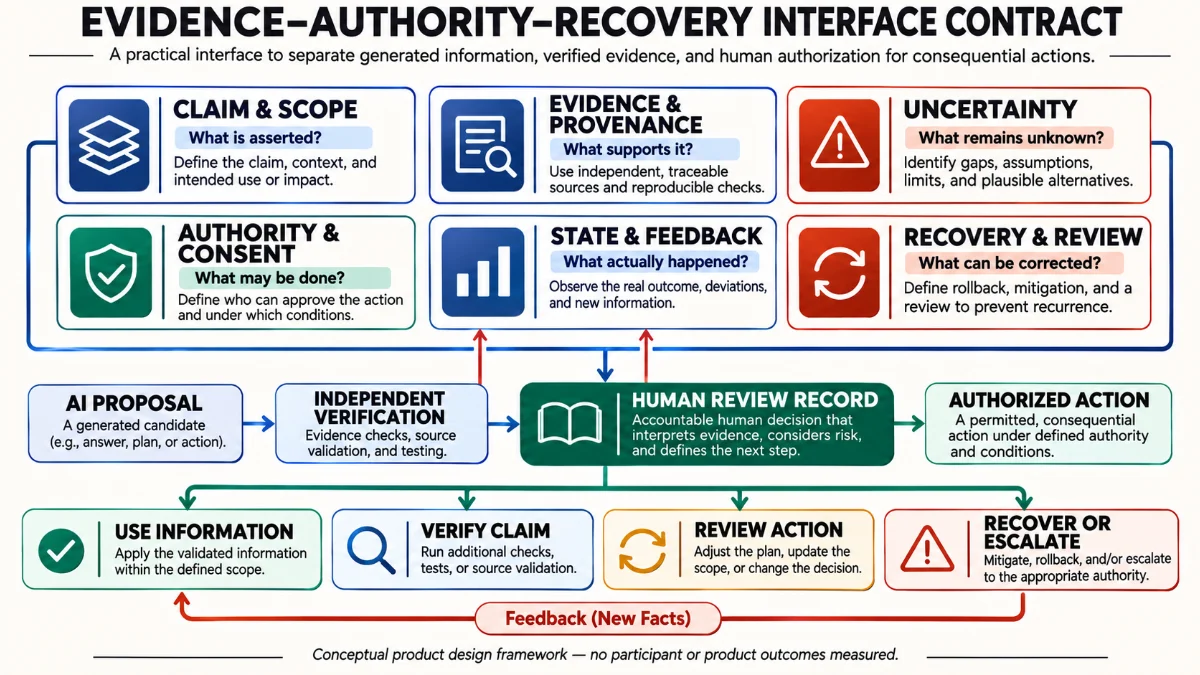
The contract is deliberately not a sequence in which one strong domain automatically excuses another. An accurate cited answer cannot justify executing an unapproved action; a valid permission cannot fix fabricated evidence; an undo control cannot prevent the damage of an already disclosed secret. The team should review the domains against the consequences of the specific workflow and record unacceptable gaps explicitly.
I would store the result as a modest product decision record: task type, user group, known failures, source and permission boundaries, critical interface states, acceptance tests, accountable owner, and the trigger for reassessment. That record is useful during design reviews and regression testing because it distinguishes a visual defect from a trust-boundary failure. It also prevents a redesign from removing a warning or confirmation without anyone understanding why it existed.
Apply the contract when the stakes change
A creative brainstorming task can be handled with source caveats, easy editing, and a low-friction reset. A decision-support feature used by an analyst may need traceable evidence and explicit uncertainty states. An AI interface that can send external messages or change access rights needs independently enforced authorization and robust reconciliation. The contract is constant; the weight of each requirement follows the actual task, not an arbitrary rating assigned to the entire product.
A Workflow State Machine Users Can Understand
Good AI interface language should map to actual backend state. I would resist using the single label Done for a workflow that can be drafted, queued, authorized, sent, acknowledged, and verified. In asynchronous systems, the distinction between an accepted request and an observed outcome is especially important. An AI interface that conflates those states can mislead even when every individual API call behaved as designed.
| System state | User-visible status | Allowed user action | Recovery requirement |
|---|---|---|---|
| Generated proposal | Suggested; not applied | Inspect, edit, discard | Original data unchanged |
| Validated proposal | Ready for your review | Compare target and impact | Return to editable draft |
| Awaiting authorization | Approval required | Approve or reject exact operation | Expiry and cancellation supported |
| Accepted for execution | Processing; result not yet verified | Check status, avoid duplicate retry | Stable operation identifier |
| Verified complete | Completed; result confirmed | Inspect outcome | Audit or revert path where possible |
| Failed or unknown | Not completed / outcome unknown | Retry or reconcile with guidance | No silent repeat of consequential effect |
Unknown is not the same as failed
Suppose a network timeout occurs after an AI interface requests a payment or sends a notification. The client does not know whether the service completed the effect. Showing Failed, try again may cause a duplicate. The safer status is Outcome not yet confirmed with a reconciliation path. This principle comes from distributed system behavior, not an opinion about the linguistic accuracy of the model.
I would write acceptance tests that compare user-facing status with durable operation records: if a system cannot prove an outcome, the AI interface must not claim one. The exact implementation may use idempotency keys, transaction identifiers, callbacks, or polling, but the user should receive a clear and truthful next step.
Error Recovery Is a Core Feature, Not a Courtesy Message
Make correction different from starting over
User control is most valuable when it is specific: a person who spots a wrong assumption should be able to correct the relevant input or result. Asking them to retype an entire complex task shifts the system’s error cost onto the user. I would preserve the current draft, make the disputed element editable, and show whether the correction applies only to this answer or changes future behavior.
Google’s Errors + Graceful Failure guidance emphasizes paths forward when AI systems make mistakes. A trustworthy AI interface should preserve user agency after a failure, including a manual path when automation is unavailable. A failure notice in an AI interface that simply says Something went wrong without a route to completion does not meet that goal.
Separate reversible from irreversible consequences
A summary can often be edited. A sent email cannot always be recalled. A public publication may have been cached or forwarded even after deletion. An access change might be recoverable technically but still harmful during the interval it was active. An AI interface should distinguish undo, compensating action, and escalation rather than implying that every effect can be erased.
For consequential tasks, recovery needs an owner and a documented next step. If the product has no ability to undo an effect, it should avoid suggesting otherwise. That constraint belongs in the pre-action disclosure as well as the post-action history.
Accessibility Is Part of Trustworthy State Communication
Status should not exist only as color or animation
A pulsing icon, subtle color change, or spinner may communicate progress visually while remaining invisible to a screen reader. An AI interface needs accessible names, appropriate roles, and programmatically announced state changes when they qualify as status messages. A message that is perceptible to one user but not another undermines the factual truth of the interaction for the excluded person.
WCAG 2.2 success criterion 4.1.3 addresses programmatically determinable status messages. I would use that guidance to review Searching, Awaiting approval, Completed, and Could not complete states without turning every token of streaming text into an urgent interruption. Accessible status design includes restraint as well as announcement.
Keyboard and error paths must remain operable
A visually clear confirmation dialog still fails when keyboard focus becomes trapped incorrectly, action labels are ambiguous, or a rejection cannot be reached without a pointer. The AI interface should support ordinary navigation, visible focus, accessible error association, and logical return to context after a modal closes. The review should include the full error and cancellation flow, not only a happy-path demonstration.
For a dynamic assistant, I would explicitly test slow network states, long responses, empty results, conflicting references, permission denials, and expired sessions with assistive technologies. These are design and implementation tests I recommend; they are not tests I performed on a particular deployed product for this article.
Common Design Shortcuts That Backfire
The confidence badge without calibration
A prominently styled confidence badge can create the impression of scientific evaluation when it is merely an unvalidated output. If the product cannot explain which event the probability describes, what population it was calibrated on, and how it behaved in testing, the badge is not appropriate evidence. An AI interface may be better served by a source preview or a clear statement about missing information.
The universal approval dialog
Requiring confirmation for every trivial action creates interruption fatigue. Users learn to accept automatically, and the product may lose exactly the attention it needs for consequential cases. I favor consequence-based review: silent reading and reversible drafting can remain streamlined; durable external side effects deserve precise inspection and independent permission checks.
The explanation that pretends to be a source
A fluent retrospective explanation can be useful for orienting a reader, but it must not be formatted as an audit trail unless it is one. I would distinguish generated rationale from retrieved evidence and from verified execution records. An AI interface should never place a decorative quote or source icon next to unsupported content to create an appearance of verification.
The attractive fallback that masks failure
Replacing an unavailable source retrieval with a plausible generated answer may preserve conversation flow, but it can violate the user’s expectation that the answer was based on their documents. The right fallback in an AI interface depends on the task: ask for permission to continue without retrieval, provide a clearly labeled general explanation, or defer the consequential decision. Smoothness is not a reason to hide a failed dependency.
Three Hypothetical Interaction Reviews
Scenario A: A correct financial summary with ambiguous provenance
Imagine an internal assistant accurately summarizes a quarterly report, but the AI interface provides no document revision or quote-level traceability. The reader needs to decide whether a number comes from a published filing, an internal estimate, or a model inference. The output may be true, but the decision context is incomplete. I would keep the summary, add exact scope and evidence links where supported, and label inferred comparisons separately.
The acceptance test is not “users liked the summary.” It is whether an analyst can identify the source of a material claim, detect an intentionally outdated source, and avoid treating an unsupported extrapolation as a reported result. If the required source is missing, the appropriate answer is a bounded statement or an investigation state.
Scenario B: A correct account recommendation with hidden execution
A support assistant correctly recommends disabling a compromised account. The UI shows Apply fix without identifying the account or duration. The AI interface has made authorization seem smaller than it is. I would split recommendation from execution, show target identity and intended effect, require the actual permission check, and display a verified outcome distinct from a queued request.
A negative test would attempt to approve one account while the prepared action is changed to another. The executor should reject that mismatch regardless of the generated explanation. The AI interface should communicate the changed state; users should not be asked to trust a stale approval preview.
Scenario C: A helpful drafting assistant with an unrecoverable error
A writing assistant proposes an accurate edit, but accepting it overwrites a previously reviewed paragraph without version history. The AI interface delivers correct language while making an unwanted data-loss action too easy. I would offer diff preview, a reversible apply step, and explicit retention behavior. For collaborative documents, concurrent edits need conflict handling rather than silent replacement.
A usability test could include a deliberate mistake, a keyboard-only correction, and a return to the prior version. The relevant observed outcome is whether people recover without losing their work, not whether the generated prose sounds polished. These three scenarios are illustrative designs, not measured incidents, customer findings, or results from my projects.
Research Plan: Test Trust Calibration, Not Just Preference
Recruit around actual decision roles
I would recruit participants who regularly perform the target workflow: the analyst validating claims, the support operator approving account changes, or the editor accepting generated revisions. Generic “AI users” may help with discoverability and comprehension, but they cannot substitute for people who understand domain-specific consequences. Recruitment criteria should include task expertise, familiarity with the interface, and relevant accessibility needs.
The test needs at least three conditions: one correctly supported answer, one incorrect or unsupported answer, and one answer that is correct while the surrounding workflow state is ambiguous. This prevents a flattering test where the assistant is always right and the participant’s only task is to click Accept. I would randomize or counterbalance task order where practical and record failures as well as successful decisions.
Observe decisions rather than only opinions
Useful research questions include: can participants identify which claim lacks support, choose to inspect the relevant source, recognize that an action is still pending, withhold approval when targets differ, and recover from a deliberate tool failure? The AI interface should be evaluated against these behaviors with task-specific criteria established before the sessions.
Confidence questionnaires still have a place, especially when paired with what participants actually did. A participant may correctly reject a bad answer but report low trust. That is not necessarily a negative result. The key is whether reliance matches the known correctness and consequence of the task. I would separately capture perceived workload and comprehension instead of collapsing them into one invented confidence index.
Keep methods and limits visible
Small formative sessions can reveal comprehension problems and broken recovery paths; they do not establish population-wide reliability or calibrated trust rates. A later controlled evaluation can compare alternative disclosures and observe whether behavior changes under known-answer conditions. Live telemetry may add evidence about retry loops and cancellations, but it cannot establish why a user trusted an answer without additional research.
The 2024 FAccT uncertainty-expression experiment illustrates why wording matters, but it is not a ready-made effect-size forecast for every product. I would replicate the relevant behavioral question in context before deciding that a first-person phrase, confidence indicator, or warning icon is optimal.
Measure the Quality of the Interaction Contract
Operational measures and research measures should agree
A team may track the fraction of consequential actions that had an accurate approval preview, the percentage of verified completion messages backed by a real status record, unresolved operation outcomes, source link failures, error recovery completion, and accessibility defects. These are proposed measurement categories, not claimed product statistics or a universal benchmark.
For human behavior, I would examine correct acceptance, appropriate rejection, source inspection when material, detection of changed targets, and successful recovery. Each should be interpreted with the underlying task difficulty and participant role. An AI interface that increases source checking may lengthen a task yet improve the correctness of a consequential decision.
Make negative tests part of release readiness
A release checklist needs adversarial or deliberately degraded situations: an unavailable document, mismatched approval target, stale permission, contradictory source, unverified tool completion, failed background operation, and inaccessible status message. The user-visible contract must continue to hold when something goes wrong. A successful demonstration of the easy path is not enough.
I would require ownership for each critical state and a rollback plan for regressions. A change to a model, retrieval index, permission policy, or UI wording can alter the person’s mental model even if the visible layout changes only slightly. Changes in behavior therefore deserve targeted re-evaluation.
Evidence and Methodology: What the Sources Establish
This article is a research-informed design analysis. It synthesizes published guidance and studies, then proposes a decision framework. It does not report original participant research, validated conversion improvement, or a deployed AI system audit. The sources support different kinds of claims, and I would keep those boundaries visible rather than convert every recommendation into a supposed empirical result.
| Source | What it contributes | What it does not prove |
|---|---|---|
| Microsoft: Guidelines for Human–AI Interaction | Research-grounded interaction principles covering expectations, correction, feedback, and change | A universal recipe that guarantees trust in every product |
| Google: People + AI Guidebook | Practical patterns for mental models, explanations, control, and graceful failure | That every pattern has been validated for the current use case |
| FAccT 2024 uncertainty study | Evidence that particular uncertainty wording altered reliance in its studied task | A generalized effect size for all AI interfaces or populations |
| NIST Generative AI Profile | Risk-management context, including confabulation and human–AI configuration | A UI certification or a numeric trust threshold |
| W3C WCAG 2.2 | Normative accessibility criteria relevant to status and consequential actions | That meeting an accessibility criterion resolves all AI trust concerns |
Counterevidence and unresolved questions
Not every explanation increases understanding. More warnings may produce habituation; more sources can add clutter; requiring approval for every action can produce routine consent without attention. A well-calibrated numerical confidence indicator may be useful for a narrow, validated task. Automation can be appropriate when effects are low-consequence, reversible, and tightly bounded. The question is which design actually improves comprehension and appropriate reliance in the relevant workflow.
The biggest unresolved question is not whether people prefer AI. It is how well an AI interface allows people to notice when they should not accept an answer or authorize a change. That requires behavioral evidence under failures and uncertainty, not only polished screenshots or satisfaction scores.
Frequently Asked Questions
Can an AI interface be trustworthy if its model sometimes makes mistakes?
Yes, depending on the task and how failures are bounded, disclosed, corrected, and evaluated. Perfect model accuracy is not a realistic general prerequisite for every useful tool. But an AI interface must not represent an uncertain result as verified or allow a model’s fluent wording to bypass an action boundary. Trustworthiness is about appropriate reliance and controlled consequences, not the absence of all error.
Should AI products always show confidence percentages?
No. A percentage is useful only when it has a meaningful, validated interpretation for the decision at hand and users can understand it. An AI interface handling open-ended synthesis may communicate source limitations or conflicting evidence more faithfully through contextual labels. A calibrated score for a constrained classifier is a different case from a generic “confidence” badge on a paragraph.
Are citations enough to prevent users from overtrusting AI?
No. A citation may be weak, unrelated, outdated, or too broad for the claim. Good source provenance requires a clear relationship between evidence and assertion. The AI interface should make that relationship inspectable. I would test whether the AI interface lets users identify unsupported conclusions, not simply whether a link icon appears beside an answer.
Does every AI action need human confirmation?
No. Routine low-risk, reversible actions can be streamlined when policy and user expectations permit. Consequential or hard-to-reverse effects call for clearer previews, consent or other independent authorization, and verified outcome states. For an AI interface, the correct boundary depends on the domain and cannot be replaced by a universal confirm-everything rule.
How is AI interface trust different from model safety?
Model safety concerns are important but not sufficient. The AI interface also shapes interpretation, permission, accessibility, and recovery. A safe model can be embedded in a confusing workflow, and a good-looking AI interface cannot repair unsafe execution permissions on its own. Both the underlying system and the user-visible experience must honor the same boundaries.
How do I evaluate this without a large research budget?
Begin with a risk-focused walkthrough and a small set of critical scenarios. Test source inspection, mismatched approval, uncertain results, unknown completion, and error recovery. Record what people do and where they misunderstand the system. Treat that as formative evidence, not proof of population-wide trust calibration, and expand evaluation for consequential decisions.
Implementation Priorities for Product and UX Leaders
I would begin by mapping each AI interface action to one of three effects: inform, prepare, or execute. The product should express that distinction in language and state, while engineering enforces it through actual permissions. Then I would audit every place the AI interface claims verified, complete, safe, sent, or approved. Each term needs an observable condition. Otherwise the UI is promising more than the system has established.
Next, I would make source limitations and missing information visible in the few flows where they change decisions. The AI interface source preview, uncertainty disclosure, and manual route should be close to the claim, not buried in generic settings. After that I would test cancellation, edit, failure, retry, and unknown-outcome paths. Recovery is more informative than a happy-path demonstration because it shows whether the interface remains truthful under stress.
Finally, I would turn the contract into regression cases. A new model, retrieval backend, or visual redesign should not silently change the meaning of a status label or remove the user’s ability to withhold consent. The organization needs an accountable owner for the user-facing promises the AI interface makes.
Conclusion: Trust Begins Where the Answer Ends
A technically correct answer can coexist with misleading provenance, unearned certainty, ambiguous approval, inaccessible status, and poor recovery. None of those defects disappears when the next model improves its benchmark score. The product can still mislead people about what they should believe or what has happened to their data.
My proposal is not to make every AI interface cautious, verbose, or slow. It is to make the material boundaries honest, inspectable, and actionable. The Evidence–Authority–Recovery Interface Contract forces evidence, uncertainty, authority, actual system state, and correction to be reviewed together without treating them as interchangeable. The right result is a user who knows when to trust, when to check, and when to stop.
Related Reading and Author’s Note
For the independent execution and permission boundary, see AI Agents Need Bounded Authority, Not More Autonomy. Explore the wider Artificial Intelligence Articles collection for adjacent analysis. I distinguish this UX discussion from model-performance evaluation and from any claim of audited production behavior.
Author’s note: I work across software engineering, AI product design, product strategy, and user experience. The framework above is my proposed synthesis of published research and engineering principles. It is offered as a design and test method rather than a product certification or an unreported client case study. My professional background is described on my About page.