


AI Interface Trust: Correct Answers Can Still Mislead

A Small Sample Is Not a Small Responsibility
Five people encounter a confusing step during a usability test. Three cannot complete the task without help. A product meeting turns that observation into a slide: “60% of our users cannot complete onboarding.” The first sentence reports what happened in a study. The second makes a population claim that the UX research never measured. That conversion is one of the most expensive mistakes in UX research, because an apparently precise number can authorize a decision far beyond the evidence behind it.
The reverse mistake is just as damaging. A team sees one participant struggling with a critical recovery path and dismisses the evidence because “one person is not statistically significant.” If the task involves lost access, a payment that cannot be reversed, or an accessibility barrier, that observation may be an excellent reason to investigate or fix a credible failure mode. UX research does not need to estimate population prevalence before every product action. It does need to be explicit about what the study has actually established.
My position is that the right sample size is downstream of the question, not the other way around. A small sample can be highly useful for discovering breakdowns, understanding mechanisms, and shaping the next test. It is weaker for estimating a population’s completion rate, comparing small performance differences, claiming that needs are saturated across heterogeneous groups, or certifying that a system is safe for everyone. Those are different evidence tasks, and treating them as interchangeable is not methodological efficiency.
In this article I separate issue discovery from prevalence estimation, explain what confidence intervals do and do not rescue, examine selection bias and information power, and propose a Question–Sample–Inference–Decision Contract for deciding what a small UX research study can legitimately support. I do not report a new participant study or a measured product outcome. All numbered product scenarios below are explicitly illustrative.
Decision Brief: What Can Five Participants Tell You?
A small qualitative UX research round can reveal where a specific participant’s task failed, what they expected, how they navigated, and which conditions produced the breakdown. Repeated observations within a narrowly defined participant group strengthen a working hypothesis. They still do not automatically establish how frequently the problem occurs in the entire target population.
- Proceed with a targeted design investigation when observations identify a plausible, reproducible mechanism and the cost of learning more is low.
- Revise a reversible design when the failure mechanism is clear, user harm is limited, and the change can be tested in another round.
- Expand or redesign the study when the decision depends on prevalence, comparison, diverse user segments, or a quantitative acceptance threshold.
- Hold consequential claims when recruitment excludes affected users, important conditions were not tested, or a safety or accessibility conclusion would exceed the evidence.
This is a decision framework, not a universal sample-size formula. In UX research, an honest boundary on inference can be more valuable than a larger-looking number in a presentation.
What “Small” Means Depends on the Research Question
In UX research, the phrase small sample describes a number of observations, not a research design. Five moderated UX research task sessions and five open-ended interviews do not have equivalent information requirements. Five expert users of a narrow administrative workflow differ from five convenience recruits asked to represent everyone who might use a public service. Even the same people can produce quite different evidence when the task, device, prototype fidelity, or facilitation changes.
Define the Unit of Analysis Before Counting People
A participant may attempt several tasks, encounter several problems, and offer many comments. Those are not automatically independent observations. Counting ten tasks completed by the same person as ten independent people can make uncertainty seem smaller than it is. In UX research, I would identify whether the planned inference concerns a participant, task attempt, observed failure mode, interview theme, user segment, or product release.
The unit matters because observations can be clustered. One user’s repeated success may result from prior familiarity gained during the session. One facilitator’s hint may affect all later steps. A prototype-specific defect may disappear in a production build. Counting occurrences without describing these dependencies confuses evidence volume with evidence diversity.
Write the Decision Question Before the Sample Target
“Can first-time users find the payment-history download link?” is a discovery-oriented question. “What percentage of first-time users download successfully without help?” is a rate-estimation question. “Does version B improve task completion by a commercially meaningful amount?” is a comparative question. “Have we understood the distinct needs of screen-reader users?” is a coverage and inclusion question. Each asks UX research to support a different inference, so none should inherit an automatic five-person answer. I discuss the earlier step of choosing the appropriate method in UX Research Methods: Choose by Decision Risk, Not Habit; here I concentrate specifically on what the resulting sample licenses us to say.
The Five-User Rule: Useful Principle, Dangerous Shortcut
Jakob Nielsen’s influential argument was about efficient, iterative qualitative usability testing, not a promise that five people statistically represent all customers. His 2000 explanation of iterative testing makes the practical case for several small rounds rather than exhausting a budget in one large round. His later sample-size guidance explicitly distinguishes quantitative tests and distinct user groups.
That argument addresses a real product trade-off. If a design contains obvious failures, the first few appropriately recruited participants may uncover enough to justify redesigning it. Waiting to finish a much larger study before changing an obvious obstacle can waste time and participant effort. Short feedback cycles can therefore make UX research more actionable, provided the next cycle tests the changed behavior instead of merely accumulating confirming observations.
The Issue-Discovery Model Is Conditional
A common model describes the probability that at least one participant exposes a particular problem as 1 − (1 − p)^n, where p is the probability that one independent, appropriately selected participant encounters that problem under the study conditions and n is the number of participants. The model is useful for reasoning about repeated opportunities to observe a known type of problem. It is not a universal discovery guarantee.
For an illustrative mathematical assumption of a 20% independent detection chance, five opportunities would produce an approximately 67% chance of seeing the issue at least once. If the individual chance were 5%, the five-opportunity discovery probability would be about 23%. Neither percentage describes this site’s users or any actual study. The difference illustrates that a fixed number of participants cannot compensate for a low exposure probability, a poorly selected group, or a task that never triggers the risk.
Those assumptions become fragile when participants have correlated experience, the issue is rare, recruitment is biased, or the moderator changes the task. More importantly, a model about detecting at least one instance does not tell us the population prevalence of that problem. UX research can discover a failure mechanism without knowing whether it affects one in twenty users or one in two thousand.
The Empirical Counterargument Matters
In Laura Faulkner’s 2003 study, Beyond the five-user assumption, researchers tested 60 people and examined different subsamples. Some five-person subsets exposed almost all of the problems found in the full study, while others exposed substantially fewer; the abstract reports a range from 55% to 99%. This does not prove that every product needs 60 participants. It shows that conclusions about the coverage of a small round can depend strongly on which people enter it.
The reasonable synthesis is not “five users are always enough” or “five users are never enough.” My interpretation is that small UX research rounds are an efficient way to begin an iterative process, while participant fit, task coverage, unresolved risks, and the next decision determine when to add more evidence. A rigid number is a poor substitute for a well-described UX research stopping rule.
Issue Discovery Is Not Prevalence Estimation
When an observer sees a participant misunderstand a label, the direct evidence is a recorded behavior in context. A prevalence claim asks how often an equivalent misunderstanding occurs among all eligible users under specified circumstances. That second claim requires attention to sampling, task standardization, independence, population definition, and uncertainty. The distinction is central to credible UX research.
| Method and purpose | What a small round can support | What it cannot establish by itself | Appropriate next step |
|---|---|---|---|
| Moderated usability test | Observed task breakdowns and plausible causes | Population-wide frequency of each breakdown | Fix, retest, and check untested conditions |
| Exploratory interview | Language, motivations, situations, candidate themes | Distribution of beliefs across the market | Expand purposeful sampling or validate quantitatively |
| Accessibility-focused session | A concrete barrier under an assistive-technology setup | Absence of barriers for all disability groups | Correct barrier and test other relevant configurations |
| Benchmark task-success study | Observed successes and failures | A precise population success rate from a few convenience recruits | Define population and statistical precision requirement |
| A/B evaluation | Potential mechanisms and unexpected outcomes | Reliable small differences between variants without power | Design adequately powered comparison |
| Card sorting or information architecture study | Possible category interpretations | Stable population-level category patterns with a tiny sample | Plan method-specific sample and tree testing |
The GOV.UK Service Manual typically describes four to eight participants in a round of qualitative research and larger studies for surveys, benchmarking, or experiments. Nielsen Norman Group also warns that a handful of participants is unsuitable for generalized quantitative usability metrics. These are practice recommendations, not a statistical law for all domains. The task still determines the design. Its qualitative-versus-quantitative explanation is especially useful when a stakeholder treats the two evidence types as equivalent.
A Finding Needs a Reproducible Description, Not Just a Count
For issue discovery, I would record the participant’s relevant characteristics, the goal they tried to achieve, the interface state, what happened, the assistance provided, the observed consequence, and the explanation I am proposing. That makes a finding inspectable. “Three people struggled” is a useful starting count; it is not a mechanism. “Three first-time participants looked for account export under Billing rather than Data Controls, then asked for help” is a better description because the mismatch can be tested and redesigned.
Even that description is conditional: it cannot establish that the label causes every failure, that returning users behave similarly, or that changing it will improve a live system. It supports a design hypothesis and a concrete next round. This is why UX research reports should separate observations, interpretations, and recommendations rather than presenting one fused sentence.
Severity and Frequency Are Different Dimensions
One participant’s failure may be severe if it blocks a critical task, reveals an irreversible mistake, or excludes someone from access. Ten mild moments of hesitation may have different priority. In UX research, severity is an assessment of impact, recoverability, context, and risk; frequency is a claim about how often the event happens. Neither can be substituted for the other.
For consequential services, I would not require a statistically representative sample before taking safe, reversible measures to contain a credible hazard. But I also would not market a design as universally accessible or safe because a small group completed a script. The difference is between acting responsibly on a warning and claiming to have certified a population outcome.
Confidence Intervals: Why “Three Out of Five” Is Not 60% of Users
A task success rate computed from five sessions is a description of five observed attempts. Under a suitable probability-sampling model, we can calculate a confidence interval that expresses sampling uncertainty. Under a convenience or purposive UX research sample, the same calculation cannot magically remove selection bias. That distinction matters more than whether the percentage is displayed with zero or two decimal places.
Illustrative Confidence-Interval Calculation
Suppose a hypothetical standardized task is completed by three of five independently and appropriately sampled participants. The sample proportion is 60%. Using a two-sided 95% Wilson score interval for a binomial proportion gives a wide approximate interval of 23% to 88%. If zero of five participants encounters a specified issue, a comparable two-sided interval for the issue rate runs from 0% to approximately 43%. These are calculations for an assumed sampling model, not observations from a client, a product, or this article’s author.
For UX research, the operational implication is straightforward: an apparently tidy 60% observed success rate does not justify reporting that 60% of all users will succeed. Nor does zero observed failures justify a claim that no users face a problem. The MeasuringU completion-rate interval calculator describes multiple binomial interval methods; its discussion of small-sample completion results explains why very strong sample percentages can still coexist with broad uncertainty.
Even these 95% interval values require important assumptions, including an appropriately defined population, comparable conditions, and a defensible independent sampling process. In typical convenience-recruited formative UX research, those conditions are not established. I would show the hypothetical calculation as a lesson in uncertainty, not attach a population confidence interval to a sample merely because software can compute one.
| Observed result | Supported statement | Unsupported statement |
|---|---|---|
| 3 of 5 complete a task | Three participants completed this task under the study conditions | 60% of all target users can complete the task |
| 5 of 5 complete a task | All five observed participants completed this task | Success is universal or the workflow is certified |
| 0 of 5 exhibit a particular defect | The defect was not observed in this round | The defect does not occur among target users |
| 1 of 5 meets a blocking access barrier | A specific barrier was observed and deserves investigation | Exactly 20% of users encounter the barrier |
Design Quantitative Research Around Required Precision
If a release decision depends on demonstrating that task completion exceeds a threshold or that a redesign produces a meaningful improvement, UX research must be designed for that claim before data collection. Define the outcome, denominator, target population, acceptable error, confidence or credible interval approach, power for comparative studies, and how incomplete or assisted attempts will be treated. A large-looking sample is not enough if the metric and recruitment design are wrong.
Small UX research samples are still useful as pilots. They reveal whether instructions are comprehensible, whether the task is realistic, and whether completion can be scored consistently. But pilot findings should not be quietly merged into a confirmatory estimate when tasks or rules changed midstream. If the decision truly needs measurement, I would prefer a smaller, clearly qualified claim today and a properly designed follow-up measurement tomorrow over invented statistical certainty.
Selection Bias Can Matter More Than Sample Size
Participant recruitment determines which kinds of failure a study has a realistic chance of seeing. If recruitment consists only of employees, technically confident volunteers, or existing power users, UX research may systematically miss the problems of first-time users, people with limited digital literacy, or users who rely on assistive technology. Recruiting twenty people through the same narrow channel does not automatically repair that coverage gap.
Participant Recruitment Must Match the Decision
I would begin with a recruitment matrix tied to behaviors that might alter the answer. Relevant attributes can include prior task experience, responsibility level, device, language, assistive technology, payment or access context, and whether the participant is a current, former, or prospective user. Demographic categories can matter, but they should not be used as a proxy when the research question concerns a specific behavior or access need.
The GOV.UK participant-recruitment guidance recommends including the different kinds of people who may need the service, and warns about selection bias introduced by recruitment channels and scheduling. It explicitly addresses participants who have disabilities, limited digital skills, and different access circumstances. This is why UX research sampling is an inclusion decision before it is a headcount.
Do Not Average Away Distinct User Segments
Imagine a hypothetical service used by both people requesting approval and administrators granting it. A small round with five requesters may expose useful requester issues. It tells us almost nothing about the administrator workflow. Calling them “five users of the platform” hides that limitation. Likewise, four desktop users and one screen-reader user do not constitute comprehensive accessibility coverage; the access conditions and tasks require their own purposeful plan.
Some characteristics are only relevant for particular questions. When testing a narrow, homogeneous enterprise workflow, recruiting people with comparable responsibilities may produce dense information quickly. When evaluating a public service intended for varied language, device, and access conditions, more purposeful variation is necessary. The UX research sample strategy must follow the consequences of being wrong.
Write Down Who Was Not in the Room
Every UX research readout should state major exclusion criteria and untested conditions. For example: “Sessions were conducted in English on desktop with five experienced account administrators; mobile, novice and assistive-technology use were not tested.” This does not invalidate the observations. It prevents a later presentation from inflating a limited finding into a universal claim.
In a qualitative study, the ideal sample is not necessarily statistically proportional to the market. Purposefully oversampling an at-risk or underrepresented user group may be the right design decision for discovering barriers. However, the resulting sample must not be used to estimate the market’s group proportions. UX research gains credibility by naming the trade-off rather than pretending one sample can answer every question.
Data Saturation Is Not a Permission Slip
Researchers often say that new sessions stopped producing new themes, so the study had reached data saturation. This can be useful within a defined qualitative analysis strategy. It is not a magical threshold that proves every meaningful need, rare experience, or subgroup has been covered. To evaluate saturation, I need to know the scope of the inquiry, the participant groups sampled, the coding strategy, and what counted as meaningfully new information.
Interviews and Usability Tests Do Not Saturate in the Same Way
Usability testing focuses on interaction with defined tasks and interfaces. Exploratory interviews may ask people to describe broad experiences, needs, constraints, and meanings. The second question can have much greater thematic variation. Nielsen Norman Group’s interview sample-size guidance explicitly cautions against simply transferring a five-participant usability rule to interview-based discovery.
A systematic review by Hennink and Kaiser found that many empirical studies reached forms of thematic saturation within roughly nine to seventeen interviews, often with relatively homogeneous participants and narrow objectives. The authors warn against converting that range into a universal number. The useful lesson for UX research is that the analytic goal and group diversity condition the stopping decision.
Information Power Offers a Better Planning Question
Malterud, Siersma and Guassora proposed information power as an alternative way to reason about qualitative interview sample adequacy. Their framework considers the study aim, sample specificity, use of theory, quality of dialogue, and analysis strategy. A narrow question discussed in depth by highly relevant participants may require fewer interviews than a broad exploratory question spanning unrelated user contexts.
I find that framing useful because it makes the reason for a smaller sample explicit. In UX research, “we interviewed five people” is an administrative detail; “we interviewed people with direct experience of this narrow workflow, obtained detailed accounts, and still need to test a separate user group” is a defensible interpretation. Information power cannot be reduced to a numeric badge any more than saturation can.
Define a Stopping Rule That Can Fail
Before starting, specify what will trigger another round: a newly observed failure class, unexplained contradictions, inadequate participant coverage, a high-consequence open question, or a quantitative decision that still lacks precision. Define what would justify stopping: an actionable mechanism is understood well enough to redesign and retest, or the research question has been narrowed and sufficiently explored within its stated population. This is a decision, not a guarantee that unknown problems no longer exist.
For a small UX research budget, I would allocate resources to analysis between rounds. Five sessions followed by a design revision and another purpose-built round may be more informative than ten sessions with unchanged tasks and recruitment. Conversely, if the team is deciding whether a rare but severe accessibility failure could occur, another round should deliberately change who is recruited and which conditions are tested rather than merely repeat the original protocol.
Better UX Research Evidence Comes From Better Observations
UX research sample adequacy is one weakness among several. Participants can be chosen correctly while tasks are unrealistic, moderators lead answers, prototypes conceal critical context, or notes record only quotes that support a preferred design. When that happens, adding participants may reproduce the same bias at a higher cost. UX research quality requires a traceable relationship from question to observed behavior.
Task Design and Facilitation Can Create Artificial Findings
Compare “Please find the Export option under Settings” with “You need a copy of your records for an external review. Show me how you would obtain it.” The first reveals the destination and can suppress the navigation problem the study was meant to detect. I would record the exact task wording, starting state, any facilitator interventions, and any help the participant received. Otherwise a purported task success rate may reflect coaching rather than interface understanding.
In UX research, prompts should be realistic enough to evoke the target behavior without giving away the solution. That does not mean every task must be unmoderated or identical across exploratory interviews; it means changes in facilitation should be visible and should limit comparisons when the conditions differ.
Counterevidence Is Part of the Finding
If three participants misinterpret a label and two understand it, I want both groups examined. What prior knowledge, task interpretation, device, or terminology differed? If a proposed cause cannot explain successful cases, the hypothesis may be incomplete. I would treat exceptions as useful analytical pressure rather than inconvenient data to hide.
Independent review of anonymized notes, a second coding pass, and deliberate attention to negative cases can improve confidence in the interpretation. None replaces a larger statistical study when the actual claim concerns prevalence. Their value is to make UX research findings less dependent on the first explanation the researcher happened to prefer.
Keep Observations, Inferences, and Decisions in Separate Fields
My preferred research record has three distinct sentences: “What was observed?” “What might explain it?” and “What can we responsibly do next?” The first should cite the anonymized session or artifact; the second should expose competing explanations; the third should describe the decision owner, reversibility and follow-up. That small discipline prevents the familiar slide-deck progression from one participant quote to an organization-wide product claim.
The Question–Sample–Inference–Decision Contract
I use a proposed Question–Sample–Inference–Decision Contract to convert a small UX research round into an accountable decision without overstating the evidence. It is a conceptual professional framework, not a validated scoring instrument, regulatory standard, or empirically measured study. Its purpose is to reveal missing conditions before a persuasive research summary becomes authority for a high-impact action. The separate problem of a decision owner overruling legitimate evidence is examined in When Stakeholder Certainty Overrules User Research; this contract addresses the quality and limits of the inference itself.
| Domain | What must be recorded | Unacceptable shortcut | Responsible disposition |
|---|---|---|---|
| QUESTION | Exact problem and decision the study must inform | Recruiting first and inventing a claim later | Proceed when the question is testable |
| SAMPLE | Eligibility, recruitment, exclusions, segment coverage | Calling convenience recruits representative | Revise when key users are missing |
| METHOD | Tasks, context, prompts, assistance, recording rules | Comparing inconsistent sessions as identical | Investigate method threats |
| OBSERVATION | What happened, to whom, and under which conditions | Reporting interpretation as direct behavior | Retain traceable evidence |
| INFERENCE | What can and cannot generalize; uncertainty | Presenting sample percentage as population prevalence | Constrain claim strength |
| DECISION | Owner, consequence, reversibility, affected users | Equating finding count with authorization | Authorize, revise, or hold proportionately |
| REVIEW | New evidence, retest conditions, reopening trigger | Calling one round permanent proof | Revisit after changes or contradictions |
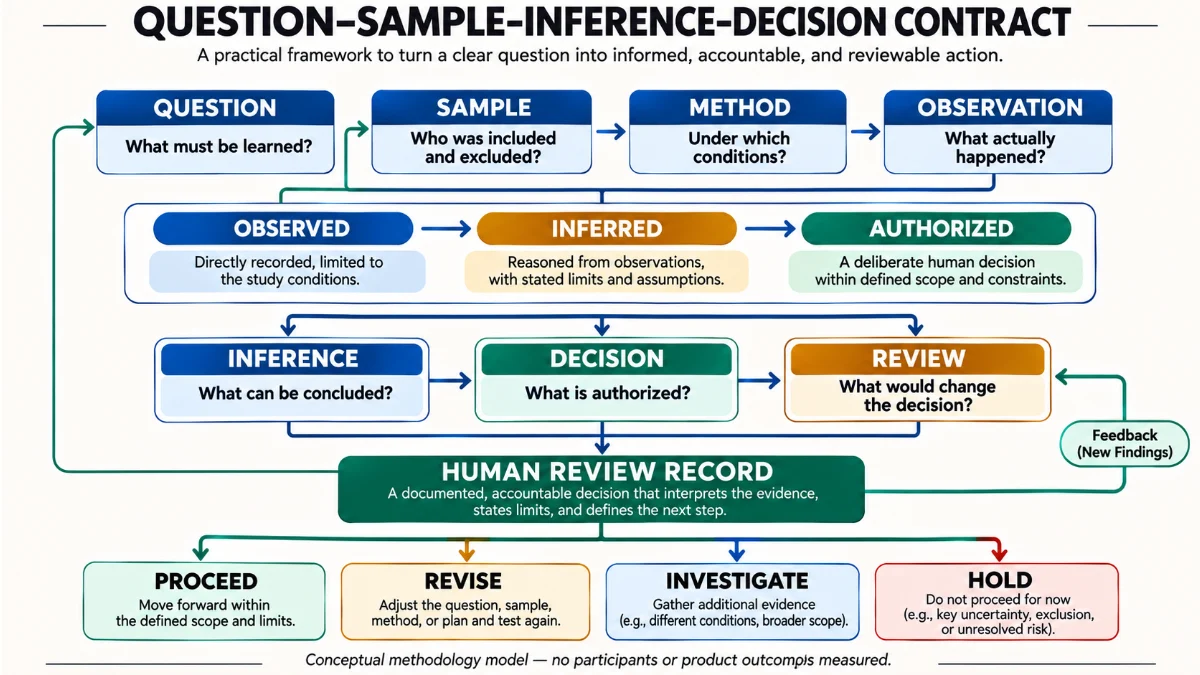
The contract’s central property is that useful UX research evidence does not automatically authorize a decision. A single credible barrier may justify a safe corrective action even when prevalence is unknown. A seemingly flawless five-person test cannot authorize a universal accessibility claim. An executive can choose to act under uncertainty, but the record should preserve that uncertainty and distinguish a deliberate risk acceptance from a research finding.
Four Decision Paths Without a Fake Confidence Score
PROCEED is appropriate when the proposed action is reversible, the observed mechanism is sufficiently clear, and no unexamined safety boundary is being crossed. REVISE means redesign the task, sampling or hypothesis, then test again. INVESTIGATE means a contradiction, rare subgroup, or unclear mechanism blocks a defensible conclusion. HOLD means a consequential claim or release requires evidence not yet collected. These paths are conditional alternatives, not steps in a mandatory funnel.
For UX research governance, I would link each path to an accountable role and a planned review date rather than to a synthetic overall score. A polished UX research number can obscure the fact that poor recruitment cannot be compensated for by good moderator notes, and adequate task coverage cannot compensate for missing consent. The dimensions constrain one another instead of averaging into false certainty.
Three Illustrative Small-Sample Scenarios
The following examples are hypothetical teaching cases, not client results, published usability studies, or observations from my projects. They exist to test whether the proposed inference rules remain coherent when the evidence appears persuasive.
Scenario A: Three of Five Cannot Export a Record
Five eligible first-time administrators attempt to export a record; three need help. The study can identify where the three became lost, whether labels or permissions created the obstacle, and what alternative they expected. It cannot establish that 60% of all first-time administrators would fail. I would record the task, assess the seriousness of the barrier, propose a design change where a mechanism is plausible, and recruit a new round with relevant differences in prior experience.
If the design fix is low risk, waiting for a population survey may be unnecessary. But if the team wants to promise a particular task success rate in a release announcement, UX research must supply a separate quantitative design with valid denominators and precision. Discovery and certification are different deliverables.
Scenario B: All Five Participants Complete the Journey
Five experienced desktop users complete a workflow without assistance. That is encouraging for those tested conditions, but it does not test novice behavior, mobile constraints, screen-reader interaction, or rare recovery states. A useful summary is “no blocking issue was observed in these five desktop sessions.” A misleading summary is “the feature is proven easy to use.” The next UX research question should be selected from the actual untested risk, not by enthusiasm about a perfect-looking fraction.
Scenario C: One Person Encounters an Irreversible Error
One participant reaches a destructive action without understanding its effect, while four complete the task safely. The study has not estimated the error’s frequency, but it has exposed a plausible high-consequence path. I would consider containment or a safer confirmation design, document the conditions, independently inspect the failure, and retest the changed flow. If the action has material security or legal implications, specialist authorization remains separate from UX research recommendations.
These scenarios demonstrate why I reject both the dismissal of small UX research samples and their promotion into universal truth. A study’s value depends on what it makes visible and which decision it is capable of supporting.
How I Would Plan a Small Round Under a Real Budget
A constrained budget should lead to narrower questions, not broader claims. Before recruiting, I would choose one or two critical tasks, define the participant group most likely to expose the uncertain mechanism, reserve time for analysis, and agree on what outcome would trigger another round. The goal is not to buy statistical certainty cheaply. It is to spend limited effort where learning changes the next product decision.
Separate Formative Learning From Confirmatory Measurement
First, conduct a short formative UX research round to discover likely failure modes and check the task protocol. Second, revise the prototype and the investigation question. Third, if the decision needs a population rate or an A/B effect, define and fund a confirmatory quantitative study with a sample plan suited to that precision. These phases may overlap operationally, but they should not be reported as one uninterrupted evidence type.
The GOV.UK round-planning guidance recommends preparing realistic tasks and planning participant recruitment, consent, equipment, and note-taking ahead of sessions. For UX research practitioners, this basic operational discipline matters because lost or contaminated sessions can be especially costly when there are only a few participants.
Triangulation Helps Only When Evidence Is Distinct
Behavioral analytics can show whether a route is rarely used or where users abandon a flow, but event data alone may not explain why. Interviews can reveal context and motivation, but reported intentions do not prove future behavior. A moderated task can expose a breakdown, but it does not give reliable market prevalence. I would combine methods only when each contributes an independent kind of evidence to the specific UX research question.
For example, a funnel drop-off pattern may identify where to investigate; a small qualitative study may reveal a plausible mechanism; an experiment or representative benchmark may then test whether the proposed change improves a defined metric. The three datasets should retain their distinct uncertainties. A triangulation slide that converts all of them into one confidence percentage would obscure the assumptions instead of resolving them.
Make Time for Negative Cases and Review
In a small UX research program, analysis is not an administrative extra after the final call. It is where hypotheses are challenged, exclusion criteria checked, and the next participant recruited deliberately. I would keep anonymized observations linked to tasks, seek alternate explanations for surprising behavior, and have another reviewer inspect key inferences where practical. A single researcher working alone can still use a structured counterevidence checklist and explicit release gate.
Accessibility, Consent, and Participant Protection Are Not Sample-Size Footnotes
UX research recruitment is an ethical decision as well as a methodological one. Excluding users with access needs because recruitment takes longer may produce findings that are efficient for the team but systematically incomplete for the product. A UX research study restricted to one assistive technology and one task can reveal a serious barrier; it cannot certify that all assistive technology configurations work. UX research must name that boundary.
Participants should understand the research purpose, what is recorded, who receives the results, how their information is handled, and that participation is voluntary. The GOV.UK informed-consent guidance sets out these practical conditions. I would collect only necessary data, preserve consent scope, avoid exposing sensitive details in stakeholder decks, and separate the participant’s identity from the explanation of a product failure.
A particularly harmful shortcut is to claim that a product is accessible because a small group reported no difficulties. UX research cannot replace appropriate accessibility evaluation, standards-based review, and testing of relevant assistive-technology configurations. Conversely, even one observed exclusionary behavior deserves serious consideration. A participant does not need to represent a statistically large population to experience a real barrier.
Claim Language: How to Report Small Samples Without Misleading
I would replace overconfident percentages with precise descriptions of the sampling and task context. “Three of five participants missed the recovery link during the moderated desktop task” is testable and useful. “Most users cannot recover their accounts” needs a different kind of evidence. Good UX research writing preserves its denominator, exclusions, and observed conditions instead of hiding them behind authoritative typography.
| Tempting statement | Better evidence-aligned statement | Missing evidence for broader claim |
|---|---|---|
| “60% of users failed” | Three of five participants did not finish the specified task without help | Representative quantitative design |
| “No one has this issue” | The issue was not observed in this round | Coverage of rare contexts and additional sampling |
| “We reached saturation” | No new major themes appeared in the last specified interviews within this narrow group | Defined analytic goal and evidence across missing groups |
| “The redesign fixed it” | The revised flow did not reproduce the observed failure in a follow-up task | Other conditions, regression checks, longer-term outcomes |
| “The interface is accessible” | Specified access conditions were evaluated; the listed barriers were or were not observed | Broader access coverage and appropriate standards evaluation |
The purpose is not to undermine findings with disclaimers. Precise language gives decision makers the information they need to act. It lets them distinguish a low-cost UX research-informed design adjustment that can be tested immediately from a high-stakes claim that requires stronger evidence. In UX research, this honesty makes the work more usable, not less persuasive.
Two Objections Worth Taking Seriously
“If Small Tests Are Not Representative, Why Run Them?”
Because discovery is not a failed version of measurement. It is an appropriate method for understanding interaction, finding problems, generating hypotheses, and informing iterative design. Engineers inspect a reproducible bug without first surveying every machine in the installed base. Similarly, UX research can identify a concrete failure mode with a small number of appropriate participants. The limitation is on the population claim, not on the usefulness of the observed event.
The strongest defense of small tests is therefore pragmatic and bounded: they help teams learn quickly enough to change the next design. It is not a promise that every severe or rare defect will be captured. More participants, different recruitment, and independent methods may be necessary as the risks and scope expand.
“Wouldn’t a Much Larger Study Always Be Better?”
Not necessarily. Larger studies can improve coverage and precision under suitable designs, but they also cost more and can delay iteration. A large homogeneous convenience sample can still exclude the users who experience the most consequential barrier. A large sample with leading tasks can collect many biased observations. For UX research, quality of recruitment and method can be more important than a simple participant count.
Yet the opposite slogan is also wrong: repeated tiny tests cannot produce every kind of evidence. If a board decision relies on whether an observed completion rate meets a contractual threshold, or whether one version meaningfully outperforms another, sample size and statistical design become central. The appropriate compromise is to spend the right evidence budget on the right decision, not to defend small or large samples as an identity.
A Publication Checklist for UX Research Findings
Before any small-sample finding enters a roadmap presentation, I would review the same questions each time. This checklist does not certify methodological validity; it makes common inference failures visible early enough to correct them.
- Is the exact research question and intended product decision written down?
- Is the participant population defined, including meaningful excluded groups and recruitment channels?
- Does the sample actually exercise the task, device, experience, language, or access conditions relevant to the claim?
- Are task prompts, assistance, and success criteria documented consistently?
- Are observed behaviors separated from explanations and proposed solutions?
- Are subgroup observations and counterexamples retained rather than averaged away?
- Is every percentage clearly labeled as a sample observation or defensible population estimate?
- Is the severity of a failure considered separately from its unknown prevalence?
- Are consent, privacy, accessibility, and specialist constraints respected?
- Is there a named owner, next test, and review trigger for decisions made under uncertainty?
When answers are missing, I would not automatically discard the whole UX research effort. I would reduce claim strength, restrict the recommended decision, or commission the smallest meaningful follow-up. Evidence quality improves when weaknesses change the action instead of disappearing from the summary.
Frequently Asked Questions About Small UX Research Samples
Is five users enough for usability testing?
Five appropriately recruited participants can be an efficient starting point for a narrow, formative usability test designed to uncover common interaction problems. It is not a universal guarantee of coverage and is not enough to establish a precise population completion rate. Plan additional rounds, segments, or methods when the next decision requires them. That is the distinction emphasized in Nielsen Norman Group’s qualitative testing guidance.
Can I report percentages from five interviews?
You can truthfully describe the sample, such as “three of five interviewees mentioned a particular concern.” Avoid presenting that as a population prevalence estimate. Interview participants are often recruited for information relevance rather than statistical representativeness, and their comments may not be independent measurements of a stable binary outcome. UX research percentages should never imply precision the design cannot support.
What if nobody in the sample experiences the problem?
Report that the issue was not observed in the specified sessions. Then ask whether the task exposed the risk, whether affected users were recruited, and whether the failure might be rare or dependent on context. Zero observed failures in a tiny sample is not evidence that the true failure probability is zero. UX research should preserve that uncertainty instead of declaring a universal negative.
How do confidence intervals help with small samples?
Under appropriate probabilistic assumptions, confidence intervals make sampling uncertainty explicit and often reveal how imprecise a small percentage is. They do not eliminate selection bias or turn convenience recruitment into a probability sample. In formative UX research, they are often best used to teach why observed fractions cannot support sweeping claims, rather than as decoration on a qualitative readout.
How many people do I need for UX interviews?
There is no universally correct number. Scope, population heterogeneity, participant expertise, dialogue quality, analytic method, and what counts as sufficient understanding all matter. Information power and carefully defined saturation can guide an adaptive plan. A broad exploratory project will generally need different coverage than a narrowly bounded expert-workflow inquiry. Begin with a justified range and reserve capacity to respond to missing themes.
Do I need a separate sample for each persona?
Not automatically. Personas are models, not statistically self-validating sampling strata. Recruit by characteristics likely to change task behavior or experience. Distinct roles with different permissions and goals may need separate study rounds. Overlapping segments may share tasks and some evidence. For UX research, explain which differences matter to the decision instead of mechanically multiplying a fixed participant number by the count of personas.
Can a single observed accessibility failure justify a redesign?
Yes, if it reveals a credible barrier and a proportionate corrective action is possible. One observation can establish that a particular failure occurred under specified conditions; it does not measure how common the failure is. Evaluate severity, access requirements, reproducibility and constraints, then retest the corrected design under relevant conditions. Do not translate a single observation into either a universal defect rate or a reason to ignore the affected person.
When should a UX researcher request a quantitative follow-up?
When the pending decision depends on population prevalence, a precise success threshold, market segmentation proportions, a meaningful difference between variants, or an externally communicated performance claim. Define those requirements before data collection and use a defensible design. A small qualitative UX research round may still be valuable as a pilot that clarifies the outcome and likely risk factors.
A Better Standard Than “We Tested Five Users”
The question is not whether five people are a respectable number. It is whether the people, tasks, observations, and methods can support the decision being proposed. Small UX research samples are powerful when they expose mechanisms quickly enough to improve a design. They are dangerous when a sample observation is dressed up as population prevalence or universal assurance.
My preferred standard is a short, inspectable chain: state the question; describe who and what was tested; show the observation; bound the inference; authorize only the action the evidence can support; and name what would make the decision change. That chain allows a team to move without pretending uncertainty has vanished. It also protects a participant’s real experience from being dismissed merely because the study was small.
The most responsible UX research program is not the one with the largest sample or the most polished confidence number. It is the one that repeatedly matches evidence strength to decision consequence, learns from counterexamples, and keeps its claims honest after the meeting is over.