


Code Review: The Hidden Cost of AI-Generated Code

AI Interface Trust: Correct Answers Can Still Mislead

Decision Brief: Accountability Without Authority Is Not a Product Strategy
A product manager can write a coherent roadmap, interview customers, clarify a problem, and assemble a persuasive business case. None of those activities grants the authority to redirect engineering capacity, change a revenue commitment, accept a security risk, or override a decision made elsewhere. When those boundaries are missing, the role becomes a convenient place to deposit dissatisfaction with the entire organization. I consider that a defect in the decision system, not automatically a defect in the individual.
The difficult part is that a weak decision system can coexist with a weak product manager. This is not an argument that product managers should escape accountability. It is an argument for examining decision rights before assigning blame. Did the person possess the right to choose? Did the team have the capacity to execute? Was the relevant evidence available? Could another leader veto the decision without accepting the trade-off? Those questions separate personal judgment from the operating conditions that constrain it.
My central recommendation is to make decision rights observable at the level of actual choices. Do not begin by rewriting job descriptions. Begin with several consequential decisions that stalled, reversed without new evidence, or were approved without a feasible execution plan. Trace the decision from proposal to authorization to execution. If the route cannot be reconstructed, a polished product organization chart will not make it real.
Decision: For decisions with material customer, financial, security, or delivery consequences, explicitly identify the final authority, responsible decision driver, required expert input, execution owner, and reconsideration trigger. Boundary: This is a conceptual governance method, not a measured intervention or a claim that any particular hierarchy is universally optimal.
Why a Strong Product Manager Can Still Deliver Weak Outcomes
Three failures that look like poor prioritization
The visible symptom of unclear decision rights is often a repeatedly slipping roadmap. The product manager appears indecisive because priorities change, or ineffective because delivery misses expectations. The same outcome can follow from three distinct causes. First, leadership may promise delivery dates before the engineering team evaluates dependencies. Second, sales, operations, and the executive group may hold incompatible priorities without an agreed mechanism for choosing among them. Third, the product manager may not have enough user or business evidence to recommend one option credibly. A decision rights audit reveals three different remedies: an authorization boundary, an explicit trade-off, and better evidence respectively.
Decision rights matter because these failures are easy to confuse. A weak recommendation should be corrected with better product judgment. An impossible capacity commitment should be resolved by changing scope, resources, or the commitment. An absent decision maker should be fixed by naming someone with actual authority. Sending all three back to the product manager as an instruction to “communicate better” avoids the cause.
The difference between influence, responsibility, and authority
In a discussion of decision rights, influence is the ability to shape another person’s decision. Responsibility is the obligation to perform work or answer for an outcome. Authority is permission to make a binding choice within a defined scope. A capable product manager uses influence to present trade-offs, but influence is not a reliable substitute for decision rights when priorities collide. An executive can overrule a proposed roadmap; the key question is whether the executive also assumes accountability for the implications of that override.
Clarifying decision rights does not make product management passive. The role still requires clear options, useful evidence, deliberate stakeholder alignment, and a willingness to recommend a choice. But demanding that someone own an outcome while withholding the decision rights needed to affect it is a governance contradiction. A company must either delegate a bounded decision or retain that decision at the proper level and acknowledge who made it.
An instructive difference between public role definitions
There is no single mandatory distribution of decision rights or product authority. The GitLab Product Manager handbook describes product managers as accountable for product investment choices and outcomes, alongside engineering and design leadership in their respective domains. The GOV.UK Service Manual lists product management work such as user needs, priorities, and product direction while describing a service owner with broader delivery authority. These are organizational examples, not a universal law.
I use this contrast to examine actual decision rights and ask a practical question: what does the title “product manager” mean here? If the organization cannot answer in terms of actual decisions, the title is not enough. The same decision rights that are sensible in a small founder-led product may be inappropriate in a regulated service, a shared infrastructure platform, or a company with separate budget holders.
Map the Decision System Before Fixing Its Meetings
The decision journey has several separate moments
To inspect decision rights, I would reconstruct decisions through five distinct moments: a problem is framed, options are evaluated, a binding choice is made, execution capacity is committed, and consequences are reviewed. Organizations often collapse these into a single meeting called “alignment.” That label can hide whether anyone actually chose, whether engineering agreed to deliver, or whether the decision can be reopened without a new fact.
Decision rights must be explicit at the third moment, but they depend on evidence and execution elsewhere in the journey. A final approver who lacks access to a credible cost estimate may make a fast but weak choice. A technically sound recommendation without a budget owner may never become work. A delegated product decision that can be silently overturned in a private conversation is not genuinely delegated.
Identify the vetoes nobody writes down
Formal decision rights are not the only constraint. A security reviewer may stop a release because a risk is unacceptable. Finance may reject an unbudgeted commitment. A data protection requirement may make a proposed experiment impermissible. These are not equivalent to someone disliking a visual design. I would classify binding safety and compliance constraints separately from preferences, and record who is authorized to interpret them. Genuine safeguards must not be bypassed simply to satisfy a commercial deadline.
Unwritten vetoes are different: someone with no formal approval role repeatedly reverses team decisions through personal influence. The remedy is not to eliminate informed disagreement. It is to decide whether this person genuinely holds decision rights, needs an input role, or should be involved only when specified criteria are met. No decision framework works if leadership treats its own exceptions as invisible.
Decision Rights Are Not a Substitute for Better Evidence
Good authority can still select a poor option
Explicit decision rights and a single named decision maker eliminate one kind of ambiguity; it does not automatically produce wisdom. Product governance needs a credible description of the problem, realistic alternatives, user evidence that matches the decision, and stated uncertainty. If those are absent, concentrating decision rights may simply make a bad decision faster. The decision owner should be able to ask for additional evidence rather than interpreting every unresolved question as resistance.
I would distinguish a decision about what to investigate from a decision about what to build. Small qualitative research can expose a usability failure without establishing population prevalence. A customer request can identify a genuine need without proving demand across segments. A revenue forecast can support financial feasibility without establishing that an interaction is safe or understandable. Evidence quality includes whether the evidence is appropriate for the claim.
Design disagreement to be informative
When product, design, engineering, and commercial teams disagree, do not assume decision rights alone settle the issue; ask which premise differs. Is the user problem disputed? Does the implementation estimate assume a different architecture? Is one group optimizing this quarter while another owns long-term support? Is legal risk being raised as an explicit constraint or as a vague rhetorical veto? Clarifying these premises improves the recommendation before the approver uses decision rights.
The Atlassian DACI framework identifies a driver, one approver, contributors, and people who must be informed. The driver assembles evidence and gets a decision made; the approver makes the final call. I use that as an example of role separation, not proof that DACI improves results in every product company. A team still has to decide which subjects deserve this formality.
Conflicting Incentives Create Conflicting Roadmaps
Each stakeholder can be locally rational
When decision rights are vague, a sales leader may be rewarded for closing an important contract without a credible capacity commitment. Engineering may be accountable for reliability. Customer support may be trying to reduce incident volume. Finance may be protecting cash flow. Product may be asked to improve long-term user value. Every group can make a reasonable argument within its own horizon and still create an incoherent shared plan. Decision rights do not remove organizational incentives, but they make their conflicts visible to someone empowered to choose.
For instance, imagine a product manager asked to prioritize a widely reported onboarding defect, while a revenue leader commits to a customer-specific integration. Both may have defensible reasons. Without a known authority that can trade capacity across the two, the product manager is likely to receive incompatible instructions. More stakeholder meetings will not create the missing authority.
Record who accepts the opportunity cost
For decision rights to mean anything, a roadmap decision must also be a decision not to do something else. If an executive adds a new commitment without removing or resourcing an old one, the work does not disappear; it becomes hidden queueing, unfinished tasks, or pressured delivery. I would require material overrides to name the displaced work and the person accepting the resulting consequences. That turns abstract stakeholder alignment into a testable product strategy choice.
This is where decision rights connect to incentives rather than merely process diagrams. People are more likely to debate openly when consequences are recorded and reviewed. The goal is not to punish a decision owner for every uncertain outcome. It is to prevent the organization from pretending that all priorities can remain intact after changing one.
Technical Debt Is a Capacity Constraint, Not a Backlog Personality Trait
A delivery promise depends on system health
In the context of decision rights, technical debt is a useful shorthand only when the team can explain what it costs or threatens: brittle deployment steps, slow changes, recurring incidents, reduced test confidence, or an architecture that makes a requested feature expensive. Treating this information as a complaint from engineering weakens product decisions. So does presenting every refactoring idea as an emergency. The relevant question is what the existing condition means for the proposed outcome and what evidence supports that assessment.
Decision rights should reflect these domain boundaries. Product may decide that a customer problem deserves investment; engineering must have authority over safe implementation and an evidence-based account of its constraints. If product is permitted to set an unconditional delivery date while engineering is held responsible for reliability but cannot reject unsafe scope, the governance model has divided authority from risk.
Capacity planning requires explicit reservations
Decision rights cannot make an impossible capacity plan executable; I would make capacity planning part of the actual decision, not a spreadsheet reconciled after the roadmap is announced. Include current commitments, expected operational work, dependencies, and the uncertainty around estimates. A team that maintains production services cannot promise every available hour to new features without treating incidents, reviews, and recovery as improbable exceptions. Nor should leaders inflate every estimate defensively because there is no credible route to revise a commitment.
The GOV.UK multidisciplinary-team standard emphasizes involving people who participate in decisions and have the expertise to operate a service sustainably. This is a useful governance principle, not evidence that one staffing pattern applies everywhere. The product manager needs a genuine view of engineering constraints before recommending an investment, while specialist safety responsibilities remain with qualified owners.
Use DACI, RAPID, and RACI for Different Problems
The words in the matrix matter
Decision rights frameworks are often presented as interchangeable templates. They are not. DACI distinguishes the person driving a decision from the person approving it. Bain’s RAPID approach distinguishes Recommend, Agree, Perform, Input, and Decide. RACI is commonly used to clarify work responsibility, accountability, consultation, and information. For a significant disputed product choice, I would start with a decision-focused method rather than assume a delivery ownership chart determines who has authority to choose.
A meaningful distinction when defining decision rights through RAPID is that the person who recommends need not be the person who decides. “Agree” can represent a necessary formal concurrence, for example on a regulatory constraint; it is not a generic invitation for every stakeholder to veto. I would not copy RAPID’s roles into my own model and claim the result is an officially certified framework. The Decision Rights Ledger below is my synthesis for a narrower operational use.
| Question | DACI lens | RAPID lens | Common misuse |
|---|---|---|---|
| Who organizes the recommendation? | Driver | Recommend | Assigning coordination but no deadline |
| Who makes the binding choice? | Approver | Decide | Treating several people as independent final approvers |
| Who contributes expert evidence? | Contributors | Input | Letting every opinion become a veto |
| Who must explicitly consent on special constraints? | Not a dedicated letter | Agree | Confusing mandatory safeguard with ordinary preference |
| Who performs the work? | Assigned outside the acronym as needed | Perform | Assuming decision approval commits capacity automatically |
| Who needs visibility? | Informed | Usually handled by communication design | Broadcasting without recording a decision |
When the matrix should stay lightweight
I do not recommend turning decision rights into a committee exercise to choose a minor label or reorder a harmless backlog item. Delegate reversible decisions with low external impact. Use fuller documentation when decisions affect money, legal obligations, service continuity, safety, cross-team capacity, or irreversible commitments. Otherwise product governance turns into procedural tax, which can be as destructive to good work as ambiguous authority.
Decision rights also need expiration conditions. A temporary incident commander may be authorized to stop a release during an outage. That does not grant permanent authority over product strategy. A founder may retain pricing decisions until a team reaches a specified maturity. These boundaries should be named rather than inferred.
The Decision Rights Ledger
I propose a Decision Rights Ledger to connect the authority to choose with the evidence and capacity required to act. It is a conceptual operational record, not a validated maturity model or automatic numerical score. It should help a leadership team answer who owns each consequential choice, which expert input is mandatory, what can block execution, and when the decision must be reconsidered. The framework can be implemented as a short document or an existing project artifact; it does not require a new governance platform.
| Ledger field | Question that must be answered | Minimum useful record | Typical failure |
|---|---|---|---|
| Decision boundary | What exactly is being chosen? | Scope, alternatives, excluded decisions | A vague approval is interpreted as a blanket mandate |
| Final authority | Who can bind the organization? | Named decision owner and delegation scope | Two leaders assume they have the last word |
| Evidence and dissent | What supports or challenges the choice? | Evidence source, uncertainty, counterargument | Selective research is mistaken for consensus |
| Constraint and consent | Which independent safeguards apply? | Legal, safety, security, financial or policy checks | A preference is disguised as a mandatory veto |
| Execution capacity | Who can deliver, and what is displaced? | Engineering and operational capacity commitment | Work is approved without an executable plan |
| Accountability and communication | Who follows through and who learns the outcome? | Delivery owner, informed parties, decision log | Blame shifts after an unrecorded override |
| Review trigger | What would reopen this decision? | Date, observation, incident or premise change | Decisions persist after their assumptions fail |
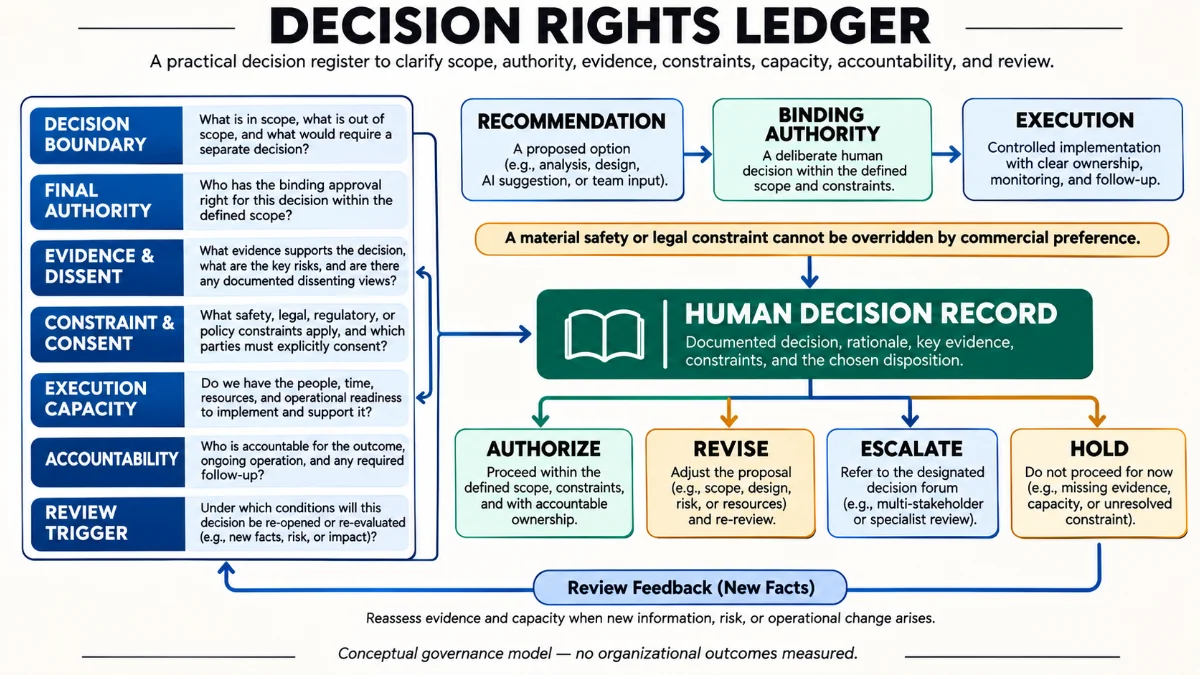
The central property is that decision rights are recorded without pretending that authority can eliminate evidence uncertainty or engineering constraints. A decision owner may choose among permissible options, but cannot make an unsafe release acceptable merely by preferring the commercial benefit. The ledger should preserve legitimate dissent, not use it as an obstacle to every decision. For high-impact changes, an explicit STOP or ESCALATE pathway can be necessary even if leadership wants to proceed.
What a completed record should show
To see decision rights in context, take a hypothetical pricing change. The decision boundary is whether to offer a new annual billing option to an identified customer group. The product manager may drive customer research and recommend an approach. Finance may provide a margin model; design may test comprehension; legal may determine mandatory disclosures; engineering may estimate billing changes and rollback capability. The final authority could be a designated product executive, provided the organization has delegated the budget and contractual choice. The ledger records the decision, conditions, displaced work, and review trigger. It does not imply that a fictional experiment was conducted.
A second hypothetical decision concerns disabling a risky account feature after a serious security finding. Here the approved response may involve a predefined operational stop authority. A product executive’s commercial preference cannot bypass that safety gate. The same organization may therefore use different decision rights for pricing strategy, interface copy, and urgent service protection. A single authority map for all three can be dangerously simplistic.
Make the Decision Ownership Matrix Concrete
A generic organizational chart cannot establish decision rights when priorities conflict. I would select a small set of consequential decision classes and assign roles per class. The following is an illustrative starting point only; the exact owners require organizational approval and may differ in regulated, founder-led, or platform businesses.
| Decision class | Recommendation driver | Binding decision owner | Mandatory input or constraint | Execution authority |
|---|---|---|---|---|
| Routine low-risk product priority | Product manager | Delegated product lead | Design and engineering estimates | Product delivery team |
| Cross-team roadmap trade-off | Product lead | Portfolio or executive owner | Affected team leads, customer impact, budget | Accountable engineering and operations leads |
| High-impact pricing or contracts | Product and finance | Delegated commercial executive | Finance, legal, customer research | Billing and customer operations |
| Security-critical release exception | Qualified security and engineering owners | Authorized risk owner under policy | Mandatory safety and compliance controls | Release or incident owner |
| Major architecture investment | Engineering leader with product partner | Approved technology/budget authority | Reliability, security, long-term costs | Architecture and engineering leads |
| Material user-research contradiction | Research and product jointly | Relevant product decision owner | Method limitations, counterevidence, user impact | Product and design delivery team |
This is not an invitation to make a product manager the driver for everything. If an issue is primarily architectural, an engineering leader may lead the recommendation. If it concerns a binding legal obligation, the organization must honor the qualified authority and applicable process. Decision rights should follow the nature and consequences of the choice, not just seniority or habit.
A test for overlapping responsibilities
Ask the relevant leaders independently: “Who may stop this decision, who may approve it, and who must deliver it?” Compare their answers before showing the proposed map. If they name different people, the conflict is already observable. Do not resolve it by quietly picking the most senior person on the call. Have the organization explicitly delegate or retain the decision rights, document the boundary, and name the escalation path when a decision exceeds that boundary.
Distinguish Performance Failure From System Failure
Four diagnostic questions before blaming the role
To distinguish personal performance from decision rights failures, I would examine repeated failures through four questions. First, was a clear and reasonable recommendation made in time? Second, was the decision owner authorized and willing to decide? Third, were the constraints and available capacity accurate enough to execute? Fourth, did the responsible team follow through after the decision? This is not a psychological evaluation of an employee; it is an attribution exercise based on documented work and observable conditions.
A product manager who repeatedly misses obvious customer evidence, refuses to frame alternatives, or avoids difficult trade-offs can be accountable for poor performance. A product manager who provides a sound recommendation that a budget holder declines is not responsible for that budget holder’s choice. Similarly, an engineering team that commits a feasible plan but misses it due to avoidable execution problems should not use product governance as a universal excuse.
Evidence of a broken system
Signs that decision rights are not working include decisions repeatedly reopening without new facts, initiatives being added without subtracting capacity, managers receiving mutually exclusive goals, leaders using different definitions of success, and an unexplained gap between an approved priority and the work actually started. These signals do not prove the cause individually. They point to transactions worth tracing in the decision log.
I would also check for survivorship bias in the evidence: teams often document completed launches but not abandoned proposals, reversals, or delayed approvals. If the only visible records are success announcements, leadership cannot learn where decision rights broke down. Measuring process health means recording relevant failures without turning them into a punitive leaderboard.
Three Hypothetical Failure Scenarios
Scenario one: a sales promise outranks the agreed product roadmap
To expose decision rights in practice, assume a sales leader promises a feature to close a deal. The product manager has already prioritized a reliability issue based on support reports and engineering analysis. The new feature needs the same developers. If the sales leader has no authority to allocate development capacity, the promise should enter a cross-team trade-off with a named approver. If an executive accepts it, the executive should acknowledge what reliability work moves, what risk is accepted, and how the customer commitment will be communicated.
If the product manager simply updates the roadmap under pressure, the team may later be blamed for the reliability issue and the missed feature deadline. The failure is not solved by a motivational speech about stakeholder alignment. It requires enforceable decision rights and a visible record of trade-offs. This scenario is constructed for analysis and does not describe a client or measured business outcome.
Scenario two: research is requested but cannot change the decision
Imagine a team whose stated decision rights permit research to inform a choice, but that commissions user interviews after leadership has privately selected a solution. The researchers identify serious confusion in a proposed workflow; leadership nevertheless insists on the same design without explaining the decision. It is possible that other compelling evidence exists, or that the research method cannot support the inference being made. The product manager should surface those boundaries rather than declare the research automatically decisive.
If leadership overrides the evidence, the ledger should record who made the decision, which counterarguments were considered, and which observation would trigger a new review. Decision rights clarify the authority to override an input; they do not turn unsupported claims into evidence. The related MVP Experiments article explains why hypotheses and decision conditions should be defined before testing. Here the focus is the governance route after evidence has been gathered.
Scenario three: technical debt is hidden until release
Suppose a product manager is assigned a date for a cross-platform launch before dependencies are estimated. Engineers later identify an authentication migration and a high-risk rollback. Neither adding weekend work nor requesting “better ownership” removes these facts. The decision owner must revisit date, scope, staffing, or acceptable risk. A safe release requirement can prevent an option altogether.
The product manager should still present the competing options clearly and explain which value can be delivered at a smaller scope. Engineering should describe the constraint in actionable terms. The organization must decide who can authorize the revised plan. Decision rights become useful only when that authority can change the original promise rather than merely approve a status report.
How Founders and CPOs Can Repair the System
First, select the decisions with the most friction
I would begin repairing decision rights with three to five material decisions from the previous operating period: a delayed roadmap choice, a cross-team conflict, a significant customer commitment, a release hold, or an investment in technical debt reduction. For each, reconstruct who recommended, who decided, who supplied evidence, who committed capacity, and who later reopened the choice. Record missing facts rather than silently infer intentions.
This narrow audit is consistent with the intent of Bain’s decision-rights work: separate roles for recommendation, input, agreement where necessary, final choice, and execution. A decision-rights tool is an operating discipline, not an argument that every company should copy a consulting diagram without adaptation. Bain’s five-step discussion explicitly connects authority to decision timing, evidence, and follow-through.
Next, make authority symmetrical with consequences
If a leader retains the right to change a commitment, that leader should also own the trade-off created by the change. If a product manager is assigned outcome accountability, delegate an appropriate scope of product decisions and ensure that necessary resources can actually be committed. If engineering owns safe release, define the boundary rather than treating security review as a courtesy consultation. These distinctions reduce ambiguity without eliminating collaboration.
The Atlassian roles-and-responsibilities exercise provides a complementary way to expose overlaps and unclaimed work. It is useful for teams discovering that nobody accepts a necessary activity. It is not a substitute for naming who has final decision rights on a contested strategic choice.
Finally, run a decision retrospective
After several weeks of clarified decision rights, review whether the new rules changed what happened. Which decisions closed within their agreed windows? Which were reopened, and why? Where did a necessary reviewer find a real defect? Did approved work enter execution without a second invisible approval? Where did capacity estimates break? Treat these as diagnostic questions rather than scorekeeping for individuals. Atlassian’s decision-making retrospective is one useful public template for examining delayed and completed decisions.
I would not announce that a new decision rights matrix improved throughput without a suitable baseline, comparable decision classes, and an observation period. A shorter meeting does not prove a better decision; faster approval may simply hide risk. The correct outcome is an auditable, appropriately paced decision that the organization can execute and reconsider.
What the Product Manager Can Actually Change
Even without final decision rights, a strong product manager can improve the quality of the question. I expect the role to clarify the customer problem, articulate real alternatives, assemble credible evidence, state trade-offs, and make a recommendation. The product manager can maintain a transparent decision log, raise conflicting commitments, and request an explicit owner when none exists. These are important contributions. They are not equivalent to controlling budgets or reorganizing departments.
There is also a professional obligation to challenge a request that cannot be justified. When product strategy is being replaced by successive urgent demands, the product manager should explain the cost rather than merely reorder tickets. Where an escalation path exists, use it; where none exists, document the gap and ask the appropriate executive to resolve it. This is how decision rights become a leadership issue that can be acted on rather than a private frustration.
For product managers with delegated authority, the standard is higher: make the decision within scope and own the consequences. Hiding behind endless consensus after authority has been granted is a different failure. My position is not “product managers cannot decide.” It is that the organization must make the boundary between decisions a product manager can make and decisions that require other authority unmistakable.
What Not to Do: Common Governance Overcorrections
Do not replace informal vetoes with formal paralysis
Overengineering decision rights through a complex approval matrix can create new queues. I would reserve formal review for decisions where the scale of harm, expenditure, regulatory exposure, or cross-team effects justify it. Routine product decisions should remain local and reversible wherever possible. The point of decision rights is to remove harmful ambiguity, not to maximize permission requests.
Do not treat executive authority as a reason to ignore dissent
A leader with formal decision rights can decide under uncertainty. That authority does not erase the obligation to consider relevant user, technical, financial, and safety evidence. A recorded dissent is useful when it identifies a testable assumption or a risk boundary. Treating every dissent as disloyalty turns the ledger into a compliance ritual rather than a learning tool.
Do not force a single owner to absorb every risk
Single-point accountability for a choice is not the same as unilateral control over all safety and domain requirements. Some decisions involve multiple legally defined roles or required approvals. The matrix should show the competent authorities and the conditions under which escalation or a hold is mandatory. A simplistic “one person always decides everything” interpretation is neither practical nor safe.
A Lightweight Decision Review for Smaller Organizations
A founder-led company or small team may not need a formal governance committee. It still needs clear choices. I would use one decision record with the following minimum elements: question, alternatives, recommended option, evidence and uncertainty, final owner, implementation owner, affected capacity, independent constraint, and review trigger. If a decision is reversible and low risk, the record can be a short note. If it changes customer terms, production security, or multi-team commitments, it deserves deeper review.
For a solo operator, decision rights may formally sit with one person. The failure mode then shifts from conflicting managers to insufficient independent checks. I would separate the stages in time and evidence: make a recommendation, inspect an engineering estimate, review user impact, and apply a distinct safety gate before release. AI tools can help structure questions, but an AI-generated agreement is not an independent authorization. The same person may hold several roles while maintaining explicit boundaries between proposal and verification.
A small team should review the ledger when decision authority changes, when key people leave, after a significant incident, or when a new business model introduces unfamiliar obligations. The owner of the method should avoid turning it into a permanent bureaucracy that outlives its value.
How to Measure Decision-System Health Without Inventing a Score
I would not publish a composite “decision rights maturity percentage.” It creates false precision and can hide severe problems behind a favorable average. Instead, track a few diagnostic observations over comparable decision classes: elapsed time from complete recommendation to authorization; proportion of decisions with an identifiable owner; decisions reopened because of new evidence versus informal override; work approved without capacity confirmation; unplanned changes to committed priorities; and safeguards that correctly stopped or revised an unsafe proposal.
Each measure requires definitions. An authorization delay can reflect bureaucracy or necessary due diligence. A safety hold is not automatically poor performance. More documented dissent can mean healthier discussion rather than worse alignment. An increase in reopened decisions may be appropriate if the organization has started responding to previously ignored evidence. I would report context alongside each signal and compare like with like.
The 2025 DORA research describes AI as amplifying preexisting organizational strengths and weaknesses. That finding concerns AI-assisted software development, not a validated test of the Decision Rights Ledger. I use it only as a reminder that inserting a new process or tool into an unresolved operating system is unlikely to remove the underlying constraints automatically.
Evidence, Methodology, and Important Limitations
This article is a reasoned synthesis of public guidance on decision rights, product role design, and multidisciplinary delivery. Primary references include Bain’s RAPID decision-rights framework, Atlassian’s DACI and role clarification guidance, GOV.UK’s Service Manual, and the publicly documented GitLab product manager role. They support the existence and interpretation of different governance approaches. They do not demonstrate that my proposed ledger has been experimentally validated, nor do they establish an optimal allocation of authority for every organization.
The Decision Rights Ledger and the example decision ownership matrix are my conceptual recommendations. The three scenarios are hypothetical; they are not case studies of named clients, private organizational records, or measured outcomes. I have not used confidential project data, made-up interviews, or invented performance gains. Advice about legal and security review describes governance boundaries at a general level and does not replace specialist obligations in a particular jurisdiction.
The main inference is narrower than an absolute statement that a product manager cannot influence organizational change. Skilled product leaders can persuade executives, redesign workflows when authorized, and help organizations mature. But they cannot legitimately commit resources, waive independent safeguards, or enforce cross-functional priorities without the relevant authority and cooperation. The decision system needs to grant that authority, retain it explicitly elsewhere, or acknowledge the limit.
Frequently Asked Questions
Are product managers responsible for delivery outcomes?
They often own product outcomes and must communicate priorities, risks, and trade-offs. Whether they own delivery dates, staffing, architecture, or commercial approval depends on the organization’s delegated decision rights. Accountability should describe what the role can actually influence and authorize, rather than assigning every downstream event to one title.
Should a product manager be the final decision maker?
Sometimes. The correct answer depends on the decision class and delegation scope. Routine product priorities may be delegated to the product manager; high-impact commercial commitments, regulatory exceptions, cross-team budget choices, or material technical risk may require different authority. The owner should be named before conflict arises.
Can an accountability matrix solve conflicting priorities?
An accountability matrix can expose who should recommend, decide, advise, and execute. It will not solve conflicting organizational incentives by itself. Leadership must still choose between real alternatives, remove displaced work, and accept consequences. That is why I pair role mapping with capacity and a decision log.
What should happen if leadership overrides research?
Record the final authority, the evidence considered, methodological limits, counterarguments, and the review trigger. The override may be warranted by other evidence or constraints, but it should not be disguised as an evidence-driven research conclusion. A material safety or legal requirement cannot be dismissed merely because an executive prefers the commercial outcome.
How do decision rights work in a startup with one founder?
The founder may own most binding decisions. The useful distinction is then between proposing, validating, approving, and executing a choice. A short record and independent checks can expose assumptions, engineering constraints, and risks without introducing an elaborate committee structure.
What is the first action for a CPO who suspects systemic failure?
Review three to five recent disputed or reversed decisions. For each, identify the recommendation, final owner, missing evidence, execution capacity, and reason for any override. If the team cannot reconstruct those paths, clarify decision rights at those specific boundaries before redesigning the entire product organization.
Final Position: Fix the Route from Evidence to Authority to Execution
I do not believe a product manager’s skill should be judged as if they possess authority they were never given. Nor should organizational problems become a standing excuse for poor product judgment. The distinction is operational: did the person make the best recommendation within their scope, and did the organization give that recommendation an accountable route to a feasible decision?
Decision rights become useful when they move beyond titles into specific, traceable commitments. Name the owner, preserve the evidence and legitimate dissent, confirm capacity, respect independent risk boundaries, and define when the decision can be reopened. That is how a product organization stops treating systemic conflicts as one person’s communication problem and starts evaluating decisions as a shared responsibility with identifiable owners.
Research Sources and Further Reading
- Bain & Company — The Five Steps to Better Decisions. Source description of RAPID roles and decision discipline.
- Atlassian Team Playbook — DACI. Driver, approver, contributors, informed, and decision record practices.
- Atlassian Team Playbook — Roles and Responsibilities. Exposing unclear and unclaimed responsibilities.
- GOV.UK Service Manual — What Each Role Does. Separation of product and service owner responsibilities in a government service context.
- GOV.UK Service Standard — Multidisciplinary Teams. Decision participation, specialist expertise, and sustainable service delivery.
- GitLab Handbook — Product Manager. Public example of product investment ownership and cross-functional accountability.
- DORA Research 2025. Context for the role of organizational systems in AI-assisted software delivery, not a validation of this ledger.
Author’s note. My recommendations concern decision architecture rather than personal performance allegations. Product governance should remain open to revision as a team’s operating context changes. A decision is only useful if its authority, evidence, and implementation are connected.