


The Reach Trap: When Viral Content Finds the Wrong Audience

Decision Rights: Why Product Managers Cannot Fix the System

If You Only Read One Thing
AI-generated code can shorten the distance between an idea and a plausible patch. It cannot, by itself, shorten the distance between a plausible patch and an accountable production change. I evaluate the full path: specifying the behavior, generating the candidate, understanding the affected system, obtaining test evidence, assessing security, integrating the change, releasing safely, and owning the result. The relevant unit of productivity is not typing time; it is a verified, maintainable outcome. Good code review protects that distinction without turning every change into an endless ceremony.
A fast draft can be valuable even when it is eventually rejected. A small patch can be dangerous even when every generated line looks reasonable. Both statements are compatible. My argument is that AI-generated code should be treated as a candidate implementation whose level of review depends on the behavior it changes and the evidence available, not on whether a model or a person wrote the first version.
The Real Question Is Not Whether AI Writes Code Faster
For many tasks, generating a first pass is no longer the most expensive step. The expensive steps can begin when an engineer must determine whether the generated design fits the repository’s contracts. This is why code review is sometimes where the apparent gain disappears. During code review, a proposal that arrives in seconds may still require tracing permissions through several services, investigating error states, adding tests, and identifying a safe rollback strategy.
I distinguish authoring time from accepted-change time. Authoring time ends when a patch exists. Accepted-change time ends only when its intended behavior is verified and the responsible engineer can defend the decision to merge. Later incidents and maintenance work can extend total cost further. An efficiency claim limited to the first number is useful, but it does not answer the second or third question.
Why lines of code are a poor productivity proxy
Line counts are simple to calculate and easy to misinterpret. A generated implementation that adds several hundred lines might replace a focused thirty-line change, import an unnecessary dependency, or duplicate existing behavior. Equally, an AI assistant might find a small, clear correction that a developer would otherwise spend hours locating. The number of lines is not evidence of either benefit or harm. Code review must examine purpose, design fit, and behavior before counting output.
The same principle applies to accepted suggestions. An accepted completion shows that a developer chose to incorporate text; it does not establish that the application became safer or more maintainable. In my measurement model, accepted suggestions are a workflow diagnostic, not a product outcome.
Where the time can move
The time can shift from implementation to specification, test generation, fixture repair, dependency evaluation, or explaining a change to a future maintainer. These code review and verification activities are not automatically waste. Some are investments we should have made regardless of who authored the patch. The question is whether AI support reduces the total verified work for a comparable outcome or merely changes where the work appears on a dashboard.
What the Research Actually Supports
Evidence about AI development productivity is mixed because studies examine different tasks, developers, tools, and outcomes. I do not combine controlled-task completion time, surveys of perceived productivity, and repository observations into a single universal speedup estimate. They measure different things. That distinction matters when a team uses a vendor demonstration to justify a policy for an entire production codebase.
A controlled task is not a production release
In a 2023 paper, researchers reporting on a GitHub Copilot experiment found that participants assigned a JavaScript HTTP-server task completed it 55.8% faster with the assistant. That result applies to the studied task and conditions; it does not mean all AI-generated code reduces release cost by the same amount. Read the original controlled-task paper.
METR’s 2025 randomized study of experienced open-source developers found slower completion when AI tools were available under that study’s conditions. Its February 2026 follow-up is especially important: newer experimental data suggested improvements, but participation and measurement biases made the current size of the effect unreliable. I would not quote the original slowdown as a prediction for every team in late 2026, nor would I treat the uncertain newer estimates as a confirmed speedup.
The organization changes the result
The 2025 DORA report describes AI as an amplifier of existing organizational strengths and weaknesses. Its findings are relevant to process design, but survey responses and organizational associations should not be mistaken for an experiment proving that a particular repository will ship more safely. A team with clear interfaces, reliable tests, and narrow changes is in a different position from a team with ambiguous ownership and unstable environments.
An experimental maintainability study published in 2026 did not find systematic downstream maintenance disadvantages in the tasks it evaluated, despite a faster initial implementation phase for AI-assisted participants. That is meaningful counterevidence to the claim that generated code is inherently unmaintainable. The authors also acknowledge that code bloat and cognitive debt deserve further investigation.
Review friction is real, but not every report measures its cost
A 2026 pull-request study examined how ChatGPT suggestions were incorporated into collaborative work and found substantial adaptation rather than routine verbatim integration. It is evidence that integration is contextual, not proof of a universal review-time penalty. A separate 2026 qualitative analysis of online developer discussions identified recurring concerns about review friction and trust. Those are reported developer experiences, not a representative measurement of how much every reviewer loses.
The appropriate conclusion is narrower and more useful: the economics of code review should be measured locally, with source evidence and scope limitations visible. Neither a blanket AI ban nor a blanket approval shortcut follows from the literature.
The Hidden Review Cost Has Multiple Layers
When I hear that a patch was “reviewed,” I ask what the word includes. A quick visual scan and a production-ready sign-off are different activities. A meaningful code review budget can include understanding, reproducing, testing, threat analysis, architectural comparison, deployment evaluation, and documentation. These layers should be explicit enough that teams can distinguish productive safeguards from avoidable friction.
| Layer | Reviewer question | Evidence expected | Typical failure |
|---|---|---|---|
| Intent | What behavior is required? | Acceptance criteria and constraints | Patch solves the wrong problem |
| Semantics | Does it work across important states? | Tests, traces, and edge-case reasoning | Plausible but incorrect behavior |
| Architecture | Does it fit ownership and interfaces? | Dependency and boundary review | Hidden coupling or duplication |
| Security | Could it violate a trust boundary? | Threat review and negative tests | Authorization or data exposure flaw |
| Release | Can we deploy and recover safely? | Monitoring and rollback plan | Operational surprise after merge |
| Ownership | Who can maintain this next month? | Named maintainer and decision record | Orphaned implementation |
These categories are an editorial framework, not an industry-standard scoring model. A typo fix may require seconds; a permission change demands more. Code review should be proportionate to the risk of the change and the strength of available evidence. It should not become a ritual where every pull request receives the same sequence of expensive checks regardless of impact.
The Correct Unit of Review Is a Behavior Change
Reading every changed line is necessary in many code review processes, but a line-by-line scan is not sufficient. Software behavior also depends on surrounding code, state transitions, external contracts, permissions, deployment configuration, and the sequence of events. An AI-generated function can be locally coherent while violating an invariant elsewhere in the system.
Trace the claim through the system
I would begin each code review with a one-sentence behavior claim: “This change permits a user with role A to perform action B on resources they own, while preserving rule C.” Then I would follow that claim through the entry point, authorization boundary, persistence layer, observability, and tests. If the patch author cannot identify those paths during code review, the change is not ready for final approval regardless of how well formatted it is.
This is consistent with Google’s public review guidance, which emphasizes design, functionality, complexity, tests, and system context. The guidance is not specific to AI, and that is precisely the point: code generated by a model still enters an ordinary engineering system with ordinary failure modes.
Review the absent behavior
Many expensive defects live in cases the patch does not mention. What happens when authorization is missing? When an operation is repeated? When an API times out after committing a write? When an old client sends unexpected data? When a feature flag is disabled? Code review has to look for these missing branches rather than simply finding a plausible success path. Generated test cases help only when their assertions are independently linked to real requirements.
Scope Matters More Than Patch Size Alone
A thirty-line change to a shared authorization helper may have greater consequence than a large self-contained documentation update. Conversely, a broad generated refactor can hide unrelated semantic changes in a mass of formatting edits. I prefer using change scope and affected trust boundaries to decide review depth, rather than an arbitrary line-count threshold.
Start with the dependency map
Identify modified modules, their callers, public interfaces, data stores, and deployment artifacts. Ask whether the code changes a contract consumed by another part of the system. If the affected surface cannot be explained concisely, split the patch or conduct a design review before investing time in line-level comments. This is also where code review can uncover a solution that technically works but solves the problem at the wrong architectural layer.
Treat infrastructure code as production code
A generated CI rule, package-install script, access policy, migration, or deployment configuration can change what code executes and which credentials it can reach. The syntax may look less impressive than an application feature, but the operational consequences may be more severe. An effective code review strategy follows authority and effect, not the visual complexity of the diff.
The Change–Evidence–Ownership–Release Contract
My proposed contract is a compact decision record that makes a generated patch accountable without pretending that one checklist can prove it safe. The author supplies the behavior claim and affected scope. Independent checks supply evidence. A human decision owner accepts or rejects residual risk. A release operator, possibly the same person in a small project, controls deployment and recovery.
| Contract domain | Required question | Acceptable evidence | Disposition if missing |
|---|---|---|---|
| CHANGE | What changed, and why here? | Scoped diff, requirement, dependency map | Revise scope |
| BEHAVIOR | What must remain true? | Positive and negative acceptance cases | Investigate |
| EVIDENCE | What was independently checked? | Reproducible tests and inspection notes | Hold |
| SECURITY | Which trust boundaries are affected? | Risk-specific verification | Escalate when material |
| OWNERSHIP | Who can explain and maintain it? | Named accountable owner | Reject orphaned change |
| RELEASE | How will failure be detected and reversed? | Deployment, monitoring, and recovery plan | Hold release |
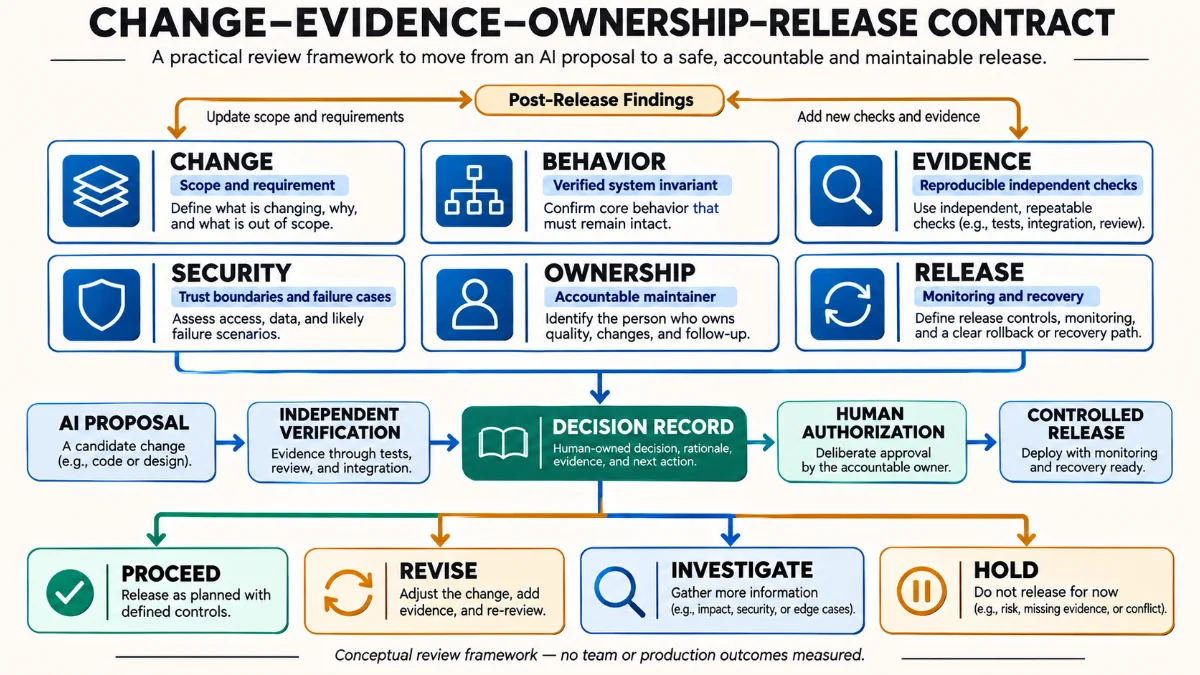
The decisive property is separation: an AI-generated explanation is not independent evidence, a green test is not automatically complete coverage, and approval of the code is not permission to bypass a controlled deployment. The contract is a proposed operating model, not a validated framework or a guarantee of compliance.
What a minimal contract looks like
In a small change, the record can fit inside a pull request description: intent, affected paths, two meaningful test commands, a negative test, an owner, and a rollback note. For a sensitive change, the same structure expands to include threat-model updates, cross-team review, migration safety, and approval by the people who own the affected boundary. The document should grow with impact, not with the marketing label of the tool that authored the patch.
Why this is not a universal approval formula
A security-sensitive defect can still be unacceptable when every table cell is filled out. A well-understood low-risk documentation correction may not need a formal meeting. Code review must preserve the right to stop, request evidence, and exercise engineering judgment. Structured records make disagreements explicit; they cannot replace the person who owns the consequences.
Tests Are Evidence Only When They Challenge the Change
AI tools can produce tests quickly, including tests that simply mirror the assumptions in the generated implementation. If a function and its tests share the same mistaken interpretation of a requirement, both may pass. The efficiency gain is real only if the new checks increase confidence in correct behavior rather than increase the count of green assertions.
Distinguish confirmation from falsification
I ask for at least one test that would fail if a key business rule were violated. For permissions, that often means trying the same action as an unauthorized actor. For persistence, it may mean interrupted writes or repeated requests. For parsers, malformed and boundary inputs matter. For concurrency, tests must examine interleavings rather than one convenient execution order. The important feature of these tests is the reason they exist, not which authoring tool wrote them.
Verify the test environment
A test run presented during code review can be misleading when the environment differs from production in data shape, configuration, dependency versions, or permission model. Code review should record what was run, on which revision, with which constraints, and what remains unverified. A reviewer does not need a giant screenshot collection; reproducible commands and clear failure conditions are usually more valuable.
Do not confuse coverage with assurance
Coverage is a useful signal of exercised code paths, not proof that assertions are correct or that critical boundary conditions were examined. For a sensitive integration, I would rather see a small set of behaviorally meaningful tests than an attractive coverage percentage attached to trivial assertions. The same caution applies to synthetic benchmarks generated alongside the code being assessed.
Security Review Must Follow Trust Boundaries
Security-sensitive AI-generated code deserves scrutiny for the same reason security-sensitive human code does: a plausible implementation can miss an authorization requirement, mishandle untrusted input, or leak data through an error path. The OWASP Secure Code Review Cheat Sheet provides detailed review considerations across input validation, session management, authorization, business logic, configuration, and deployment. I use those categories as a starting point, not as a substitute for a system-specific threat model.
The recurring boundary questions
Where is authorization enforced? Is validation performed on a trusted server boundary? Can an attacker select an object they do not own? Can a retry duplicate a financial or destructive side effect? Did the patch introduce a dependency with privileged installation behavior? Did it change a workflow that previously required explicit approval? These questions connect generated code to the system’s actual assets and authority model.
Automated scanners are complementary
In code review, static analysis, dependency scanning, secret detection, type checking, and policy tests can help a reviewer catch repeatable problems early. None can understand every product rule or business-context permission. The NIST Secure Software Development Framework describes secure development practices that extend across planning, implementation, and response. I would not interpret passing one scanner as certification that the entire development process satisfies those practices.
The Cognitive Cost of Plausible Code
During code review, an AI-generated implementation often reads smoothly. That fluency can be useful, but it can also tempt reviewers to replace verification with familiarity. Recognizable patterns, polished comments, and apparently complete tests make a patch easier to skim. They do not establish that the chosen abstraction respects the repository’s invariants.
Explainability is a property of the change
Before approving, I want an engineer to explain why the logic belongs in this module, what alternatives were rejected, how errors propagate, and what would break if the code were removed. A confident summary generated by the same system that wrote the code is useful for orientation, but not a substitute for the maintainer’s understanding. This is an ownership requirement, not a demand that every engineer memorize every line.
Review queues have capacity limits
A team can produce more patches without increasing the amount of informed attention available to review them. When review capacity becomes the bottleneck, bigger diffs and parallel agent tasks may create queue time, context switching, and delayed feedback. That is a plausible mechanism, not a measured universal law. It should be tested with local data such as review latency, revision cycles, and defects discovered after integration.
Ownership Cannot Be Delegated to a Model
Models can propose code, describe design options, and suggest recovery steps. They are not the accountable operator who will receive the production alert, decide whether customer data is at risk, or explain a regression to another engineer. I require a human owner for changes that reach shared systems. In a solo project, I am that owner; the absence of a second reviewer does not remove the need for a documented independent check.
What code ownership means in practice
Ownership includes knowing the requirement, being able to reproduce the tests, understanding the dependencies, and having access to the release and recovery paths. It also means recording unresolved assumptions for the next person. A patch that passes tests but cannot be understood by its responsible maintainer is not automatically ready. A small delay to clarify the system can prevent expensive future ambiguity.
Avoid performative human approval
In code review, a checkbox labeled “reviewed” provides little protection when the reviewer has not inspected the risky behavior. A better code review process gives the reviewer the right amount of context, a clear authority to reject or split the change, and enough time to verify material claims. In organizations, an independent reviewer should have the relevant expertise and decision authority; a nominal reviewer added to a ticket is not the same thing.
A Risk-Tier Rubric for Code Review
I use a risk-tier rubric to decide how much code review a change deserves. The rubric does not assign a synthetic safety score. Instead, it identifies conditions that change the required evidence and who may approve the work. Risk follows the system boundary affected, not the presence of the phrase “AI-generated” in a commit message. A generated wording correction and a human-authored permission bypass should not receive the same treatment.
| Review tier | Typical change | Minimum verification | Approval posture |
|---|---|---|---|
| Routine | Documentation or isolated presentation text | Scope check, preview, relevant checks | Standard code review |
| Behavioral | Validation, state change, data transformation | Acceptance tests, edge cases, regression review | Owner confirms contract |
| Boundary-sensitive | Authentication, authorization, migrations, external writes | Threat analysis, negative tests, recovery plan | Specialist or independent approval where available |
| System-wide | Shared architecture, deployment pipeline, broad dependency change | Impact map, staged release, incident response path | Design and operational review |
This is a proposed code review policy, not a claim that every organization uses four tiers. A change can move between tiers as new information appears. A routine UI adjustment that exposes a private endpoint is no longer routine. Likewise, an apparently broad patch may be reduced to a small, auditable set of isolated changes before review begins.
The stop conditions are as important as the approval conditions
I would stop a code review when requirements are unknown, a destructive operation lacks a recovery path, a sensitive permission rule is not enforced at the correct boundary, or the patch cannot be connected to a responsible owner. These are not matters of personal code style. A reviewer can request more evidence without claiming the generated code is definitely defective. That distinction keeps the process fair and technically defensible.
Keep the rubric adaptable
For a mature system, a trusted component may have stronger automated guarantees than an untested new integration. The review path can then be simpler for changes covered by reliable contracts. The point is to spend attention where failure matters. Good code review architecture reduces redundant checking while preserving scrutiny of consequential changes.
What a Useful Review Record Contains
A reviewer should not have to reconstruct the author’s intent from hundreds of generated lines. I prefer a structured pull request description with a claim, scope, evidence, unverified assumptions, ownership, and release plan. This supports code review in any conventional repository system; it does not depend on a particular editor, agent, or vendor.
CHANGE: Add idempotent handling for repeated write requests
WHY: Prevent duplicate effects after client retries
SCOPE: API handler, persistence constraint, tests
EVIDENCE: Unit tests, integration replay test, migration check
NOT VERIFIED: Production load and cross-region failover
OWNER: Named engineer responsible for this subsystem
RELEASE: Staged enablement with monitored duplicate-event rate
ROLLBACK: Disable feature path; preserve committed records
DECISION: Hold until migration recovery is demonstrated
This is a hypothetical illustration, not a real pull request, test result, or operational claim. Its value is in the shape of the evidence. A model can draft the description, but a reviewer must verify the statements. Code review fails when generated evidence summaries become an unchecked echo of the implementation they are supposed to evaluate.
Require an explicit uncertainty field
One underrated improvement is allowing “not verified” to be a valid answer. A code review process that punishes visible uncertainty incentivizes confident-sounding claims and incomplete review notes. The right question is whether the remaining uncertainty is acceptable for the change’s risk tier. Sometimes it is; sometimes the release must wait. The uncertainty belongs in the decision record either way.
Can AI Review AI-Generated Code?
Yes, AI tools can help summarize a patch, identify suspicious patterns, suggest tests, compare an implementation with a stated requirement, and flag unfamiliar dependencies. This may make code review more efficient. But two model outputs agreeing does not create independent proof. They may rely on similar assumptions, share training-pattern blind spots, or accept an incorrect specification.
Separate automated findings from verified conclusions
I label the source of each finding: static tool, runtime test, human review, or AI suggestion. During code review, an AI-generated risk comment is a lead to investigate, not an established vulnerability. A model saying a function “is secure” is not equivalent to a negative authorization test. An independent reviewer may use AI assistance while retaining responsibility for judging the evidence. The key requirement is traceability, not artificially banning all automated review.
Avoid review recursion
A model may propose a fix to a model-reported issue, then explain that its own fix resolves the problem. Without a finite acceptance condition, this can produce a chain of plausible revisions with no additional confidence. I would define specific testable claims and stop when they are satisfied or when the case requires a human design decision. Code review should converge on evidence rather than endlessly regenerate prose.
A Solo Developer Still Needs an Independent Verification Boundary
A one-person project cannot always obtain a second human reviewer. Pretending otherwise makes a review process unusable for independent professionals. I separate authoring and verification into distinct passes, even when I perform both. The first pass proposes a change; the second pass begins from the requirement and observable behavior, not from the generated explanation. This is a practical code review boundary, though it is not equivalent to independent peer review.
My preferred solo sequence
Before using a code assistant in my code review workflow, I write the acceptance condition and identify the boundary likely to fail. I let the assistant work on a narrow change. Then I close or set aside the authoring discussion, inspect the diff independently, run the existing tests, add a negative test, and check that the patch has not expanded the intended scope. Finally I write down what remains unverified and whether a staged release is justified.
For sensitive changes, I also compare the actual files against the original requirements, not against a generated summary. That reduces the chance that code review becomes a confirmation exercise. I do not claim these steps have produced a measured speedup in my own work. They are a proposed safeguard consistent with the responsibility I retain as a solo maintainer.
Tool independence matters
A second model can offer a useful independent hypothesis, particularly when it does not inherit the same conversational assumptions. But different model branding does not prove independent reasoning or correct results. I give the verifier a concise requirement and the actual diff, ask for falsifiable concerns, and insist on reproducing material findings. Code review should be possible with conventional tools even if the preferred AI provider becomes unavailable tomorrow.
Measure the Full Cost, Not Only the Drafting Interval
If I were evaluating AI assistance for a team, I would define a fixed observation window and compare like-for-like classes of work. The measurement should include authoring time, reviewer active time, waiting time, revision cycles, test and integration effort, deployment recovery, and subsequent defects. Code review effort is a component of the denominator, but a larger denominator is not inherently bad if it buys a safer and more valuable outcome.
| Measure | Useful interpretation | Common limitation |
|---|---|---|
| Time to verified completion | End-to-end work per accepted task | Task complexity differs |
| Active code review time | Human inspection and investigation burden | Timer and self-report bias |
| Review cycles | Rework and clarification frequency | More comments can mean better diligence |
| Defects after merge | Escaped quality problems | Lag and detection differences |
| Recovery time | Ability to limit operational loss | Incidents are infrequent and heterogeneous |
| Maintainer understanding | Knowledge needed for future work | Difficult to measure reproducibly |
I would segment these measures by risk tier, task class, repository maturity, and developer familiarity. A small UI correction should not be mixed with a multi-service security change. Nor would I interpret the absence of a production incident in a short trial as proof that a review strategy is safe. Code review quality and long-term ownership often require longer observation periods than a tool adoption experiment can afford.
Pre-register success criteria
Before comparing AI-assisted and conventional work, define what counts as successful: passing a specified set of behavior tests, maintaining required security controls, completing the change within an agreed scope, and retaining an accountable owner. Code review time alone can be gamed by approving quickly. Accepted-change time can also be gamed by choosing trivial work. Predefined criteria reduce the temptation to change the definition of success after the results arrive.
Watch for hidden selection effects
Developers may choose AI for tasks they already understand, avoid it for sensitive systems, or run several agents in parallel. A code review comparison that ignores those choices can attribute task selection to tool capability. METR’s 2026 research-design update offers a concrete illustration of why participant selection and measurement design matter. I would report uncertainty rather than convert a biased sample into a precise productivity claim.
Scenario One: A Plausible Authorization Patch
Consider a hypothetical generated patch that adds a role check to an API handler. The visible conditional appears correct. Existing happy-path tests pass. But a second endpoint reuses the same underlying service without the handler check. The generated code did not cause the original architectural inconsistency; it simply failed to detect the broader contract. A superficial code review would approve the visible diff and miss the bypass.
A stronger code review begins with the invariant: unauthorized actors must never invoke the protected action, regardless of entry point. The reviewer traces the trust boundary, adds negative tests through both endpoints, and considers moving enforcement into the shared service. The implementation may become smaller, not larger. This example illustrates the difference between verifying a patch and verifying a system behavior. It is not a report of a real defect found in a client system.
The appropriate resolution could be REVISION of the code, INVESTIGATION of the architecture, or a HOLD on release. It is not automatically rejection because AI was involved. Good code review asks whether the intended property can be supported with evidence, and whether the new design will remain understandable to its owner.
Scenario Two: A Safe, Boring Improvement
Now consider a hypothetical change that renames an internal variable and clarifies an explanatory comment without modifying behavior. The affected file is isolated, the diff is narrow, and the existing checks pass. A lengthy code review meeting would be difficult to justify. The fact that an assistant drafted the update should not trigger the same process as a database migration or a permissions change.
This counterexample matters because overcorrecting for AI risks can impose costs of its own. A code review system that treats every generated edit as dangerous may discourage useful automation and push developers toward less transparent workarounds. The right standard is risk and evidence proportionality, with higher scrutiny when the actual behavior or authority boundary changes.
Maintenance Cost Is More Than Future Debugging
Long-term maintenance includes reading unfamiliar code, upgrading dependencies, migrating data, changing an API contract, responding to incidents, and teaching a new maintainer the intent behind an abstraction. Some of these costs are unavoidable. Some are reduced by clearer naming, smaller modules, explicit interfaces, and high-quality tests. Code review should preserve these properties regardless of how the first draft was created.
The 2026 controlled maintainability study is useful precisely because it challenges a simplistic narrative: it did not observe a systematic downstream disadvantage for the tested AI-assisted solutions. I would therefore measure maintenance burden instead of assuming it. At the same time, one study’s task design cannot rule out problems in years-long, multi-team systems, regulated integrations, or rapidly changing dependencies.
The documentation test
Ask whether a future developer can explain the important invariant from a concise comment, a test, or an architectural note. If the only explanation is buried in a private conversation with a code assistant, knowledge has not entered the repository. That is a maintainability problem. Code review is a natural moment to move essential reasoning into durable artifacts without preserving unnecessary generated commentary.
When AI Assistance Is Worth Keeping
I favor AI assistance when it makes a narrow change easier to understand and verify, reduces repetitive implementation effort, helps generate useful counterexamples, or surfaces alternatives a developer can independently assess. I would not reject a tool because one study reported a slowdown, nor adopt it universally because another reported faster task completion. The correct decision depends on the team, task, and system.
Look for a repeatable engineering benefit
A useful local experiment might compare a small set of similar bug fixes under stable acceptance criteria. Track the time from problem statement to verified resolution, including code review and recovery preparation. Review representative failures instead of hiding them as outliers. If AI-assisted work improves the outcome without increasing unacceptable uncertainty, keep it. If it expands diffs, confuses ownership, or makes reviews harder to reproduce, change the workflow or restrict its role.
Treat the model as a collaborator, not an authority
A tool can suggest; requirements, verified evidence, and accountable maintainers decide. This distinction is important in both software engineering and AI product governance. A robust code review process preserves human authority without denying the practical value of automated assistance. It also allows the team to revise its controls as tools, tasks, and measurements change.
Evidence, Methodology, and Limitations
This article is a research-informed engineering argument and a proposed workflow design. I compared controlled-task studies, organizational surveys, repository research, professional review guidelines, and secure development practices. I did not run a new randomized developer productivity experiment, inspect a proprietary client repository for this article, or measure an intervention on real production incidents. No hypothetical scenario above should be read as a documented customer outcome.
Research results are deliberately separated by evidence type. Experimental findings support specific task-level comparisons; survey findings describe reported experiences and associations; repository studies observe behavior in selected datasets; qualitative reports identify concerns and patterns. None, alone, establishes universal code review costs. The contract and risk-tier rubric are original decision aids offered for critical adaptation, not empirically validated standards.
For methodological context, the source base includes the 2023 Copilot controlled study, METR’s 2026 update, the 2025 DORA report, two 2026 maintainability and pull-request integration studies, Google’s code review standard, OWASP review guidance, and NIST SSDF. These sources should be read for their specific methods and limits rather than treated as interchangeable benchmarks.
Key Terms for Engineering Decisions
AI-generated code is code initially proposed or substantially transformed with an AI system. The term says nothing by itself about correctness. Pull request review is the process of examining proposed changes in context before integration. Review burden refers to time and attention needed to verify and reconcile a change, not merely the number of reviewer comments.
Developer productivity is meaningful only when the unit of work and quality threshold are clear. Test evidence is a reproducible observation supporting a specific behavior claim. Code ownership is the accountable ability to maintain and respond to the change. Security review examines trust boundaries and threat-relevant behavior. Regression testing checks that existing required behavior remains intact. Engineering judgment resolves context-specific trade-offs that automated checks cannot fully encode. Release readiness includes recovery and operational observability, not just a green build.
Practical Questions Before Approving a Change
Is an AI-generated pull request inherently less trustworthy?
Not solely because of its origin. I assess its scope, behavior, independent evidence, and owner. There are reasons to increase scrutiny when the reviewer lacks context or the patch touches sensitive boundaries, but those reasons apply to human-authored changes too. The best code review policy makes uncertainty visible and evidence expectations proportionate.
Should I ask AI to review its own output?
It can be helpful as an early diagnostic pass. However, I would not use self-review as the only approval gate for consequential changes. Distinguish model suggestions from test results and independent human reasoning. Require reproducible checks where the potential effect justifies them.
How do I avoid slowing every release?
Use narrow diffs, a documented behavior claim, automated baseline checks, and explicit risk tiers. Escalate the changes that cross trust or operational boundaries. Routine changes can move quickly when evidence is clear. Code review efficiency comes from removing unnecessary ambiguity, not from skipping the hard questions.
What if I am the only engineer?
Separate implementation and verification sessions, start with the requirement, inspect the actual diff, run meaningful negative tests, and record the release decision. A solo code review is not independent peer review, but it can still be disciplined, testable, and auditable. Request specialist review for security-critical changes when you lack the needed competence.
Decision Brief: Verify the Outcome, Not the Authorship
My recommendation is to evaluate AI coding tools by their contribution to successful, safe, maintainable changes rather than by the volume of code they produce. Use code review to protect system invariants, preserve accountability, and expose uncertainty. Make the review depth depend on risk, not on ideology for or against AI. Where evidence is weak, investigate; where the design is wrong, revise; where trust boundaries cannot be protected, stop.
A team that drafts faster but cannot understand, test, or recover its changes has not solved the core engineering problem. A team that automates routine work while improving verifiable outcomes may have. The difference is revealed in code review and in the system’s behavior after merge. That is the cost I would measure, and the responsibility I would refuse to outsource.