


GA4 Measurement Plan: Decisions Before Dashboards

Business Model vs UX: When Revenue Incentives Harm Trust

Decision Brief: Which Independence Are We Buying?
Choosing between a modular monolith and microservices is not a contest between old and new software. It is a decision about where a growing product needs independence, which dependencies it can tolerate, and who will operate the resulting system. An application can have strong internal boundaries and one deployment unit. Another application can have dozens of services that still require one coordinated release. The labels reveal less than the actual dependency structure.
My position is that a modular monolith often provides a better starting point when the business domain is evolving, engineers work across closely related features, and the team cannot yet justify distributed deployment and data-management costs. Microservices become more attractive when independently owned capabilities have demonstrated release, scaling, security, or reliability needs that a shared runtime cannot satisfy economically. Neither architecture deserves a universal recommendation.
Decision: Select the least distributed design that meets independently verified product and operating requirements. Main risk: Treat a diagram of separate components as proof of genuine autonomy. Evidence: Domain ownership, change coupling, release coordination, runtime isolation, transaction requirements, and operating capability. Review trigger: An observed business capability repeatedly forces costly coordination or requires isolation that cannot be achieved inside the current deployment model.
This is an evidence-led architecture analysis with illustrative examples and a proposed decision framework. It is not a benchmark comparison, a production case study, or a claim that I measured the performance of particular deployments.
A Modular Monolith Is Not an Unstructured Monolith
A modular monolith is a single deployable application organized into explicit internal modules. Each module owns coherent business behavior, publishes a deliberately limited interface, and hides implementation details from other modules. The deployment unit is shared, but the design does not require every component to know about every other component. That distinction matters because a folder structure alone does not create boundaries.
Three Architectures That Are Often Confused
A poorly structured monolith permits uncontrolled cross-feature imports, shared mutable state, and implicit database access. A modular monolith applies interface and ownership rules inside one process, even if some infrastructure is shared. Microservices place selected capabilities behind separate runtime, network, deployment, and often data-ownership boundaries. The meaningful spectrum runs from coupling without discipline to deliberate modularity to independently operated services.
The Spring Modulith documentation provides one concrete example of enforcing internal application-module boundaries. It describes exposed module interfaces, private implementation elements, structural verification, module-level integration tests, and observable interaction. Those are useful design ideas outside the Java ecosystem, too; this article does not require that framework or claim every stack offers the same tooling.
Logical Boundaries and Runtime Boundaries Solve Different Problems
An in-process module call can be fast and operationally simple, but it does not provide process-level failure isolation. A remote service boundary can isolate processes and deployments, yet introduces network failure, retries, timeouts, version compatibility, and partial completion. A modular monolith can make a business capability independently understandable without making it independently deployable. Microservices exchange some local convenience for that potential deployment autonomy.
Neither option eliminates coupling. A remote service that changes its API whenever another team changes a feature is still coupled. A shared executable with stable module interfaces may allow substantial development autonomy while retaining coordinated releases. A responsible architecture review examines the cost of change rather than counting repository folders, APIs, containers, or network endpoints.
Start With Domain Boundaries, Not Deployment Units
The hardest part of both designs is deciding which behaviors belong together. A modular monolith requires clear responsibility for business rules, data mutation, and external contracts. Microservices require the same conceptual clarity and then impose distributed operations on top of it. Splitting a system before the domain becomes intelligible can convert uncertain boundaries into expensive network contracts.
Bounded Contexts Are Models, Not Automatic Services
Consider a hypothetical subscription product with Accounts, Billing, Entitlements, and Reporting. These names are plausible business areas, not a map of predetermined microservices. Billing may own invoice state, while Entitlements owns the rules determining which product capabilities a customer may use. Accounts may manage identities and workspace membership. Those are candidate domain boundaries whose quality must be tested against real workflows.
The Monolith First discussion by Martin Fowler notes that discovering stable bounded contexts is difficult early in a product’s life. A modular monolith allows teams to refactor those boundaries within one deployment while making domain knowledge more precise. But the same source cautions that arbitrarily tangled monoliths may not be easy to split later. Modularity has to be engineered, not assumed.
Define a Module Contract That Can Be Enforced
For each module I would record what it owns, which operations other modules may call, which events it emits, which state is private, and what must never be imported directly. A modular monolith benefits from automated checks that reject forbidden dependencies and from tests that verify behavior through its public interface. Documentation without enforcement slowly becomes a historical description rather than an architectural constraint.
A practical module contract includes ownership of read and write models, a published interface, a dependency direction, test obligations, and an explicit exception process. Shared technical utilities should remain narrow; turning a common package into a universal domain-data access layer quietly defeats ownership. If every feature can alter every table, a modular monolith has lost much of its promised advantage before deployment architecture even enters the discussion.
Data Ownership Must Be Stronger Than Namespace Ownership
One physical database does not require every module to have unrestricted access to every table. The Billing module should own invoice transitions, and other modules should request those transitions through a controlled contract rather than writing billing tables directly. A modular monolith can preserve local transactions where the business invariant demands them, while keeping cross-module read and mutation responsibilities explicit.
Microservices take this ownership challenge further. The database-per-service pattern describes private persistent data and the resulting difficulty of cross-service transactions and joins. It does not require a physically separate database server for every service. When comparing a modular monolith with distributed services, I would therefore distinguish logical data ownership, physical storage isolation, and transaction consistency instead of treating them as one decision.
The Five Forms of Independence
Teams often say they need microservices because they need independence. Independence is not a single property. A modular monolith may already satisfy several forms of independence while remaining one deployment. Before splitting, I would ask which form is missing and how much the missing property costs today.
1. Code and Domain Independence
Can a team change Billing without understanding the internal implementation of Reporting? Can it test the change through supported interfaces? Well-enforced internal module rules can offer meaningful code ownership even without separate services. If changes routinely break unrelated modules, investigate import violations and shared-state leakage before blaming the deployment model.
2. Team and Decision Independence
Can different teams make local decisions without daily approval from a central group? Microservices are often associated with autonomous teams, but smaller teams may not have separate owners for on-call, schema evolution, security patches, or incident response. A modular monolith can minimize coordination for a small organization by keeping infrastructure consistent and business responsibilities explicit. Team autonomy should be measured in actual waiting and review dependencies, not inferred from org charts.
3. Release Independence
One deployment means a modular monolith generally ships as one application artifact. This is a real constraint. However, feature flags, backward-compatible interfaces, small releases, and automated tests can prevent every change from becoming a cross-team ceremony. If independent releases are repeatedly needed for distinct business capabilities, service extraction may pay for itself. If most changes are already coordinated by shared business rules, remote deployment may merely relocate the coordination.
4. Scaling Independence
Microservices can allocate resources separately when an expensive search pipeline, rendering worker, or event consumer has a materially different workload. A modular monolith may instead scale the whole application or offload specific work to a queue, worker process, or managed service without decomposing the primary domain. The decision depends on observed utilization patterns, resource costs, and reliability requirements. A theoretical future traffic spike is weaker evidence than a repeatable bottleneck.
5. Failure and Security Independence
Separating services can establish process, infrastructure, credential, and network boundaries. These can be necessary for sensitive workloads or high-impact failure domains. A modular monolith shares a process failure domain unless additional process or infrastructure separation is introduced. Yet services can still fail together through a shared database, identity provider, message broker, or synchronous dependency chain. Isolation must be demonstrated in an incident scenario, not declared from topology alone.
Boundary–Independence–Cost Matrix
I use the following conceptual matrix to avoid a false binary. It compares a modular monolith with microservices across requirements that might justify separate deployment. The rows are questions for a particular organization to answer. They are not a weighted scoring model, validated benchmark, or universal industry threshold.
| Decision dimension | Modular monolith advantage | Microservices advantage | Evidence to collect |
|---|---|---|---|
| Domain boundaries | Lower-cost refactoring while concepts evolve | Strong runtime contract when boundaries are stable | Cross-module changes and ownership disputes |
| Team autonomy | Shared tooling and simpler coordination for few owners | Independent runtime ownership for mature teams | Review delays and deployment dependencies |
| Release cadence | One pipeline with predictable compatibility | Separate deployments for genuinely independent changes | Coordinated-release frequency and wait time |
| Failure isolation | Fewer remote failure modes to operate | Process and infrastructure boundaries where designed | Blast-radius analysis and dependency tests |
| Data consistency | Simpler local transaction options | Independent storage ownership where needed | Invariant and transaction-boundary inventory |
| Scaling | Simple operational profile for similar workloads | Targeted scaling for divergent resource profiles | Representative workload and capacity traces |
| Operating cost | Fewer moving parts and simpler incident response | Potential efficiency when independent scale dominates | Infrastructure, on-call, tracing and recovery effort |
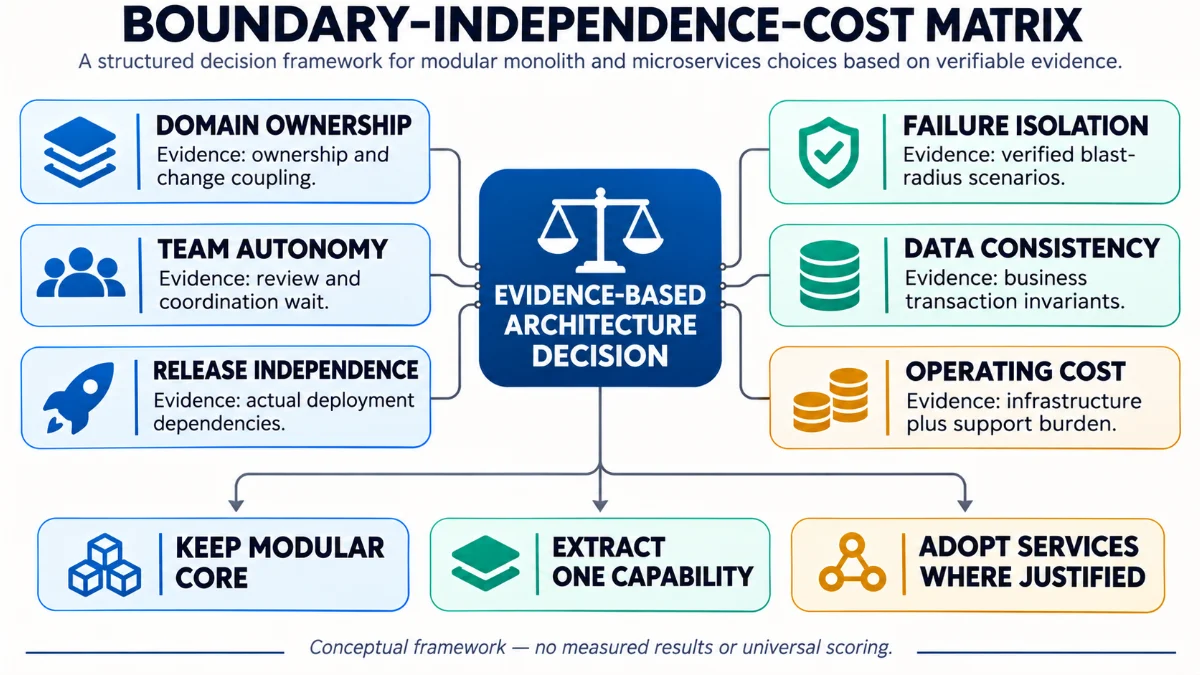
The matrix deliberately resists a single numerical answer. When reviewing a modular monolith, I would first identify the capability causing friction, then compare its cost of remaining in-process with the cost of distributing it. An architecture that wins six rows but fails a mandatory regulatory isolation requirement may still be the wrong choice. Conversely, one scaling advantage does not justify imposing remote-system overhead on every other capability.
The key question is whether a specific boundary earns its independence. If evidence supports one extraction, it does not follow that every internal module should become its own service. Hybrid systems are often reasonable outcomes of a measured decision.
Why Deployment Boundaries Can Increase Coordination
Microservices can reduce release coupling, but they can also create new forms of integration coupling. An operation that previously involved three in-process modules may become three network requests, two service versions, a queue, and an observability trace. A modular monolith avoids many of these runtime interactions by keeping calls local, though it still needs sound interfaces, testability, and disciplined releases.
Partial Failure Changes the Programming Model
A network call may time out even though the receiver completed an action. Retrying may duplicate a side effect unless the operation is designed for idempotency. A caller can be healthy while one of its dependencies is not. Microsoft’s microservices architecture guidance identifies service discovery, communication, consistency, testing, and transaction management as system-level challenges. These are design obligations, not reasons to reject services under every circumstance.
A modular monolith does not eliminate failures such as database outages or bad deployments. It does avoid turning every interaction between internal capabilities into a distributed request that requires timeout budgets, retry policy, and compatibility handling. That can be especially valuable when a workflow is tightly coordinated and the product is still discovering its business invariants.
Independent Deployment Requires Contract Compatibility
A team cannot deploy freely if another service must update immediately whenever its API changes. Successful service autonomy usually requires backward compatibility, contract testing, version handling, and explicit retirement policies. A modular monolith can often change a public module interface and its callers in one controlled release, provided the dependency rules are documented and the change is verified.
This convenience should not become an excuse for unrestricted cross-module refactoring. The shared application still needs interface stability because it is preserving future options. The difference is that the team can choose when to pay for asynchronous compatibility rather than paying that price on every internal boundary from the first iteration.
Transactions Expose Weak Service Boundaries
Consider the illustrative subscription product again. A customer changes a plan; Billing updates the invoice, Entitlements changes access, and Reporting records the outcome. If the business requires an immediate all-or-nothing invariant across these operations, a modular monolith with a suitable local transaction model may implement it more directly. That is a design possibility, not proof that all modules should share tables or that one database guarantees correctness.
A Saga Is a Business Protocol, Not a Free Replacement
When data ownership moves across services, multi-step workflows may use messaging, explicit states, and compensating actions. The Saga pattern describes coordinating local transactions and handling failures with compensating work. It does not magically turn several local transactions into one globally atomic operation, and compensation is not always equivalent to undoing what a user observed.
A microservice boundary makes sense when the organization can articulate acceptable intermediate states, ownership of retries, reconciliation rules, and what happens during partial completion. If those rules are unsettled, distributing the workflow can make the business problem harder to reason about. A modular monolith may allow the team to learn the actual invariant before choosing the appropriate distributed consistency model.
Eventual Consistency Has Product Consequences
From a customer’s perspective, a delayed entitlement update can look like a broken payment or inaccessible feature. Architects must work with product and UX teams to define whether a temporary pending state is acceptable, how status is communicated, and when support must intervene. The decision to use microservices is therefore partly a product decision. A modular monolith may offer simpler user-facing consistency for workflows whose intermediate states would be confusing or harmful.
Not every workflow needs synchronous consistency. Audit events, search indexing, notifications, and reporting often tolerate delay when the product explicitly defines that behavior. Both architectures can publish events and use background processing. Event-driven design is not exclusive to microservices; the meaningful distinction is who owns the state and which consistency guarantees the user actually needs.
Team Topology Is an Architectural Input
Assigning each microservice to an imaginary independent team does not create more engineers. A modular monolith can be advantageous for a small or medium team that already shares priorities, participates in the same releases, and maintains a single operational rotation. The same organization may outgrow that arrangement when distinct domains require independent schedules, support responsibility, and failure management.
Who Owns the Incident at 2 AM?
If a service fails, someone must understand the application, its dependencies, deployment history, dashboards, alerts, and recovery procedure. A modular monolith concentrates operations into a smaller runtime surface, but its owners still need useful logs, traces, error budgets, and rollback procedures. Microservices expand the number of separately deployable units, which often expands the number of things that can drift or fail.
Martin Fowler’s Microservice Premium articulates the cost of deployment automation, monitoring, failure handling, and eventual consistency. I would treat that premium as an operating budget with accountable owners rather than as a fashionable engineering investment. If a team cannot support several on-call boundaries, separating code might create vulnerability instead of resilience.
Platform Capability Changes the Answer
An organization with mature service templates, policy enforcement, centralized tracing, automated rollout, and capable domain teams pays a different marginal cost for an additional service than a team operating everything manually. A modular monolith can still be the better solution for tightly coupled business rules in that environment, while a service split may be justified sooner where tooling and ownership are already in place.
The relevant question is not team headcount alone. It is whether independent ownership is real, whether the platform lowers distributed complexity enough to matter, and whether the capability’s needs differ from the rest of the product. Team count is a clue. Verified coordination cost is stronger evidence.
Three Illustrative Scenarios With Different Answers
These scenarios are hypothetical. Their purpose is to expose different decision mechanisms, not to claim a measured success rate or describe an actual client environment. I would expect a modular monolith and microservices to produce different trade-offs under each set of constraints.
| Situation | Primary constraint | Reasonable starting decision | Revisit when |
|---|---|---|---|
| Early B2B workflow product | Few owners; product rules and permissions evolve together | Modular monolith with explicit domain contracts | One capability requires persistent release autonomy |
| Mature analytics ingestion pipeline | Large, bursty ingestion workload independent of core transactions | Evaluate extracting ingestion workers or services | Capacity and failure tests confirm a real isolation benefit |
| Regulated processing boundary | Separate credentials, isolation, and operational control required | Assess dedicated service or separately controlled runtime | Threat modeling and policy review define mandatory guarantees |
Scenario A: The Domain Is Still Moving
A new B2B platform changes billing rules, access levels, and onboarding flows every few weeks. One product team owns the whole workflow and cannot fund a full distributed operations platform. A modular monolith is a defensible starting architecture because the team can evolve internal boundaries, test end-to-end behavior coherently, and avoid externalizing unstable contracts too early. The critical obligation is to maintain module access rules instead of letting convenience generate hidden coupling.
Scenario B: One Workload Has a Distinct Operating Profile
Suppose an ingestion subsystem processes bursts of external data while core account workflows need predictable interactive latency. A modular monolith could initially isolate background processing and resource queues without separating domain ownership. If representative load tests show that ingestion repeatedly competes for process resources or requires a radically different scaling regime, extraction may be justified. The outcome is likely to be one carefully bounded service, not an instruction to distribute the whole application.
Scenario C: Isolation Is a Mandatory Requirement
Suppose a sensitive operation must run under a distinct security policy, network boundary, or privileged credential regime. A shared-runtime design might fail an applicable requirement even when its domain modules are clean. Separate services or isolated workers become stronger candidates, provided the design demonstrates the required boundary and does not simply move privileged operations into a service with broad access to everything else.
Notice that architecture selection changes with the required property. The modular monolith is not always better, and microservices are not necessarily overengineering. A good decision names the non-negotiable requirement, the evidence that it exists, and the least expensive mechanism that genuinely satisfies it.
An Architecture Decision Path That Can Reject Both Extremes
I prefer a decision path that starts with observed need rather than an architecture label. A single application with enforced internal boundaries is a useful default candidate for many growing products, but even that default should be tested against integration constraints, compliance needs, and operational realities. These are review gates, not automatic scoring rules.
- Name the capability: What business behavior would be independently owned? Avoid naming a service for a technical layer such as “Database Manager” without a coherent domain responsibility.
- Define the independence: Is the need separate deployment, data access, scaling, failure isolation, technology choice, or team accountability?
- Show the current pain: Provide release records, capacity traces, coupling analysis, incident patterns, or concrete policy requirements.
- Try the smallest internal correction: Would stricter module contracts, better deployment automation, queuing, caching, or a new worker resolve the problem inside a modular monolith?
- Price the distributed boundary: Include reliability engineering, observability, transaction workflows, migration, infrastructure, incident response, and cross-version testing.
- Define an extraction and rollback gate: Require measurable success criteria before moving production state and traffic to the new boundary.
The path intentionally allows a third result: keep the domain module internal but isolate one technical workload. A modular monolith can interact with a separate search index, job worker, or specialized data processor without converting every business capability into a microservice. Architectural options are not limited to one process or dozens of independent services.
Signals That Support an Extraction Decision
Evidence becomes more persuasive when different observations converge: a capability has stable ownership, its release waiting time is persistently significant, its load profile differs materially, and a separate runtime can reduce meaningful failure exposure. Keeping modules together may still be acceptable when only one signal appears. For instance, high CPU usage might be solved by better queries or asynchronous processing rather than a new team and deployment system.
Signals That Do Not Justify a Split Alone
A large codebase, an attractive Kubernetes diagram, a popular architecture conference talk, or the statement that “we may need to scale” is insufficient. Size can be a symptom of poor boundaries, but a modular monolith with clear contracts is not automatically worse than a fragmented architecture. If teams cannot state which independent action a new service enables, the extraction proposal remains a hypothesis rather than a conclusion.
What to Measure Before Choosing Microservices
Architecture debates become more useful when they distinguish leading indicators from business outcomes. A shared-deployment application can be evaluated with the same measurement discipline applied to microservices: change lead time, deployment frequency, change failure modes, recovery capability, latency, resource usage, and ownership clarity. I would not use generic industry averages as universal pass/fail thresholds; the baselines must reflect this product’s work and constraints.
Change-Coupling Inventory
Review a representative set of recent changes. Record which modules were touched, whether the same business requirement crossed multiple ownership boundaries, and whether changes were coupled because of a genuine shared invariant or an avoidable implementation leak. In a modular monolith, repeated multi-module changes can reveal a boundary problem, but they can also reflect normal end-to-end product work. Classify the reason before treating the count as proof.
Release and Recovery Evidence
Measure how often a team wants to ship one capability but must wait for unrelated work. Record validation effort, deployment reversibility, incident recovery steps, and the consequences of a rollback. A modular monolith may have one shared release artifact while still deploying frequently and safely. Conversely, a service architecture can require coordinated deploys if clients are version-coupled. Release independence should be established through the actual process.
Operational and Economic Evidence
Compare infrastructure usage, service and database costs, build and test time, monitoring burden, production support labor, and incident complexity. Include operational work done by humans rather than pricing only cloud instances. A modular monolith may incur inefficient shared scaling for one expensive subsystem, yet a distributed design can consume additional resources merely to support the communication and reliability machinery. The relevant comparison is total cost of satisfying a required outcome.
| Question | Possible observation | Interpretation limit |
|---|---|---|
| Are boundaries coherent? | Dependency graph, changes spanning modules, rejected forbidden imports | Cross-module change is not automatically a defect |
| Is deployment autonomy missing? | Waiting time, release coordination, rollback coupling | Low delivery speed may be a testing problem |
| Is failure isolation inadequate? | Fault-injection plan, dependency maps, incident review | Process separation does not remove shared dependencies |
| Is independent scaling justified? | Representative resource and throughput traces | One synthetic peak does not prove recurring demand |
| Can the organization operate services? | On-call ownership, deployment maturity, trace coverage | Tools installed do not prove operational readiness |
None of these measurements has been run for this publication. The plan is a reproducible approach a real team could apply to its own modular monolith or service architecture before investing in migration.
How to Extract One Service Without Rewriting Everything
If the evidence favors extraction, I would keep the rest of the modular monolith intact initially. A single well-chosen extraction creates a testable migration whose operational benefit can be evaluated. Rewriting every boundary at once makes it difficult to distinguish architecture improvements from the cost and risk of the rewrite itself.
Step 1: Stabilize the Candidate Module Contract
Document its owned data, public commands, queries, emitted events, critical invariants, access controls, and dependencies. A modular monolith that already enforces these rules gives engineers a useful starting interface. Where internal callers bypass the candidate’s interface, repair that first. Otherwise the service extraction will inherit hidden coupling as shared database reads, backdoor APIs, or emergency synchronization calls.
Step 2: Establish a Baseline and Failure Policy
Before moving traffic, capture latency distributions, error rates, relevant business outcomes, and the complete workflow trace. Specify acceptable timeouts, retry limits, idempotency behavior, recovery ownership, and cancellation rules. A modular monolith can provide simpler local function semantics; converting them to network calls without a failure policy is a functional change even when the API names remain identical.
Step 3: Establish State Ownership Before Moving State
Choose a controlled migration plan for writes and reads. The candidate service must eventually become the authoritative writer for its owned records. The original application and a new service writing the same data independently can create a dangerous dual-authority period. If dual writes are temporarily unavoidable, define reconciliation, idempotency, and cutover responsibilities explicitly. Do not assume that moving tables proves the business invariant has survived.
Step 4: Migrate Behind a Controllable Boundary
Use an adapter, route switch, or incremental strangler-style migration where the application and infrastructure permit it. Martin Fowler’s Strangler Fig discussion describes the gradual replacement idea rather than demanding a whole-system rewrite. For a modular monolith, a narrow routing boundary can let the team compare real behavior and revert safely if a new service fails its acceptance criteria.
Step 5: Prove the Benefit, Not Only Technical Survival
After extraction, ask whether the team actually gained release autonomy, fault isolation, scaling efficiency, or required security separation. If the new service still deploys in lockstep with the original application and requires a shared-schema migration for every feature, it may be a distributed monolith in practice. The original application may have been the simpler architecture until those coupling sources were resolved.
A successful extraction produces evidence that the organization can maintain the new contract over time. A microservice is not an architectural improvement merely because it boots separately. I would keep the migration reversible until both business behavior and operational outcomes have been validated in the intended environment.
Rules I Would Require Inside a Modular Monolith
The strongest objection to a modular monolith is that its boundaries may erode under delivery pressure. That objection is serious. A shared deployment can make direct internal calls and database shortcuts deceptively easy. The architecture earns its name only when boundaries can survive routine maintenance, new features, and staff changes.
Keep Imports and Database Writes Honest
I would require explicit allowed-dependency rules, tests that detect cyclic dependencies, module-level public APIs, and a single business owner for each important write model. A modular monolith should allow fast local collaboration without granting unrestricted access to private implementation details. When an exception is necessary, document why it exists and when it will be removed.
Test Modules and Whole Product Behavior
Module tests should verify contracts without reaching into another module’s internals. Integration tests should validate meaningful workflows and transaction boundaries. Architecture tests should detect dependencies that violate the intended design. The Spring Modulith integration-testing guidance offers a concrete example of module-focused tests within a larger application. Other stacks can adopt the principle through their own test and static-analysis tools.
Preserve Authorization at the Real Operation Boundary
A shared-runtime application is not exempt from security checks because its modules run in one process. Authorization must protect the operation and resource, not merely a navigation item or package reference. In my related authorization architecture analysis, I distinguish policy decisions from enforcement paths. The same concern applies when a module becomes a service: its effective authorization contract should not weaken at the new API boundary.
Make Reversibility Part of the Architecture Decision Record
Record why the modular monolith is suitable now, which options were rejected, which capabilities might require extraction, and what measurable triggers reopen the choice. An ADR should state the operating assumptions and the most important risk: for example, that Billing and Entitlements are too closely coupled today for separate transaction ownership. This gives future engineers a decision they can evaluate rather than an unexplained architectural preference.
Four Architectural Shortcuts That Fail Under Growth
Turning Every Module Into a Service by Default
This creates network boundaries before ownership, failure policies, and contracts have stabilized. A modular monolith is not inherently a temporary phase that must eventually disappear. Some systems can retain a substantial modular core indefinitely while extracting only a few capabilities that need independent operation.
Calling Shared Tables Independent Data Ownership
Services that directly update each other’s tables often preserve the tight coupling of the original codebase while adding distributed deployment. A modular monolith may make this coupling easier to see and fix because all callers are in one repository, but engineers still need access rules. Service topology does not repair a weak data model.
Assuming a Shared Deployment Prevents Frequent Releases
A shared artifact can still be built, tested, and deployed quickly when the pipeline and module boundaries are healthy. A modular monolith may be limited by one rollback scope, but that is different from assuming it cannot support continuous delivery. Diagnose why releases are slow before using microservices as a universal cure.
Claiming Process Isolation Guarantees Resilience
Independent services may share downstream failures, cascading timeouts, data dependencies, or central infrastructure. A modular monolith has a clearer shared process risk but often fewer interservice failure paths. Resilience depends on actual dependency isolation and tested recovery behavior. Count the failure modes the product can survive rather than the number of services it contains.
Evidence and Methodology
This article draws on architecture guidance from Microsoft, Spring Modulith, Martin Fowler, and microservices.io, then synthesizes the findings into an explicit decision matrix and migration path. Those sources describe design principles, patterns, and their trade-offs; they do not validate the Boundary–Independence–Cost Matrix as an empirical scoring instrument. The matrix and three scenarios are my conceptual analysis, not research results from a controlled experiment.
The exact costs of a modular monolith or microservices depend on workload, domain volatility, operating platform, service boundaries, team ownership, deployment engineering, and reliability expectations. I have not claimed measured savings, incident rates, or migration outcomes from any named product. A real architectural decision would require its own system inventory, telemetry, compliance requirements, and failure tests.
The main limitation is organizational variation. An engineering organization with platform tooling and domain-owned on-call responsibilities can operate services differently from a small group sharing one pipeline. A shared application can also become unmaintainable if its boundaries are not enforced. Both problems deserve explicit investigation, not assumptions derived from the architecture’s name.
Frequently Asked Questions
Can a Modular Monolith Scale?
Yes. A single-deployment application can use horizontal scaling, caching, background workers, and database optimization where appropriate. Its main limitation is that independently scaling an internal capability may be less direct than scaling a dedicated service. Measure the workload before concluding that service separation is required.
Does a Modular Monolith Require Every Team to Coordinate Every Release?
No, but the application commonly has one deployable artifact. A modular monolith can support frequent automated deployments and localized feature changes. Whether this creates unacceptable coordination depends on actual release ownership, dependency discipline, and rollback requirements.
Does a Modular Monolith Have to Use One Database?
No. The modular monolith definition concerns application modularity and deployment, not a mandatory database count. Even with one physical database, modules should preserve data ownership. The important question is which component owns each state transition and which invariants require coordinated transactions.
Are Microservices Always More Secure?
No. Separate runtimes may support stronger isolation and credential boundaries, but they also create more communication surfaces and distributed trust relationships. A modular monolith must protect its internal operations and data ownership, while any extracted service must enforce equivalent or stronger controls. Threat modeling determines which boundaries are meaningful.
When Should I Extract a Service?
Consider extraction when a domain capability has stable ownership and a recurring, measurable requirement for separate releases, fault isolation, security control, or resource scaling. The existing architecture should first be assessed for lower-cost remedies. If extraction is justified, migrate one boundary with observable success criteria and a recovery route.
What Is a Distributed Monolith?
It is an informal description of a system whose components run as separately deployed services but remain tightly coupled in changes, availability, data ownership, or releases. A modular monolith may offer more useful internal independence than such a system. The assessment should focus on effective coupling, not the name of the architectural pattern.
Conclusion: Earn the Distributed Boundary
A modular monolith deserves serious consideration when a product needs disciplined domain design but not yet the cost of independently operating many services. It keeps internal responsibilities visible and can make change easier while business boundaries mature. Microservices become valuable when a real capability requires separate deployment, scaling, isolation, or operating ownership and the organization can sustain the resulting contracts.
My rule is to require every new distributed boundary to explain what independence it purchases, how that benefit will be verified, and which new failure modes it introduces. A modular monolith that enforces its contracts is a deliberate architecture, not a failure to modernize. The right destination may be one application, a handful of services, or a hybrid. The evidence should decide.
For further context, explore the Software Development Articles collection and the broader Software Development & Systems practice.
Author’s Note and Further Reading
I approach architecture decisions by making trade-offs and review triggers explicit. This article is written for software architects, engineering leaders, and technical founders deciding how to preserve changeability without committing prematurely to distributed operations. The decision framework is a proposal for review, not a substitute for production measurements and independent engineering validation.
Professional profiles: LinkedIn, X, Threads, GitHub, and Behance.