


AI Agents Need Bounded Authority, Not More Autonomy

A product team can conduct careful user research, observe a consequential failure, and still release the design that caused it. The result is not always a dispute about evidence. It may be a dispute about authority: who can change a roadmap, who carries commercial risk, which observations count as legitimate, and whose explanation becomes the official decision. When stakeholder certainty wins without an explicit review of those questions, research becomes a presentation rather than an input to product strategy.
I do not believe every disagreement with user research is proof that a stakeholder ignores users. Researchers can select the wrong participants, overstate a finding, test an artificial task, or present a persuasive anecdote without sufficient scope. A commercial leader may also know about contractual obligations or operational constraints that a study never investigated. The problem is not disagreement itself. The problem is making an irreversible decision without distinguishing a genuine evidence limitation from a preference protected by organizational authority.
This article proposes an Evidence–Authority–Decision Contract: a transparent way to connect user research claims, their boundaries, competing explanations, decision rights, a chosen action, and conditions for review. It is my conceptual synthesis of established research and governance practices, not a validated organizational framework or a report of experiments with real clients.
Decision Brief: Research Cannot Override a Decision System by Existing
The decision: When research conflicts with a committed product direction, should the team continue, revise, investigate, or explicitly accept the risk? I would not give the researcher an automatic veto. I would require the person with decision authority to address the evidence, the alternative explanation, and the cost of being wrong before the team commits.
The principle: User research has a right to be represented accurately, not a right to be declared infallible. Stakeholder judgment has a legitimate role, not immunity from scrutiny. The same standard should apply when a finding supports leadership’s preferred plan and when it contradicts that plan.
The operating rule: Every significant override should identify the decision owner, evidence scope, reason for disagreement, residual risk, next observation, and a trigger that could change the decision. The goal is not a larger research report. It is an inspectable route from evidence to consequence.
Why Stakeholder Certainty Can Defeat Strong Evidence
Incentives Can Make a Finding Expensive to Accept
Imagine that a team has promised a new enterprise onboarding flow for the coming quarter. User research suggests that first-time administrators misunderstand a permission step and cannot complete it independently. A launch owner sees the risk of postponing a contracted milestone; a researcher sees the risk of releasing a confusing access decision. Those perspectives concern different potential losses. If the meeting treats both as mere opinions, the person responsible for the date will often have more authority than the person responsible for the evidence.
The answer is not to portray commercial pressure as unethical by definition. A launch may have legitimate commitments, and delay may also harm customers. I would ask leaders to make that trade-off explicit: which users will encounter the failure, how serious is the consequence, what temporary safeguard is possible, and who will monitor the outcome? User research becomes useful when its findings can change a decision’s conditions, even when they cannot erase external constraints.
The Roadmap Can Become a Commitment Before the Question Is Asked
User research frequently arrives after a solution has acquired a name, a budget, a sponsor, and a launch date. At that point, the organization is not only evaluating a design. It is deciding whether to reverse an earlier promise. Confirmation bias can therefore appear as a request for additional evidence while the original feature decision received little scrutiny. The asymmetry creates a stakeholder alignment problem: user research must sometimes prove a negative against a plan that was approved without equivalent proof.
I would record the evidence standard before a high-impact design choice becomes difficult to reverse. A team can agree which task failures would stop launch, which uncertainties justify a pilot, and which commercial constraints are non-negotiable. That does not remove politics. It gives political trade-offs an observable form and makes selective skepticism easier to identify.
Research Language Can Fail to Meet Decision Language
A finding that ‘participants struggled with the flow’ is too vague to challenge a signed release plan. Which participants? What task? What was the observed failure? Did they need a hint, choose the wrong option, or abandon a necessary action? What would that mistake mean in production? A credible user research synthesis should make each of those boundaries explicit before recommending a design change.
The GOV.UK guidance on sharing research findings recommends explaining observations, their significance, and their implications so teams can use the work in decisions. I would take that one step further for contested decisions: attach an explicit decision request and the evidence required to reconsider it. User research should not depend on a stakeholder inferring the recommended action from a collection of slides.
Separate Evidence, Interpretation, Preference, and Constraint
These four categories are often blended in stakeholder meetings. Evidence describes an observation under identifiable conditions. Interpretation explains what the observation may mean. Preference expresses a desired outcome. Constraint specifies something the team must respect, such as a contractual obligation, technical limit, law, or available capacity. All four can be relevant, but they cannot be used interchangeably.
For example, a participant selecting the wrong permission in a moderated task is evidence about that task. ‘The terminology is confusing’ is an interpretation. ‘Keep the current layout’ is a preference. ‘We must support the existing integration contract this quarter’ is a constraint. User research can justify further testing or redesign without proving that the terminology caused every mistake; equally, a deadline does not transform the observed wrong selection into a non-event.
| Statement in a decision meeting | What it actually is | Useful next question | Typical failure if confused |
|---|---|---|---|
| Four recruited participants selected an unintended access role | Bounded observation | Who were they and what was the task definition? | Claiming a population-wide error rate |
| The role label probably caused the error | Explanation to test | What competing explanation could produce the same behavior? | Treating a hypothesis as a confirmed mechanism |
| We need the release this quarter | Business constraint or commitment | What must ship, and what can be gated or revised? | Calling schedule pressure evidence of usability |
| I prefer the simpler screen | Preference | Which user or business outcome should the design improve? | Overriding task evidence with aesthetic confidence |
| The sample cannot estimate market-wide frequency | Valid methodological limit | Does this decision need prevalence or a failure mechanism? | Dismissing qualitative findings that answer a different question |
When user research is summarized in this way, a team can disagree productively. The objective is not to remove executive judgment. It is to prevent judgment from appearing as if it were itself a measurement.
Legitimate Challenges to User Research Deserve Real Answers
Sampling Limits Are Not a Universal Rejection
A stakeholder who asks whether the sample includes the relevant user roles and whether recruitment introduces sampling bias may be identifying a genuine problem. If the study examined novice operators while the decision concerns expert administrators, the inference may not transfer. Conversely, the fact that a qualitative study used a small number of participants is not grounds to ignore directly observed usability defects. A small study can expose a mechanism while being unsuitable for estimating how often it occurs across the full population.
The Nielsen Norman Group discussion of quantitative sample sizes distinguishes studies seeking statistical estimates from qualitative investigations. I would ask which claim the decision actually needs. For a dangerous permission-selection error, qualitative research can reveal a failure mechanism; the existence and consequence of a reproducible failure may matter before an exact prevalence estimate. For a costly global redesign, estimating frequency across segments could be decisive.
A User Research Finding Must Be About the Decision at Hand
Stakeholder objections can also be valid when the tested prototype lacks real data, the workflow has changed since the sessions, or the participants received instructions that ordinary users would not see. Those weaknesses should be documented rather than concealed. User research cannot establish the effects of a release that was never tested, just as a funnel dashboard cannot explain what uninstrumented users understood.
The appropriate response is a discriminating check, not endless retesting. This is a question of research synthesis and decision relevance, not merely another round of data collection. If critics claim that experienced users will succeed, recruit that segment or examine their task behavior. If they claim a revised label solves the issue, test comprehension with a realistic scenario. If they claim support will absorb errors, estimate and monitor the support pathway instead of assuming it. The best challenge makes a falsifiable alternative possible.
User Research Can Be Correct and Still Insufficient
Some user research supports a strong observation but not a clear recommendation. Participants may consistently misunderstand a concept, yet two redesigns might resolve it differently, with different engineering and policy consequences. The user research lead should separate the problem from a favored solution. I would protect the validity of the observation while allowing product and engineering leaders to compare viable remedies.
When Skepticism Is Selective, the Decision Process Is the Problem
One warning sign is a double standard: user research that supports the preferred roadmap is treated as decisive, while evidence that challenges it is dismissed for having too few participants. Another is repeated demand for new research without specifying the missing information or what outcome would change the decision. A third is preserving a design after a serious observed failure by relabeling the finding as ‘subjective’ even when the task outcome was directly observed.
I would not diagnose motives from a meeting transcript alone. The practical test is procedural. Ask each side to state the claim, the evidence standard, the decision consequence, and an outcome that would alter its position. If no possible evidence would change a stakeholder’s choice, the disagreement is not currently empirical. It is about authority or a non-negotiable preference, and the decision record should say so.
Involve Stakeholders Before the Results Become Uncomfortable
Agree on the Research Question and Consequences
User research is easier to dismiss when decision-makers never helped define what should be learned. I would involve the people responsible for scope, delivery, compliance, and support before participant recruitment. Their job is not to script the expected answer. It is to clarify the user groups, task, failure consequences, business constraints, and types of evidence needed to act.
The GOV.UK research planning guide recommends collaborating on research questions and assumptions, then feeding findings into the team’s routine planning practices. In my view, the missing step is to make the decision threshold explicit. If independent task completion matters, define it before launch pressure appears. If a label that causes an unintended security action would justify stopping, write that condition down in advance.
Invite Observation Without Turning Participants Into Performers
Stakeholders who observe actual task behavior may understand a finding better than stakeholders who receive quotations in a deck. But the observation setting must still protect participants: observers should not direct sessions, coach people toward success, or pressure them to disclose information beyond consent. User research needs clear moderator roles, recording permissions, and a distinction between participant evidence and stakeholder interpretation.
The GOV.UK introduction to research encourages team members to watch real users and participate in analysis. That supports shared understanding, not the idea that the loudest observer gets to reinterpret every session. I would ask observers to write what happened before writing why they think it happened.
Make the Next Decision Part of the Playback
A user research readout or playback should end with three things: the bounded claim, the options that remain open, and the decision requested. A person who did not attend the sessions should be able to see why the proposal follows from the evidence and where uncertainty remains. User research gains influence when stakeholder buy-in depends on a sponsor understanding exactly what adopting or declining a recommendation would mean.
The Evidence–Authority–Decision Contract
I propose the Evidence–Authority–Decision Contract as a lightweight governance artifact for consequential design disputes. It is a conceptual tool rather than a published standard or a score that predicts business performance. It gives research owners and decision owners one shared record without pretending that every claim is equally certain.
| Contract field | Required entry | Why it matters | Invalid shortcut |
|---|---|---|---|
| Decision and affected users | Specific choice, workflow, and user segments | Keeps user research tied to a bounded decision | “Improve UX” with no decision |
| Observed evidence | Behavior, source, method, sample and product version | Makes findings inspectable | Unattributed quotation or score |
| Inference boundary | What the finding can and cannot establish | Prevents overgeneralization | Turning a few sessions into prevalence |
| Counterevidence and constraints | Alternative explanations, contractual and operational limits | Preserves legitimate trade-offs | Using a deadline as a rebuttal |
| Decision authority and action | Named owner, chosen option, accepted risk and safeguards | Shows who can commit the product | Consensus without accountable owner |
| Review trigger | Next observable signal, review date or condition | Makes reversal possible | “Monitor it” without criteria |
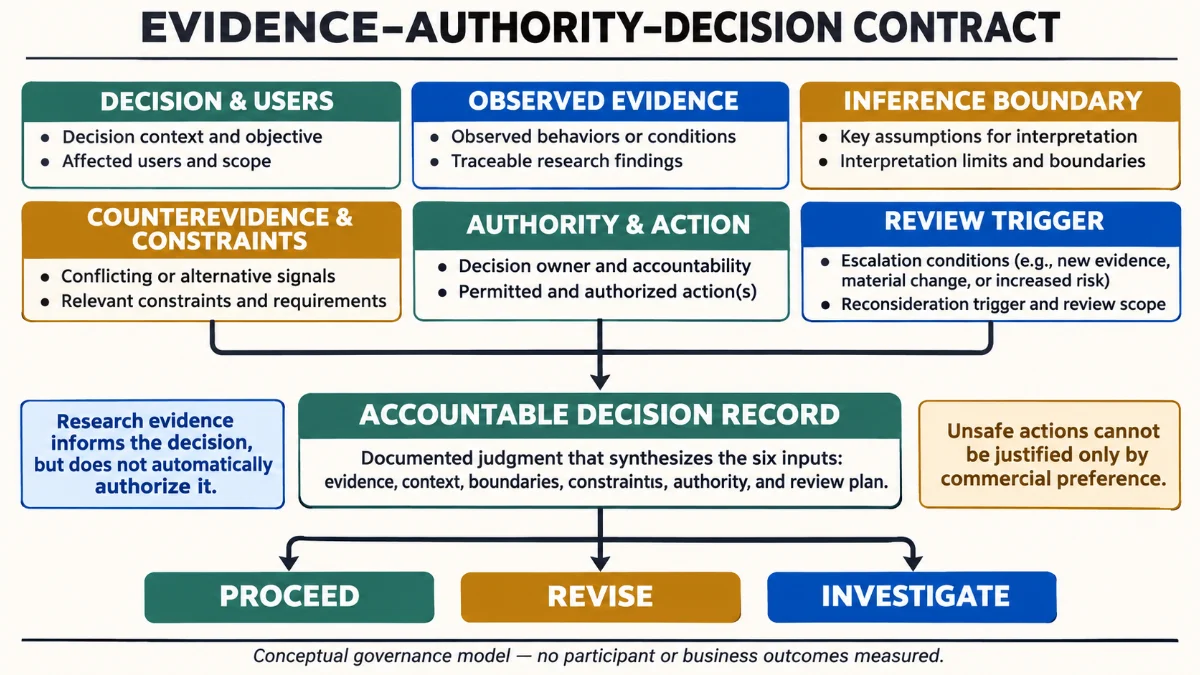
The decisive property of this contract is that it does not force a research conclusion to become a product decision automatically. Instead, it makes the transition accountable. A user research lead can challenge the quality of a claim; a product owner can accept or reject a recommendation; engineering can describe technical constraints; and the record can show what the team chose and why. User research remains evidence, while organizational authority remains visible.
Do Not Convert the Contract Into a Fake Numerical Score
It would be tempting to assign each stakeholder a vote and each finding a confidence score, then choose the highest average. That would create precision without necessarily establishing meaningful comparability. A directly observed severe error and a contractual launch constraint are not two items on one numerical scale. I would use explicit trade-offs and, where available, calibrated operational estimates rather than a decorative composite metric.
Define Review Triggers as Conditions, Not Promises
“We will monitor the release” is not a review trigger. A better record says which workflow will be monitored, what counts as an adverse event, who examines reports, what safeguard activates, and under what conditions the choice will be revisited. The trigger should depend on the risk: an incorrectly granted permission may need immediate intervention, whereas moderate comprehension friction in a reversible flow could justify additional study.
Three Illustrative Stakeholder Conflict Scenarios
Scenario One: A Contractual Launch Against a Permission Error
Consider a fictional B2B administration product. During user research, some recruited administrators assign a role that permits broader access than the task requires. The account team has promised customers a new management screen by the end of the month. The user research finding supports concern about a consequential task error; it does not establish the market-wide rate or prove that one label is the root cause.
I would separate an immediate control from a complete redesign. The team could restrict the risky choice behind an explicit confirmation, narrow the permissions available at launch, or delay only the affected capability, depending on the verified security and contractual requirements. The decision owner should state what remains unresolved. Launching without acknowledging the risk would be a governance failure, not a victory for either discipline.
Scenario Two: A Conversion Win With Poor Comprehension
Imagine a hypothetical subscription product with higher checkout completion after the cancellation terms become less noticeable. The growth team points to improved conversion; user research finds that some participants misunderstand renewal conditions. Both observations could be true. The appropriate question is whether the business model relies on informed choice and what consequences follow from misunderstanding, not which department’s dashboard is more impressive.
Here I would require comprehension checks, support and cancellation indicators, and an assessment of applicable consumer obligations before treating conversion as success. The related business-model and user-experience analysis explores why immediate revenue is an incomplete decision metric. This scenario is illustrative; no company-specific conversion outcomes are being claimed.
Scenario Three: Research Rejects a Feature That Experts Need
A researcher tests a complex analytics workflow with new users and concludes that several controls should be removed. A domain expert objects that advanced operators need those controls for critical edge cases. That objection may be legitimate because the research sample does not represent the decision’s full user population. The responsible response is to preserve the observed novice difficulty while investigating expert requirements.
Possible decisions include progressive disclosure, role-aware pathways, or separate expert tools. Each has trade-offs: more routes can increase navigation complexity, while one simplified route can eliminate necessary functionality. User research should guide which problem each solution serves; it should not erase the work of a user segment that was never studied.
Which Stakeholder Objections Should Change the Research Plan?
A challenge should change the plan when it identifies a missing population, a study condition that does not match reality, an unsupported causal interpretation, a consequential risk, or an unmeasured outcome that could alter the product choice. It should not automatically change the plan merely because the result is inconvenient, because one executive disagrees with a participant, or because a study lacks the sample size required for an entirely different research question.
| Objection | Classification | Appropriate response | Decision implication |
|---|---|---|---|
| “These were first-time users, not experienced operators.” | Potentially valid scope challenge | Check the intended population and test relevant role differences | Limit or extend the finding’s scope |
| “Only six people participated, so the observed error is imaginary.” | Invalid dismissal of direct observation | Separate defect discovery from prevalence estimation | Investigate severity and reproducibility |
| “We have a contractual date.” | Real constraint, not user evidence | Assess safe partial launch or mitigation | Record accepted risk and accountable owner |
| “The prototype did not include the production help text.” | Potentially valid context gap | Retest the relevant task with realistic information | Reassess whether the mechanism persists |
| “The dashboard improved, so comprehension does not matter.” | Invalid metric substitution | Measure understanding and task correctness separately | Do not declare full usability success |
| “What evidence would change our choice?” | Constructive governance challenge | Define an observable discriminating check | Establish a review trigger |
The value of this classification is not to win an argument for user research. It is to allocate further study only where that study can meaningfully alter the next decision.
ResearchOps Is Decision Infrastructure, Not Just a Participant Calendar
ResearchOps is often introduced as scheduling, recruitment, and repositories. Those functions matter, but the more consequential organizational problem is whether evidence retains its meaning when it travels between teams and across months. A finding stripped of product version, population, task, and caveats becomes easy to misuse. User research needs operational continuity if leadership is expected to rely on it.
Nielsen Norman Group’s ResearchOps model identifies six operational areas: participants, governance, knowledge, tools, competency, and advocacy. I would connect these to decision quality rather than treat them as an administrative checklist. Recruiting improves participant relevance; governance protects consent and privacy; knowledge systems preserve provenance; competency helps teams understand method limitations; and advocacy makes evidence easier to integrate into planning.
Make Evidence Retrievable With Its Limits Attached
A user research repository should contain the claim, method, audience, date, product state, and known limitations, with access controls for sensitive underlying material. A discovery from an older prototype should not silently become a timeless statement about all users. User research is most reusable when another team can see why a finding mattered and what would invalidate it. A short decision trace with evidence traceability linked to an insight can be more useful than a research repository filled with polished presentations.
Protect Participants While Increasing Stakeholder Access
More stakeholder visibility does not justify distributing recordings without appropriate consent, exposing identifiable participant information, or granting broad access to sensitive research files. The GOV.UK consent guidance emphasizes informed consent and clarity about how results will be used and shared. I would distribute bounded findings and appropriately approved excerpts rather than treating raw data as an unrestricted persuading tool.
Design the Research-to-Decision Handoff
ResearchOps can also define a narrow handoff contract: each consequential finding links to a decision owner, a backlog or roadmap choice, and a review condition. That does not mean every observation requires a ticket. It means the most important user research findings should not disappear after a playback because there is no organizational mechanism for acknowledging them.
Decision Rights: Who Can Approve an Override?
In organizations with multiple responsible roles, an implicit veto is dangerous. The user research lead may control study design and evidence quality, the product leader may own product scope, engineering may own implementation risk, and compliance or security may control particular prohibited outcomes. Those responsibilities overlap but are not interchangeable. I would write decision rights by consequence, not by seniority alone. Explicit decision ownership is especially important when a stakeholder can authorize a release but cannot waive a safety obligation.
For a reversible interface experiment, a product owner might proceed with an explicit monitoring plan despite provisional user research. For a consequential privacy or access-control defect, the same product owner may not be entitled to waive an applicable safety rule. Conversely, a researcher should not claim authority to block every release on the basis of personal taste. The contract must distinguish advice, authorization, and independent guardrails.
When product governance is unclear, I would propose a narrow escalation path: identify the contested claim, classify its consequence, determine who owns the affected risk, and set a deadline for an accountable decision. Escalation should produce an action or documented deferral, not an endless meeting. User research can then inform decisions without being assigned responsibility for risks it cannot actually control.
Present Research as a Decision, Not as a Performance
A vivid recording may help stakeholders understand a task failure, but emotional force is not the same as representative evidence. I would present a concise sequence: decision question, user and task context, directly observed behavior, pattern and exceptions, inference limit, alternative explanations, and decision options. The audience should know what it would take to reproduce the issue and what data is missing.
Clips and quotations require participant permission and surrounding context. A dramatic moment can mislead if edited to hide a moderator prompt or if one participant is used as a stand-in for a population. The GOV.UK research analysis guide recommends distinguishing observations, synthesized findings, and subsequent actions. I would preserve that order, particularly when a senior sponsor has already signaled a preferred direction.
One-page decision memos can help: a short evidence summary, an option comparison, a proposed action, and the uncertainty that leadership would knowingly accept. User research should be legible to colleagues who could not attend the sessions without creating the impression that qualitative observations are universal statistics.
Measure Whether Research Changes Decisions, Without Incentivizing Agreement
A simple count of research sessions, repository visits, or playback attendance measures activity, not decision quality. Counting how often leadership follows a research recommendation can also create bad incentives: a team could maximize adoption by proposing only comfortable conclusions. I would evaluate whether user research affected the decision process in more meaningful ways.
Useful operational signals include the proportion of consequential decisions with a documented evidence trail; time from a finding to an explicit decision; the share of important overrides with a named owner and review condition; and whether high-risk issues receive timely follow-up. Those are proposed process indicators, not validated benchmarks or proof that the resulting product is better.
I would pair process indicators with outcome measures appropriate to the task: independent completion, consequential error rate, comprehension, support burden, accessibility barriers, and the impact of a change on the people it affects. The Measuring Usability Beyond Conversion Rates article explains why commercial completion alone is not a complete account of usable outcomes. When metrics disagree with interviews or task observations, my UX Research Triangulation analysis offers a separate method for checking whether the evidence sources truly conflict.
A Low-Overhead Review Protocol for a Small Product Team
This framework should not require a dedicated research department. A small product team can use one shared decision note and a recurring review point. I would reserve formal review for meaningful changes: those affecting essential tasks, vulnerable users, irreversible actions, customer trust, or substantial development commitments. Routine labeling improvements need proportionate scrutiny rather than a miniature governance committee.
- Write the decision first. Identify the affected people, real workflow, and choice the team must make.
- State the finding with its boundaries. Include method, sample, task, product version, and directly observed behavior.
- Invite the strongest alternative explanation. Ask what observation would distinguish it.
- Classify the consequence. Separate reversible discomfort from safety, privacy, or damaging business errors.
- Identify the decision owner. Clarify who can choose, who must review, and who cannot waive a control.
- Decide or run the smallest useful check. Do not demand further study without a decision it could change.
- Record the review trigger. State what evidence or event will reopen the decision.
For a small team, user research may happen in short rounds, with the same person coordinating design and product decisions. That increases the importance of explicitly recording competing interpretations. The method does not require invented numerical confidence scores or a large stack of tools. It requires a decision record that remains honest when the team would prefer certainty.
Common Failure Modes of Evidence-Led Governance
User Research Theater and Performative Listening
A team can observe users, celebrate insights, and continue unchanged because the decision had already been made. Research theater occurs when participation and presentation substitute for permission to affect product choices. To detect it, ask whether user research could have changed the scope or whether every possible result would have been described as supporting the roadmap.
Methodological Perfection as a Delay Tactic
The opposite failure is demanding statistical certainty from an exploratory study before correcting a directly observed, consequential defect. User research methods have legitimate boundaries, but those boundaries should lead to a suitable next check, not permanent dismissal. User research should not have to prove every conceivable consequence before a team admits a narrow problem exists.
Replacing Judgment With a Checklist
A completed contract is not evidence of a wise decision. A team could fill in every field and still rely on poor recruitment or an invalid interpretation. The artifact creates visibility, not correctness. Its value depends on open review, relevant expertise, and willingness to reverse course. User research remains a source of bounded insight, not an automatic scoring engine.
Overloading Researchers With Commercial Accountability
Researchers should explain likely user consequences and uncertainty, but they cannot be held personally responsible for every business result following a decision they did not authorize. Product leaders need to own trade-offs; engineering leaders need to evaluate implementation risk. Otherwise user research can become both underpowered in decision rights and overexposed in blame.
Evidence and Methodology: What This Article Does Not Claim
This analysis synthesizes publicly available practitioner guidance from GOV.UK and Nielsen Norman Group on planning, sharing, and interpreting research; stakeholder involvement; sample limitations; and ResearchOps. The Evidence–Authority–Decision Contract, objection classifications, and review sequence are my proposed analytical tools. They have not been empirically validated, standardized, or tested in a named client organization.
The three product situations are hypothetical. They illustrate competing responsibilities but provide no measured conversion rate, sample statistic, incident frequency, or commercial outcome. A user research study that identifies a failure mechanism does not automatically establish market prevalence. A valid stakeholder constraint does not prove a design usable. The purpose of the article is to show how user research and decision authority can be reconciled without pretending either is infallible.
There is also a limit to procedural solutions: a leader may knowingly reject credible evidence for reasons that a transparent record cannot change. A contract can make that choice visible; it cannot force integrity or eliminate organizational power. I regard that limitation as part of the framework, not an implementation bug.
Frequently Asked Questions
Should user research always override stakeholder opinions?
No. The appropriate question is what each side knows, what the study can actually establish, which constraints are legitimate, and who is accountable for the outcome. A decision owner may reasonably choose a reversible pilot despite uncertainty. They should not silently recast observed errors as nonexistent because the launch date matters.
Can small qualitative samples justify a product change?
They can reveal concrete usability problems and support investigation of how failures happen. They generally cannot provide precise population estimates without appropriate sampling and measurement. The action depends on consequence, reproducibility, the affected population, and the evidence needed to select a remedy.
What if stakeholders demand more evidence indefinitely?
Ask which specific result would change the decision and how that result can be observed. If no result would change the choice, the dispute concerns preference, constraint, or decision rights rather than missing user research alone. Record the authority and accepted consequences.
How can a solo product manager use ResearchOps ideas?
Maintain a simple archive of research questions, participant criteria, evidence summaries, consent boundaries, and decisions. Link each consequential finding to an accountable action and a review trigger. A small practice should preserve provenance and protect participants without reproducing heavyweight enterprise ceremonies.
Conclusion: Evidence Needs a Path to an Accountable Decision
Stakeholder certainty becomes most damaging when it can replace evidence without explaining why. But researchers also undermine trust when they present a plausible explanation as a proven cause or treat a limited sample as the entire market. The answer is neither unconditional obedience to user research nor unconditional deference to seniority. It is a decision system that can distinguish what happened, what it might mean, what must be done, and who has the authority to decide.
I would judge a user research practice by whether consequential observations can survive disagreement and reach an accountable choice. A bounded finding, a clear decision owner, an honest counterargument, and an observable review trigger are more useful than a confident presentation that the organization forgets. The strongest outcome is not consensus. It is a product decision that remains justified, inspectable, and correctable when new evidence arrives.
Author: Recep Emre Ercetin · LinkedIn · X · Threads · GitHub · Behance.