


When a Modular Monolith Beats Microservices

AI Agents Need Bounded Authority, Not More Autonomy

When Revenue Incentives Reshape the User Experience
A product can improve its purchase conversion rate and still make the relationship with its customers worse. That sounds contradictory only if the business model is assessed through the moment money changes hands. A person might complete checkout without noticing the renewal terms, accept an upgrade because the alternative is visually obscured, or continue paying because cancellation is difficult. The transaction exists. The quality of the decision is another question.
I do not treat user experience and commercial viability as opposing goals. Products need sustainable revenue to keep serving people, and customers benefit when a dependable product can fund its own operations. The tension begins when a business model rewards actions that conflict with the user’s understanding, control, or long-term interests. It is possible to generate legitimate demand through a clear price and valuable service; it is also possible to manufacture short-term conversion through confusion. The dashboard may not distinguish them.
My central argument is that a business model should be evaluated as an operating contract between the organization and its users. Pricing, scope of service, renewal conditions, support obligations, cancellation, and recovery shape that contract as much as the headline price. To make those trade-offs explicit, I propose a Revenue–Trust–Cost Contract: a conceptual decision framework that connects unit economics to comprehensible product interactions and observable downstream effects. It is a planning synthesis, not a validated statistical instrument or a report of customer research I conducted.
This article is intended for product managers, growth leaders, UX directors, and technical founders deciding how to monetize without converting the interface into a source of avoidable distrust. I compare several business model choices, present an illustrative cohort calculation, and describe how to test the tension without claiming that every frictionless experience is good or that every subscription is harmful.
Decision Brief: Revenue Is Not the Same as Sustainable Value
The risk: A business model optimized around immediate paid conversion can conceal misunderstanding, refunds, involuntary retention, support burden, and future churn. A growing purchase metric may coexist with a deteriorating user relationship.
The decision: Evaluate changes to pricing and purchase journeys with both financial outcomes and user evidence. Define the intended customer value, the terms people must understand, the post-purchase behaviors that matter, and the unit costs that can reverse a first-month win.
The limit: Neither an attractive funnel nor a small qualitative study establishes long-term profitability or user trust. The business model assessment needs appropriate financial data, a credible observation window, task-level research, and explicit uncertainty. Where those inputs are missing, label the decision as provisional rather than inventing confidence.
How the Business Model and the Interface Become Misaligned
Commercial Incentives Are Embedded in Small Design Decisions
A business model appears in the interface wherever users choose a plan, accept a renewal, encounter a usage limit, understand a fee, or ask to leave. The product team may describe these as conversion touchpoints. For the user, they are decisions with financial, operational, and sometimes emotional consequences. An annual commitment, for example, is not only a discount card. It is a duration of obligation and an assumption about future needs.
The interface can support that decision by making price, billing frequency, scope, and exit conditions understandable. It can also conceal those facts behind typography, ambiguous defaults, or unnecessary steps. The FTC’s report on dark patterns documents deceptive practices such as obscured material terms, subscription traps, and interface designs that steer consumers in ways they may not intend. The report establishes that these concerns are real; it does not prove that every high-conversion flow is manipulative.
Incentives Matter More Than the Team’s Stated Intentions
A team may sincerely say it values user trust while rewarding individuals only for trial starts, upgrade clicks, or first-month sales. That business model creates pressure to treat clarity as lost revenue if clearer choices reduce the tracked numerator. I would examine the metric owners, experiment decision rules, and whether any team has authority to reject a lucrative change that produces severe comprehension failures.
The corrective action is not a motivational poster about ethics. It is a decision system in which business outcomes, evidence of user understanding, and downstream costs are visible together. If a pricing experiment raises first payments but also increases unintended renewals and dispute tickets, the evaluation must account for both rather than treating the latter as another department’s problem.
Friction Can Protect a Decision or Exploit It
Not every extra step is harmful. Confirming a high-impact deletion, validating payment information, or checking a sensitive authorization can be legitimate safeguards. Conversely, a supposedly frictionless signup can be harmful if it removes the opportunity to understand an ongoing charge. I distinguish purposeful confirmation from asymmetric friction: the business model should not make entry easy through uncertainty while making correction or exit disproportionately difficult.
This distinction is especially important in business software. A clear approval step may prevent an administrator from buying seats for the wrong group. Reducing every click would improve a narrow efficiency metric while increasing operational error. Good UX is not simply the shortest path; it is a path appropriate to the user’s goal and the consequences of a wrong decision.
A Business Model Is More Than a Pricing Page
Subscriptions Exchange Predictability for an Ongoing Obligation
Recurring revenue can fund ongoing service delivery and make budgeting easier for customers with continuous needs. A subscription business model becomes difficult when usage is intermittent, the value proposition is poorly understood, or the renewal conditions are obscure. Product fit matters more than the mere presence of a recurring billing switch. A professional tool used every day has a different value pattern from a one-time migration utility.
I would ask whether the customer can predict the value they will receive during the billing period, understand the renewal timing, and stop the arrangement without an unnecessary obstacle. The FTC’s consumer guidance on subscriptions explains the risks surrounding automatic billing and unclear cancellation. Legal requirements differ by jurisdiction and change over time, so the article is not a substitute for current legal review.
Usage-Based Pricing Connects Bills to Consumption but Adds Uncertainty
A usage-based business model may seem equitable because customers pay for what they consume. Yet unpredictable metering can make an otherwise valuable product feel risky. A user should know what triggers a billable unit, what happens when usage spikes, whether failed attempts cost money, and how to inspect consumption. Budget caps, alerts, previews, and recoverable mistakes are therefore UX features that protect the economics of both parties.
For AI-assisted tools and infrastructure platforms, the cost source may be difficult for a nontechnical buyer to predict. A fair interface cannot promise a fixed price while allowing unbounded billable actions without meaningful visibility. The business model should expose a comprehensible estimate when precision is possible, define uncertainty when it is not, and provide practical controls before surprises accumulate.
Advertising and Attention-Based Revenue Change the Incentive Structure
An advertising-supported business model may deliver access without a direct subscription price, but the commercial reward can shift toward time on screen, impressions, or data collection. Those outcomes may sometimes overlap with the user’s interests, but they are not equivalent to success. Endless prompts, disguised advertisements, and unnecessary engagement loops illustrate how monetization incentives can redirect interface choices.
The OECD’s Dark Commercial Patterns report describes consumer-facing design practices that steer, deceive, coerce, or manipulate choices. I use it as an evidence source for risk patterns, not as a universal causal estimate for the financial effects of a specific product. The business model still requires direct evaluation in its actual context.
Pricing Transparency Is a Core UX Requirement
Show the Actual Decision, Not Only the Attractive Number
For a user comparing offers, a business model is understandable only when the visible decision includes the relevant terms: billing unit, total payable amount where determinable, renewal date, applicable taxes or fees, usage thresholds, material limitations, and what changes after a trial. If the product presents a monthly-equivalent price but bills annually, that distinction must be prominent enough to influence a real choice.
In retail checkout research, the Baymard Institute documents substantial checkout UX problems, including how difficult account selection, authentication, and unclear pathways can obstruct purchasing. This is useful evidence that payment interaction design matters. Its checkout findings should not be automatically transferred to subscription SaaS or enterprise procurement as if those populations were identical.
Clarity Requires Comprehension, Not Merely Disclosure
A detail placed somewhere in a long terms document is technically present but may not be meaningful at the point of commitment. For high-consequence choices, I would test whether the intended users can answer basic questions without coaching: What am I buying? What will I pay now and later? What ends the trial? What happens if I cancel? Which features or services are excluded? The business model fails the comprehension test if the interface hides the answer at the moment it matters.
That does not mean removing all legal detail or compressing complex conditions into a misleading slogan. Progressive disclosure can present the essential terms first while leaving comprehensive documentation accessible. The user’s path should be able to support a careful decision, and important exceptions should not appear only after payment details are submitted.
Trust Cannot Be Reduced to a Conversion Rate
Observe the Decision the User Believes They Made
When evaluating a business model, I would separately observe completed purchase actions and the participant’s understanding of what was purchased. A successful payment says little about whether the buyer knows the renewal conditions, the scope of an upgrade, or the available refund path. The distinction matters because a conversion can represent informed acceptance, impulsive hope, or avoidable misunderstanding.
Google’s original HEART framework research offers a useful reminder that user-centered product measurement can include happiness, engagement, adoption, retention, and task success. I would not convert those dimensions into an invented trust index. Instead, I would define specific observable signals and preserve the limits of each one.
Retention, Renewal, and Forced Continuation Are Different States
A business model can display impressive retention when users remain because they value a service. It can also display continued billing when people did not understand how to cancel or could not complete an exit path. Revenue records alone may not separate those conditions. Research should examine active use, explicit renewals where applicable, cancellation attempts, support contacts, refund requests, and reported reasons for leaving.
Similarly, a cancelled customer is not necessarily evidence of product failure. A project-based tool may have delivered its promised value completely. Treating every departure as a retention defect can pressure teams to make the exit journey unpleasant. A healthy business model accepts that some customer relationships are finite and designs for an honest ending.
The Revenue–Trust–Cost Contract
I propose the Revenue–Trust–Cost Contract as a structured review of six areas that a business model decision can affect. It is not an empirically validated score or a rule that every dimension must receive equal numerical weight. Its purpose is to expose uncertainty before a pricing experiment is declared a success and to identify which evidence belongs to commercial analysis, UX research, operations, or legal review.
| Dimension | Decision question | Evidence to seek | Common interpretation error |
|---|---|---|---|
| Value delivered | Does the offer solve a meaningful, recurring or appropriately finite problem? | Task outcomes, usage context, qualitative research | Confusing clicks with useful outcomes |
| Price comprehension | Can buyers explain the total commitment and important limits? | Unassisted comprehension tasks, pricing audit | Assuming a disclosed term was understood |
| User agency | Can people choose, decline, change, and leave? | Choice architecture review, cancellation walkthrough | Counting involuntary continuation as loyalty |
| Revenue quality | What proportion of sales reflects qualified ongoing value? | Cohort revenue, refunds, renewals, active use | Optimizing first-payment conversion alone |
| Operating cost | What does this pricing decision add to service, support, and recovery? | Cost allocation, ticket volume, resolution effort | Ignoring cost shifted to another team |
| Evidence confidence | Which claims have been measured, and which remain hypotheses? | Study method, uncertainty, segmentation, assumptions | Turning one example into a universal conclusion |
For this business model review, I would use the contract before an experiment and again after results arrive. Each row needs an owner and a clearly defined evidence standard. A legal requirement or a severe customer harm should not be averaged away by a favorable revenue result. The absence of evidence should remain visible rather than receiving a reassuring but arbitrary score.
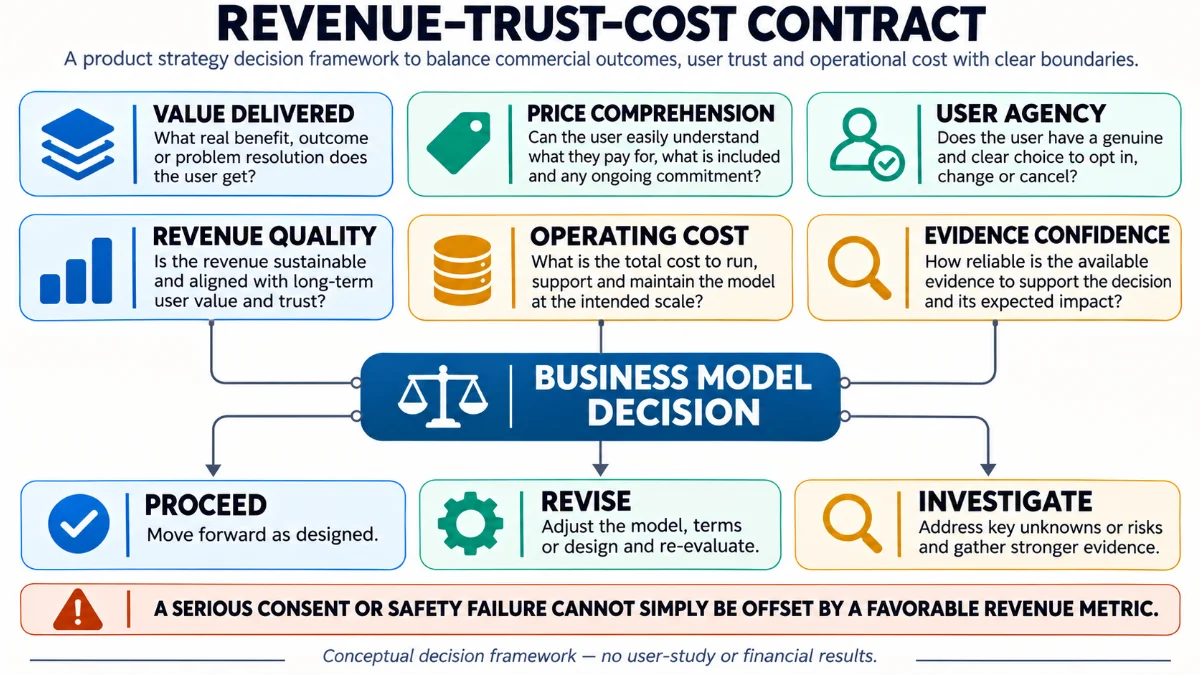
Use the Contract to Record Conflicting Results
Consider a proposed annual-plan default. Finance expects stronger near-term cash collection. Growth expects more completed purchases. Support warns that buyers already confuse monthly and annual billing. UX research finds that the renewal label is poorly understood. The business model decision should record all four observations, separate expectations from measurements, and decide what must be changed or tested before wider release.
For a business model change, the contract is most useful when it creates a legitimate stopping condition. A team may refuse to launch a pricing change until cancellation works reliably, a major term is comprehensible, and the billing event matches the copy. This is not hostility to revenue; it is an attempt to prevent a business model from relying on avoidable user error.
Illustrative Unit Economics: A Conversion Win That Loses Value
To show why a business model needs more than an initial conversion metric, consider two entirely hypothetical enrollment designs for the same subscription. The following figures are chosen only to explain arithmetic. They are not findings from an A/B test, a client account, or any actual product. Both designs receive 10,000 qualified visitors; each active subscription month generates $20 in revenue. The scenarios differ in paid starts, second-month continuation, and allocated first-cohort support and refund handling costs.
| Assumption | Design A: clear commitment | Design B: aggressive conversion |
|---|---|---|
| Qualified visitors | 10,000 | 10,000 |
| First-month paid customers | 400 (4% conversion) | 500 (5% conversion) |
| Second-month active customers | 320 (80% of paid cohort) | 300 (60% of paid cohort) |
| Two-month paid subscription months | 720 | 800 |
| Revenue at $20 per active month | $14,400 | $16,000 |
| Allocated support and refund-handling costs | $1,200 | $4,000 |
| Variable service cost at $2 per subscription month | $1,440 | $1,600 |
| Illustrative two-month contribution | $11,760 | $10,400 |
The calculation is straightforward: contribution equals billed subscription-month revenue minus the two stated cost categories. For Design A, (400 + 320) × $20 − $1,200 − (720 × $2) = $11,760. For Design B, (500 + 300) × $20 − $4,000 − (800 × $2) = $10,400. Design B wins first-month paid conversion and total two-month gross revenue, yet loses on the narrower contribution definition used in this illustration.
The business model comparison does not prove that a clearer interface causes higher retention or lower support cost. The retention and cost values were deliberately assumed. Acquisition spend, fixed costs, taxes, payment processing, chargebacks, refunds as revenue reversals, revenue recognition rules, discounting, and outcomes after month two are excluded or simplified. A real business model analysis must define those accounting treatments and avoid counting refund effects twice. Different plausible inputs could reverse the result.
What Would Have to Be Measured for a Real Decision?
For a real business model experiment, I would record the customer population, exposure and assignment method, consent and pricing comprehension, paid starts, refunds, renewal attempts, actual active use, support costs, and the full observation window. I would distinguish user-initiated cancellation from payment failure and account suspension. I would also predefine which costs are included so that the finance comparison cannot be rewritten after seeing the result.
Where traffic and sample sizes support randomized comparison, uncertainty estimates and a prespecified primary outcome are important. Where the product has few buyers or a long renewal cycle, a small qualitative study or a staged rollout may reveal comprehension failures without pretending to estimate long-term retention precisely. The business model should be evaluated through the evidence each method can legitimately produce.
Compare Business Model Choices by Their UX Obligations
There is no universally superior business model. Different revenue structures shift different risks to the customer and different obligations to the organization. I would compare them by the questions users must answer, the controls they need, and the failure modes the team can observe rather than by a simplistic list of “modern” monetization strategies.
| Model | Potential advantage | UX risk | Design obligation |
|---|---|---|---|
| Recurring subscription | Predictable access and recurring funding | Unclear renewal and exit terms | Explain billing, renewal, cancellation, and current status |
| Usage-based billing | Cost can track actual consumption | Surprise charges and meter ambiguity | Show units, estimates, usage, limits, and alerts |
| Per-seat licensing | Simple purchasing for stable teams | Unused seats and permission confusion | Clarify seat ownership, assignment, and removal |
| Freemium | Low entry barrier | Unclear boundaries and coercive upgrade prompts | Make limits and paid benefits understandable |
| Advertising supported | Reduced direct access price | Attention capture and privacy pressure | Separate ads from content and protect meaningful choice |
| One-time purchase | Visible initial commitment | Unclear maintenance or future-upgrade support | Describe ownership, updates, service scope, and lifecycle |
A Hybrid Business Model Can Compound Ambiguity
A subscription with metered overages can be legitimate, but combining both requires more explanation. A customer may understand the monthly base fee while missing that certain actions trigger additional charges. The interface must explain the boundary between included usage and variable billing. In enterprise contracts, the team may also need administrative approvals, role-specific billing views, and audit records so that the person who performs an action is not mistaken for the person authorized to spend.
Adding multiple monetization mechanisms should therefore trigger a new comprehension and operational review. The business model becomes harder to understand as independent fee conditions accumulate, even if each individual condition is disclosed. A useful design test is whether a qualified customer can predict the consequence of a common workflow without consulting a sales representative or an internal billing specialist.
Cancellation and Recovery Are Part of the Product Promise
Do Not Build an Easy Entry and a Hidden Exit
A business model based on recurring billing creates continuing responsibilities. Users need to know whether cancellation ends billing immediately, stops the next renewal, preserves access to the end of a paid period, or changes data availability. These states should be represented clearly before and after the user commits. Confirmation can be appropriate, but a maze of misleading offers or dead ends is not a neutral retention strategy.
The FTC’s 2022 discussion of subscription traps identifies difficult cancellation and buried terms as examples of deceptive design. That is evidence of a documented risk category. Specific legal requirements and enforcement status must be checked for the relevant market at publication and implementation time.
Recovery Includes More Than Refund Buttons
When a purchase is accidental or a charge disputed, the business model determines what relief is possible. But the product experience determines whether the user can understand the bill, access evidence, contact support, correct a seat assignment, or end a mistaken renewal. A customer who must leave the product and reconstruct an unexplained invoice through support is paying an operational price even if a refund is eventually granted.
I would document the full recovery route, including accessible navigation, language support where necessary, error states, promised response times, and what happens to a customer’s content when service ends. The quality of exit often becomes part of the customer’s final judgment of the brand. That judgment cannot be inferred solely from a churn percentage.
Research the Revenue Decision Without Gaming the Evidence
Use Task Research for Comprehension and Analytics for Scale
A small moderated session can show whether a prospective buyer notices billing frequency, understands an overage rule, or can locate cancellation. That is valuable diagnostic evidence, not a precise population estimate. Production analytics can identify broad patterns in purchase, renewal, contact, and exit behavior but may not explain the user’s beliefs. I would plan both methods around the decision rather than using whichever chart already exists.
Our previously published Measuring Usability Beyond Conversion Rates article addresses this distinction at the task level. The business model question adds a second layer: what does that task experience imply for revenue quality, service obligations, and long-term product value? Neither analysis replaces the other.
Do Not Turn the A/B Test Into Permission to Mislead
Random assignment can estimate the effect of two eligible interface treatments under appropriate conditions. It cannot make an ethically unacceptable treatment acceptable. A business model experiment should exclude misleading charges, false scarcity, hidden consent, and designs that prevent meaningful user control. The team must also decide in advance how it will respond to serious harms discovered during the test.
Small statistical differences can also be misleading when traffic sources shift, customers belong to different segments, or people see multiple versions of a flow. An experiment design should account for exposure, allocation, sample size, seasonality, and the observation period. Reporting a lift in first-month conversion without showing the associated customer population or later outcomes is inadequate for a high-stakes monetization decision.
Build a Guardrail Dashboard, Not a Single Success Number
I would define the business model’s primary commercial outcome alongside guardrails: billing comprehension, refund rate, disputed charge rate where lawful to process, cancellation task completion, support contacts per paid cohort, active product value, and contribution after variable costs. A guardrail is not an arbitrary benchmark. Its threshold should be justified by risk, existing performance, contractual obligations, or a credible baseline.
A practical event taxonomy also separates user intent from successful system execution. Clicking “cancel” is not the same as a completed cancellation. Clicking “upgrade” is not necessarily an accepted financial commitment. Event contracts, event validation, and clearly bounded interpretation are therefore necessary before a monetization dashboard is trusted. A tracked purchase click is not proof of an authorized, completed financial transaction.
Who Has Authority to Reject a Profitable but Harmful Design?
A business model decision is rarely owned by one function. Growth may own acquisition, finance may own revenue forecasts, design may own the interaction, legal may review disclosure, and support may inherit the consequences. If nobody is responsible for reconciling those perspectives, an apparently successful experiment can shift hidden costs and risks into departments with less decision authority.
Specify Decision Rights Before the Experiment
I would assign a decision owner, required reviewers, a clear stop condition, and an escalation route. The review should include the people accountable for customer impact and those who can verify financial assumptions. A material change to renewal or cancellation requires more than visual approval. Teams should record what was decided, what evidence was available, which concerns remain unresolved, and which future signals would trigger a reconsideration.
The MVP Experiments article provides a related approach to defining hypotheses and decision conditions before launching experiments. Here, the business model is already a key part of the product’s promise. The test is not merely whether a customer can be persuaded to pay, but whether the transaction is comprehensible, sustainable, and consistent with the value the product will deliver.
Document the Trade-Off Rather Than Hiding It
Sometimes a choice really does involve a trade-off. A monthly plan may increase flexibility for customers while raising forecasting uncertainty for the provider. A usage cap may protect financial sustainability while reducing spontaneity for advanced users. A paid onboarding service may improve enterprise implementation while adding purchase complexity. My aim is not to pretend the trade-off disappears. It is to make the affected populations, consequences, alternatives, and mitigation options visible.
That record protects the team from a misleading narrative in which every conversion gain is necessarily good or every additional step is necessarily bad. The business model should be justified by evidence about the product’s value and costs, with the reasons for its interface constraints available for future review.
Illustrative Scenario: An Educational Product With Two Upgrade Paths
Imagine a fictional professional learning product. The service offers a free introductory module and a paid library with continuing updates. The team is considering two ways to introduce subscriptions. In the first, the pricing page clearly identifies billing frequency, the included catalog, whether new materials are promised, and the cancellation conditions. In the second, the interface emphasizes a discounted monthly-equivalent amount while obscuring that the customer is agreeing to an annual charge.
The business model assumptions differ even if the catalog is identical. The second path may appear to improve checkout performance, but a serious evaluation asks whether buyers comprehend the commitment, continue using the learning material, later request refunds, or spend time resolving a mistaken expectation. The team must also consider whether the stated update promise is operationally feasible and whether support can answer questions about content access after cancellation.
I would begin with transparent prototype comparisons and comprehension tasks, not actual hidden charges. If the first path performs worse on purchases but better on understanding, the next decision may be to improve the clarity of value, plan comparison, and onboarding rather than adopt the misleading option. This business model scenario illustrates a method; it describes no EDUVIA customer study, product feature, deployed pricing system, or measured outcome.
Counterarguments: When Revenue Optimization and UX Work Together
Clearer Pricing Can Help Qualified Customers Buy Faster
The business model need not be defended through unnecessary friction. Clear plan differences, meaningful defaults, precise terminology, and accessible comparison tools can reduce effort for customers who want the product. An honestly presented annual discount can be attractive without concealing the annual commitment. A well-designed upgrade path can explain the incremental value instead of bombarding users with interruptions.
Some friction also comes from poor technical implementation rather than commercial intent. A confusing tax estimate, unreliable payment error, or difficult sign-in can reduce both business and user outcomes. Fixing those problems is a straightforward win when the proposed change preserves clarity and control. This is why I reject a simplistic story that monetization and good experience are inherently incompatible.
A Higher Price Can Be More Honest Than Artificially Cheap Access
It can be better to charge a sustainable price for a service that actually meets its obligations than to advertise an implausibly low price and recover costs through concealed add-ons. The business model must cover ongoing maintenance, support, hosting, payment costs, and expected delivery effort. Price fairness is not established by making every service inexpensive; the relevant questions concern clarity, truthful scope, customer value, and what the customer can reasonably choose.
A Practical Review Sequence for Product Teams
- State the value exchange. Describe what the customer receives, when value is delivered, and whether the need is recurring or finite. If this is unclear, pricing optimization is premature.
- Map each financial commitment. Include price, billing cadence, renewal, fees, usage limits, and the support or access conditions that materially affect the purchase.
- Test comprehension and control. Ask qualified participants to explain the offer and demonstrate plan change, correction, and cancellation without coaching.
- Define the business model cohort. Specify who is included, how revenue and costs are attributed, which time window matters, and how renewals and refunds are represented.
- Choose guardrails before exposure. Establish legitimate constraints for misleading consent, failed cancellations, material errors, and harmful support outcomes.
- Run a fit-for-purpose evaluation. Combine qualitative task evidence with controlled financial measurement where a real experiment is feasible and ethical.
- Review the total decision. Compare commercial value, user understanding, recovery, operational cost, and uncertainty before expanding the change.
- Write the reconsideration trigger. Reopen the business model decision if pricing expectations, service costs, regulation, customer needs, or observed behavior materially change.
This sequence is deliberately adaptable. An enterprise procurement process may need procurement and contract specialists; a consumer subscription may need more direct usability research on renewal and exit; a regulated service may require review beyond the product team’s authority. The goal is disciplined judgment, not a universal checklist that claims to settle every legal or economic question.
Evidence, Methodology, and Limits
This business model analysis synthesizes publicly available primary consumer-protection guidance, UX research, and product measurement literature. The FTC and OECD materials support the risk analysis of manipulative commercial interfaces. Baymard’s work supports the importance of checkout interaction quality within its studied contexts. The HEART research supports distinguishing user-centered outcomes from narrow commercial metrics. These sources do not establish causal effects for the fictional financial examples or validate the Revenue–Trust–Cost Contract as a measurement instrument.
The two-month cohort table is explicitly hypothetical. It has no sampled customers, treatment assignments, or statistical inference. The educational product is fictional. No private project economics, named product capabilities, or personal research experience is asserted. The sources were reviewed for this article on November 3, 2026; legal and platform conditions may change and should be verified before implementation.
Finally, a business model can be profitable while remaining ethically questionable, and an ethical design is not automatically financially viable. I would not collapse those distinct questions into one score. Sound product decisions require independent evidence about value, consent, comprehension, economics, and the consequences of error.
Frequently Asked Questions
Does a higher conversion rate mean the business model improved?
Not by itself. Paid starts are one important signal, but the business model also depends on informed purchase, refunds, renewal quality, support costs, service delivery, and outcomes over a meaningful time window.
Are subscriptions inherently harmful to UX?
No. Recurring access can be appropriate where customers receive ongoing value and understand renewal, billing, and cancellation. The risk comes from mismatch, hidden terms, and asymmetric control rather than from recurrence alone.
Can easier cancellation improve the business model?
It may reduce frustration and support burden, but the effect should be investigated rather than assumed. Easier cancellation protects user agency even if some customers choose to leave; its financial outcome depends on the product and customer population.
What metrics should accompany purchase conversion?
At minimum, consider comprehension of the commitment, active use, renewals, refunds, cancellation outcomes, customer support effort, and contribution after defined costs. The right selection depends on the business model and the decision being made.
Does one usability test prove transparent pricing increases retention?
No. A usability test can uncover confusion and task barriers. Retention requires longitudinal behavioral evidence, credible cohort definitions, and an observation window appropriate to the product’s billing and usage cycle.
Is the Revenue–Trust–Cost Contract a validated standard?
No. It is a proposed conceptual synthesis for cross-functional decisions, with explicit dimensions and evidence boundaries. It should be adapted, critiqued, and tested before being treated as an operational measurement method.
The Best Commercial Experience Helps the Right Customer Choose
I evaluate a business model by the value it can sustain and by the quality of the choice it offers, not just the money it collects at one interaction. Growth becomes more defensible when the buyer knows what is promised, the product can deliver it, the costs are visible, and mistakes can be corrected without unnecessary harm.
A business model should have a coherent answer to four questions: Why will customers want to pay? What exactly are they accepting? What does the organization owe after payment? And what evidence could change the decision? When those answers are clear, UX and commercial strategy can reinforce each other without pretending that the trade-offs have disappeared.
Author’s Note
This article is an independent professional analysis and a conceptual decision framework, not a case study claiming a measured commercial improvement. For more work on software, product strategy, UX, and digital systems, connect through LinkedIn, X, Threads, GitHub, or Behance.