


3D Environment Design: Exploration Meets Performance

When a Modular Monolith Beats Microservices

Decision Brief: Decide What Matters Before Choosing What to Track
A GA4 measurement plan can prevent a technically accurate dashboard from becoming strategically useless. It may display traffic sources, engagement rates, conversions, and campaign trends while leaving the central business question unanswered: what decision will change because these numbers are available? I would begin a GA4 measurement plan before installing another event, designing a reporting screen, or deciding which number deserves the largest card. A GA4 measurement plan has value when it helps someone distinguish a useful action from an attractive but misleading signal.
The central proposition of this article is that measurement strategy is a decision architecture. A metric requires a decision owner, a definition, a collection mechanism, a data-quality standard, and an interpretation boundary. Without those parts, adding more analytics can increase confidence without increasing understanding. This matters for brands that publish research, content teams that connect articles to inquiries, and product organizations that need to know whether users achieve the outcomes their experiences promise.
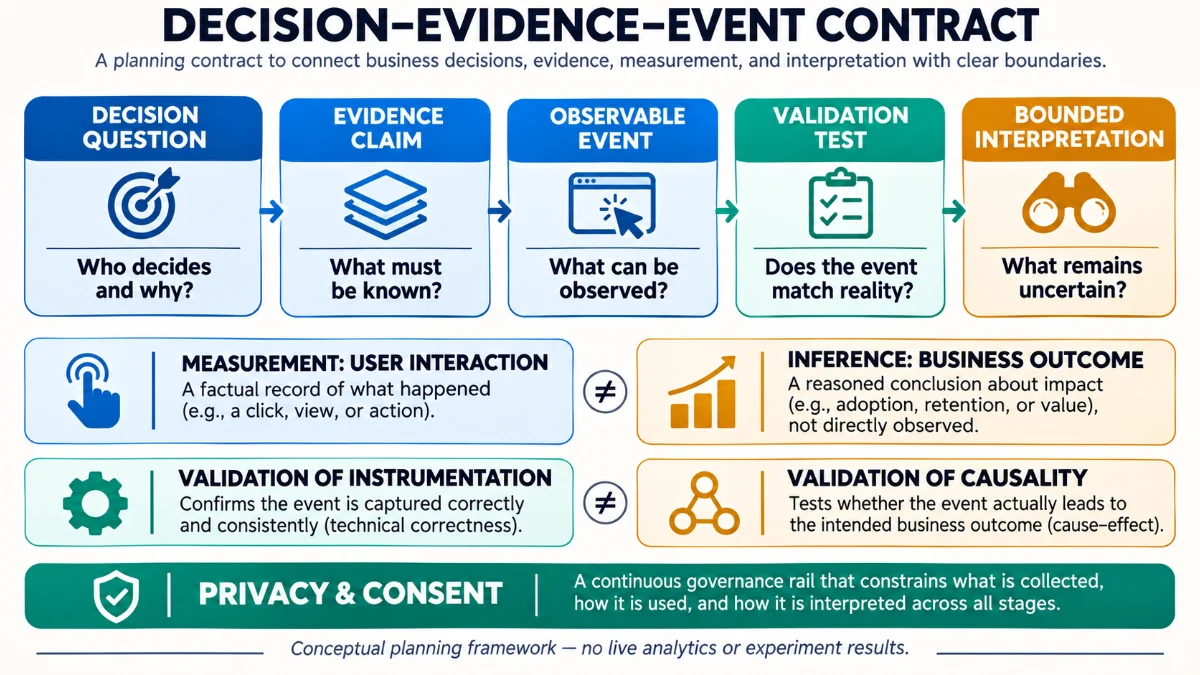
I propose a Decision–Evidence–Event Contract to make those relationships inspectable. It is my conceptual planning framework, not a Google product feature, an independently validated research method, or a claim about results achieved in an undisclosed project. The examples are hypothetical, and the protocol deliberately separates observed interactions from attributed value, inferred outcomes, and causal effects.
Why the Measurement Question Comes Before GA4
A common implementation sequence starts with a tracking tool, turns on automatic collection, attaches click handlers, and then asks stakeholders which dashboard they would like. The danger is subtle: once metrics are available, they can begin defining the organization’s priorities by default. A page view is convenient to count, so content production becomes a competition for page views. A button is easy to instrument, so clicks are treated as a proxy for demand. A form submission appears in a report, so it is called revenue before anyone knows whether the inquiry was qualified or resolved.
My alternative is to begin the GA4 measurement plan by writing the decision question in ordinary language. For example: Should we spend the next quarter improving a technical research series, revising the consultation page, or changing the distribution mix? That is not a request for a chart. It is a request for evidence about audience fit, content usefulness, qualified interest, and delivery capacity. Different observations contribute to different parts of the answer, and not all of them should come from Google Analytics.
Every Metric Needs a Decision Owner
A growth lead may need to decide which acquisition investment to continue. A content editor may need to identify a topic whose readers consistently progress to deeper material. A product manager may need to investigate a user journey that fails after successful sign-in. Those questions overlap, but they require different units of analysis and different tolerances for uncertainty. The same number can be useful to one role and irrelevant to another. I would record who owns the decision, the review cadence, and what alternatives they can actually choose.
This also prevents a reporting system from becoming a performance theater. A stakeholder who cannot act on an indicator should be cautious about declaring it a leading KPI. Conversely, a low-volume but high-consequence signal may deserve attention even if it never produces an impressive trend line. The goal of the GA4 measurement plan is not to fill a dashboard. It is to make evidence fit the decisions that matter.
Separate Outcomes by Their Time Horizon
A GA4 measurement plan must account for the fact that not all outcomes become observable at the same time. A successful file download can be measured near the interaction. Understanding a technical argument may require task-level research or follow-up feedback. A consultation may lead to a qualified conversation after several days. A business relationship may develop much later. I would not compress these into one fictional real-time conversion metric just because GA4 can display data quickly. The collection plan must state which outcomes are observable on-site, which require another system, and which are beyond reliable attribution.
Build a KPI Tree From Value, Not From Available Events
In a GA4 measurement plan, a KPI tree is useful when it shows how a desired outcome is related to observable activity without treating every branch as a proven cause. I would organize the model across four levels: the business or user outcome, observable intermediate behavior, the instrumented interaction, and the evidence limitations. This prevents a single click count from standing in for an entire customer journey. A tree should expose disagreement, not conceal it with a smooth-looking arrow.
| Decision level | Example question | Possible evidence | Interpretation boundary |
|---|---|---|---|
| Qualified outcome | Are relevant professionals finding enough value to begin a serious conversation? | Qualified inquiries reviewed outside analytics; aggregate follow-through | Qualified interest is not contracted revenue |
| Intermediate intent | Do readers seek deeper evidence or next steps? | Meaningful related-article navigation; intentional resource requests | Intent signals may not imply satisfaction |
| Interaction event | Can we observe a defined action reliably? | Confirmed resource download or successfully completed request | Click alone does not prove completion |
| Collection quality | Is the observation complete and permitted? | Consent status, test logs, duplicate and missing-event checks | Consent and measurement limitations affect coverage |
Leading Indicators and Lagging Indicators Are Different Claims
A useful leading indicator can change before the eventual outcome does, but proximity in time does not establish causal power. Reading another closely related article may be an encouraging sign of interest, yet it does not necessarily predict a sales conversation. A lagging indicator such as a verified qualified inquiry is closer to the business outcome but may arrive too late, or in quantities too small, to guide weekly editorial decisions. I would use leading indicators for diagnosis and lagging indicators for accountability, then examine whether the proposed relationship survives real-world observation.
There is no universally correct ratio of metrics between these categories. The relevant question is whether an indicator adds information that could change a decision. If two metrics always move together because one is mechanically derived from the other, displaying both may create artificial richness. If a metric has a known selection bias, mark it. If it depends on user-level tracking that would be intrusive or impermissible, redesign the question instead of assuming data collection must expand.
Understand GA4 Event Types Before Writing an Event Taxonomy
Google documents four GA4 event categories: automatically collected events, enhanced measurement events, recommended events, and custom events. This classification is not simply vocabulary. It determines what may already be present, where configuration is required, and whether the analytics platform has standard meaning attached to the event. The official GA4 event setup documentation is a better implementation starting point than a generic list of fashionable engagement events.
For example, `session_start` is among the events collected by default when the tag is properly configured. Enhanced measurement can collect interactions such as `scroll`, outbound `click`, and `file_download` under appropriate settings. A recommended event such as `generate_lead` represents a defined kind of business interaction and normally requires implementation. Custom events should express actions not adequately covered by those categories. I would inventory existing events before adding another handler that records the same action under a different name.
Event Naming Conventions Must Describe Behavior
In a GA4 measurement plan, good event naming conventions describe what happened rather than what someone hopes it means. `consultation_button_clicked` is an interaction, not a completed consultation. `generate_lead` can represent a confirmed lead submission when the event definition and implementation fit the Google documentation, but a click that only opens a modal should not borrow the same semantic promise. I prefer names that survive redesigns: a user intent and a confirmed state are usually more durable than a button’s color, screen position, or internal component name.
Google’s recommended event reference defines events such as `generate_lead`, `sign_up`, and `purchase`. Their official names should not be treated as interchangeable catch-all actions. A custom `research_resource_requested` event might be appropriate if its meaning and trigger are carefully documented. It must not be presented as a built-in GA4 event or a guaranteed source of qualified leads.
Key Events Are Important Actions, Not Proof of Value
GA4 uses the term key events for interactions identified as important to a business. Google’s key event documentation explains the process of marking a collected event for that purpose. I would reserve the designation for activities that deserve separate reporting, rather than every scroll and external-link click. A key event is an analytics classification; it does not independently prove that the action was valuable, that the user was satisfied, or that a campaign caused it.
It also helps to distinguish GA4 key events from advertising conversions and their reporting context. Google’s key-events-and-conversions guidance describes how different settings and scopes can produce discrepancies. A team that uses the same word for two technically different counting systems is likely to misinterpret campaign changes. I would label reports with their actual scope, counting method, and reporting purpose.
The Decision–Evidence–Event Contract
I use the phrase Decision–Evidence–Event Contract for a compact specification that connects each important event to a question an actual decision-maker needs answered. Unlike a dashboard inventory, the contract starts with the decision and then works backward to the minimum sufficient observation. Its required fields are decision, evidence claim, observable event, trigger, permitted parameters, verification method, and limitation. The contract is intentionally reviewable by product, marketing, engineering, and privacy stakeholders.
To make a GA4 measurement plan concrete, consider a hypothetical professional publication and the question: Does a downloadable research resource lead to genuinely relevant inquiries? One observable event might be a download initiated through an accessible link. Another might be successful completion of a consultation request. But the connection between these events should not be invented from unverified identity stitching. The contract acknowledges that useful content engagement, lead generation, and qualification exist at different measurement layers.
| Decision / claim | Event or source | Trigger and parameters | Validation | Limit |
|---|---|---|---|---|
| Should the publication invest in downloadable technical resources? | `file_download` if enhanced measurement captures the intended download correctly | Qualifying file-link interaction; permitted file category, content identifier | Compare test interaction with GA4 DebugView and expected destination | Download initiation does not prove reading or usefulness |
| Does the contact journey function? | `generate_lead` when a relevant form submission is actually accepted | Confirmed submission success; approved nonpersonal form category | Compare test success with confirmed server outcome; prevent duplicates | Submission is not qualified interest or revenue |
| Do readers meaningfully navigate the research archive? | Potential custom `research_path_selected` | Explicit related-resource navigation; source category and destination category | Verify precise navigation trigger and event count | Navigation intent does not prove comprehension |
| Are incoming requests relevant? | Human-reviewed, aggregated qualification record outside GA4 | Defined qualification rubric; minimal retained business categories | Independent periodic review and documented definitions | No automatic identity-level join or causal claim |
A Contract Needs Both a Positive and a Negative Test
Before approving a GA4 measurement plan, I would define what must fire each important event and what must not. A successful form submission is a positive case; a failed validation attempt or repeated button click is a negative case. A download that is already recorded by enhanced measurement should not silently trigger a second custom event with identical meaning. A user declining analytics consent should produce the configured privacy-respecting behavior, not an unnoticed fallback to an unauthorized tracker.
The contract should also identify the boundary between technical confirmation and product meaning. A form success response may establish successful submission; it does not establish that the recipient read the message. A request classified as relevant by a human may establish qualified intent according to a rubric; it does not establish a sale. The distinction is particularly important when teams discuss funnel leakage, because missing downstream outcomes may reflect uninstrumented processes rather than failed persuasion.
Version Definitions, Not Just Dashboards
A GA4 measurement plan must anticipate that when a team changes a trigger from click to successful completion, the apparent metric may fall even though the measurement became more accurate. I would record that change in the event contract, note its effective date, and avoid comparing the two periods as if they shared one stable definition. Similar care is needed when form flow, consent behavior, channel classification, or campaign tagging changes. An event taxonomy is a maintained agreement about semantics, not a one-time spreadsheet handed to developers.
Cross-Channel Measurement: Preserve the Differences Between Brand, Content, and Product
Cross-channel measurement becomes misleading when every channel is evaluated as if it has the same role. An article may build technical credibility; a short professional post may introduce a thesis; a product page may explain capability; a consultation form may facilitate a relationship. I would define each channel’s legitimate contribution before ranking it by its last observable click. Otherwise a channel responsible for discovery can appear weak simply because the final interaction occurred elsewhere.
Consider how a GA4 measurement plan must handle a hypothetical sequence in which someone encounters an argument on a professional network, later searches for the author’s article, reads a related technical case, and eventually sends an inquiry. GA4 may observe some parts of that journey when collection conditions allow. It may not observe the first impression, the reader’s private deliberation, activity on another device, or a subsequent offline discussion. I would not describe an acquisition report as a complete memory of the relationship.
Brand Indicators Need a Definition of Qualified Attention
Impressions, reach, branded search, profile visits, and referral traffic can provide useful context, but they represent different populations and measurement systems. A rise in branded queries could accompany a successful brand initiative, general market activity, or unrelated events. I would pair aggregate discovery signals with evidence of relevance, such as the types of professional questions people ask or the topics that generate sustained substantive engagement. That qualitative work should use consent and appropriate aggregation; it should not be disguised as data coming from GA4.
Content Indicators Need an Editorial Interpretation
Within a GA4 measurement plan, a long time on a page can indicate deep reading, confusion, an idle tab, or complex material. A low scroll completion rate can be normal if the answer appears near the top. Conversely, a high scroll rate is not evidence that someone understood the argument. I would assess content with a combination of observable navigation, the question a page answers, evidence of reader needs, and task-level research where it is justified. This builds on my owned media strategy argument: the publication is a durable knowledge asset, not merely a surface for generating sessions.
Product Indicators Need a Defined User Outcome
The product branch of a GA4 measurement plan should ask whether people completed the meaningful task under acceptable conditions. An onboarding screen view is not completion; a successful account creation is not necessarily activation; repeated use is not always satisfaction. I would map each critical task to observable completion, errors, recovery, and contextual evidence rather than adding a single generic engagement score. A team can link product analytics to a strategic measurement plan without pretending the same metric represents brand trust, content quality, and product usability.
Attribution Uncertainty Is a Feature of the Evidence, Not a Reporting Defect to Hide
Attribution uncertainty remains in a GA4 measurement plan whenever observed events cannot reveal the complete causal history of an outcome. GA4’s attribution configuration assigns credit according to selected models, eligible channels, and lookback windows. Google’s attribution settings guidance explains that reporting models can distribute fractional credit and that changing settings affects how key events are represented. Credit allocation is a reporting model; it does not establish that a specific touchpoint caused the underlying user decision.
I would separate three distinct questions in any GA4 measurement plan or strategic report. Observation: what did we record? Attribution: according to which rules did we allocate credit? Causality: what evidence would justify saying an intervention changed an outcome? The first can be supported by event logs, the second by clearly specified model settings, and the third often requires an appropriate experiment or stronger quasi-experimental design. Treating the three as synonyms turns measurement into a story rather than a discipline.
Measured, Modeled, and Inferred Results Need Visible Labels
In privacy-sensitive environments, a GA4 measurement plan must recognize that observed datasets may exclude some interactions or incorporate modeled behavior where product eligibility and configuration allow. Google’s Consent Mode overview explains differences between basic and advanced implementations and describes how modeling can contribute under some circumstances. A modeled number is not automatically invalid; it is simply a different type of evidence and should not be reported as a complete set of directly observed individual actions.
There are also reporting thresholds. Google’s data thresholds documentation describes cases where data is withheld to reduce reidentification risk. Small audiences and narrow segments can therefore produce gaps or unexpected differences between views. I would report missingness and threshold effects where material, rather than infer that no relevant user behavior occurred.
Privacy Is a Design Input to the Measurement Plan
Consent and data minimization belong in the original GA4 measurement plan, not in an implementation checklist completed after tracking is deployed. An organization cannot fix an intrusive event definition merely by placing the same personal information behind a nicer banner. I would avoid sending names, email addresses, free-text form messages, sensitive query terms, or unrestricted user identifiers as analytics event parameters. Google’s Measurement Protocol, SDK, and User ID policy explicitly restricts personally identifying data and requires appropriate user information and permissions.
For a professional publication, the most useful events often need only low-cardinality context: a page category, a nonpersonal resource identifier, or the type of completed action. The event contract should state whether such fields are necessary and what they might reveal when combined with other dimensions. Where privacy rules or consent prevent a desired analysis, that is a constraint to reflect in the decision rather than an invitation to quietly seek another identifier.
Consent Mode Is Not a Legal Compliance Shortcut
Google’s Consent Mode implementation guidance requires defaults and updates that accurately reflect user choices. The difference between basic and advanced implementations also affects whether tags transmit limited measurements before consent. Neither technical mode automatically establishes that an organization’s processing is lawful in every jurisdiction. I would determine legal requirements, permitted purposes, retention, and user controls separately, then configure collection to follow the resulting policy. A report may become less complete because a user exercised a legitimate choice; it does not follow that the choice should be bypassed.
A Minimal Privacy Review Before Instrumentation
Before approving a new event within a GA4 measurement plan, I would ask whether it has a documented purpose; whether its parameter values can identify a person; whether default consent states and later withdrawal are handled correctly; whether the information belongs in analytics at all; whether retention and access are limited; and whether the same business decision can be supported through less intrusive aggregated evidence. Those are operational questions, not a declaration of universal regulatory compliance. The relevant jurisdiction, product context, and legal obligations still require their own assessment.
Data Quality Begins With Semantics, Then Moves to Collection
A valid event payload is not proof that a GA4 measurement plan yields valid measurement. The event may fire on the wrong UI state, fire twice because two handlers are attached, disappear on a navigation transition, or attach a misleading content category. I would define data quality along at least five dimensions: semantic correctness, technical delivery, coverage, consistency over time, and decision usefulness. These dimensions can fail independently, so a single green implementation status is not enough.
In a GA4 measurement plan, technical tests should verify real behavior using the available debugging tools. Google’s event setup guidance points to Realtime and DebugView for inspection. I would also compare controlled test interactions against the application’s own successful outcomes when appropriate, without inventing server logs that do not exist. A consent-denied test, a failed form submission, a repeat submission, and a navigation interruption can expose flaws hidden by an ideal happy-path walkthrough.
Use an Acceptance Matrix, Not Just a Tag Inventory
| Risk | Acceptance check | Possible failure | Decision response |
|---|---|---|---|
| Semantic mismatch | Action matches documented event definition | Form click counted as successful lead | Correct trigger and revise historical comparisons |
| Duplicate collection | One qualifying action produces expected event count | Enhanced and custom handlers both fire | Consolidate instrumentation and retest |
| Coverage | Document browser, consent, and platform limitations | Some permitted interactions are not observed | Qualify metric rather than assuming completeness |
| Parameter hygiene | Only approved nonpersonal values are sent | Free-text or sensitive identifier appears in events | Block transmission and review exposure |
| Time comparability | Definition and settings remain documented | Change in trigger looks like performance change | Annotate break and avoid false trend interpretation |
An acceptance matrix can be useful without becoming an automated test suite or a new product feature. I would keep it as visible, versioned documentation that engineers and stakeholders can challenge. When an event is materially redefined, the decision owner should know which historical comparison is no longer valid. This is a stronger control than quietly adding another note to a dashboard legend.
Three Decisions That Require Different Evidence
Scenario One: Should We Publish More of a Research Topic?
Imagine a publication whose technical articles attract steady visits but relatively few contact inquiries. I would not immediately conclude that the topic fails commercially. Its purpose may be to establish authority, answer narrow questions, or help highly qualified readers long before they need professional assistance. I would examine whether the pages answer distinct search intents, whether readers find related research, and whether qualitative feedback indicates the topic solves meaningful problems. A decision to expand the topic should account for editorial effort and the quality of the evidence, not raw visits alone.
In this scenario, a GA4 measurement plan may provide navigation and engagement observations, while search tools, editorial reviews, and appropriate interviews contribute other evidence. The important discipline is to preserve the provenance of each finding. Search impressions are not the same as visits, and visits are not the same as professional relationships. Combining them in a narrative can be useful only when their different meanings are explicit.
Scenario Two: Is a Consultation Flow Underperforming?
Suppose people open a consultation form but few successful submissions are recorded. That pattern could indicate confusing form requirements, technical validation errors, low intent, or incomplete instrumentation. Before treating the issue as copywriting, I would verify that the event contract distinguishes opening, submitting, failure, and confirmed success. I would then inspect task-level evidence and accessibility where appropriate. Measuring more clicks without confirming the flow can make a broken experience look active.
A GA4 key event attached to a successful lead-generation action may support reporting, but the quality of the inquiry and any subsequent professional fit may belong in an independently maintained process. Those later steps should not require collecting personal message content in analytics. A reliable measurement plan keeps the user journey observable where appropriate while preserving the boundaries of confidential communication.
Scenario Three: Should We Change Channel Investment?
Suppose an external network produces high impressions but low observable visits. A simplistic dashboard may recommend abandoning it. I would first ask what the channel was intended to accomplish, whether its audience matches the professional target, and whether attribution can observe its contribution. Some interactions may occur inside a platform without producing a measurable website session. Some readers may return later through search or direct navigation. That uncertainty does not prove the channel works; it means the observation alone cannot decide the matter.
A GA4 measurement plan should support a rational review that combines comparable channel-native metrics, permitted site observations, the cost of producing and distributing content, and the quality of professional responses. I would resist turning a single attribution model into a universal strategy score. If evidence remains weak, the decision may be to run a controlled, time-bounded distribution experiment rather than commit to a large new investment.
A Practical Sequence for Building a GA4 Measurement Plan
The order of work in a GA4 measurement plan matters because each stage can invalidate what follows. I prefer to begin with decisions, then identify the evidence needed, select the least intrusive collection method, formalize event definitions, test the implementation, and only afterward design the reporting interface. That process may produce fewer events and fewer dashboard cards. It should produce clearer questions and a more defensible record of what was actually observed.
- Write the decision register. Record each strategic question, decision owner, possible options, review interval, and consequences of being wrong.
- Map the KPI tree. Distinguish the actual outcome from intermediate behaviors, technical observations, and external evidence sources.
- Inventory existing collection. Identify automatic, enhanced, recommended, and custom events already present; note overlap and gaps.
- Define the event taxonomy. Specify exact triggers, counting rules, parameters, exclusions, consent requirements, and retention constraints.
- Write acceptance tests. Include positive, negative, duplicate, failure, and consent-change cases; document the expected observation.
- Label interpretation boundaries. Distinguish observed behavior from modeled estimates, attributed credit, qualitative judgments, and causal effects.
- Build decision-oriented reporting. Display only metrics that support real choices, with definitions and uncertainty visible beside important numbers.
- Review and revise. Reassess whether the information changed decisions; remove unnecessary collection and annotate definition changes.
This GA4 measurement plan sequence is a planning method, not a claim that every organization should implement the same tooling. For a small publication, a decision register, event contract, simple validation checklist, and a few carefully scoped reports may be enough. For a larger product organization, responsibility and auditability may need to be distributed across analysts, engineers, legal teams, product owners, and data governance specialists. The invariant is that every measurement should have a reason to exist.
Implementation Boundaries: Do Not Turn the Article Into a Tracking Installation Guide
A GA4 measurement plan should not be confused with instructions to copy tracking code into a website, enabling an additional tag manager, or modifying an application’s privacy controls. Instrumentation decisions belong to the actual product, its consent and data governance requirements, and the supported analytics environment. A code snippet copied without that context can double-count events or undermine an existing privacy configuration. I therefore keep the event taxonomy illustrative and refer to the official implementation documentation for supported configuration details.
Before deployment I would also verify that a proposed event does not conflict with events already automatically collected, that recommended names retain their documented meaning, that any custom dimension is justified, and that the system responsible for confirming an action can distinguish success from intent. Event capture and business process evidence may be maintained in separate systems. Where they cannot be reliably joined or should not be joined for privacy reasons, their separation is part of the published interpretation.
Limitations: What This Framework Does Not Establish
Even a GA4 measurement plan using the Decision–Evidence–Event Contract does not make analytics complete, causal, or privacy compliant by itself. It does not estimate the incremental value of a marketing channel without appropriate research design. It does not solve identity resolution across devices, overcome denied consent, restore withheld report rows, or guarantee that a behavioral proxy predicts a qualified business outcome. It is a way to expose these limitations before executives build decisions on them.
I have not performed a live GA4 audit, imported confidential account data, or run a controlled campaign experiment for this article. The event names, KPI tree, scenarios, and acceptance criteria in this GA4 measurement plan are planning examples. Their operational usefulness must be judged against the real product, data permissions, audience, reporting requirements, and available validation evidence. That limitation is deliberate: inventing a success rate would be less useful than giving a decision-maker a method that can be tested.
Frequently Asked Questions
Should every button click become an event in a GA4 measurement plan?
No. A click is worth instrumenting when it adds meaningful evidence for a decision and the interaction is not already appropriately collected. A team should distinguish intent from completed task outcomes and avoid recording duplicate events solely to create a richer dashboard.
What is the difference between a GA4 key event and a qualified lead?
A key event is a designated important interaction in GA4. A qualified lead requires a separate definition of relevance or readiness and may depend on information or review outside analytics. A successful form submission can be measurable without establishing that the request is appropriate for a business engagement.
Can attribution reports prove which marketing channel caused a conversion?
No. Attribution reports distribute credit according to data and model rules. Establishing incremental causal impact requires stronger evidence, potentially including a suitable experiment or quasi-experimental evaluation with clearly stated assumptions and limitations.
Does Consent Mode mean all users are fully measured?
No. Consent Mode controls tag behavior according to consent choices, and implementations differ. Reporting may include observed, modeled, incomplete, or withheld information depending on circumstances. It is not a substitute for obtaining and honoring legally required consent.
How many KPIs should an analytics dashboard contain?
As many as are needed to support distinct decisions and no more than can be explained responsibly. A few strong, well-defined indicators with visible limitations can be more useful than dozens of overlapping signals without an owner or action.
What should be written before any GA4 tracking work begins?
A minimal GA4 measurement plan should state the decision question, desired outcome, observable proxy, expected event trigger, required parameters, privacy constraint, counting method, acceptance test, and the limitation of the resulting evidence. Those fields make later technical implementation and reporting reviewable.
Conclusion: A Measurement System Should Earn the Decisions It Influences
GA4 is useful infrastructure, but it cannot decide what a brand, publication, or product should value. That judgment comes first. I would rather build a modest GA4 measurement plan that clearly states what can be observed than a sophisticated dashboard that quietly turns proxies into outcomes, attribution into causality, or consent-limited evidence into certainty. The most important analytic capability is sometimes the discipline to say what a number cannot establish.
A GA4 measurement plan built around the Decision–Evidence–Event Contract gives teams a practical way to connect their strategic questions to observable actions and to test whether those actions are collected correctly. A KPI tree explains the intended relationships without inventing proof. Privacy and quality controls bound the evidence. When those pieces are in place, reports can become useful decision instruments rather than decorations. The objective is not comprehensive surveillance or a perfect metric. It is better judgment under known uncertainty.
Related Research and Further Reading
My Owned Media Strategy: Building a Durable Publication examines the publication architecture behind long-term content value. Digital Brand Strategy: Build Trust Through Evidence considers why qualified professional trust cannot be reduced to impression counts. Explore the wider Digital Media Articles collection for complementary work on publishing and growth decisions.
Connect and Follow My Work
I share software engineering, product strategy, UX, applied AI, research, and digital growth work on LinkedIn, X, Threads, GitHub, and Behance.