


When Stakeholder Certainty Overrules User Research

AI Image Consistency: Why Prompting Is Not Art Direction
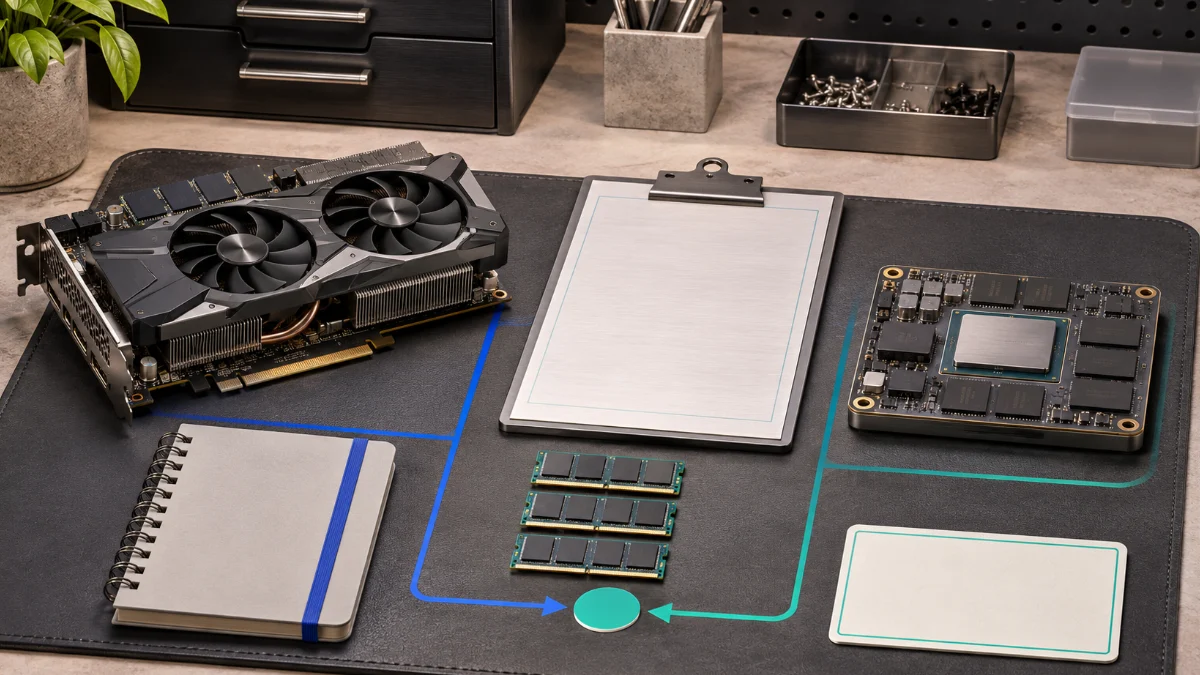
Decision Brief: Buy for the Task, Not the GPU Label
A GPU upgrade can be an excellent investment for local AI, but it is not automatically the first investment I would recommend. A larger graphics processor will not repair a poorly chosen model format, an unnecessary context setting, an unsupported software backend, or a workflow whose real bottleneck is evaluation and review. The useful decision starts with a defined task, not with a specification sheet.
For an engineer running local language models, the question is not simply whether a new card has more video memory. I want to know the model architecture, weight format, quantization level, effective context window, number of simultaneous requests, time spent processing input versus generating output, and the application’s acceptable quality threshold. For local AI inference, the deployment environment is part of the product constraint, not a footnote. I also want to know whether the task is intermittent or continuous. These details can change the economics of a GPU upgrade more than a generic product ranking suggests.
This article develops a Task–Memory–Throughput Contract: a decision framework linking required output quality, memory feasibility, latency, sustained workload, and total ownership cost. It is an engineering synthesis based on documented software behavior, not a benchmark report. The scenarios are illustrative; I have not measured the named hardware combinations or claimed any tokens-per-second improvement.
If you only read one thing: treat a GPU upgrade as a testable response to a measured constraint. First prove that the current system cannot meet a defined local AI task after reasonable model, context, and execution-path adjustments. Otherwise, the upgrade may only make the wrong configuration more expensive.
Why a GPU Upgrade Is a Workload Decision
The expression local AI covers very different jobs. A short single-user code completion session, a document assistant processing long passages, a batch transcription pipeline, and a model evaluation harness place different demands on compute, memory, storage, and operator time. The same device can feel responsive in one job and unusable in another without any hardware fault. Before considering a GPU upgrade, I define the work unit that must finish, the maximum acceptable delay, and the minimum quality that counts as correct.
For interactive generation, first-token delay and steady generation speed are separate experiences. Processing a long prompt can require substantial computation and memory activity before a user sees an answer. Generating subsequent tokens can be constrained by different resources, often including memory bandwidth and the model’s decoding characteristics. A GPU upgrade that helps one phase may have a smaller effect on the other. Reporting only one headline speed hides that distinction.
Parallel use adds another dimension. One engineer running a single assistant does not have the same requirements as a local service handling multiple tools or users. Concurrency can increase memory consumption, scheduling contention, and tail latency. The llama.cpp multi-GPU and memory troubleshooting guidance specifically discusses context size, concurrent slots, KV cache, and layer offloading as separate capacity levers. That is why I would not approve a GPU upgrade until the concurrency requirement is explicit.
Write the acceptance criterion before pricing hardware
For example, an acceptable requirement might be: “Complete the same document-question set with citations, preserve required factual accuracy, and return each answer within the agreed interactive latency envelope.” That is a test specification, not a performance result. If the task needs a very long context but rarely generates text, the investigation may point toward context management and memory rather than maximum arithmetic throughput.
I prefer requirements that can fail clearly. “Run larger models comfortably” does not define comfort. “Support the selected model and its actual context without swapping, while sustaining the required concurrent workload” does. The more specific the acceptance test, the easier it becomes to compare a GPU upgrade against a software change or a different system architecture.
GPU VRAM Is Not the Entire Memory Budget
GPU VRAM matters because resident model weights, inference buffers, attention state, and other allocations compete for available device memory. But the size displayed on a model download page is not a complete runtime memory requirement. A GPU upgrade must account for everything allocated during the actual run, not just the serialized model file. The graphics system and any other applications may also reserve device memory.
I separate memory into five planning categories: model weights; KV cache or other sequence state; intermediate and workspace buffers; runtime, driver, and allocator overhead; and memory required by other applications. Some runtimes manage these differently. Some workloads use sliding windows or architectures that do not follow a conventional full KV cache model. Consequently there is no universal “parameter count multiplied by bits” formula that guarantees a model will fit.
The most common mistake is checking a model at startup with a small prompt, observing that it loads, and treating the test as proof of capacity. A GPU upgrade chosen on that evidence alone could still fail under the production context length. It may fail when the real document arrives, when the context grows, or when a second session opens. I consider a GPU upgrade justified by memory only after recording the peak consumption under the intended context and concurrency, preferably with headroom for ordinary system variation.
KV cache makes context length an operational choice
In transformer-based autoregressive inference, the key-value cache stores attention information from earlier tokens for reuse. The Hugging Face caching explanation describes that mechanism. Longer contexts can consume substantial additional memory; cache implementations, precision, and model architecture determine the actual cost. The cache strategies documentation also describes offloaded and quantized caches, including the trade-off that cache quantization can hurt latency when memory is already sufficient.
Before a GPU upgrade, I therefore ask whether the application truly needs the configured maximum context. Retrieval that selects relevant passages, bounded conversation histories, summarization with explicit loss checks, or separate short tasks may lower pressure. These are not free optimizations: they can omit information or change answer quality. The relevant test compares task correctness as well as memory use. Increasing context merely because the model advertises a large window can make the machine look inadequate without improving the product.
Do not confuse advertised context with useful context
A model’s supported context setting, the runtime’s available memory, and the model’s demonstrated ability to use distant evidence are three different properties. A GPU upgrade may solve the second without establishing the third. I would run long-document questions with known answers at different positions before assuming the whole context is valuable. Where retrieval is used, check for missing citations and answer omissions rather than counting only prompt tokens.
Unified Memory Changes the Trade-Off, Not the Laws of Physics
On Apple silicon, CPU and GPU access a shared memory pool. The MLX unified memory documentation explains that an array can be used by either processor without the usual explicit device-copy model. That is a meaningful architectural distinction from a discrete GPU with its own VRAM. It can make certain local AI configurations practical without purchasing a separate graphics card.
A GPU upgrade comparison must account for system architecture before comparing nominal gigabytes. Shared memory is not unlimited memory. The operating system, applications, and inference workload still compete for the same physical resource. Nor does a nominal amount of unified memory map directly to the same performance as an equal number of discrete VRAM gigabytes: bandwidth, compute units, kernels, model support, thermal limits, and the runtime matter. A GPU upgrade comparison that treats unified memory and VRAM as interchangeable units will mislead purchasing decisions.
The MLX LM project documents model generation and quantization workflows designed for Apple silicon, while llama.cpp supports Apple Metal alongside CUDA, HIP, Vulkan, CPU, and hybrid execution paths. This does not make every model and feature equally supported on every backend. Compatibility should be verified for the exact model and task, especially for multimodal components and newer architectures.
What a comparative test must preserve
If I compare an Apple silicon system against a discrete-GPU workstation, I keep the model revision, quantization target, useful context, prompt set, output quality checks, and number of simultaneous sessions constant where technically possible. I also document where equivalent formats or kernels do not exist. The result should answer a workload question, not crown a universal platform winner. For a buyer considering a GPU upgrade, the right alternative might be a higher-memory shared architecture, a lower-cost existing device, or no hardware purchase at all.
Quantization May Change the Purchase Decision
Quantization represents weights at lower precision to reduce memory requirements and potentially improve inference efficiency. The llama.cpp quantization guide describes converting models to GGUF and documents possible quality loss. This creates a practical alternative to a GPU upgrade: use a suitable quantized model that still passes the actual task’s quality threshold.
However, a smaller file is not automatically the better decision. Aggressive quantization can change outputs, and the effect can vary by model and task. A code assistant, multilingual writing system, structured extraction flow, and reasoning-intensive evaluation may respond differently. I would not select the lowest-bit format solely because it fits. I would compare candidate formats on fixed inputs, record concrete failure categories, and retain a higher-precision reference where feasible.
GGUF is a model container and metadata format in common local inference workflows; it does not guarantee compatibility with every runtime or architecture. Quantization labels such as Q4 or Q5 are not universal quality grades across families and implementations. A GPU upgrade remains a hypothesis; it may become appropriate if the only versions that meet the acceptance threshold exceed the available memory, but that conclusion requires model-specific evidence, not a generic parameter-count chart.
Quality loss can cost more than the saved hardware
Suppose a lower-precision candidate saves memory but produces more incorrect structured outputs. If each incorrect output triggers review, rework, or an external verification call, the apparent efficiency gain can disappear. This is a hypothetical decision pattern, not an observed conversion or productivity result. The test must include downstream repair cost. A GPU upgrade can be rational precisely when higher precision materially reduces that cost, but the burden of proof is the measured quality delta.
CPU Offloading Is a Capability, Not a Free Performance Gain
Some inference runtimes can execute a model using both CPU and GPU resources. The llama.cpp documentation explicitly describes CPU+GPU hybrid inference for models larger than available VRAM. This can make a workload feasible without an immediate GPU upgrade. It is particularly useful when the priority is occasional access to a model rather than consistently fast interactive responses.
Crossing device boundaries carries costs. Depending on the implementation, CPU memory bandwidth, transfer bandwidth, operator placement, and synchronization can become limiting. A system that technically loads a larger model may still miss the latency objective. Therefore I treat offloading as a separate test configuration with its own measurements, not as evidence that VRAM no longer matters.
Conversely, a GPU upgrade that allows more layers or model state to remain on the accelerator can reduce those crossings. The gain depends on architecture and runtime. Before purchasing, compare three states: current hardware with reasonable offloading, current hardware with a smaller or differently quantized model, and a proposed hardware configuration when real comparable measurements are available. If the new configuration has not been tested, label its projected benefit as a hypothesis.
Separate Prefill, Decode, Concurrency, and Tail Latency
A single tokens per second number is not enough to justify a GPU upgrade. A GPU upgrade must improve the phase the end user actually waits for. Prompt processing and token generation have different computational characteristics; caching, batching, and input shape can change the relationship. Before a GPU upgrade, I measure elapsed time to first useful output, sustained decoding performance, task completion time, memory peak, and the slowest reasonable requests under the expected parallel load. A speed increase that leaves the user’s real task unfinished is not an operational success.
For a document assistant, prefill and retrieval time might dominate. For a long creative drafting session, sustained generation may matter more. For background classification, total items processed per unit time and failure retries may be the relevant quantities. Each case can produce a different recommendation for the same GPU upgrade. This is why I would design a representative prompt mix rather than choose one favorable synthetic input.
Measure correct completions, not only fast tokens
I use two layers of acceptance: infrastructure performance and task quality. Infrastructure measurements tell me whether a GPU upgrade changes resource behavior. Task-level evaluation tells me whether it improves useful results. A model that generates faster but requires more corrections can have higher total cost. Conversely, a slower setup may be fully adequate when runs are asynchronous and the review queue, not the GPU, is the true bottleneck.
Task–Memory–Throughput Contract: The Decision Matrix
I use a Task–Memory–Throughput Contract to prevent a hardware wish list from replacing an engineering requirement. Each row describes an obligation that the workload must satisfy, evidence to collect, and the condition under which a GPU upgrade becomes plausible. The contract has no automatic score: an unresolved safety or correctness requirement cannot be offset by a faster benchmark.
| Domain | Question | Evidence | Possible decision |
|---|---|---|---|
| Task quality | Does the output meet the job’s acceptance tests? | Fixed prompt set, error taxonomy, human review rules. | Change model or format before hardware. |
| Memory feasibility | Can weights, state, and buffers fit under real load? | Peak allocation at target context and concurrency. | Reduce avoidable memory or consider capacity. |
| Latency | Are prefill and decode within the user’s threshold? | First useful response, completion time, p95 where meaningful. | Test runtime path; then evaluate acceleration. |
| Runtime compatibility | Does the backend support the exact model and features? | Versions, architecture, unsupported operators, logs. | Resolve support before a GPU upgrade. |
| Workload frequency | How much useful work recurs each month? | Actual runs, active hours, concurrency. | Compare ownership with alternatives. |
| Operational recovery | Can the job retry or fall back safely? | Failure reproduction, rollback and quality checks. | Improve workflow before scaling hardware. |
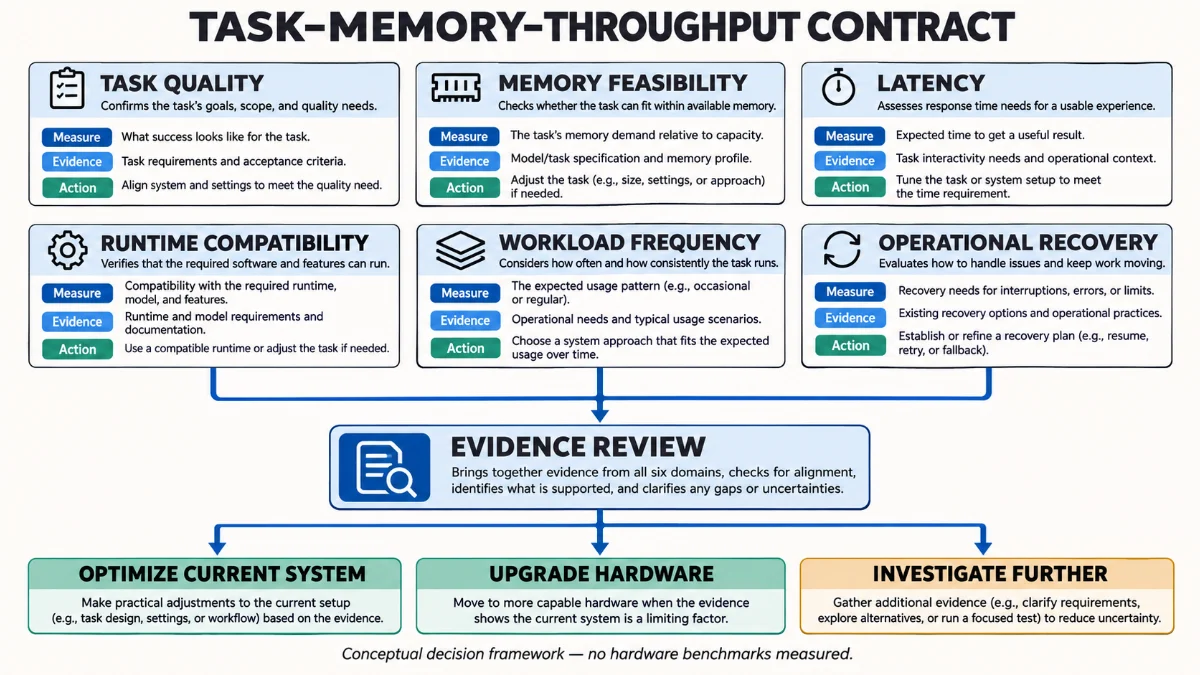
The central property is that every proposed GPU upgrade is traceable to one failed contract condition. If memory is the constraint, I should show the peak memory evidence. If throughput is the constraint, I should show representative task completion times. If quality is the constraint, I should prove that the proposed configuration enables a version that materially improves the work.
Three legitimate outcomes
Optimize the current system when a smaller context, compatible runtime, quantization change, or prompt pipeline solves the measurable problem without unacceptable quality loss. Upgrade the hardware when the present device fails a necessary capacity or latency test and the proposed purchase has adequate comparative evidence. Investigate further when data are missing or multiple constraints change at once. These are dispositions, not rankings.
Three Illustrative Workload Decisions
These examples are deliberately hypothetical. They show how I would reason about a GPU upgrade, not outcomes from any particular Mac, desktop GPU, or tested customer environment.
Scenario One: A Solo Engineer Running Short Coding Prompts
An engineer uses a local assistant for short code questions and occasional test suggestions. The model loads consistently, and responses arrive within the agreed interactive threshold. The bottleneck is manually checking suggestions before merging them. In that context a GPU upgrade has no demonstrated value. Better unit tests, change review, and a model selected for the language and repository may reduce real effort more reliably than extra throughput.
If the work later expands to larger repositories or simultaneous agents, the contract changes. I would then measure context growth, parallel sessions, and the actual completion queue. The decision should be revisited because workload evidence changed, not because a new card was announced.
Scenario Two: Long-Context Document Review
A research workflow loads many pages into each request. The model fits for short inputs but memory pressure appears as the context grows. Before a GPU upgrade, the engineer tests retrieval, task-relevant extraction, cache precision where supported, and a smaller context. The quality gate checks whether important evidence is lost, including answers that require distant passages. If careful context reduction preserves performance, memory investment may be unnecessary.
If full-context fidelity is a hard requirement and the tested runtime cannot stay resident, more memory becomes a serious option. However, the buyer still needs to compare a discrete-GPU configuration, a high-memory unified system, and the possibility of separating ingestion from inference. The memory requirement alone does not decide which architecture wins.
Scenario Three: A Batch Workflow With Overnight Processing
A content-classification pipeline completes jobs asynchronously. Users do not wait on each token, and the system already finishes its required batch within its deadline. A GPU upgrade that raises peak throughput might not produce any additional business value. The energy cost, purchase price, maintenance overhead, and operator time would need to be justified by an actual volume increase or new deadline.
If the pipeline grows and misses its completion window, the equation changes. The next experiment should compare faster hardware with batching improvements, reduced repeat work, a smaller model that passes classification quality checks, and temporary rented capacity. I would not treat a GPU upgrade as the default merely because the workflow is computational.
Total Cost of Ownership Beats a Hardware Price Tag
The purchase price of a GPU upgrade is only one cost category. A fair comparison includes electricity and power consumption during active inference, idle power where relevant, cooling and noise constraints, system memory or power-supply changes, compatibility work, software maintenance, and the engineering time required to tune and validate the setup. Some of these costs will be negligible in a home environment and substantial in an always-on installation. A GPU upgrade that is rarely utilized may never recover its acquisition cost through useful work. The important point is to measure or declare them rather than silently omit them.
I would calculate a task-normalized cost: acquisition and setup cost amortized over an explicitly chosen period, plus operational energy and maintenance, divided by the number of correct, useful tasks completed. That denominator matters. Comparing cost per raw token across models with different output quality can reward a system that requires more rework. The method should also show the assumed utilization, since a card used a few hours a month has different economics from one running continuously.
Energy calculations need measured watts or a clearly labeled estimate. The generic relationship is energy in kilowatt-hours equals average power in kilowatts multiplied by operating hours. This is arithmetic, not a forecast about a specific GPU upgrade. Electricity prices, thermal conditions, idle draw, and hardware age differ widely, so I would not publish a fabricated monthly energy saving for an untested machine.
| Cost input | Current setup | Proposed setup | Verification |
|---|---|---|---|
| Hardware acquisition | Existing sunk cost, noted separately | Actual total purchase and integration quote | Vendor quote and compatibility review |
| Active energy | Measured wall-power draw | Measured comparable draw or labeled estimate | Power meter, workload duration |
| Useful throughput | Accepted tasks per hour | Same tasks and acceptance gate | Repeated representative run |
| Quality/rework | Correction and rejection effort | Same evaluation procedure | Blind review where feasible |
| Maintenance | Backend and driver upkeep | New dependencies and downtime | Documented operating plan |
Include the cost of not upgrading
There are legitimate opportunities where doing nothing is expensive: analysts wait on local inference, private data cannot be sent to an external service, or tasks fail when memory is exhausted. But I treat these as quantified workflow costs, not rhetorical reasons to buy hardware. A GPU upgrade should be approved when its expected benefit exceeds the cost and uncertainty, with a plan to verify that benefit after deployment.
A Reproducible Test Before Any GPU Upgrade
My proposed test protocol is deliberately small enough for one engineer yet strong enough to expose common confounders. It compares configurations rather than inventing universal performance numbers.
1. Freeze task and model identity
Record model name and revision, architecture, quantization, backend version, model file or repository identifier, prompt templates, context setting, batch or parallel configuration, and the target outputs. A GPU upgrade comparison is invalid if the models or prompts silently change between runs.
2. Establish the correct-result gate
Choose a fixed task set representing routine work, long inputs, difficult edge cases, and expected failures. Define what counts as a correct answer before running the hardware comparison. Record refusals, malformed structured results, missing citations, and hallucinations by category. Faster wrong answers are not successful work.
3. Profile memory at the hardest valid workload
Measure peak host memory and device allocations with intended context and concurrency, not only a startup screen. Capture allocation failures and CPU offloading state. A GPU upgrade should be tied to an observable memory gap rather than the model’s headline file size.
4. Split response time into useful phases
Record first useful output, prefill, decode, total task completion, and repeated-run variation as supported by the runtime. Note cold starts, cache state, background processes, temperature, and power mode. Compare samples under consistent conditions. A single best run is not a reliable buying decision.
5. Compare reversible changes before buying
Test reasonable context limits, candidate quantization formats, alternate compatible backends, and carefully selected CPU offloading settings. Change one major variable at a time; preserve the quality gate. Some changes trade accuracy for memory or latency, and those trade-offs must remain visible.
6. Record the decision and its reversal trigger
Write an architecture-style decision record stating what failed, what evidence supports the selected option, which alternatives were rejected, the cost assumptions, and what new evidence would reverse the choice. A GPU upgrade has earned approval when it addresses a defined failure and remains defensible after quality, resource, and operating costs are considered together.
The Metrics That Can Falsify the Buying Hypothesis
An effective hardware evaluation should be able to say no. I would predefine failure conditions that disprove the need for a GPU upgrade. Examples include: the existing setup already satisfies all real task deadlines; a quantized model passes quality checks with sufficient memory; the bottleneck appears in data preparation rather than inference; or the expected utilization is too low to justify ownership.
I also need conditions that strengthen the buying case: repeated out-of-memory failures at required context, sustained CPU offloading that violates latency limits, inability to meet throughput without reducing validated quality, or repeated deadlines missed because inference—not data or review—is constrained. These are observable conditions, not proof that a particular card will solve them. The proposed configuration still needs credible evidence.
| Observed symptom | Possible explanation | Required next check |
|---|---|---|
| Loads small prompts, fails large ones | Context-state memory, buffering or concurrency | Peak memory at target sequence length |
| Low GPU use, slow answers | CPU path, transfer stalls, tokenization or synchronization | Runtime logs and phase timing |
| Fast tokens, poor completion quality | Model, quantization or evaluation mismatch | Task-level error classification |
| Batch finishes before deadline | No demonstrated throughput problem | Real utilization and projected workload growth |
| Large model only partly offloaded | VRAM insufficiency or chosen execution configuration | Layer placement and measured latency |
When a GPU Upgrade Really Is the Right Answer
This framework is not an argument against discrete GPUs. A GPU upgrade is often sensible when supported kernels, dedicated memory capacity, sustained acceleration, and appropriate software make an otherwise impossible or unacceptably slow task practical. Training, fine-tuning, multimodal inference, and high-concurrency serving may also change the equation. The relevant comparison includes model support and actual operational constraints.
Some buyers also value offline availability, confidential local processing, predictable control over the environment, and the ability to experiment without metered remote inference. Those are real product requirements, although local execution alone does not guarantee security or privacy. They can justify ownership even when raw operating cost is not lowest. The hardware specification should follow that policy decision, not substitute for it.
Where accuracy or safety is critical, a GPU upgrade should never serve as an excuse to skip independent evaluation. Hardware can make a model run; it does not validate generated content. I would insist on quality thresholds and logging even after the machine is upgraded.
My Decision Rule: Prove the Bottleneck, Then Purchase
I would approve a GPU upgrade for local AI only when five conditions hold: the task is explicit, the quality threshold is defined, the present bottleneck is observed, lower-cost reversible alternatives have been tested, and the proposed configuration has evidence of meeting the target with acceptable total cost. This is intentionally stricter than “more VRAM is better.” It is a method for protecting engineering budgets from an attractive but unfalsified assumption.
The decision may still be to stay with an existing Apple silicon system, tune a CPU+GPU path, choose a smaller quantized model, rent capacity for occasional large jobs, or purchase a discrete accelerator. Each can be correct under different requirements. The defensible recommendation is the one that can show what the user gains, what it costs, and which measurement would prove the recommendation wrong.
My broader principle is that local AI hardware is a product and systems decision. A GPU upgrade is an implementation choice within that decision. Keeping the two separate makes the outcome more reliable, auditable, and easier to revisit when model runtimes, quantization methods, workloads, or costs change.
Evidence, Methodology, and Limits
This is a documented technical synthesis and a proposed operational decision framework, not an empirical benchmark. I used the published runtime and framework documentation cited throughout, prioritizing the original projects for quantization, model offloading, unified memory, and KV cache behavior. No throughput, energy, financial, or model-quality figures were gathered for this article. The illustrative examples cannot establish a performance ranking.
Hardware, driver, backend, model, and cache implementations evolve. Any purchasing decision should repeat the compatibility and measurement checks against the exact versions in use. There is no universal “minimum VRAM” threshold that covers every model, context, quantization level, and concurrency goal. For related system-level performance reasoning, see the Technology & Hardware Articles collection; internal article URLs are intentionally omitted here unless their live routes can be confirmed.
Key terms
GPU VRAM: dedicated graphics memory available to a discrete accelerator. Unified memory: a shared memory architecture, not an independent pool of extra VRAM. GGUF: a model file/container format used by certain local inference runtimes. Model quantization: a change in numerical representation that may reduce memory use and alter quality. KV cache: attention state used for autoregressive generation. CPU offloading: keeping some computation or model state outside the GPU execution path.
Editorial status: Research reviewed November 4, 2026. The Task–Memory–Throughput Contract is the author’s conceptual framework; it has not been empirically validated as a universal scoring model. Publication date should match the actual WordPress publish timestamp.