


AI Image Consistency: Why Prompting Is Not Art Direction

Code Review: The Hidden Cost of AI-Generated Code

The Reach Trap Is Not a Problem of Too Much Visibility
A post can travel far beyond its intended audience and still leave a professional brand weaker than it was before. The distinction is not that viral content is bad. It is that distribution and positioning answer different questions. Distribution asks who encountered the message. Positioning asks what people now believe I am qualified to do, whether the right people want a second interaction, and whether the work produces relationships worth continuing. Viral content sometimes advances all three. Sometimes it advances only the first.
I call that second outcome the reach trap: an attention spike becomes a management signal, and the publisher starts adapting the entire editorial system to the people who happened to respond. The next post imitates the surprise hit. The original subject matter gets pushed aside. Soon, the content is highly recognizable but less connected to the problems the author actually solves. None of that requires manipulation by a platform or bad intent by an audience. It can emerge from ordinary decisions made under noisy feedback.
My focus here is professional publishing: software, AI, product, design, consulting, and other expertise-driven fields in which the desired next step is usually not an impulsive purchase. A meaningful outcome might be a qualified conversation, informed referral, substantive question, article return, or a credible invitation to work together. Viral content is only useful to this system when it helps rather than distorts those outcomes. This is an analytical framework, not a report of a measured campaign or a claim that I can read a platform’s ranking algorithm.
Why the Wrong Audience Is a Real Strategic Risk
The audience for viral content is not inherently the wrong audience. People outside my current professional niche may become clients, collaborators, readers, or useful critics. The risk begins when I cannot articulate a plausible connection between the people responding and the future work I want to be known for. Viral content about a trending product might attract general curiosity; a detailed systems-design article may attract fewer people who are preparing a real architecture decision. Neither group is morally superior. They simply serve different editorial purposes.
Consider a consultant whose practice centers on software architecture. A viral joke about a consumer gadget might generate thousands of reactions. A detailed explanation of reliability trade-offs might generate a few responses from engineers facing the same decision. If the consultant’s objective is peer learning or project discovery, the second conversation may deserve more attention even though the first dominates the dashboard. The point is not to assume every professional comment about viral content becomes revenue. It is to test whether attention is related to the stated purpose.
Viral content creates a special measurement temptation because the signal arrives quickly and appears objective. An impression is countable. The quality of an inquiry takes interpretation, time, and sometimes a private conversation. For viral content, this asymmetry favors the faster number. That is a content positioning risk: the resulting strategy can drift before anyone notices that the new audience primarily expects a kind of content the publisher does not intend to produce.
A Misaligned Audience Can Still Be a Legitimate Audience
The phrase “wrong audience” describes mismatch, not a judgment about people. Students, hobbyists, customers, executives, researchers, and general-interest readers can all be valuable in different contexts. If I claim to support founders making product-investment decisions, then attention from people looking only for entertainment is less predictive of that specific outcome. If my goal is public education, that same attention may be entirely welcome.
I therefore avoid reducing audience fit to job titles alone. Someone with a relevant title may never need my expertise, while someone outside the target title may introduce a decision-maker. Audience fit is a hypothesis based on needs, behavior, and intent. Viral content gives me an opportunity to examine that hypothesis, not permission to label unfamiliar viewers as irrelevant.
Impressions, Reach, and Interest Are Different Measurements
Platforms already distinguish some of these concepts, although their vocabulary and counting methods differ. According to LinkedIn’s post analytics documentation, impressions count displays; members reached approximates distinct members and Pages; profile viewers and followers gained from a post are separate activities. The company explicitly describes its post-level numbers as estimates. For viral content, these definitions make it unreasonable to treat an impression as a person who has formed a view of the author’s expertise.
YouTube’s Audience analytics documentation separately defines new, returning, casual, and regular viewers. Those categories are not a universal definition of loyalty, but they illustrate a better question than raw exposure: does the person come back? On a professional website, I would ask a similar question through repeat engagement, useful navigation, or a relevant contact action, while acknowledging consent and attribution limits.
| Signal | What it can support | What it cannot establish by itself |
|---|---|---|
| Impressions or views | How often content was displayed or played under the platform’s counting rules | Unique people, comprehension, or buying intent |
| Estimated unique reach | Approximate breadth of exposure | Relevance of each viewer or trust |
| Reactions and reposts | Visible forms of response and redistribution | Endorsement of professional capability |
| Profile visits and saves | A stronger indication of deliberate exploration | Whether a visitor fits a professional need |
| Returning readers or viewers | Continued attention under a defined measurement window | Satisfaction, causality, or contract value |
| Qualified inquiries | Observable conversations connected to a defined need | That the content alone caused the opportunity |
This table is a measurement interpretation, not a scoring formula. I would never add the rows into an invented “audience quality” percentage. With viral content, the data types, privacy protections, and opportunities for attribution differ too much. Viral content can produce more of every signal in the table without proving that the relationship between those signals has improved.
A Higher Engagement Rate Is Not Automatically Higher Intent
An angry correction, an amused reply, and a serious implementation question may all be counted as comments. A repost of viral content may express disagreement. A save may mean “read later,” not “hire this person.” Even a click may reflect curiosity rather than durable interest. I use engagement quality as a qualitative description of what people are asking and doing, not as a secret algorithm that converts every reaction into commercial value.
For viral content, the composition of responses matters more than a single percentage. Do people ask about evidence, constraints, implementation, and trade-offs? Do they return to the central topic? Or do they mainly request another version of the entertainment format? Neither pattern is a complete verdict. Together with audience fit and subsequent actions, they help make the exposure intelligible.
Audience Segmentation Should Start With a Decision
Most social audience segmentation begins with demographics. Age, seniority, and geography can be useful for a defined market, but an expert publisher needs a second layer: what decision is the reader trying to make? A design leader evaluating research methods and a software architect diagnosing deployment risk may both be senior technology professionals. They need different evidence, examples, and next steps.
Before evaluating viral content, I start by naming a primary audience in terms of the decision I can help. For example: “engineering leaders deciding whether a proposed AI integration is reliable enough to deploy.” Then I identify adjacent audiences, such as practitioners learning the method or founders planning procurement. Finally I describe opportunistic attention, meaning people who found the subject interesting but have not shown a connection to the decision. It is a working model for viral content and specialist publishing, not a classification of individuals by private traits.
| Segment | Observable question | Valuable next action | Interpretation caution |
|---|---|---|---|
| Decision owner | “Would this change our choice?” | Reads a decision framework or requests a substantive discussion | Silence may reflect private evaluation |
| Practitioner | “How would I implement or test this?” | Saves the method or asks a technical question | May be a valuable referrer rather than a buyer |
| Adjacent peer | “How does this connect to my field?” | Connects ideas or shares qualified context | Indirect value takes time to emerge |
| General-interest observer | “What happened, and why is it interesting?” | Enjoys, shares, or discusses the post | Interest can be legitimate without commercial intent |
An audience need not fit one permanent box. The same reader may learn as a practitioner and later approve a budget. Viral content might introduce that reader at the general-interest stage. The practical requirement is to look for a credible transition rather than claim every introduction has equivalent value.
Segment Evidence Must Be Aggregated and Consent-Aware
I do not need to identify individual visitors or infer protected personal characteristics to measure audience fit. LinkedIn can provide aggregated viewer demographics where enough data exists; the documentation notes privacy-related availability limits. On a website I can compare broad, consent-compatible acquisition sources and on-site events, not reconstruct a person’s identity from a few traces. A small set of private messages should not become a public case study without permission.
If responses to viral content provide only a tiny sample, I would report patterns as hypotheses. If viewer demographics are missing, I would not fill the gap from profile photographs, names, language, or guesswork. A trustworthy review of viral content explains what was observed, what remains unknown, and which conclusions would require more evidence.
The Signal Lag Between Attention and Opportunity
A content dashboard operates on the timescale of minutes and days. Professional trust often operates on the timescale of repeated encounters, projects, and referrals. For viral content, this creates an evaluation problem: a viral post has already produced visible numbers while the next relevant interaction may not happen for weeks. A publisher who reviews only the first day is systematically biased toward content that produces immediate response.
I separate three observation windows. The first covers the initial distribution event: estimated reach, reaction type, and any unusual attention. The second examines follow-on behavior over subsequent publications: do those viewers interact with the expertise I want to sustain? The third looks for qualified outcomes within a longer period: relevant inquiries, repeat reading, references, or invitations. These windows are planning conventions, not empirically validated universal thresholds.
Viral content may earn attention today and lead to a productive relationship later. The reverse is also possible: a huge initial reach creates no observable sustained interest. I cannot infer either result from a single post. This is why the monitoring design must include a later review trigger and a written explanation of what would count as meaningful progress.
The Invisible Value of a Quiet Post
A post read by a small number of relevant professionals may not accumulate public reactions. Someone can share it privately in a team, revisit it while preparing a decision, or remember the author during a future project. These possibilities are plausible, not measurable proof of hidden success. I would document known inbound references when they appear and leave the rest uncertain.
When reviewing viral content, this guards against two equal mistakes: dismissing all low-reach work as a failure, and romanticizing low-reach work as secretly valuable. The standard is still evidence. Viral content does not deserve credit merely for being loud, and specialized content does not deserve credit merely for sounding serious.
A Public Platform Example: LinkedIn’s Analytics Taxonomy
When reviewing viral content on LinkedIn, consider the metrics the platform publicly makes available: in-network versus out-of-network exposure, members reached, profile viewers attributed to a post, followers gained, saves, and other actions. These fields describe different parts of the journey from distribution to possible interest. The existence of those fields does not prove that any particular author converted attention into business. It does show that the platform itself distinguishes distribution from later behavior.
If a technical article generates broad out-of-network impressions but almost no relevant exploration, I would investigate the framing and distribution context rather than automatically celebrate or condemn it. If a lower-reach article brings strong peer questions and deliberate profile exploration, I would treat that as a different pattern. I would still avoid a causal conclusion: topic, format, publication time, audience composition, and platform state may all differ.
For viral content, the useful question is not “Did the post escape my network?” but “Did the next observable behaviors support the kind of relationship this content was meant to start?” A trustworthy analysis keeps the numerator, denominator, and measurement window visible. For example, profile visits divided by estimated unique viewers is a descriptive ratio, not a verified conversion probability; the quantities may be incomplete or differently counted.
X and Threads Require Different Evidence Boundaries
I also publish across X and Threads, where discussion dynamics and available analytics differ from LinkedIn. I do not treat impressions, replies, reposts, link visits, or follower changes across these networks as interchangeable measurements. The same viral content can attract professional analysis in one context and broad debate in another. Comparing raw totals would hide that difference.
When viral content crosses platforms, I record the platform, content format, publication context, observation window, and measurement definition. I separately read a sample of substantive replies for topical relevance. If I cannot access a platform-specific metric reliably, I mark it unavailable instead of substituting a different number. The goal is not perfect data. It is disciplined uncertainty.
Public Research Shows Why Platforms Cannot Be Treated as One Audience
The Pew Research Center’s October 2026 social media and news fact sheet, based on an August 2026 survey of U.S. adults, reports different news-consumption patterns across platforms and user groups. This is evidence that platforms can host distinct information-seeking contexts. It is not evidence that users of one platform are more valuable, nor proof that social reach predicts business outcomes.
That methodological distinction matters when judging viral content. The audience for viral content is never simply the national demographic table. Platform samples, professional niches, content formats, language, and distribution paths differ. Viral content can reach people from an entirely different conversational context than the one in which a consultant normally operates. An audience-level survey can help frame a hypothesis about channel selection, but only direct content and outcome observations can test the publisher’s own fit.
I also avoid treating a trending news audience as a substitute for a professional market. Someone may engage because an issue is timely and never return to the underlying engineering or product discipline. The relevance of that engagement depends on the article’s declared goal, not on the fact that it occurred.
The Reach–Relevance–Trust–Opportunity Contract
To make the decision concrete, I use a conceptual governance record called the Reach–Relevance–Trust–Opportunity Contract. The contract is not an algorithm, a score, or a claim of scientific validation. It is a compact agreement about what a publishing decision is intended to accomplish and which observations could justify changing the next move. The word “contract” means a decision rule the publisher is willing to inspect later, not a legal instrument.
| Assessment domain | Decision question | Evidence worth collecting | Stop or review condition |
|---|---|---|---|
| Reach | Who encountered the work under the platform’s metric definition? | Impressions, estimated unique viewers, channel, period | Exposure is increasing but denominator is unknown |
| Relevance | Does the response connect to our topic and target decisions? | Topic-coded replies, aggregate demographics, relevant follow-on reading | Attention concentrates on an unrelated theme |
| Trust | Does the audience understand the claim and its limitations? | Substantive questions, corrections, reliable sourcing, return behavior | Misleading framing or unsupported certainty spreads |
| Opportunity | Does attention create appropriate next conversations? | Qualified inquiries, useful referrals, newsletter or site return, time spent | Editorial effort displaces higher-value work without evidence |
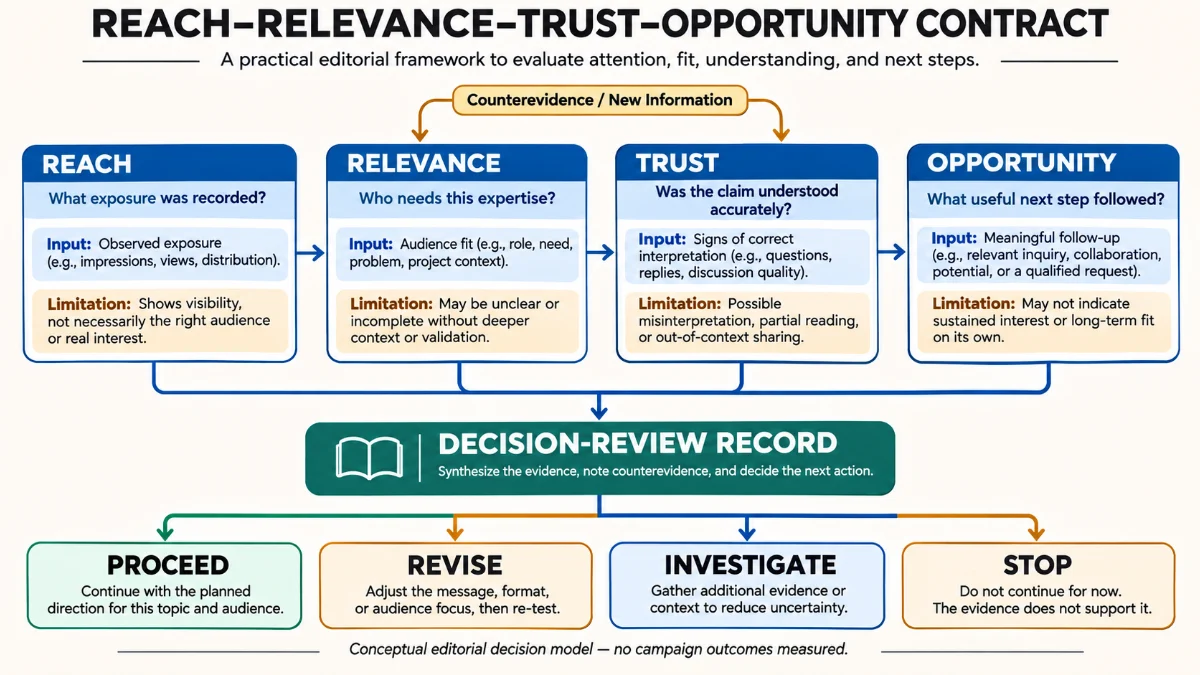
The contract for evaluating viral content begins before publishing. I state the editorial purpose and the audience hypothesis, then write down what would change my mind. After publication, I compare the evidence with those conditions. Viral content receives the same evidence standard as a narrow technical article; it is not exempt from review because the chart looks attractive.
The graphic for this framework belongs immediately after the table. A valid decision may be to proceed with the topic, revise the format, investigate an unexplained pattern, or stop amplifying an unhelpful variation. None of these outcomes should be generated from an arbitrary weighted sum. The decision owner must explain why the evidence is sufficient for the specific action.
Distinguish Observations, Inferences, and Decisions
An observation might be: “This post had more impressions than the preceding posts.” An inference might be: “The broader audience seems interested in the topic.” A decision might be: “We will allocate another publishing slot to this theme.” Those are three different statements. The second requires supporting evidence; the third requires an explicit trade-off with other work.
The most common failure I see in growth reviews is skipping directly from observation to decision. Viral content produces a visible spike, so the team assumes the audience hypothesis was validated and reallocates the calendar. A careful record of viral content asks what evidence would support the audience inference and what counterevidence would invalidate the expansion.
The Counterevidence Gate: When Reach Should Not Win
Before scaling a successful post format, I look for disconfirming signals. Are the most active replies focused on an incidental joke rather than the subject? Has follow-on content on the core topic received less relevant engagement? Did the expanded exposure drive questions the publisher cannot answer or services they do not provide? Has the content relied on a simplified claim that needs correction? Each pattern can challenge the conclusion that more distribution is beneficial.
When viral content succeeds, I also look for counterevidence against my skepticism. Perhaps new readers arrived for a broad explanation and later moved into technical material. Perhaps a general-interest post introduced decision-makers who would never have encountered a specialist article. Perhaps an apparently casual discussion led to a substantive collaboration. These are reasons to investigate, not excuses to declare viral content inherently harmful.
| Initial signal | Possible explanation | Additional check | Decision posture |
|---|---|---|---|
| Sudden reach increase | Broad topic, redistribution, unusual format | Compare topic-coded replies and follow-on actions | Investigate before repeating |
| High reactions, few inquiries | Entertainment fit or long professional buying cycle | Review intent and longer observation window | Do not infer failure or success |
| More followers, weaker core-topic engagement | Audience expectation drift | Compare returning participation by content theme | Revise content mix if pattern persists |
| Lower impressions, relevant technical conversations | Concentrated professional interest | Examine inquiry quality without inventing value | Preserve the specialist format |
| High referral traffic, little on-site depth | Curiosity clicks or landing-page mismatch | Check content relevance and consent-aware events | Diagnose the handoff before amplifying |
A counterevidence gate is particularly useful when a team is emotionally invested in the success of a viral post. It introduces a review mechanism without insulting the audience or dismissing a legitimate creative breakthrough.
Connect Social Reach to Owned Media Without Inventing Attribution
An independent website, newsletter, portfolio, or knowledge base can provide a second opportunity for readers to evaluate expertise. That does not mean every social post should contain a link, or that a traffic surge is automatically a qualified lead. Owned media is valuable because it lets the publisher explain the full argument, retain a stable reference, and design a more meaningful next action than another reaction.
Google Analytics 4 distinguishes traffic-source dimensions by scope. The Traffic acquisition report documentation describes session source, medium, engaged sessions, and key events. The attribution documentation explains why user-, session-, and event-scoped acquisition views answer different questions. I would use these distinctions rather than claim that a social interaction directly caused a sale.
When analyzing viral content, I can tag links consistently where platform rules permit, define a small number of meaningful key events, and document consent-related gaps. I should not equate every page view with reading or every inquiry with a customer. Conversion intent remains uncertain: a visitor may discover an article through social media, return from search, and make contact much later. Attribution is an interpretation under a defined model, not an eyewitness account of motivation.
The Handoff Must Respect Reader Intent
For viral content, the most convincing post-to-site journey keeps the promise of the original content. If a post discusses a measurement blind spot, the linked article should explain that blind spot in depth. If it introduces a technical trade-off, the destination should supply assumptions, alternatives, and limits. For viral content, a generic “book a call” page may be a poor continuation for a reader who only wanted to understand a concept.
Viral content sometimes creates an audience too broad for one destination. The solution is not a deceptive funnel. It may be a clear set of optional paths: a beginner explanation, a specialist article, and a project overview. The reader retains control. Qualified engagement grows from relevance and trust, not from hiding the real topic behind a viral hook.
Three Hypothetical Cases That Test the Claim
The following cases about viral content are explicitly illustrative. They are not my measured results, customer studies, or confidential campaign reports. Their purpose is to show how the same reach pattern can justify different decisions.
Case A: A Trend Post Outperforms the Technical Series
A software consultant publishes a short, amusing comment on a consumer technology controversy. The post spreads widely, but the questions center on the controversy rather than architecture or delivery work. The consultant’s next specialized article receives fewer impressions. It would be premature to say that this viral content damaged the audience. It would also be premature to redesign the entire calendar around the controversy.
My decision would be to retain the post as a broad distribution experiment, publish a related but substantive bridge article, and watch whether anyone crosses into the actual expertise. Viral content has earned a follow-up test, not a mandate to change professional identity.
Case B: A Narrow Research Note Sparks Valuable Discussion
A product researcher shares a careful explanation of why a small usability study can reveal problems without estimating population prevalence. The post reaches fewer people but triggers nuanced questions from product and design leads. No contract is signed and no revenue is measured. The evidence supports one limited conclusion: the subject attracted relevant professional discussion.
In this case, I would preserve the research line, make the methods accessible, and observe repeat engagement. I would not use a later popularity spike from unrelated viral content to declare the research format obsolete. Different formats serve different decision stages.
Case C: A Broad Story Creates a Legitimate Bridge
An AI product leader tells a widely understandable story about an automated system taking an action it should only have proposed. The narrative spreads beyond the immediate engineering audience. Some readers then explore the detailed piece on approval gates, audit trails, and bounded authority. A few provide questions about their organizational review process. That transition would be evidence worth recording, subject to measurement limits.
The broad content did not become valuable solely because it was viral. It became strategically useful because the story preserved the original technical thesis and offered a credible route to deeper material. Viral content can work when it invites the right second interaction without misrepresenting the expertise behind it.
How I Would Review a 30-Day Content Window
For viral content, I prefer a short, repeatable review protocol to an elaborate dashboard that nobody maintains. The review starts by recording each post’s declared role: awareness, education, evidence, collaboration, or direct opportunity. I assign a primary audience hypothesis and a core topic before publication. At review time, I compare posts within similar roles rather than rank every piece by views alone.
Week one is about collecting data and noting distortions. I record the platform’s own reach definition, basic engagement, and visible changes in discussion. Week two checks follow-on behavior: are readers asking for related material, returning to the topic, or engaging with a different subject? Weeks three and four look at qualified inquiries, referrals where known, and the editorial hours spent to create, distribute, moderate, and follow up. These are operational checkpoints, not a promise that all opportunities appear within thirty days.
A review of viral content should record what it could not measure. Comments may have been deleted; private shares are often invisible; referrals may be unattributed; small counts may fluctuate dramatically; platform analytics can be estimates. I would keep a compact uncertainty note alongside the metrics. A clean chart without its uncertainty can create more false confidence than the missing data itself.
A Minimal Measurement Ledger
| Field | Required entry | Why it matters |
|---|---|---|
| Editorial intent | The decision or understanding the post should support | Prevents retrofitting success after publication |
| Audience hypothesis | Primary, adjacent, or exploratory segment | Establishes relevance criteria |
| Channel and format | Platform, format, link context, date | Prevents false cross-platform comparisons |
| Exposure | Source-defined metric and time window | Preserves counting limitations |
| Response quality | Short topical summary, not a secret numeric grade | Keeps actual conversation visible |
| Follow-on evidence | Relevant return, referral, inquiry, or none observed | Separates first contact from durable interest |
| Cost and uncertainty | Creation effort, moderation time, data gaps | Prevents free-reach illusions |
| Next decision | Proceed, revise, investigate, or stop | Makes the review operational |
A ledger lets me evaluate viral content without constructing a surveillance system. I do not need names from private messages, hidden identities, or sensitive demographic inference. Aggregate counts and a privacy-respecting summary of relevant themes are sufficient for many editorial decisions.
Opportunity Cost Is More Than Publishing Time
Viral content may create additional work: answering questions, moderating conflict, checking claims, revising an overly simple explanation, and managing new audience expectations. None of these costs makes viral content undesirable by itself. They become important when the publisher is an individual or a small team with limited time. One more hour spent sustaining a trend is one less hour spent researching, building, improving the website, or responding to a qualified inquiry.
I include production effort, review time, and reputational risk when deciding whether viral content deserves another publishing slot. I do not assign imaginary dollar values to each impression or assume every expert hour has the same price. An editorial opportunity cost is a comparison between real alternatives. If a post generates helpful attention but consumes most of the week’s attention budget, a lighter follow-up may be better than a larger campaign.
Viral content can also impose a trust cost when the original claim is stretched for simplicity. A technical expert may know an exception but omit it from a provocative hook. Later corrections may be necessary even if the short-term performance looks strong. I consider accuracy a constraint, not a variable to trade against the possibility of extra views.
When Viral Content Is Exactly the Right Tool
There are legitimate reasons to seek broad distribution. Public-interest explanations, product launches with large accessible markets, recruitment campaigns, education, creative work, and community-building projects may benefit directly from scale. A specialist can also use a clear, relatable story to reach relevant people who would ignore a highly technical title. I would not defend low reach as a badge of integrity.
The strongest case for viral content is a good match between message, audience, and next step. A broad hook can be accurate; a popular story can preserve technical nuance; a large audience can contain a meaningful number of qualified readers. The review should test the relationship, not prejudge it. If repeated viral content produces relevant return behavior and trust, the evidence supports continuing.
Even then, the creator should preserve the distinction between an accessible entry point and the expertise behind it. Viral content is a distribution method, not a replacement for substance. The audience should find a coherent body of work when it follows the trail from the first post.
Protect the Editorial Identity Across a Content Portfolio
One example of viral content does not define a professional identity, but repetition can. If every popular topic receives multiple follow-ups while core topics are neglected, the public portfolio begins to describe a different practice. The problem is not the popularity of any single piece. It is the editorial allocation rule that privileges visible reach over a deliberate professional thesis.
I organize the portfolio around durable domains of expertise and assign more experimental content a specific job. A broad post may attract attention through content distribution. A deep article establishes method and limits. A case study demonstrates implementation when verifiable evidence exists. A project page explains what was built. The formats support one another only if their claims remain consistent. Viral content should point toward this system rather than pull it into a new unrelated niche every week.
A returning audience may change over time, and the portfolio may legitimately evolve. If sustained evidence shows that a different audience has an important unmet need and the publisher can serve it responsibly, repositioning is possible. That is a strategy decision requiring capability, demand, and sustainability evidence. A one-day spike is not enough to make it for me.
What I Would Stop Doing
I would stop treating the most-viewed post as an automatic template, comparing raw engagement rates across incompatible platforms, describing impressions as people who trust me, and attributing private opportunities to one social post without evidence. I would also stop interpreting low reaction counts as proof that a carefully researched article failed. These habits can make viral content reviews look data-driven while bypassing basic measurement validity.
I would keep experimenting with concise hooks, accessible explanations, and distribution timing, provided the substance remains defensible. The goal is not a sterile account with no personality. It is a recognizable, evidence-backed practice that can survive an unexpected burst of attention.
A Decision Path for the Next Unexpected Spike
When viral content outperforms the rest of the portfolio, I ask four questions in order. First, was the attention earned through an accurate promise? Second, what audience behavior actually followed? Third, did that behavior connect to the intended professional topic or opportunity? Fourth, what work would be displaced if I repeated the format? I write down answers and unresolved questions before using the post as a new content strategy.
If the claim was misleading, I correct it regardless of performance. If the follow-on behavior is relevant and the cost is sustainable, I may proceed with a deeper companion piece. If the audience is mixed or the data thin, I investigate with a low-cost bridge rather than a major pivot. If repeated work only brings attention for an unrelated topic, I stop scaling that theme. These are decision pathways, not thresholds calculated from an invented score.
I also preserve a place for noncommercial goals. Some writing exists to educate, respond to a public issue, or contribute to professional discussion. Its value may not be captured by qualified inquiries. The contract still applies, but the purpose and criteria change. Viral content should be judged against what the author actually meant to accomplish, not against a universal revenue funnel.
Evidence, Methodology, and Limits
This article combines public platform metric definitions, Google’s analytics measurement guidance, and a 2026 Pew Research Center audience study with my own proposed editorial decision framework. The public sources support what those measurements mean and demonstrate that platform contexts differ. They do not establish that viral distribution necessarily damages professional trust or causes audience drift. That is a risk hypothesis to test for a particular publisher.
No private account analytics, experiments, client outcomes, follower breakdowns, or revenue figures were supplied or independently measured for this article. The hypothetical cases are labeled as such. Where I discuss causal explanations, I describe alternatives and uncertainty. My framework is a practical method for decision-making, not an empirical prediction engine or a standardized audience-quality score.
A reader implementing this approach should define their own goals, respect local privacy and consent rules, preserve source definitions, and test whether the evidence justifies the next editorial action. The result should be a more accountable decision, not a more elaborate dashboard.
Frequently Asked Questions
Does viral content always attract the wrong audience?
No. Viral content can introduce a relevant professional audience to a useful idea, especially when the entry point is accessible and the next material offers real depth. The risk is assuming that reach automatically implies fit, trust, or opportunity. I would examine subsequent behavior and the original publishing objective before deciding what to repeat.
Should expert creators ignore impressions and follower growth?
No. These metrics can explain distribution and potential audience expansion. They are useful when interpreted alongside their definitions, measurement windows, and later actions. A reach number is not a relationship metric. Follower growth can matter, but it does not establish whether new followers want the expertise the author plans to publish.
How can I evaluate audience fit without tracking people?
I start with aggregate demographics where platforms make them available and privacy thresholds permit, then examine the substance of public discussion, return behavior, and consent-respecting site events. I describe uncertainty when samples are small. I do not infer identity, profession, or sensitive traits from individual viewers merely because viral content reached them.
What if I have no leads or sales to attribute to social media?
I use a clearly stated noncommercial or intermediate goal: qualified discussion, useful referrals, technical questions, article return, or contribution to a shared professional problem. I do not invent a monetary value or treat the absence of immediately attributable revenue as failure. If commercial opportunity is the goal, I eventually need evidence closer to that outcome.
Can low-reach content still be a poor investment?
Certainly. A complex article can consume substantial effort and fail to answer a meaningful question. Specialist framing is not automatic quality. I use the same contract to check relevance, evidence, audience response, and opportunity cost for small posts and viral content alike. The purpose is fair evaluation, not defense of any one format.
How often should I reconsider a content strategy after a viral post?
I would conduct an initial review when platform metrics stabilize, a follow-on review after adjacent content has appeared, and a longer review when meaningful opportunities could plausibly emerge. The thirty-day example here is an operational design, not a universal standard. A single spike rarely justifies wholesale repositioning without corroborating evidence.
The Decision Is Bigger Than the Dashboard
I want a publishing system that is discoverable without being controlled by its own popularity. That requires attention to the people who return, the questions they bring, the accuracy of the claims they encountered, and the time needed to serve them. Viral content can expand that system or distract it. The difference is not visible in impressions alone.
The reach trap is avoidable when I keep distribution, relevance, trust, and opportunity as separate evidence domains and make the next decision explicit. For viral content, the right question is not “How do I go viral again?” It is “What did this attention actually help me accomplish, and what would repeating it cost?”