


MVP Experiments: Testing Risk Before Building Features

Measuring Usability Beyond Conversion Rates

AI Feature Economics: Why a Cheap Request Can Be Expensive
API pricing makes artificial intelligence look easy to budget: choose a model, estimate input and output tokens, multiply by published rates, and calculate a cost per request. That arithmetic matters, but it is only one part of AI feature economics. A product also pays for retries, tools, orchestration, review, monitoring, incident response, and tasks that never produce a usable result. A system with low token cost can become expensive when a person must repeatedly repair what it produces.
When I evaluate AI feature economics as a product investment, I want to know more than how quickly a model responds or how little one inference costs. I want to know which user outcome the feature delivers, which failures are acceptable, what evidence confirms success, and what the system consumes before reaching that point. This changes the denominator from generated outputs to verified useful results.
My approach to AI feature economics is a Cost per Verified Outcome framework linking model usage, reliability, latency, tool execution, human quality control, and support into one decision model. It is an analytical framework, not a benchmark of any product I operate. The example figures below are explicitly illustrative unless identified as a dated quotation from a public provider price list.
Decision Brief: Optimize Outcomes, Not Tokens Alone
Question: Can this AI feature produce its intended outcome at an acceptable cost, reliability level, latency, and operational burden compared with a non-AI alternative?
Approach: Calculate all billable operations, record failure and retry behavior, include human review and support effort, and divide total attributable operating cost by correctly completed tasks under a defined quality standard.
Boundary: That ratio is useful only if outcome quality, user mix, time window, and allocation assumptions are comparable. A low cost per success must not disguise unsafe behavior or unfairly exclude difficult tasks.
AI Feature Economics Starts With the Unit of Value
For a text assistant, one API response is not necessarily one completed user task. A request may ask a clarifying question, call a tool, trigger a secondary model, or return content that fails validation. A user may abandon the feature before resolution. Conversely, a cached or deterministic response may complete a task without a fresh model invocation. AI feature economics should distinguish technical events from user-level work.
Choose a Denominator That Represents Real Work
I would define a verified outcome for each use case before collecting cost data. In a document extraction feature, it may mean a record accepted by a domain validator with required fields correct. In customer support, it may mean a resolved issue without later reopening within an agreed observation window. In a coding workflow, it could require tests passing, review acceptance, and no immediate regression. These definitions are not interchangeable, and no single automatic metric proves every form of quality.
AI feature economics also needs to distinguish success from partial progress. If a user eventually succeeds after a manual repair, the task may count as completed, but the review time must remain in the numerator. Hiding manual remediation outside the AI cost center would make the feature look efficient without reducing the work required by the business.
Compare With the Non-AI Alternative
Sometimes the best decision in AI feature economics is not to call a model. A deterministic rule, improved interface, search index, or manual escalation workflow may handle a narrow task with fewer failure modes. The comparison should hold user outcomes and service obligations constant where possible. An AI feature that processes more cases may still be worth it even if individual calls are costlier, but the broader benefit must be demonstrated rather than assumed.
Token Pricing Is a Variable Input, Not a Business Model
In AI feature economics, providers commonly distinguish billable input tokens, output tokens, cached inputs, and processing modes. Rates vary by model and service tier, and some modalities or tools use different units altogether. The OpenAI API pricing documentation, reviewed on November 2, 2026, demonstrates why a rate must be quoted with its model, tier, and unit rather than treated as a universal AI price. Public prices may change after publication; live commercial decisions require checking the current provider page.
A Dated Public Price Example
As a dated example, the first displayed flagship pricing table reviewed on November 2, 2026 listed gpt-6.1-terra at USD $1.00 per million input tokens, $5.00 per million output tokens, and $0.05 per million cached input tokens. The same page also displayed other processing configurations with different rates. These figures are a point-in-time illustration of price structure, not a claim that every account, mode, region, or future request uses those exact rates.
Token pricing also does not mean every prompt is charged as if its full text were uncached. Cached input tokens may have a different rate when the request qualifies for caching, while prompt variation and model behavior can alter the effective hit rate. A planner should log the actual usage fields returned by the provider and use the correct tier for each request.
Caching Needs Correct Cost Accounting
In an AI feature economics calculation, cached input tokens can reduce billed model input cost, but they do not automatically remove latency, network usage, validation, or review work. Cache configuration can also introduce freshness and invalidation considerations. I would separate cached and uncached token counts, record cache-hit behavior under representative workloads, and avoid claiming savings based on a perfect cache-hit assumption. When a provider’s rules include cache write costs or retention options, the model should include those charges too.
Retries, Tool Calls, and Orchestration Change the Cost Curve
In AI feature economics, a model call can fail by timing out, returning an invalid schema, producing unsupported facts, or selecting an unhelpful tool. Each failure may trigger a retry, validation pass, fallback model, or human intervention. AI feature economics becomes unreliable when it records only the successful final response and discards the preceding work. A low visible price per request may conceal several billable operations per task.
Retry Costs Are Not All the Same
In an AI feature economics model, a network retry after an ambiguous timeout may consume a different amount from a retry prompted by an invalid JSON response. Some retries are automatic, others are user-driven, and others result from a weak task specification. I would track their causes rather than aggregate them into one generic failure rate. Otherwise an optimization might reduce token usage while creating more expensive, less predictable recovery behavior.
Idempotency matters when a tool performs real-world actions. Repeating a retrieval request may be mostly wasteful; repeating a payment or notification action can create a business incident. Retrying safely requires explicit contracts around authorization, state, deduplication, and compensation. A failure that causes an incorrect side effect is not merely an extra model bill; its support and remediation consequences may dominate the economic calculation.
Tool Call Overhead Includes External Systems
For AI feature economics, searching a database, fetching documents, executing code, or calling a third-party service adds costs and dependencies beyond the model’s token ledger. Some tools have direct usage prices; others consume CPU, bandwidth, storage, and engineering effort. Every dependency also introduces latency, availability, and access-control requirements. A workflow should be evaluated end to end, including the possibility that the tools provide inconsistent or stale information.
Inference Latency Has a Product and Operational Price
Latency is often treated as a performance metric separate from AI feature economics. But slow interactions can increase abandonment, trigger duplicate submissions, require progress-state design, and expand support demand. Latency may also force architectural choices such as asynchronous execution, queues, notifications, and persistent state. These changes can be correct for long tasks, yet they must be included in product cost rather than assumed to be free infrastructure.
Measure the Right Time Window
The OpenTelemetry generative AI client inference conventions specify duration-related measures for model operations. These technical metrics are useful, but a product may need additional timing from user submission to validated completion. Time to first token can make an interface feel responsive while the full task remains unfinished. I would report both user-observed time and the operations contributing to it.
AI feature economics cannot rely on mean latency alone because it can conceal difficult user experiences. Distribution tails and failure timeouts matter for interactive products. A product manager should define the reliability budget and acceptable time window for the actual workflow, and determine whether the response must be reversible, interruptible, or safely resumable. A faster but less reliable model may not improve the outcome once retries and human review are counted.
Observability Costs Money but Reduces Blindness
AI feature economics needs telemetry sufficient to answer where costs arise and which errors affect users. The OpenTelemetry token metric conventions distinguish token usage counters from per-operation distributions, which should not be added together as if they represented different bills. Good instrumentation can associate model version, operation, billable token usage, latency, errors, and task outcomes without exposing private prompt content unnecessarily.
Record Accountability Without Creating a Data Leak
The observability component of AI feature economics includes collection, retention, dashboards, alerting, and analyst time. Raw prompts may contain confidential information, and detailed traces can increase privacy and security exposure. I would collect only the fields needed for a defined operational question, apply retention and access limits, and avoid treating full prompt logging as a prerequisite for cost analysis. Aggregate usage and controlled samples often provide more appropriate evidence than unrestricted content retention.
That trade-off is visible in the model: monitoring makes it possible to detect unexpected cost increases or failed tool chains, but excessive instrumentation has its own cost and risk. The objective is sufficient evidence for decisions, not maximal data collection.
Human Review and Support Can Dominate Model Spending
An AI feature that requires constant correction can create hidden labor, changing the feature economics dramatically. Reviewers may inspect outputs for factual accuracy, privacy, policy compliance, brand requirements, or domain-specific correctness. A product team might budget for token pricing but treat review effort as an existing staff cost. This distorts the economics: the work still exists and often scales with usage unless the workflow changes.
Define Review by Risk, Not by Habit
Human review in AI feature economics should be proportionate to impact. Low-consequence drafts can be checked differently from actions affecting financial records, sensitive information, or irreversible transactions. Review itself requires a clear authority boundary: a model recommendation is not an authorization to execute an action. The quality assurance and oversight policy should say which outputs may proceed automatically, what evidence reviewers need, and how rejected results are handled. Reviewers must be empowered to reject or escalate, not merely approve by default.
Support costs also include user explanations, issue investigation, reversals, complaints, and documentation updates. A model version change may alter the support workload even when provider prices fall. AI feature economics therefore needs a feedback loop from real incidents to evaluation criteria and cost assumptions. A cheap output that undermines trust is not an inexpensive outcome.
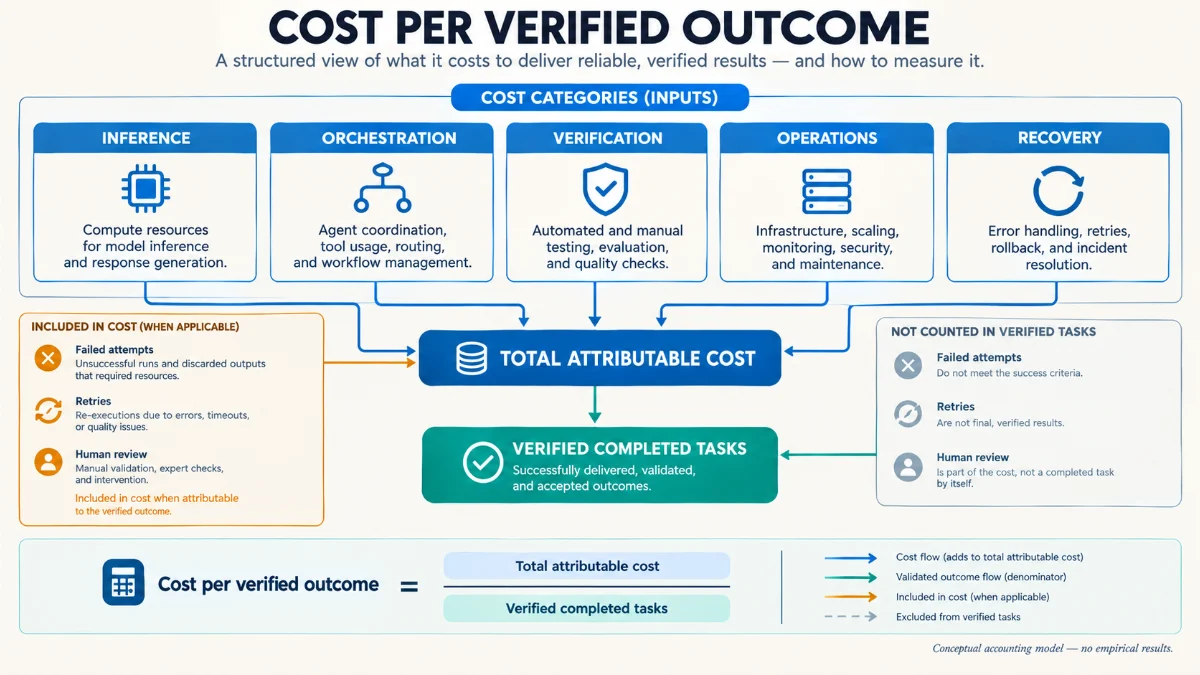
The Cost per Verified Outcome Framework
For AI feature economics, I use a multi-layer model with four questions: what was requested, what operations were consumed, what evidence establishes correct completion, and what support or recovery followed? This framework separates model expenditure from total attributable operating cost. It is conceptual and should be calibrated with real task logs, not filled with optimistic guesses.
| Cost layer | Examples | Measurement requirement |
|---|---|---|
| Inference | Input, output, cached tokens, modality charges | Billable usage by model and processing tier |
| Orchestration | Retries, tool calls, fallback models, queues | All attempts associated with each logical task |
| Verification | Automatic validation, evaluation, human review | Acceptance criteria, reviewer effort, outcome quality |
| Operations | Observability, storage, compute, support | Attributable cost and allocation method |
| Recovery | Reprocessing, incident handling, correction | Failure categories and actual remediation work |
Cost per verified outcome = total attributable feature operating cost / number of outcomes meeting the stated completion standard. The numerator should use consistent allocation rules and include failed attempts. The denominator should be auditable and based on the user’s task, not the system’s total number of model responses. If the success standard changes, historical cost ratios are no longer directly comparable.
A Reproducible Illustrative Calculation
Assume a fictional text-only feature serves 10,000 user tasks in one month. Each initial inference uses 2,000 uncached input tokens and 500 output tokens. For illustration only, apply the dated public price example above: $1.00 per million input tokens and $5.00 per million output tokens. The variable model cost per inference is therefore (2,000 / 1,000,000 × $1.00) + (500 / 1,000,000 × $5.00) = $0.0045. No tool or other fees are included in that number.
Now assume, for a synthetic scenario rather than an observed service, that 10% of tasks require one additional inference of the same size. That produces 11,000 billable inferences and an estimated inference charge of 11,000 × $0.0045 = $49.50. If 8,000 of the original 10,000 tasks meet the defined quality threshold, inference-only cost per verified outcome is $49.50 / 8,000 = $0.0061875. The ratio is not a vendor benchmark; it follows directly from the stated assumptions.
Suppose 5% of the original tasks also require two minutes of human review at an illustrative fully loaded labor cost of $30 per hour. Then the review allocation would be 500 × 2 / 60 × $30 = $500. In this synthetic scenario, review labor is substantially larger than model charges. The subtotal for inference and review would become $549.50, or approximately $0.06869 per verified outcome, before tools, storage, support, or other costs. This arithmetic is illustrative; actual staffing, chargeable time, and rate structures can differ greatly.
Use Sensitivity Analysis Before Trusting a Forecast
For robust AI feature economics, consider which inputs are uncertain: average output length, retry incidence, verified success rate, reviewer minutes, cache-hit eligibility, tool usage, and pricing tier. I would vary them individually and in plausible combinations. If the expected economic case collapses when the review rate increases slightly, the feature needs stronger quality evidence before scaling. A sensitivity analysis does not predict which scenario will occur; it reveals which assumptions the decision depends on.
Which Optimization Actually Improves the Product?
In AI feature economics, model routing can assign simpler requests to lower-cost paths and escalate difficult ones. Prompt caching can reduce repeated input charges. Better task design can reduce ambiguity and retries. Structured validation can reject bad outputs earlier. Yet each optimization changes the reliability and support profile. The correct objective is not minimizing one cost field but reducing total cost without degrading the required outcome.
A Smaller Model Can Be More Expensive After Recovery
A cheaper model may require additional clarification turns, fail more validations, or push complex cases to a human. It could still be the best choice for well-defined tasks. I would compare models on a fixed, representative task set and measure accepted outcomes, time, tokens, retries, and review effort. A head-to-head model comparison needs controlled prompts, versions, datasets, and repeatable scoring; this article does not pretend such a test was run.
Batching and Asynchronous Work Need Product Fit
Delayed processing can make some workloads cheaper or easier to manage, but not every user will accept the wait. A background research task may tolerate asynchronous completion; an interactive error message may not. The right processing mode depends on user expectation, response-time obligations, and operational design. Provider price differences should be evaluated together with these constraints.
Tie the Economic Decision to Reliability and Governance
In AI feature economics, some failure costs are not adequately represented by a monthly bill. Privacy incidents, incorrect financial actions, unavailable support, and unsafe autonomous behavior create risks that require separate controls. The NIST AI Risk Management Framework is a relevant reference for thinking about AI risk in context. It is not a blanket approval for any particular product design, nor does cost efficiency substitute for governance.
I would require clear ownership for model selection, evaluation criteria, deployment changes, incident response, and retirement. If a feature cannot meet an acceptable reliability or oversight boundary, a lower token price does not justify its launch. The decision should remain reversible where practical, and the operational records should identify when assumptions need renewed testing.
A Practical AI Cost Model Checklist
- Define a valuable user task and a verifiable completion criterion.
- Record the non-AI alternative and the requirements for equivalent outcomes.
- Identify each model, price tier, token category, tool, and infrastructure dependency.
- Measure all attempts per task, including errors, retries, and fallbacks.
- Define the latency budget, human review policy, and support escalation path.
- Estimate attributable cost for verification, telemetry, storage, and recovery.
- Calculate cost per verified outcome and vary the assumptions that dominate uncertainty.
- Reassess after provider, model, task, or product behavior changes materially.
For AI feature economics, this is a decision-support sequence, not a universal deployment recipe. The order of evidence collection can change when privacy, safety, or regulatory constraints require controls before a public trial. The main requirement is that the economics remain linked to the actual quality and reliability obligations of the feature.
Limitations: Costs and Outcomes Change Together
AI feature economics is sensitive to case mix, human behavior, quality thresholds, provider pricing, model updates, and system architecture. Fixed operating costs require an allocation policy, and those allocations can distort comparisons when usage levels differ. An evaluation dataset may not represent future users. Cached inputs may have different eligibility across workloads. Latency, token counts, and human review time may be correlated rather than independent.
For that reason, I would not reduce AI feature economics to one forecast ratio as a universal business-case score. Report cost and quality together, retain the raw assumptions, and explain how the estimate was produced. This article includes a dated public pricing example and reproducible hypothetical arithmetic, not a live vendor quotation for every processing tier and not measured operating results from a deployed AI system.
Measure the Cost of a Correct Result
When I assess AI feature economics, I begin with the user’s desired outcome and work backward to the full cost of delivering it well. That changes how I think about a model selection, a retry, a tool call, a review step, and even an interface loading state. The cheapest inference can be the wrong product choice if it produces avoidable failures. A more expensive inference may be justified when it reduces total work and reliably meets the requirement.
Token prices are necessary inputs. They are not substitutes for product economics. The more useful question is whether the system can produce a verified outcome with acceptable reliability, latency, oversight, and recovery cost, compared with the alternatives people could use instead.
Frequently Asked Questions
Why is cost per token insufficient for budgeting an AI feature?
It excludes retries, tools, support, verification, infrastructure, and failed tasks. Token pricing is one component of total operating cost; it is not the cost of a completed user outcome.
Does prompt caching always reduce the total cost of a feature?
No. It may reduce eligible token charges, but cache behavior, write or retention fees where applicable, freshness needs, and other operational costs still matter. Actual usage should be measured.
How should a team calculate cost per successful task?
Define success in user terms, sum attributable operating costs including failed attempts, and divide by tasks meeting that criterion. Keep the cohort, time window, and allocation rules explicit.
When should a deterministic approach replace an AI feature?
When a constrained workflow can meet the same user need more reliably and affordably with rules, search, or simpler software. The decision depends on quality, flexibility, safety, operations, and long-term ownership rather than price alone.
Related Reading and Professional Profiles
Explore broader evaluation, integration, and governance questions in Artificial Intelligence Articles. This article focuses on costs and decision structure rather than claiming experimental performance for a particular model or hidden development process.
Connect with me on LinkedIn, X, Threads, GitHub, and Behance.