


AI Feature Economics: Tokens, Latency, and Support

Measuring Usability When Conversion Hides Failure
When measuring usability, a product dashboard can celebrate an increase in conversion while users struggle to understand what they agreed to, complete a task with avoidable errors, or depend on support to recover from a confusing interface. Conversely, a redesign may reduce an easily counted click while making a complex professional workflow safer and clearer. Measuring usability requires looking beyond the number of people who reach a particular commercial endpoint.
When measuring usability, I treat conversion as an important business signal, not a sufficient description of user experience. It is affected by traffic source, audience, offer, timing, incentives, and interface behavior. It cannot tell us on its own whether a person understood a decision, recovered from an error, or completed the intended task independently. Measuring usability means studying those outcomes in a specified context of use, with an explicit definition of success and a careful account of what the observations do not prove.
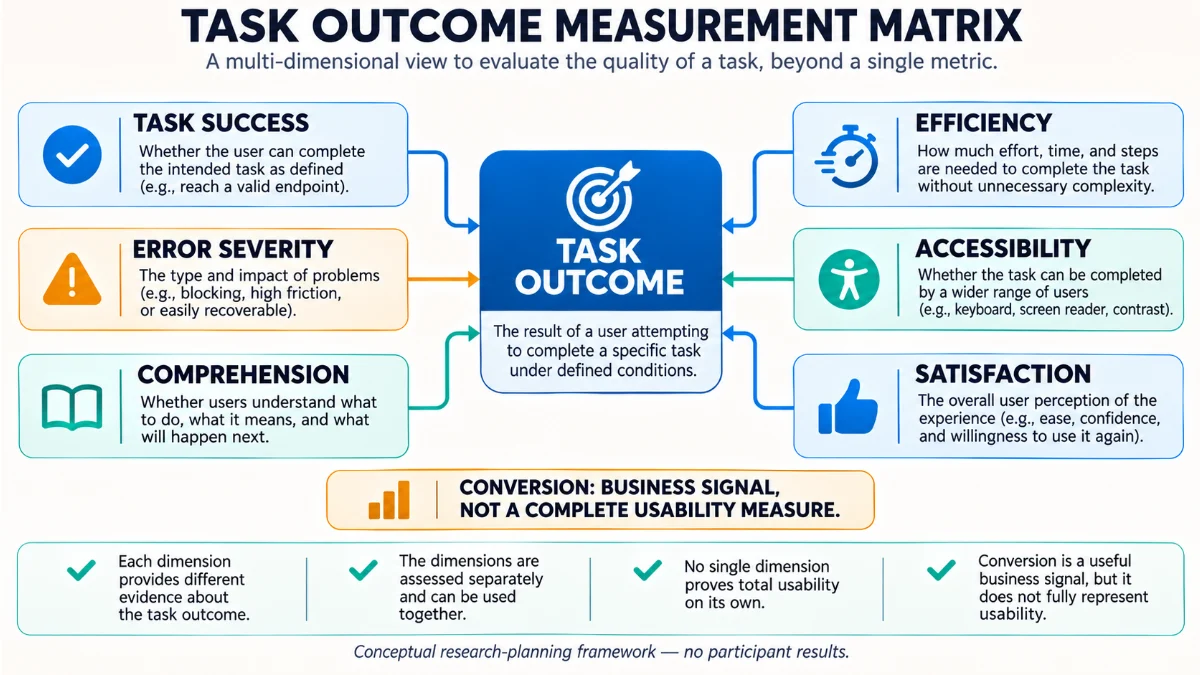
My proposed approach to measuring usability, the Task Outcome Measurement Matrix, connects task success, error consequences, comprehension, effort, and accessibility evidence to the decisions a product team must make. It is a practical synthesis for research planning, not a new validated usability instrument. No fictitious participant study or claimed conversion improvement is used to demonstrate it.
Decision Brief: Measure the User’s Task, Not Just the Funnel
The problem: A commercial completion metric may improve while task quality, understanding, or fairness deteriorates.
The method: Define user goals and relevant contexts, observe whether tasks are completed correctly and independently, classify errors by consequence and recoverability, examine comprehension and effort, and evaluate accessibility with more than automated checks.
The limit: A small task study can reveal meaningful problems but cannot automatically estimate population-wide prevalence, compare tiny changes precisely, or establish that an entire product conforms to accessibility standards.
Usability Means Effectiveness, Efficiency, and Satisfaction in Context
Before measuring usability with selected metrics, I would define the actual context in which people use the product. The NIST glossary citing ISO 9241-11:2018 describes usability in terms of effectiveness, efficiency, and satisfaction for specified users pursuing specified goals in a specified context. That emphasis on context is essential. A workflow that performs well for an experienced specialist with a large monitor may behave very differently for a new user on a mobile connection.
Specified Users and Goals Change the Interpretation
Measuring usability starts by naming which users and situations are relevant. An enterprise administrator creating a new role, a customer exporting a receipt, and a screen reader user correcting a form error may all use the same product but face different tasks and constraints. Combining their outcomes into one average can conceal important problems. I would define participant criteria, experience levels, required assistive technology, environment, and task goals before reporting a result.
The context should reflect real responsibility rather than demographic convenience. For example, a highly experienced user may complete a complex workflow quickly because they already know a shortcut, while a new but legitimate user cannot find the same function. Both observations matter; neither should be treated as a universal claim about every user.
Business Conversion Is Not Equivalent to User Effectiveness
In measuring usability, conversion rates can identify where a funnel loses users, but they rarely explain why. A checkout might gain more completed purchases after a disruptive default is introduced. The business metric looks positive; the user may have misunderstood a recurring commitment. Measuring usability requires independent checks of comprehension and user control when the consequences of a decision matter. Similarly, an error-free-looking conversion can hide a later correction or support request.
Business outcomes should still be tracked. The useful relationship is diagnostic: if conversion changes, ask which users were affected, which tasks improved, and whether the change produced new mistakes. Metrics become more informative when they are allowed to disagree rather than being forced into a single success narrative.
Task Success Rate Needs a Clear Definition of Success
The Nielsen Norman Group discussion of task success treats completion as a direct measure of whether users accomplish an assigned goal, while recognizing that the binary measure is coarse. That limitation becomes important in workflows where the visible final state can be reached through an incorrect sequence or with substantial assistance. A submitted form is not necessarily a correct form.
Separate Completion From Correct, Independent Completion
When measuring usability, I would distinguish successful unaided completion, successful completion after permitted assistance, partial completion, and failure. The task must have an externally recognizable outcome. If the goal is to create an invoice for the correct customer and amount, reaching a confirmation screen with the wrong customer is not a valid success. If a researcher tells the participant which menu to open, that assistance must be recorded rather than silently counted as independent task success.
When comparing designs, the definition must remain stable. A team cannot count partial successes in one version and only perfect successes in another. Recording both the completion category and the reason for failure is more informative than a single percentage. If the sample is small, the raw numerator and denominator should be shown so readers understand the fragility of any estimate.
An Illustrative Task Outcome Rubric
| Category | Operational definition | Interpretation |
|---|---|---|
| Unaided success | Goal achieved correctly without facilitator guidance | Independent task completion |
| Assisted success | Goal achieved after explicitly recorded help | Task possible, but independence not established |
| Partial completion | Some required conditions met; final goal not met | Investigate remaining barriers |
| Incorrect completion | Interface reaches an end state but task result is wrong | Potentially serious outcome error |
| Abandoned task | Participant stops before required outcome | Explore cause, context, and uncertainty |
This rubric is a conceptual example. It should be customized for the task and piloted with a small number of sessions to confirm that observers classify outcomes consistently. An incorrect but apparently completed action may be more serious than an abandonment, depending on the domain. Measuring usability benefits from recording the nature and consequence of failure, not only whether an endpoint was reached.
Error Severity Is About Consequences and Recovery
Measuring usability by counting every error equally can obscure the experience. Entering an invalid character and correcting it immediately is not equivalent to accidentally deleting data or granting the wrong user access. I would assess error severity through the consequence of the error, its likelihood in the relevant task population, the clarity of feedback, and the effort or authority required to recover. This is an analytical rubric for product decisions, not a universally validated severity scale.
User Error, System Error, and Design-Induced Error
Researchers should avoid blaming users for every wrong action. A misleading label, inaccessible validation message, unclear scope selector, or unexpected default can make an error highly predictable. The observation should identify what happened and what the interface contributed. In a collaborative research review, I would ask whether the design created a plausible but incorrect path. The objective is to improve the system, not grade participants.
Errors also differ by timing. A user may notice a mistake before submission, immediately afterward, or days later when a downstream process fails. Measuring usability only within the initial session can miss those consequences. For high-stakes tasks, follow-up data and operational incident patterns may be needed, with appropriate privacy protections.
Error Feedback Must Be Perceivable
WCAG 2.2 Success Criterion 3.3.1 addresses the identification of automatically detected input errors and their description in text. The W3C explanation of Error Identification shows why an error state that is conveyed only through a color or a hidden indicator may be insufficient. I would observe whether people can find, understand, and correct errors, not merely whether the application displays a red outline.
Comprehension Is a Separate Usability Outcome
When measuring usability in financial, privacy, administrative, and AI-assisted workflows, a person may complete a task while misunderstanding what will happen next. Measuring usability should include comprehension when informed action is a meaningful requirement. A checkbox ticked without understanding is still a conversion, but it does not establish that the interface communicated the consequences effectively.
Ask Participants to Explain the Decision in Their Own Words
To evaluate user comprehension when measuring usability, I would use neutral comprehension probes after observing the task, such as asking participants what they believe will change, who will see the result, or whether the action can be reversed. The probe should not supply the correct answer. Its purpose is to reveal the participant’s interpretation, not to test memory of the researcher’s wording. Researchers should record whether the participant inferred the correct consequence independently or needed clarification.
Comprehension checks can introduce their own bias if the facilitator makes participants suspicious of an otherwise ordinary step. That is a reason to pilot questions and compare them with observed behavior. The best measurement captures whether someone could make an informed choice under realistic circumstances, not whether they can repeat a sentence from the screen.
Time on Task Needs the Context of Success and Effort
In measuring usability, time on task is easy to quantify and easy to misuse. A shorter completion time can indicate better efficiency, but it can also reflect users skipping important information, accidentally choosing defaults, or being prompted toward the wrong action. For a high-consequence workflow, spending more time reviewing a critical choice may be appropriate. Measuring usability means interpreting time relative to correctness, task complexity, and user confidence.
Compare Time Only for Comparable Tasks
The Nielsen Norman Group usability metrics guidance illustrates that aggregating task times can mislead when tasks differ in frequency or importance. I would report time distributions by task and completion category, rather than one grand average across unrelated actions. If one group performs a task much more often, its experience may deserve a different product priority, but that weighting should be explained.
Behavioral observation also matters: repeated backtracking, hesitation, scanning the wrong region, and unnecessary confirmation loops may indicate effort that elapsed time alone does not explain. A researcher can learn more from a participant’s route and interpretation than from a stopwatch value with no behavioral context.
Accessibility Testing Is Not a Single Automated Score
The W3C Web Accessibility Initiative evaluation overview explains that tools are useful but cannot determine complete accessibility conformance by themselves. Measuring usability should include appropriate manual evaluation, assistive-technology interactions, keyboard operation, focus behavior, text alternatives, and meaningful error recovery. Automated checks are one source of evidence, not an endorsement that all users can complete the task.
Evaluate Whether Essential Tasks Are Reachable
I would define critical workflows for participants who rely on keyboards, screen readers, magnification, or other access methods and examine whether the workflows remain understandable and operable. Successful tab navigation alone does not establish usable task completion. Focus can technically move through every control while the labels, announcements, or error recovery remain confusing. Similarly, a mobile layout can appear visually correct while interaction targets or reflow cause barriers.
The scope of measuring usability should be explicit. A few task observations can identify significant barriers; they cannot certify the whole site against WCAG 2.2 AA. Accessibility conformance evaluation requires the appropriate standard, page scope, methodology, and qualified human assessment. Measuring usability and assessing conformance overlap but answer different questions.
The Task Outcome Measurement Matrix
I propose the Task Outcome Measurement Matrix as a practical method for measuring usability by connecting an intended task with multiple observable dimensions. The goal is not to compress user experience into an arbitrary index. It is to make disagreements visible, such as high task completion alongside poor comprehension or improved speed alongside an increase in consequential errors.
| Dimension | Operational question | Evidence type | Interpretation risk |
|---|---|---|---|
| Task success | Did the intended result occur correctly and independently? | Observed outcomes and validated task state | Assistance or wrong results counted as success |
| Error severity | What went wrong, with what consequence and recovery effort? | Error log, screen recording with consent, task notes | All errors treated as equivalent |
| Comprehension | Did the participant understand the action and its consequences? | Neutral explanation probes | Researcher cueing or memorization |
| Efficiency | What time and effort were required for a correct outcome? | Task timing and behavioral observation | Fast incorrect actions interpreted as improvement |
| Accessibility | Could people using relevant access methods complete the task? | Manual checks and appropriate participant sessions | Automated pass treated as full conformance |
| Satisfaction | How did the experience meet participant expectations? | Contextual interview or standardized measure when appropriate | Positive ratings hiding observed failure |
The matrix is intended for a research plan and a decision review. It does not assign a fixed weight to every dimension. The appropriate interpretation depends on the domain: a wrong transfer destination deserves different attention than a minor labeling hesitation. The output should identify the design decision supported by evidence and the uncertainties still unresolved.
What to Do When Metrics Disagree
If conversion rises but errors become more severe, I would investigate which users and tasks drove the change before declaring success. If satisfaction increases while comprehension stays low, I would question whether respondents felt comfortable without understanding the consequences. If task time decreases but more participants need assistance, the apparent efficiency gain may be misleading. Measuring usability is partly the discipline of resisting premature aggregation.
When multiple research sources disagree, the UX research triangulation analysis offers a complementary framework for examining differences in method, sample, and time window. The Task Outcome Measurement Matrix focuses specifically on defining and interpreting task-level measures.
A Usability Measurement Plan Before Data Collection
A credible plan for measuring usability begins with the decision the team needs to make. I would identify the workflow at risk, recruit participants who match its real users, define task success and error consequences in advance, select suitable observation methods, and decide how findings will be classified. Measuring usability after a release is not inherently wrong, but changing the evaluation criteria after seeing a favorable result weakens the conclusion.
- State the product decision and the users who will be affected.
- Describe the real task, context, expected outcome, and forbidden mistakes.
- Define unaided, assisted, partial, incorrect, and abandoned outcomes.
- Set error severity and recovery criteria appropriate to the domain.
- Select comprehension, timing, satisfaction, and accessibility measures only where meaningful.
- Recruit ethically, record necessary context, and pilot the tasks and observer rubric.
- Collect observations with consistent facilitation and document exceptions.
- Report raw counts, limitations, conflicting evidence, and the resulting design decision.
It is important to avoid turning the rubric into a scripted obstacle course. Participants should understand a realistic goal without being told the exact sequence of controls to use. They should not need to guess what the researcher expects. For regulated or high-consequence workflows, domain experts may also need to verify that task scenarios reflect real operational responsibility.
Sample Size, Selection Bias, and Confidence Intervals
In measuring usability, small studies are often well suited to discovering usability problems and investigating their causes. They are much less suited to estimating a precise population success rate. A result from five participants is not equivalent to a survey of an entire user base, and repeating a study with the same recruitment bias does not remove that bias. Measuring usability responsibly requires acknowledging what the sample can support.
Do Not Present a Small Percentage Without Its Denominator
For binary task success, the number of independent observations and the sampling process matter. A proportion should be reported with its numerator and denominator, and an appropriate uncertainty interval may be useful for inferential work. Confidence intervals do not repair biased recruitment, inconsistent tasks, or non-independent observations. I would avoid declaring one design superior from a tiny numerical difference when the method does not support that conclusion.
Learning Effects Can Distort Repeated Tasks
Participants completing a second design may benefit from familiarity with the task rather than the design. Order, prior experience, fatigue, coaching, and task realism should be considered in the study plan. Counterbalancing can reduce some order effects, but it is not a substitute for meaningful participant selection. If users repeatedly perform a task in their real jobs, the ability to learn may itself be important; the study should say whether it measures first-use or practiced performance.
Illustrative Scenario: A Fast but Misunderstood Permission Change
Imagine a fictional enterprise administration screen where managers can change a colleague’s workspace permissions. A redesign reduces the number of steps and increases completion, but some managers misunderstand whether a permission grants read-only access or the ability to export sensitive records. A funnel metric might celebrate the faster completion. The usability question is whether the intended access was granted to the right person with the right understanding and without dangerous mistakes.
For this hypothetical task, I would observe independent completion, whether the selected permission matches the scenario, what the manager believes it enables, and how easily the action can be reviewed or reversed. I would include keyboard and assistive-technology checks for relevant workflows. No numerical results are provided because no such participant test is claimed to have occurred.
The role-based information architecture analysis discusses navigation and authorization as distinct design concerns. That distinction makes a useful bridge: finding a control, understanding its implications, and having authority to execute the action are three separate requirements.
Translate Findings Into Product Priorities
After observing tasks, I would group usability issues by consequence, affected user needs, reproducibility, and how confidently the design contributed to the failure. A severe, rare error may merit urgent attention even if conversion is strong. A common hesitation with low impact may be handled through clearer labeling or guidance. The aim is to match evidence to a decision, not create a single rank that hides its assumptions.
Some findings may require further research rather than immediate redesign. If a small sample suggests confusion only among one role, the team should check whether recruitment, permissions, or onboarding caused the difference. Measuring usability should improve the next decision while preserving the distinction between an observed problem and an inferred root cause.
Limits of Task-Based Usability Measurement
Task studies can oversimplify real work when measuring usability. Participants may behave differently under observation, time limits can distort careful tasks, and artificial data may remove stakes that influence real decisions. Satisfaction questions can be shaped by social desirability, while analytics may lack the context necessary to explain an error. Measuring usability requires combining methods thoughtfully rather than treating one data source as the complete truth.
The approach to measuring usability here is a proposed research-planning synthesis. It has not been experimentally validated as a new index and does not claim that a product meets ISO 9241-11 or WCAG 2.2. The rubric and hypothetical permission task are illustrative. A team should adapt them to real participants, domain risks, and evidence needs before making design or compliance claims.
A Successful Outcome Must Be Correct, Understandable, and Reachable
When measuring usability, I want the product team to look at what people achieved, what it cost them, what they understood, and which barriers remained. Conversion is useful, but it is not a substitute for these questions. A product can persuade people to finish a journey without making that journey clear, safe, or accessible.
The quality of a usability measure is determined by the decision it supports and the limits it makes visible. Define the task, study the consequences of errors, listen for misunderstandings, and report uncertainty. That is how a product learns whether its interface truly helps people accomplish the right thing.
Frequently Asked Questions
Is conversion rate a usability metric?
It can be a relevant behavioral or business outcome, but it does not independently establish task accuracy, understanding, effort, or accessibility. Use it alongside measures that reflect the user’s intended goal.
Should assisted task completion count as success?
It should be recorded separately unless the task’s real-world design explicitly includes that assistance. Combining assisted and independent completion without disclosure can hide important barriers.
How do you evaluate the severity of usability errors?
Consider the consequence of the wrong action, its recoverability, user exposure, and how clearly the interface supports detection and correction. Severity definitions should be specific to the domain and agreed before final interpretation.
Can five participants prove a redesign is better?
No. A small qualitative study can surface meaningful problems and support a reasoned design change, but it generally cannot estimate precise population effects or establish statistical superiority. Method and sampling matter.
Does a passing accessibility scan prove users can finish the task?
No. Automated tools identify some issues, but accessible task completion often requires manual checks and suitable assistive-technology evaluation. Full conformance claims need a defined assessment scope and method.
Related Reading and Professional Profiles
Continue through UX & UI Design Articles, UX Research Triangulation, and Role-Based Information Architecture for complementary research and navigation decisions.
Connect with me on LinkedIn, X, Threads, GitHub, and Behance.