


SEO and AI Search Visibility Without GEO Myths

MVP Experiments: Testing Risk Before Building Features

Software Maintenance Starts When Routine Changes Remain Routine
Software maintenance is rarely the task that makes a product look impressive in a demonstration. It is the work that determines whether a product can accept a small correction next month without turning that correction into a migration, an outage, or a week of detective work. I would not judge maintainability solely by the age of the codebase or the number of automated tests. I would ask what a responsible engineer must know, verify, observe, and recover before changing behavior that real users depend on.
Long-lived products accumulate obligations. A payment status may be referenced in billing, reporting, notifications, and exports. A permission rule may be enforced by a server but reflected differently in an administrative interface. A configuration switch may alter behavior without touching application code. In each case, the change itself can be small while the uncertainty around it is large. That uncertainty is the core cost of software maintenance: deciding what may safely change when guarantees are scattered across the system.
My central argument is that tests, observability, change ownership, deployment controls, rollback planning, and release documentation form one operational system. Treating them as disconnected engineering chores creates blind spots between writing code and accepting its consequences. This article develops a practical Change Safety Contract for those boundaries. It is a proposed engineering framework supported by established practices, not a report of a completed experiment or a universal certification method.
Decision Brief: Protect the Ability to Change
The decision: When maintaining a production system, choose the smallest verifiable behavior change that preserves a known recovery path. The relevant unit is not the changed line of code; it is the behavior and its dependencies that must remain dependable.
The method: Establish the intended change, identify contracts and affected workflows, gather proportional regression evidence, specify observable acceptance signals, name the decision owner, and rehearse or document how to stop or reverse the release. Where a rollback cannot reverse data, define a forward-recovery or compensating action instead.
The limitation: This is an engineering decision discipline, not proof that failures will not occur. A team can execute every step and still miss a novel failure mode. The value lies in making assumptions inspectable and recovery decisions less improvisational.
Software Maintenance Is an Architecture, Not a Cleanup Sprint
A cleanup sprint can remove unused code or rename confusing functions. It may be worthwhile, but it does not by itself establish software maintenance capability. A healthy software maintenance architecture links what the system promises to how a change is tested and deployed. The same behavior should be recognizable in requirements, executable checks, runtime signals, and incident response. If those descriptions disagree, people must reconstruct truth under pressure.
Where Hidden Contracts Accumulate
Contracts exist beyond API signatures. They include data meaning, ordering guarantees, authorization boundaries, scheduled job behavior, external partner expectations, accessibility behavior, and the assumptions behind operational dashboards. Consider a report that lists invoices. A change to the invoice state machine could preserve the endpoint and still cause the report to omit legitimate records. Unit tests for the modified service may pass while an important customer task fails.
My first software maintenance question would therefore be: which outcomes could change even when interfaces still compile? That is the reason to practice dependency mapping: examine dependency direction and important data flows, and user-critical workflows before selecting tests. An architectural diagram is useful when it identifies decisions and coupling. A diagram that simply illustrates every component without revealing affected contracts does little to control change risk.
Risk Depends on Reach and Recoverability
Not every change requires a major release ceremony. A text correction and a change to tenant-scoped access checks should not receive identical scrutiny. I would assess how broadly a change can propagate, how confidently its behavior can be tested, how quickly problems can be detected, and whether the previous state can be restored. The purpose is proportional rigor, not bureaucracy. High-consequence changes should make their evidence visible; low-risk changes should not be slowed by ceremonial documentation.
Regression Testing Should Follow Behavioral Boundaries
Regression testing is often described as running the old tests again. That is a mechanism, not a strategy. Software maintenance requires a defensible answer to which behaviors could fail because of a particular change. A test suite can contain thousands of green checks and still omit the path that matters. Conversely, one carefully selected contract test may expose a dangerous integration failure that broad but shallow tests miss.
Four Layers of Change Evidence
At the lowest level, unit tests help isolate calculations, validation, and state transitions. At the contract boundary, contract testing asks whether clients and providers still agree on requests, responses, and errors. At the workflow level, integration or end-to-end tests exercise important tasks across components. Finally, release verification checks whether the built artifact and deployed configuration actually behave as intended in the target environment. I do not treat these layers as a universal percentage pyramid; their value depends on the system and its failure modes.
For example, a billing change might need a focused state-transition test, a negative authorization test, an integration check against a reporting projection, and a smoke check of the deployed invoice flow. It would be wasteful to rerun every expensive browser scenario on every keystroke, but dangerous to assume a passing isolated unit test validates invoice visibility across tenants. The software maintenance objective is a traceable set of claims: what was checked, under which conditions, and what remains unknown.
Negative Tests Expose Broken Boundaries
Positive tests demonstrate that authorized, expected behavior works. Negative tests ask what should never happen: a revoked member exporting records, a repeated event causing a duplicate charge, an invalid configuration silently activating, or a timed-out update leaving data inconsistent. These cases make invisible contracts concrete. For permission-sensitive changes, the authorization architecture analysis discusses enforcement boundaries and matrix-based negative testing in greater detail.
Security checks belong in the normal change process, not only in an annual audit. The NIST Secure Software Development Framework, SP 800-218, provides high-level practices for integrating security into software development. It is a useful foundation for identifying responsibilities around protecting software, checking releases, and responding to vulnerabilities. It should not be misrepresented as a guarantee that a particular pipeline is secure.
Observability Turns Deployment Into an Inspectable Decision
Software maintenance becomes harder when a release can technically succeed while users experience a hidden regression. A service may return HTTP 200 responses while producing incorrect totals, omitting records, or delaying critical work. Monitoring infrastructure availability alone will not answer whether the intended user outcome is preserved. For software maintenance, useful observability connects behavior to signals that can support a release decision.
Logs, Metrics, and Traces Have Different Jobs
The OpenTelemetry observability primer describes logs, metrics, and traces as complementary signals. Metrics show quantities and trends; logs provide discrete events and context; traces expose the path and timing of work across components. For software maintenance, I would choose signals from the question the team must answer, rather than instrument everything simply because a telemetry platform can collect it.
For a background export, an operational view might include job completion rate, age of queued work, retry behavior, and a correlation identifier linking a request to its job and final artifact. For a permission change, a spike in denials may be meaningful but must be segmented carefully: increased denials could signal a regression or successful blocking of previously inappropriate requests. An alert without an interpretation path may create noise rather than safer decisions.
Define the Evidence Before the Release
Before a software maintenance release, I would specify the signals that would justify proceeding, pausing, or reverting. A vague instruction to “watch the logs” gives the on-call engineer little support when a metric moves. Define the affected workflow, the observation window, expected comparison behavior, and an owner who can make the decision. Thresholds must come from real service characteristics and risk tolerance, not fabricated values borrowed from an unrelated product.
The Change Safety Contract: My Proposed Framework
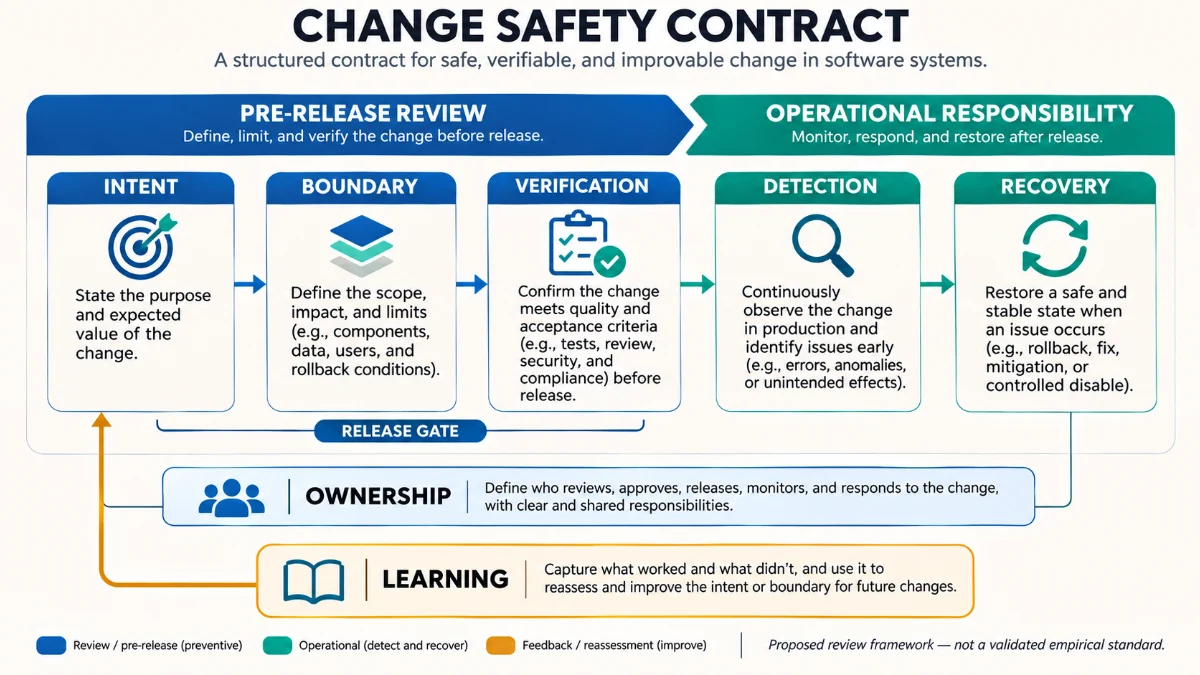
I use the term Change Safety Contract for a compact record that links a change to its justification, affected behavior, verification evidence, runtime signals, accountable decision, and recovery route. It is not a new industry standard, a compliance badge, or a substitute for incident management. Its purpose is to make the operational assumptions behind a routine software maintenance decision visible to reviewers and future maintainers.
| Field | Question to answer | Appropriate evidence |
|---|---|---|
| Intent | Which user or system behavior must change? | Linked requirement and concise acceptance conditions |
| Boundary | Which modules, data contracts, users, and integrations may be affected? | Dependency sketch and impact review |
| Verification | What proves intended behavior and important negative cases? | Named automated checks and manual validations |
| Detection | What signal will reveal a damaging regression after release? | Service-specific metrics, logs, traces, or outcome checks |
| Ownership | Who approves, observes, and intervenes? | Named operational responsibility and escalation path |
| Recovery | How can the change be stopped, reversed, or compensated? | Rollback conditions, data constraints, and restoration steps |
| Learning | What would cause this decision or test plan to change? | Incident follow-up, unresolved risk, or review trigger |
For everyday software maintenance, the framework is deliberately small enough to apply to a single meaningful change. For a low-consequence edit, the answers may fit in a short review note. For a data migration or shared authentication change, they may require a staged rollout plan and explicit approval. The important thing is continuity between the questions. A recovery procedure that does not match the migration plan is not a recovery procedure, however polished its document looks.
An Illustrative Change Review
Imagine a fictional subscription application moving an invoice-export job to a new queue. The stated intent is to reduce waiting time, but the affected behavior includes permission checks, export consistency, status notifications, cancellation, and duplicate deliveries. The verification plan therefore needs more than a speed test. It should exercise cancellation, revoked access, retry after failure, and repeated job execution, then inspect the resulting artifacts. This is a hypothetical reasoning example, not a report of any project I deployed or benchmarked.
The release owner would also define how to observe queue age, failed exports, duplicate processing, and customer-facing completion. If the old and new workers cannot run concurrently without duplication, staged migration must address that constraint explicitly. In the worst case, simply redeploying old code may not repair already-produced duplicate artifacts. The contract should distinguish a technical rollback from the business action required to restore trustworthy data.
Release Engineering Is Part of Software Maintenance
For software maintenance, reproducible builds, environment configuration, deployment stages, and rollback procedures are sometimes treated as concerns outside software design. They are not outside the consequences of software change. A production incident can originate in a configuration mismatch, an incompatible dependency, or a migration executed in the wrong order. Maintaining an application means being able to explain exactly what was released and how it differs from what ran before.
Staged Rollouts Reduce the Blast Radius, Not the Need for Tests
The Google SRE release engineering chapter describes reproducibility, deliberate configuration management, canarying, and rollback as parts of reliable delivery. A staged rollout lets a team observe a smaller population before expanding exposure. It does not guarantee that an uncommon customer path will be exercised in the first stage. Its value depends on representative traffic, meaningful signals, and the ability to stop a rollout promptly.
Feature flags can also decouple deployment from activation, but they introduce their own software maintenance burden. Flags can outlive experiments, create combinations no one tested, and obscure which behavior is active. I would require a removal owner and an expiry or review condition for temporary flags. For permission changes, flags must not create a weaker fallback path that bypasses authoritative enforcement.
A Code Rollback Cannot Always Undo a Data Change
Rolling back a binary may restore application logic, but it cannot necessarily reverse a database migration, messages already delivered, payments already captured, or external notifications already sent. Safer changes often need expand-and-contract migration stages, backward-compatible readers, idempotent operations, or compensating actions. The recovery question should therefore be posed while designing the change, not discovered after release.
A useful release note identifies version or revision, deployment scope, compatibility assumptions, expected signals, and the recovery operator. This is not documentation for its own sake. It lets a second engineer determine what changed when the author is unavailable. Software maintenance depends on shared operational memory rather than exclusive knowledge held by one contributor.
Change Ownership Must Survive the Original Author
A software maintenance process can have clean code yet remain fragile if only its creator knows how to release it. I would define ownership at the level of decisions and recovery capability, not merely repository folders. The maintainer should know where a policy is enforced, which integration contract is authoritative, and what would invalidate the chosen architecture. That information belongs near code, tests, and release records so that it survives staffing changes and pauses in development.
Keep Records That Answer Future Questions
A useful maintenance record should be concise, dated when it records an actual decision, and linked to the changed behavior. An architecture decision record can document why an approach was chosen and when it should be revisited. A runbook can specify incident detection and recovery. A test inventory can identify critical behaviors and blind spots. None of those documents helps if it is silently out of date; ownership includes checking that a change has not invalidated them.
In software maintenance, I prefer a small set of living records to a large static wiki. The most valuable test is practical: could another qualified engineer understand the change, reproduce its verification, detect an important failure, and take the next safe action? If not, the maintenance architecture still has an undocumented dependency on the original author.
Measure Change Safety Without Gaming Delivery Metrics
There is a temptation to call software maintenance successful when deployments become more frequent or test counts increase. Neither metric establishes that users are safer. The DORA software delivery metrics guidance separates throughput from instability, including change fail rate and deployment rework rate. Those measures are helpful at a system level, but local interpretation matters: an apparent improvement may reflect smaller releases, classification changes, or a different mix of work.
| Dimension | Possible measurement | Interpretation limit |
|---|---|---|
| Release quality | Changes needing immediate remediation | Depends on consistent incident classification |
| Recovery | Time to restore behavior after a failed deployment | Varies by incident severity and detection delay |
| Rework | Unplanned deployments caused by production defects | Cannot be interpreted without workload context |
| Verification | Critical behaviors covered by meaningful automated checks | Coverage counts do not prove test effectiveness |
| Operational understanding | Time to identify which release changed a failing behavior | Can be affected by incident type and team familiarity |
I would resist inventing a single change-safety score from these dimensions. A weighted number can disguise a critical weakness: a project could score well on routine deployments while lacking a viable data-recovery procedure. Better to retain separate measures, annotate the context, and ask whether the next decision becomes more informed. A measure is useful when it can lead to a concrete improvement, not merely a favorable dashboard.
When a Rewrite Is the Wrong Maintenance Strategy
Software maintenance debates often begin when long-lived systems are labeled unmaintainable because parts of the implementation are unfamiliar or unfashionable. A rewrite can seem attractive because it promises to remove accumulated complexity. But replacement creates a second system that must rediscover old behavior, integrate with live workflows, migrate data, and earn operational confidence. The risk is not only schedule overrun; it is the loss of undocumented contracts that the original product has been satisfying for years.
Martin Fowler’s Strangler Fig application pattern offers a useful alternative: replace or extend behavior incrementally rather than assuming a complete replacement will be safer. I would first identify a boundary where the new component can be tested independently, coexist with the old path where feasible, and be retired or reversed without sacrificing customer workflows. Gradual replacement is not universally superior; deeply coupled data or regulatory constraints can still make migration difficult.
When Replacing a Subsystem Can Be Justified
A rewrite or subsystem replacement can be rational when the existing design prevents necessary capability, critical dependencies are no longer supportable, or incremental correction costs more than a controlled migration. But the decision should compare actual alternatives, migration exposure, operating costs, and recoverability. “Modern technology” is not a measurable outcome. The better question is whether the proposed route reduces the cost and risk of future behavior changes after accounting for transition risk.
A Practical Software Maintenance Review Before Release
For a meaningful change, I would begin with the real user or system outcome and then walk the Change Safety Contract in a short review. Identify the affected boundary, write expected and forbidden behaviors, choose tests that could falsify the change, confirm the deployable artifact, agree on signals, and give someone the authority to pause or recover. This sequence is intentionally more concrete than saying “ship carefully.”
- State the behavior being changed and the consequences of getting it wrong.
- Map the interfaces, data, permissions, and jobs that may be affected.
- Choose focused positive, negative, and integration regression checks.
- Confirm build provenance and environment-specific configuration.
- Decide what post-release evidence allows continuation or requires intervention.
- Define recovery, including any irreversible side effects and compensating actions.
- Record what would trigger reassessment after the change.
Where documentation is incomplete, the correct response is not to assert safety. Narrow the release, add targeted evidence, or defer an irreversible step. A small team does not need a large committee to do this well; it needs explicit decisions and a realistic operational owner. A larger organization may need separate approval and execution responsibilities, but it still benefits from the same traceability.
Limits: No Process Eliminates Unknown Failures
The Change Safety Contract cannot predict every dependency or prove that a test suite captures all relevant behavior. Observability may reveal symptoms only after some damage has occurred. Canary traffic may miss low-frequency scenarios. Rollback may be technically impossible for certain data changes. Security updates may require urgent action before ideal test evidence is available. Each limitation should influence release scope and response planning rather than become an excuse for false certainty.
This article is a method synthesis, not a performance study. No deployment counts, time-to-recovery measurements, reduction percentages, or incident outcomes are presented as personal results. Organizations should adapt the fields to their architecture, domain risks, and support arrangements, then evaluate whether the approach actually improves decisions. A checklist whose owner cannot explain its purpose is another form of maintenance debt.
Maintainability Is the Ability to Make the Next Decision Safely
I consider software maintenance successful when the next engineer can change a product without depending on luck or inherited folklore. They should know what the system promises, which checks matter, what signals reveal a regression, who can intervene, and what recovery means for real data. Good architecture does not make every change trivial. It makes the consequences of change easier to reason about.
That is why I would invest in software maintenance architecture before a system becomes a crisis. The investment is not simply more tests, more dashboards, or longer documentation. It is a connected decision path from intended behavior to evidence, observation, accountability, and recovery. A product that preserves that path can continue evolving without treating every update as an uncontrolled rewrite.
Frequently Asked Questions
Does a comprehensive test suite guarantee safe software maintenance?
No. Tests cover selected assumptions and execution paths. They can miss unexpected integration behavior, production data conditions, configuration changes, or operational failures. Meaningful software maintenance requires selecting the right tests and connecting them to runtime verification and recovery.
Can observability replace regression testing?
No. Regression tests attempt to catch failures before release; observability helps detect and explain behavior in a running system. They address different parts of the risk and are strongest when their expected outcomes are consistent.
Is rollback always safer than a forward fix?
Not necessarily. A straightforward code-only rollback may be appropriate for a reversible change. After an irreversible schema migration or external side effect, reverting code can increase inconsistency. The safe path depends on what changed and whether data or external actions must be compensated.
Can a solo developer use the Change Safety Contract?
Yes. The contract can be a concise, versioned release note that names the same person as implementer and operational owner while making the checks and recovery path explicit. Separation of duties may be desirable in higher-risk contexts, but the model does not require a large organization.
When should a team refactor instead of rewrite?
Favor incremental change when a behavior boundary can be isolated, tested, and migrated without losing essential contracts. Consider broader replacement when critical constraints cannot be resolved incrementally and a controlled transition is demonstrably feasible. Neither approach should be selected from code age alone.
Related Reading and Professional Profiles
For the broader publication, see Software Development Articles. For a deeper examination of one especially sensitive change boundary, read Authorization Architecture: RBAC, ABAC, and Permissions.
Connect with me on LinkedIn, X, Threads, GitHub, and Behance.