

Software Maintenance: Testing, Observability, Safe Change

AI Feature Economics: Tokens, Latency, and Support
An MVP Is Valuable Only When It Changes a Decision
An MVP experiment can be small and still be poorly designed. A team might build a polished subset of a platform, ship it to a handful of users, and call the result an MVP simply because the feature list is short. But reduced scope is not the same as reduced uncertainty. If the experiment cannot distinguish an important product hypothesis from an attractive story, the team may have built less software without learning anything decisive.
I approach MVP experiments as a question of risk before a question of features. What belief would make the proposed product fail if it proved false? What observable behavior would challenge that belief? Could the team learn enough from a prototype, interview, concierge service, or workflow simulation before committing to a production feature? The answers determine the experiment, not the other way around.
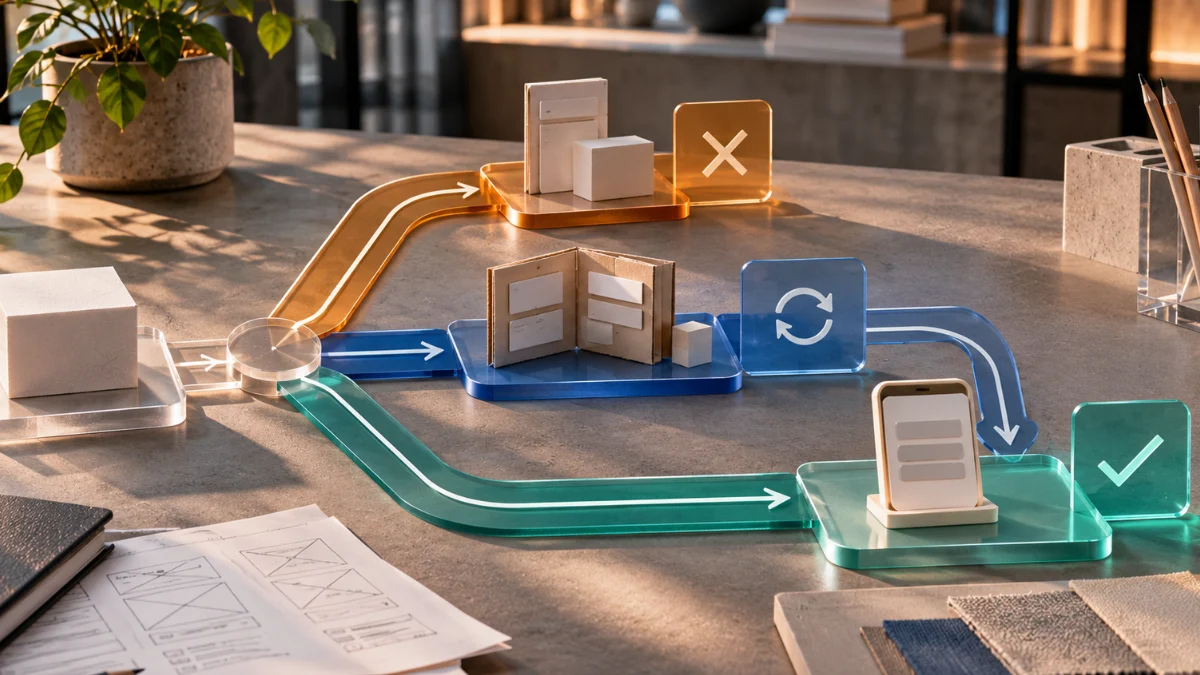
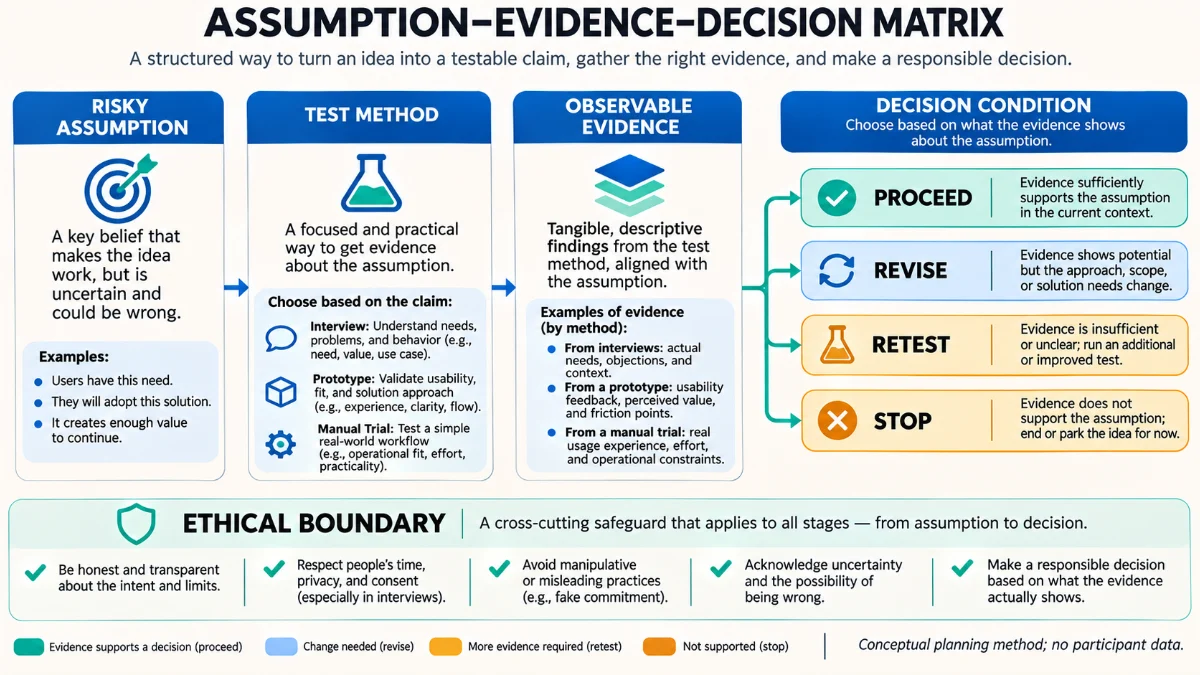
For MVP experiments, my proposed Assumption–Evidence–Decision Matrix links a risky assumption to a testable hypothesis, a method, a predetermined decision condition, and an ethical constraint. The matrix is a planning tool, not a validated statistical method or an account of a study I ran. Its purpose is to keep product discovery honest when the pressure to build is greater than the evidence that building is necessary.
Decision Brief: Design Learning Before Delivery
The risk: MVP experiments built around a minimal feature release can establish that engineering can deliver something while leaving demand, usefulness, trust, willingness to adopt, and business feasibility unresolved.
The decision: Design MVP experiments around the smallest ethical test that could change the next investment decision. A test should name the uncertainty it addresses and the observations that would count against the preferred idea.
The limit: MVP experiments cannot manufacture representative demand from a convenience sample or guarantee future purchase behavior. A positive early signal may justify another test rather than a production launch.
A Minimum Viable Product Is Not a Feature Quota
In MVP experiments, the phrase minimum viable product has been stretched to cover everything from a landing page to an almost-finished application. The difference matters because each artifact supports different claims. A clickable interface may reveal comprehension problems; it cannot by itself prove that an operational service is reliable. An interview may expose a painful workflow; it cannot demonstrate that respondents will pay. An actual limited service may show usage in a specific context, but even that observation needs careful interpretation.
Separate the Problem from the Favorite Solution
The GOV.UK discovery guidance advises teams to question solution-first briefs and reframe them around user problems. That distinction is central to product discovery. If a founder believes users need an AI assistant, the first uncertainty may concern whether the underlying task is frequent and costly at all. Testing an AI interface before investigating the task risks validating a proposed implementation rather than the user need.
I would write the problem without naming the proposed feature. Then I would specify which observable situation would convince me that the problem is real for the target group. Only after that would I compare possible interventions: clearer information, a manual workflow, better defaults, automation, or no new product. A product decision improves when a team can genuinely reject its first solution.
Distinguish Desirability, Feasibility, and Viability
MVP experiments need to respect multiple layers of product risk. Desirability asks whether people need the outcome strongly enough to change behavior. Feasibility asks whether it can be delivered safely under the required constraints. Viability asks whether the economics and operating model can support it. Other important risks include legal obligations, privacy, accessibility, and organizational adoption. One successful usability session cannot settle all of these questions. MVP experiments should identify the particular uncertainty being tested.
Make Assumption Testing Explicit
A hypothesis such as “customers will love this” cannot be falsified meaningfully. A useful hypothesis identifies an intended audience, context, behavior, and observation. “New account managers preparing weekly reports can locate and export the required data without assistance” is more testable, but even that statement needs a defined task and evaluation method. Assumption testing becomes powerful when disagreement about outcomes is settled before data collection.
Start With What Could Invalidate the Product
Not every assumption deserves equal attention in MVP experiments. I would prioritize beliefs that combine high consequence with low evidence confidence and high cost of being wrong. A dependency can also matter: it makes little sense to spend heavily optimizing a checkout flow if the target audience does not trust or understand the underlying offer. The right order is contextual, not a universal formula, because some safety and regulatory conditions must be satisfied regardless of observed demand.
The practical output is an assumption register, not a confidence score invented after a workshop. Each entry should identify an accountable person, the source of existing evidence, a possible contrary observation, and the cost of the next test. Research teams can disagree over confidence while still agreeing on which evidence would justify the next decision.
Write Testable Hypotheses and Decision Thresholds Before Observing Outcomes
Good MVP experiments need rules for interpreting their own results. Without predetermined decision thresholds, teams can move the goalposts after seeing a weak outcome. A high click-through rate can suddenly become sufficient when a paid conversion test fails, or enthusiastic interview comments can replace the actual task success condition. That is not learning; it is defending an existing preference.
What Counts as Enough Evidence?
I would distinguish a measurement definition from a decision threshold. The measurement might be whether a participant completes a workflow independently. The decision condition specifies what patterns would lead to proceeding, revising the solution, changing the audience, or abandoning the idea. For qualitative studies, the condition may be a defensible pattern of observed problems and explanations rather than a manufactured percentage. For statistical comparisons, it requires an appropriate sample design and uncertainty analysis.
A threshold chosen for convenience is not automatically meaningful. It should relate to the product’s economics, risk tolerance, existing alternative, and consequences of error. If the team has no basis for a numerical target, I would state the uncertainty explicitly and use an exploratory research phase. Pretending a number is scientific does not make a decision more rational.
Design to Be Surprised
For MVP experiments, my preferred brief includes one question many teams avoid: what result would make us stop building this feature? A method that only collects confirming feedback is not a serious test. For example, if customers say they want automated reports but consistently choose to review and export manually, the discrepancy is valuable evidence. The next step might be to examine trust, authority, or error-recovery concerns, rather than automate more aggressively.
The Assumption–Evidence–Decision Matrix
I propose the Assumption–Evidence–Decision Matrix to link the product decision to the kind of evidence actually needed. It makes the evidence boundary visible: an interview can investigate a problem story, a prototype can reveal interaction failure, and a limited real service can offer early adoption observations. None of them automatically proves sustainable market demand. The matrix is a conceptual planning instrument, not empirical findings from an experiment.
| Risky assumption | Fit-for-purpose test | Observable evidence | Possible decision | Ethical boundary |
|---|---|---|---|---|
| Weekly reporting is painful | Contextual interviews and task observation | Repeated friction in real workflows | Refine or reject problem hypothesis | Voluntary participation and privacy |
| Users understand the proposed navigation | Task-based prototype study | Comprehension, errors, independent task completion | Iterate interaction model | Do not misrepresent prototype capabilities |
| Manual assisted reporting creates value | Consent-based concierge trial | Observed return use and task value | Explore scalable implementation | Explicitly disclose the manual service |
| Target buyers will pay | Transparent pricing discussion or genuine offer | Qualified commitments under clear conditions | Investigate purchase feasibility | No fake scarcity or deceptive payment collection |
| Automation can meet reliability requirements | Controlled technical proof of concept | Correctness, failure handling, and operation cost | Develop or change technical approach | No fabricated benchmark results |
For MVP experiments, the table is intentionally illustrative and contains no measured results. Its purpose is to force three distinct questions: what do we believe, how would we know, and what would change? It also prevents the team from using one weak positive signal to answer every product risk. A single product may need several deliberately different MVP experiments before an investment decision is justified.
Match Validation Experiments to the Claim
Interviews Clarify Context, Not Purchase Guarantees
As part of MVP experiments, well-conducted interviews can expose language, workarounds, constraints, and priorities. They are less reliable when researchers ask participants to predict a distant future or approve a solution presented by an enthusiastic founder. I would ask about recent actual behavior, available alternatives, and consequences of the problem. The GOV.UK research planning guidance emphasizes specific research questions and fit-for-purpose participants. Recruiting only interested friends is a meaningful threat to validity.
Prototype Testing Reveals Interaction Risks
In MVP experiments, prototype testing is appropriate when the question concerns findability, terminology, comprehension, or decision flow. A paper flow may be enough for an early structural question; an interactive mockup may be needed to observe navigation and feedback. The GOV.UK prototyping guidance describes exploring multiple options before committing to production code. I would avoid polishing details that do not influence the hypothesis being tested.
Prototype completion is not the same as sustained usage. Participants can complete a scenario under artificial conditions while never choosing the service in real life. The team should record facilitation, task instructions, and what was missing from the simulated environment. That limitation belongs in the decision, not in an ignored appendix.
Concierge and Manual Trials Test Value at Lower Engineering Cost
In MVP experiments, a concierge test delivers an outcome manually while observing whether the outcome matters. It can be useful when automation is expensive but the service promise can be fulfilled safely on a small scale. Its weakness is that it does not establish scalability, unit economics, or autonomous operational reliability. Participants should know what is manual and what data is handled. A hidden fake automation can create both misleading evidence and ethical problems.
A/B Tests Need Sufficient Volume and Clean Assignment
Randomized MVP experiments can estimate effects on predefined measures when assignment, exposure, and sample size support a valid comparison. They are not automatically better than qualitative research. An early B2B product with a few eligible customers might not have the volume needed to estimate small changes reliably. A team that repeatedly checks significance and stops when the result looks favorable can bias its conclusions. Sometimes the correct next step is a small usability study, not an underpowered A/B test.
Learning Metrics Must Map to Product Behavior
In MVP experiments, registrations, clicks, and impressions are easy to count, but they may not answer whether a user achieved a valuable outcome. I would define learning metrics around the hypothesis: independent task completion, continued use after a meaningful interval, confirmed willingness to adopt, quality of an operational result, or cost of delivering the promised outcome. A metric must have a clear numerator, denominator, relevant population, and observation window.
Do Not Confuse Interest With Adoption
A landing-page signup can indicate curiosity or intent. It may justify contacting qualified people, but it does not prove retention, task value, or revenue. A participant’s statement that a feature is useful is a reported attitude, not a behavior. This does not make those signals worthless. It makes them narrower than teams often claim. I would preserve their proper interpretation rather than turning early evidence into a stronger marketing statement.
A limited trial can also generate misleading satisfaction when the founder provides extraordinary personal attention. That assistance may be part of a viable premium service, or it may make an otherwise impractical workflow look successful. Record the support effort and remove it from any unjustified assumptions about the scalable product.
Ethical Experimentation Is a Product Requirement
MVP experiments that test uncertainty do not justify deceiving participants. Fake availability, fabricated testimonials, misleading price promises, or collecting payment details for an offer the team cannot honor contaminate the evidence and can harm users. The FTC’s dark patterns report documents how deceptive interface design can distort consumer choice. Product discovery should not replicate those patterns in the name of validation.
Recruitment, Consent, and Data Minimization
I would explain the test’s nature and what information will be collected, and avoid gathering sensitive personal data unless the research truly requires it and appropriate controls exist. Participants should be able to decline or withdraw within the study’s terms without pressure. Where the study involves minors, employment relationships, health information, or regulated contexts, additional legal and ethical review may be needed. A small sample does not remove these responsibilities.
Ethical constraints may also change the chosen test. If an unsafe workflow cannot be exposed to real customers, a simulated task or internal feasibility evaluation may be the only acceptable starting point. The inability to run a production experiment is a boundary of the evidence, not a license to claim the result anyway.
Record the Decision, Including Unfavorable Results
MVP experiments should end with a decision record that compares the original hypothesis to what was observed. I would keep the method, participant criteria, test environment, exceptions, and ambiguous outcomes together. The record should say whether the evidence supports proceeding, revising, stopping, or collecting different evidence. A null or contradictory result is not wasted work if it prevents a larger commitment based on a false assumption.
The record must also distinguish a test’s failure to detect an effect from evidence that no effect exists. That distinction is particularly important when samples are small or measures are noisy. Confidence should follow the method, not the founder’s excitement. Where necessary, the next iteration can improve recruitment, operational realism, or measurement quality.
Build a Review Trigger Into the Roadmap
A roadmap decision should specify what future evidence could reverse it. A feature may be justified for a narrow audience but not for every customer segment. A manual process may remain preferable at low volume and become uneconomical later. The point is not to preserve endless optionality. It is to understand when the basis for a decision no longer holds.
When converting customer evidence into competing investment priorities, the RICE sensitivity analysis explores how input uncertainty can change a ranking. That relates to the decision after an experiment, whereas this article concerns choosing and interpreting the experiment itself. Evidence quality matters in both steps.
Illustrative Product Scenario: Do Users Need a New Dashboard?
To demonstrate MVP experiments without inventing results, consider a fictional operations product whose team wants to build a dashboard summarizing weekly delivery risk. The proposed feature is visually attractive, but the underlying assumption is that operations leaders struggle to identify which delivery issues need action. Before writing the dashboard, I would observe how qualified users currently gather information, what decisions they make, and whether missing information actually delays those decisions.
The first test might compare a lightweight structured briefing against the existing reports. Participants could be asked to identify a high-priority issue and explain what action they would take, without coaching. If they succeed equally well with a simple briefing, the dashboard’s visual sophistication has not been justified. If they fail because the information is incomplete, the team may need better data rather than new charts. These are possible interpretations of a hypothetical experiment, not findings from users I recruited.
The next investment would depend on the observation, not the team’s attachment to a chosen interface. An MVP experiment can disconfirm a feature and still produce a valuable product decision. That is precisely why I prefer the question “What should we learn?” before “What should we build?”
A Practical Seven-Step MVP Experiment Brief
- Describe the target user’s real task or problem without naming the preferred feature.
- List assumptions and identify the one whose failure would most seriously weaken the product decision.
- State a falsifiable hypothesis, its intended population, and the context of observation.
- Select the least elaborate ethical method that can produce relevant evidence.
- Define measures, interpretation limits, and decision conditions before collecting results.
- Document the observations, including ambiguity, contradictory evidence, and participant constraints.
- Choose to proceed, revise, stop, or run a different test; record what would reopen the decision.
MVP experiments do not require long documents for every step. A single page may be sufficient for a focused prototype question, while a high-consequence product requires deeper review. The discipline is in the causal logic from assumption to decision. Tools, canvases, and templates are only useful if they force that logic to remain visible.
Methodological Limits and Competing Approaches
Some teams argue that only releasing a working product creates real evidence because expressed interest and prototype behavior are unreliable. That criticism is valid for adoption and retention questions. It does not follow that every uncertainty requires production code: dangerous technical assumptions, confusing navigation, and weak problem definitions can often be investigated earlier. The appropriate level of realism depends on the claim the test is intended to support.
Others favor extensive research before building. That can reduce obvious mistakes, but it can also delay contact with real operational constraints. I would neither romanticize speed nor defend endless discovery. A credible sequence moves between low-cost inquiry and increasingly realistic behavior under appropriate safeguards, using the evidence to decide when additional investment is warranted.
This article proposes an experiment design method for MVP experiments. It contains no completed user study, measured conversion lift, purchase validation, or benchmark outcome. The example matrix and scenarios are illustrative. Teams must test their assumptions with their own target audiences and acknowledge when available evidence remains insufficient.
The Best MVP Can Be the Feature You Decide Not to Build
I would judge MVP experiments by the clarity of the decision they enable, not by the appearance of the artifact they produce. A prototype that exposes a fatal misunderstanding can be more valuable than a small launch that attracts unqualified attention. A manual trial that reveals unacceptable operating costs can save months of engineering effort. A null result that changes the roadmap is a useful product outcome.
Use MVP experiments to build when evidence justifies building. Explore when the problem is unclear. Stop when the central assumption does not survive an honest test. A minimum viable product should preserve the ability to learn, not merely demonstrate the ability to ship.
Frequently Asked Questions
Can a prototype count as an MVP?
It can serve as a minimum artifact for learning about interaction or comprehension, but it cannot establish every claim that a working product might support. Name the hypothesis and evidence boundary rather than relying on the label.
How many participants does an MVP test require?
There is no universal number. The appropriate approach depends on whether the method is exploratory qualitative research, task-based usability evaluation, a randomized comparison, or a pricing study. Small samples in MVP experiments can reveal problems but cannot justify precise population estimates without suitable design.
Does a negative experiment mean the idea failed?
Not necessarily. It may invalidate a specific assumption, audience, or implementation. Record what the evidence does and does not support, then decide whether a narrower product question remains worth testing.
Should every experiment have a numerical success threshold?
No. Numerical thresholds are appropriate when they reflect meaningful, measurable outcomes and credible methods. Exploratory interviews and early contextual research may be better evaluated through documented themes and contradictions. The decision conditions still need to be explicit.
Related Reading and Professional Profiles
Explore additional research and decision methods in Product & Strategy Articles. The RICE sensitivity analysis examines a complementary problem: what happens to prioritization when the inputs themselves are uncertain.
Connect with me on LinkedIn, X, Threads, GitHub, and Behance.