


External SSD as a Working Drive: Speed, Heat, and Risk

Content Repurposing: One Thesis Across Three Platforms
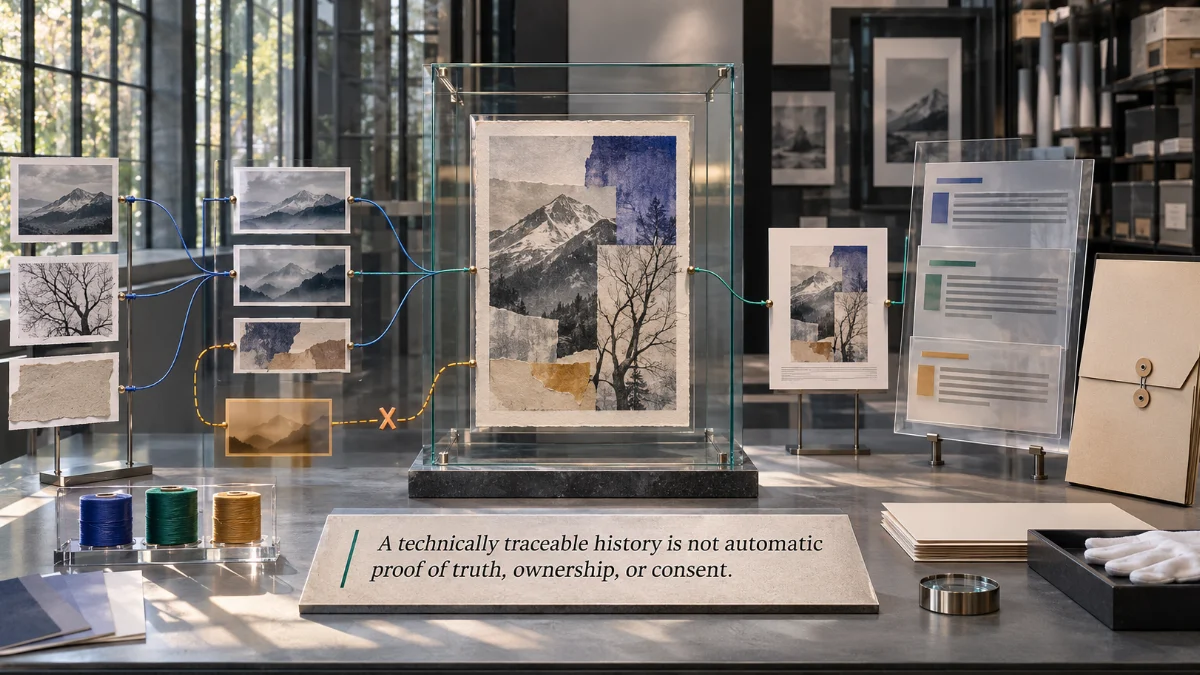
If you only read one thing: C2PA can help verify that signed claims about a digital asset are linked to it and have not been silently altered. It does not independently establish whether the depicted event happened, who owns the copyright, or whether every production step was disclosed. I treat content provenance as an evidence layer, not an authenticity verdict.
Why a Verified Badge Is Not a Verdict
A beautifully produced image arrives in a studio’s approval queue. It has plausible lighting, a credible file name, and a reassuring indicator that its Content Credentials can be inspected. A deadline is approaching. The easiest decision is to read the indicator as permission to publish. That shortcut is exactly the problem I want to prevent.
C2PA is a technical framework for content provenance, not an automatic editorial or legal clearance service. A successfully validated claim tells us something about signed statements and their association with the asset. It does not independently test the statements against reality. A legitimate signer may describe a staged photograph accurately; the photograph can still be used with a misleading caption. A valid chain can document an edit without proving that the editor obtained the rights to every ingredient.
I see a productive middle ground between two poor reactions: treating provenance as proof of truth, and dismissing all provenance because it cannot prove truth. Neither position gives a production team a useful decision process. What matters is choosing which questions the technology can answer and establishing independent controls for the questions it cannot.
This article develops a practical creative-operations method. It separates cryptographic validation, asserted history, editorial verification, rights clearance, and release authority. Where the standard has specific technical requirements, I rely on the published specification. Where I introduce a studio decision model, I label it as my proposed framework rather than a tested industry standard.
What Changed in the C2PA Standard by November 2026?
The editorial starting point for this topic was C2PA 2.2, released in May 2025. At publication planning time, however, the official specification site lists C2PA 2.5, dated October 2026. Version 2.3 followed in December 2025, and version 2.4 in April 2026. An article written as if version 2.2 were still the current edition would miss meaningful developments in formats, declarations, and validation requirements.
I therefore use the 2.5 specification for current technical descriptions and retain 2.2 as the historical baseline. The core proposition has not changed: a claim generator signs assertions about an asset and binds them to digital content; a validator evaluates the manifest and the associated trust conditions. The format coverage and supporting mechanisms continue to evolve, which is precisely why studios should record the validator version and the specification support level instead of assuming every consumer interprets every manifest identically.
The official C2PA 2.5 technical specification is the normative reference for this analysis. The C2PA 2.2 archive is useful when examining older workflow assumptions. In particular, version history is not proof that a creative application has adopted every new feature. Implementation support is a separate matter to verify.
Version support is part of the evidence
A validator that cannot interpret a newer assertion should not quietly invent an interpretation. A studio should record which tool inspected the manifest, which version it supports, which checks succeeded, and which statements were omitted or only partially interpreted. This is especially important when C2PA records move between camera systems, editing tools, asset-management services, and publication platforms with different update cycles.
I would never write “validated” in a release record without specifying what was validated. Was the signature cryptographically correct? Was the signer credential trusted under the relevant trust list? Was the active manifest bound to the delivered bytes? Were referenced ingredients available? The word alone conceals too much.
Understanding Assertions, Claims, Manifests, and Signatures
The C2PA vocabulary is precise because different objects solve different problems. An assertion is a statement about an asset: for example, an editing action, a source type, or information about an ingredient. A claim references assertions and binding information. A claim signature signs the claim using the relevant signing credential. A manifest packages these elements so that consumers can evaluate them. A manifest store can hold the active manifest and related provenance records.
The distinction matters operationally. An assertion about an editing action is not necessarily an independently observed fact. The signature establishes the integrity and attributable source of the claim under its trust model; it does not transform every assertion into a verified real-world event. A studio that confuses signed assertions with forensic certainty will grant C2PA more authority than it was designed to carry.
| Layer | The question it helps answer | What it does not settle | Studio control |
|---|---|---|---|
| Asset binding | Does the relevant manifest correspond to this asset or its covered content? | Whether the depicted scene occurred | Preserve the delivered file and verify binding |
| Claim signature | Has the signed claim changed since signing? | Whether the signer was honest | Validate signature and credential |
| Signer trust | Is the credential acceptable under a selected trust policy? | Who owns all creative rights | Record trust-policy context |
| Assertions | What creation and editing information is declared? | Whether all steps were captured | Compare with production records |
| Ingredients | Which inputs or earlier assets are represented? | Whether every source is licensed | Run a separate rights check |
| Release authorization | Who approved this exact asset and intended use? | Whether future reuse remains authorized | Maintain a human decision record |
A sample structure, not a fabricated credential
A simplified conceptual tree is useful: asset → active manifest → claim → assertions + content binding → signature, with related ingredient manifests where available. This is a description of relationships, not a valid production manifest and not a claim that I signed an asset for this article. A genuine C2PA record is produced by a compatible claim generator and must be validated against the actual media; typing a JSON example cannot manufacture cryptographic provenance.
For the same reason, I would not publish screenshots of a fictional validation tool as if they were evidence. Screenshots are persuasive even when they are only mockups. If an article teaches validation, an explicit conceptual diagram is safer and more honest than a fake green checkmark.
Five Questions a Studio Must Not Collapse Into One
1. Is there provenance information?
Presence is a discovery question. A file may contain an embedded manifest, reference an external manifest, or have no discoverable credentials in a particular tool. The absence of a visible Content Credentials indicator does not establish that the file was produced by AI, created deceptively, or modified improperly. It can reflect missing support, deliberate omission, metadata loss, or a workflow that never generated a credential.
A missing record is an evidence gap, not affirmative evidence of misconduct. I would log the outcome as “not found by this validator in this asset,” then decide whether the use case warrants obtaining the original from its source.
2. Is the manifest well formed and the signature valid?
This is a technical validation question. C2PA defines checks over manifest structure, claim signatures, credentials, and binding to content. A malformed or invalid manifest should not be presented as successfully authenticated. Conversely, a valid signature alone does not establish that the signing identity meets a studio’s acceptance policy.
The right interface separates invalid, untrusted, not found, unsupported, and needs review. Those states should not collapse into a binary “real/fake” badge. Even when a consumer tool simplifies them, the internal record needs the distinctions.
3. Are the asserted creation and editing steps sufficiently complete?
A chain may be partial. An editor can import an ingredient without its original provenance, a conversion can remove metadata, or a stage may be handled by a non-aware application. C2PA offers mechanisms for describing actions and ingredients, but the observable history depends on what the participating workflow records. A later manifest cannot reconstruct undocumented decisions simply by being digitally signed.
I would ask the production owner which stages should have been represented, whether any source manifests were missing, and whether a transformation changes the meaning of the content. Completeness is a workflow judgment supported by evidence, not a cryptographic checkbox.
4. Does the content accurately represent its subject?
Even an unmodified, correctly attributed photograph can mislead through cropping, timing, staging, selection, or captioning. A signed provenance record can support attribution and traceability without proving the truth of an editorial claim. The official C2PA explainer explicitly distinguishes provenance information from factual accuracy. That is the most important boundary in this article.
For consequential claims I would seek primary documents, reliable contextual reporting, subject verification, or a human fact-check appropriate to the asset. C2PA is one item in that evidence package; it is not its substitute.
5. Do we have permission to publish this particular use?
Copyright ownership, license scope, model-output terms, publicity rights, privacy obligations, and contractual restrictions sit outside basic C2PA signature validation. A signer may be a production tool or service rather than the person who owns copyright. Even a correctly signed chain cannot adjudicate all underlying rights.
A separate clearance record should identify the source license, intended channel, territory where relevant, permission for edits, expiration conditions, and the responsible approver. Legal questions require qualified review when stakes justify it. I would not label an asset “rights cleared” just because a manifest validates.
Content Provenance Is Not an AI Detector
The debate often begins with “Can we tell whether this image is AI-generated?” That is narrower than the real creative-governance question. C2PA can carry declarations about digital source types and AI-related operations, including source-type information in appropriate action assertions. Such a declaration can be useful when present and attributable. But its absence is not proof of human creation, just as its presence is not a universal measurement of the amount of AI involved.
Consider a composite: a licensed photograph, generative background cleanup, typography by a human designer, and a final crop. A binary “AI” label omits the composition’s ingredients and editorial responsibility. The more useful record describes relevant origin, transformation, and human control without pretending that every workflow can expose all inputs.
I recommend separating declared AI involvement from independently detected AI indicators. The former is a provenance statement signed by a participant. The latter, when a product offers it, may be an inference based on separate signals with its own error rates and coverage. These are not interchangeable proof systems. Nor should a studio imply that a missing C2PA manifest has been independently analyzed by an AI detector.
This distinction becomes particularly important for archival content. Older files will often lack modern provenance data. Penalizing them solely for that absence creates false confidence in newer tools and unjustified suspicion of earlier work.
What Survives Export, Editing, and Platform Distribution?
A pristine source file is not the same artifact as a social image, a compressed website preview, a thumbnail, a campaign video cut, or a screenshot. The C2PA connection can be broken or harder to discover as content is converted and redistributed. A distribution pipeline that strips or rewrites metadata may make otherwise valid provenance unavailable to downstream consumers.
There are also soft-binding and remote-recovery approaches intended to improve durability. Their presence, performance, and recovery behavior depend on the implementation, content characteristics, and supporting services. I would therefore test preservation through each actual channel rather than claim that Content Credentials always survive resizing or transcoding.
The minimum end-to-end check
For one representative asset, record the source file’s checksum, inspect its C2PA status, export each required rendition, inspect those output files again, and test the bytes actually downloaded from the publication channel. Do not stop at the asset-management preview. The delivered object is the relevant object for the recipient’s experience.
Check whether the platform returns the same content, a recompressed copy, or a generated thumbnail. If a manifest is not found in the delivered copy, distinguish metadata removal from validation failure; preserve the original and the export log. This is an operational test design, not a test I have executed on a named platform.
| Pipeline stage | Evidence to retain | Failure mode | Response |
|---|---|---|---|
| Source intake | Original bytes, source details, credential status | Misattributed or unknown input | Hold for sourcing review |
| Editing | Revision notes, ingredient list, export settings | Undeclared meaningful transformation | Revise disclosure |
| Approval | Exact final asset, rights record, intended use | Approval refers to older revision | Reauthorize current version |
| Export | Format, transform, output checksum | Manifest lost or unsupported | Test recovery or supply companion evidence |
| Distribution | Downloaded rendition, validator result | Published bytes differ from approved file | Investigate delivery pipeline |
| Archive | Source, manifests, clearance, decisions | Later unverifiable reuse | Retain independent records |
The Provenance–Integrity–Rights–Release Contract
I propose a six-domain review contract for creative operations. It is not part of the C2PA specification and is not a statistical score or externally validated assurance model. Its purpose is to prevent a successful technical check from silently authorizing an unrelated editorial or commercial decision.
| Domain | Required question | Evidence owner | What cannot be inferred |
|---|---|---|---|
| Provenance | What source and history are declared? | Producer | All undisclosed steps are absent |
| Integrity | Which manifest and asset checks passed? | Technical reviewer | The described event is true |
| Interpretation | What do the claims actually mean? | Editor | Signature equals factual accuracy |
| Rights | Is the intended use permitted? | Rights reviewer | A signer necessarily owns copyright |
| Distribution | Does the delivered rendition retain evidence? | Publishing operator | A valid source guarantees a valid derivative |
| Release | Who authorizes this exact content and context? | Accountable human | A green technical state requires publication |
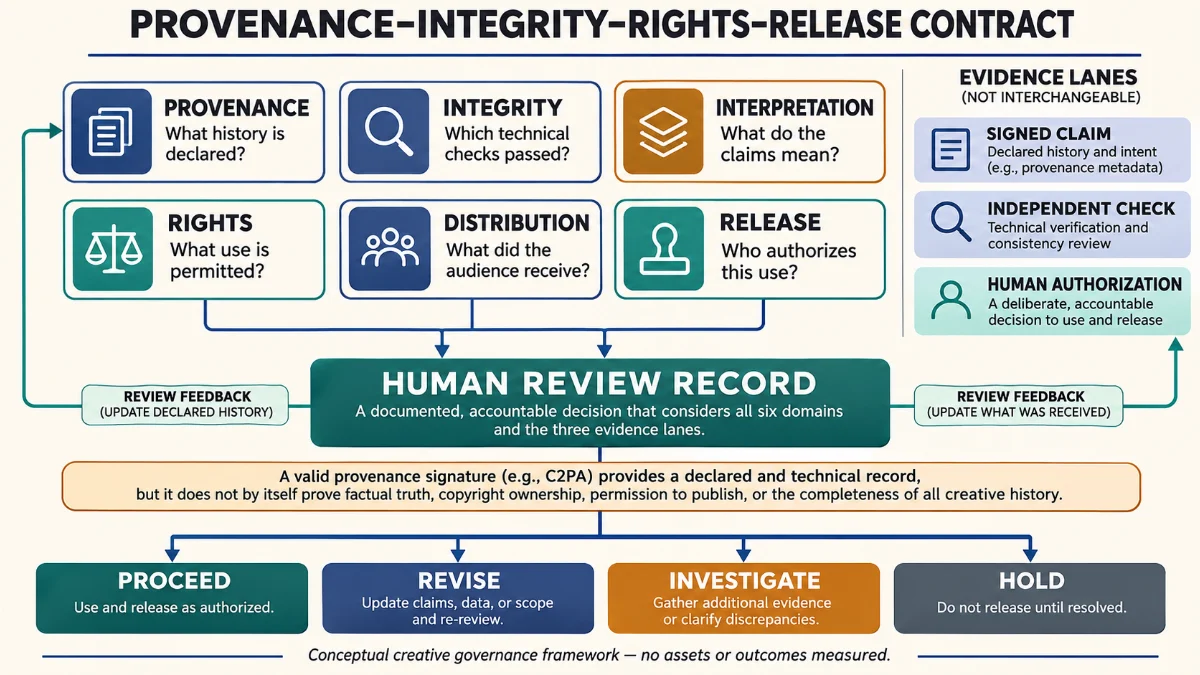
The Provenance–Integrity–Rights–Release Contract keeps technical assertions, editorial findings, and permission decisions in different lanes. When C2PA evidence is incomplete, the accountable reviewer may still proceed for a low-risk use if other evidence suffices; when stakes are high, missing evidence may justify investigation or a hold. I would never implement a global “four checks passed, therefore publish” rule.
Four appropriate dispositions
Proceed means the evidence is sufficient for a defined use under an authorized review, not that the asset is universally trustworthy. Revise means a fixable mismatch exists, such as an inaccurate disclosure or a missing link to a retained original. Investigate means the state cannot responsibly be interpreted with the current materials. Hold means release should stop because a relevant safety, legal, attribution, or integrity concern remains unresolved.
These pathways are not a ranking of content quality. They are accountable outcomes tied to a specific asset, audience, and purpose. A small editorial illustration can pass under a different evidence requirement than a high-impact news photograph. The method is proportional; the distinctions remain mandatory.
Why a Rights Ledger Must Remain Separate
Creative teams often collect license agreements, stock purchase records, contributor permissions, model terms, and brand approvals in scattered folders. Adding C2PA can improve traceability, but it does not consolidate those legal relationships for us. A more reliable approach is to link the provenance inspection record to a separate, access-controlled rights ledger that can be updated without rewriting technical provenance.
For each source ingredient, I would track its identifier, supplier, applicable agreement, license constraints, permitted transformations, and reviewer. When material is generated or transformed using AI, I would document the workflow, the declared source type when available, and any additional contractual restrictions. I would also distinguish “supplier asserts permission” from “permission independently reviewed.”
The studio should avoid embedding sensitive personal identities, confidential prompts, or private contract details into publicly distributed metadata without a compelling reason. Privacy and human safety can conflict with maximal disclosure. C2PA supports flexible assertions and redaction-related mechanisms, but disclosure policy is an organizational responsibility. More data is not automatically better data.
Twelve checks, not one generic authenticity signal
For a repeatable creative workflow, I would distinguish content provenance from Content Credentials display; preserve the C2PA manifest rather than a screenshot alone; verify the claim signature and content binding; document signer trust; examine ingredient history and declared digital source type; and keep rights clearance, manifest validation, and editorial verification as separate release checks. These names refer to different questions. Their separation is the operating principle, not an additional technical guarantee from C2PA.
Three Hypothetical Production Cases
Case A: A signed but misleading promotional photograph
Imagine a photograph captured by a credential-capable device and signed through a valid chain. The promotional copy claims it depicts an operating service location, but the photograph was staged in a temporary set. The technical provenance could be intact. The content provenance status cannot validate the promotional claim. I would mark the cryptographic check separately from the factual copy review, then revise or hold the release according to the evidence.
Case B: A licensed composite with a missing ingredient history
Imagine an illustration built from licensed elements and an AI-assisted background. A production export has a valid active manifest but some imported ingredients have no discoverable earlier provenance. That gap does not prove misuse; it does mean the chain is incomplete. I would retain the supplier licenses, identify which steps are declared, and ask whether the distribution context needs a disclosure beyond the information currently visible in C2PA.
Case C: A correct source becomes an opaque social rendition
Imagine a source asset with valid Content Credentials. The distribution service produces a smaller copy that no longer exposes the embedded manifest to the chosen validator. The right conclusion is not that the source credential was false. The delivered artifact has a provenance discoverability limitation in this pathway. I would preserve the original, record the export and delivery process, and assess whether a supported external reference or companion disclosure meets the publication need.
All three cases are illustrative scenarios. They are not measurements, legal findings, or accounts of real client incidents.
How I Would Audit a Creative Pipeline
I would begin with a single clearly bounded use case instead of a broad organization-wide authenticity badge. Define the asset type, intended channels, source conditions, audience risk, and the question a reviewer must answer before publication. Select a compatible claim generator and validator, then create a documented sample with explicitly permitted ingredients.
Next, run a repeatable sequence: original file inspection; authorized edit; export; further transformation; platform distribution; downloaded asset inspection; and archive recovery. At each stage, capture the validator output and the tool version, but never replace raw evidence with a presentation screenshot alone. Test both a supported path and a deliberate interruption, such as a format conversion known to your workflow. The goal is to learn what the pipeline preserves, not to force a predetermined success story.
Keep four independent evidence sets: machine validation results, editorial context checks, rights records, and release authorization. Track unresolved items to an owner, not a colored dashboard. A short documented “not available in this rendition” outcome is more trustworthy than an invented continuous chain.
Evidence acceptance checklist
- Confirm the exact file and its checksum before inspection.
- Record the validator, version, trust policy, and reported states.
- Inspect the active manifest and relevant ingredient references.
- Separate created assertions from gathered information where the tool exposes them.
- Determine whether missing history matters to the intended claim.
- Verify editorial statements with sources independent of C2PA.
- Clear usage rights independently and document permitted scope.
- Inspect the actual distributed rendition, not only the source file.
- Identify the human approver and a review trigger for later changes.
This is a proposed studio checklist, not a guarantee that a particular C2PA deployment satisfies legal obligations or industry accreditation. It also does not imply that the workflow has been tested on a production system for this article.
What Not to Say in a Content Credentials UI
Language can destroy careful technical distinctions. I would avoid “Verified real,” “Copyright certified,” “100% authentic,” “AI-free,” and “No manipulation detected” unless some separate rigorous process truly supports the precise claim. C2PA itself does not authorize those conclusions.
Better statements name the actual result: “A cryptographic signature was validated for this file”; “The signer credential is trusted under the selected policy”; “The declared editing history is available”; “Some ingredients have unknown provenance”; or “No usable credentials were found in this rendition.” The user should be able to inspect the grounds for the result and understand the limits without reading the entire technical specification.
An interface should also disclose when a tool only supports part of a newer version. A green indicator that hides an unsupported assertion is misleading even if the underlying signature happens to be valid. The value of C2PA increases when the UI communicates confidence appropriately rather than making maximal claims.
A Pragmatic Roadmap for Independent Studios
A smaller studio does not need a proprietary authenticity platform to start making better decisions. It needs a clear content-origin policy, a way to retain original files, a current validator it can trust for its use case, and a rights/approval ledger. Start with the channel where attribution matters most and where the team can inspect the delivered asset.
Then introduce C2PA signing at a controlled point in the workflow. Make room for assets with no credentials, older files, licensed inputs, and people who have legitimate reasons not to reveal identity details. The release process should work with uncertainty rather than punish it automatically.
Finally, revisit the policy whenever technical support changes, a platform alters its export pipeline, or a significant incident demonstrates that the existing record is inadequate. Version 2.5 is a reminder that the standard itself is moving. A responsible content provenance strategy is a maintained practice, not a one-time metadata switch.
Frequently Asked Questions
Does a valid C2PA credential prove that an image is real?
No. It helps validate signed statements and their association with the asset under the applicable trust model. It does not independently prove that the depicted event happened or that the surrounding caption is accurate.
Does the absence of Content Credentials mean an image is AI-generated?
No. Credentials may never have been created, may have been removed in distribution, or may not be discoverable by the available validator. Absence is not an AI-detection result.
Can C2PA prove copyright ownership?
Not by itself. A credential can provide useful origin and history statements, but copyright ownership and the rights to a particular use require additional evidence and sometimes legal review.
Can a valid signature still describe incomplete history?
Yes. A manifest can validate while some earlier operations or ingredient records are unavailable. Validation of the signed claim and completeness of the production history are different questions.
What is the difference between C2PA 2.2 and 2.5?
Version 2.2 was released in May 2025; the official version history identifies 2.5 as October 2026. Later versions expand capabilities and clarify technical requirements. The relevant practical question is which version a tool generates and another tool can validate.
Does resizing or recompression always preserve credentials?
No. Preservation depends on the export and distribution workflow. Some implementations support external recovery mechanisms; they should be tested for the actual published rendition rather than assumed.
Should a studio refuse every asset without a credential?
Not automatically. The appropriate decision depends on the intended use, risk, source evidence, and independent editorial and rights checks. A missing credential is a reason to assess uncertainty, not a universal prohibition.
What should a creator retain for future disputes?
Retain the original asset, relevant manifests and validation records, licenses, editing history where appropriate, final approved rendition, publication context, and the accountable release decision. Such records help reconstruct events but do not guarantee a legal outcome.
Evidence and Methodology
This is a document-based technical and operational analysis, not a live test of a signing application or distribution platform. Technical descriptions are grounded in the official C2PA 2.5 specification and archived 2.2 material, alongside public guidance on viewing Content Credentials. The proposed review contract, three scenarios, and pipeline checklist are original conceptual methods. No participants, platform-preservation rates, incident statistics, or actual asset-verification results were measured.
Primary references: C2PA Technical Specification 2.5; C2PA Technical Specification 2.2 (archive); C2PA Explainer; Content Credentials inspection guidance; Content Credentials verification interface.
Final Decision: Make Provenance Useful, Not Magical
I would rather publish a cautious, accurately interpreted provenance record than a reassuring badge that makes promises the system cannot keep. C2PA can materially improve asset traceability when implemented, preserved, and explained well. It also gives creative teams new responsibilities: maintain signer and validator policy, test delivery paths, protect sensitive information, and preserve a clean boundary between technical validation and human authorization.
The durable principle is simple: verify the manifest, examine the claims, clear the rights, validate the editorial context, and authorize the specific release. Every step matters; no one step can silently stand in for the others.