


C2PA Content Credentials: What They Can and Cannot Prove

Security Hardening Without Breaking Site Operations

One argument, three platforms, and three very different conversations. A professional can spend hours researching a software engineering problem, write a careful explanation, and then reduce it to three social posts that no longer mean the same thing. The first version names the conditions. The second sounds confident because a qualifier was removed. The third asks an engaging question that accidentally presents a recommendation as a measured outcome. The work was multiplied, but its evidence became weaker with each adaptation.
That is the problem I want content repurposing to solve. I am interested in preserving a defensible thesis while adapting its explanation to LinkedIn, X, and Threads. I do not want three copies of a paragraph, three algorithmic guesses, or a more dramatic claim created to fit a shorter text box. I want three useful expressions of the same underlying reasoning, each shaped for a particular conversation without altering what the research permits me to say.
My professional publishing work sits at the intersection of software, AI, digital products, UX, and strategy. Across those areas, the evidence often matters more than the slogan. A decision framework is not a tested performance improvement. A security recommendation is not an audit of a real system. A model’s reported capability is not proof that my own implementation works. When content repurposing forgets these distinctions, distribution starts manufacturing credibility that the original material never earned.
If You Only Read One Thing
Keep the core thesis, its supporting evidence, and its limitations stable. Change the entry point, the amount of context, the order of explanation, and the invitation to respond. Good content repurposing is not a mechanical shortening exercise. It is controlled editorial translation: the same defensible claim becomes readable in three different settings without becoming stronger, broader, or more certain.
My minimum content repurposing rule is simple: if I place the LinkedIn post, the X post, and the Threads sequence next to the source article, I should be able to trace every material assertion back to the same evidence. If any variant requires a fact, result, participant count, or personal experience that does not exist in the source, I rewrite the variant or remove the claim.
Decision Brief: Three Platforms, One Accountable Argument
Content repurposing is useful when a substantial idea deserves more than one way into the conversation. An engineering leader might need an executive decision summary. A developer might want a precise failure condition. A reader on Threads might want to explore why that condition matters in practice. These are different paths for content repurposing, not permissions to invent different findings.
Before writing any social version, I identify three things: the thesis I am prepared to defend, the evidence boundaries I will not cross, and the reader action that would make this particular version useful. Content repurposing should move these decisions ahead of format optimization. Choosing a hook first can quietly reverse the process: the hook begins to dictate what counts as true.
| Element | Preserve | Adapt | Review trigger |
|---|---|---|---|
| Core thesis | Meaning and strength | Opening question and example | Variant implies a stronger conclusion |
| Evidence | Source, scope, relevant date | How much support is summarized | A material fact appears without a source |
| Uncertainty | Limitations and missing knowledge | Plain-language explanation | A qualifier disappears |
| Audience | Who the work can help | Use case and vocabulary | Framing attracts a different promise |
| Call to action | No fabricated urgency or outcomes | Question, discussion, or reference | Interaction is requested at the expense of accuracy |
This is a content repurposing rubric, not an experiment establishing that one format performs better. I use it to prevent avoidable information loss before content distribution begins.
What One Thesis Actually Means
For content repurposing, a thesis is more precise than a topic. “AI coding” is a topic. “AI-generated code may reduce drafting time, but release readiness still depends on independent verification and maintainable ownership” is a thesis. The second statement can be examined, challenged, supported with standards and research, and adapted for different readers. It also has a clear limitation: it does not claim AI always slows down developers or that every code change needs an identical review procedure.
For content repurposing, I write the thesis in one sentence before creating a post. Then I write one sentence about what the thesis does not establish. That second sentence often prevents more editorial errors than an elaborate style guide. It catches words such as “always,” “proven,” “guaranteed,” and “everyone” when the underlying source supports only a conditional conclusion.
A Claim Can Be Tested; a Topic Can Only Be Discussed
Without a claim, three platform variants become three collections of observations. One might turn into a motivational LinkedIn lesson, another into a deliberately provocative X opinion, and the third into a personal Threads diary. All could mention the same topic while asking readers to believe incompatible things. Content repurposing needs a claim ledger so the author can compare meanings, not only keywords.
Protect the Conditions
In content repurposing, some statements depend on context: a defined product, a particular task, a specific dataset, a legal jurisdiction, or an observed sample. The adaptation can simplify terminology, but it cannot remove a condition that makes the claim valid. For example, “In this controlled task, the method reduced review effort” cannot become “This method reduces review effort” without new evidence. The latter is a generalization, not a shorter sentence.
Build a Source and Claim Ledger Before Writing Posts
My preferred starting point for content repurposing is a small evidence ledger linked to the original article. It records the assertion, the supporting source, the kind of evidence, the relevant date or version, and what remains uncertain. This is not bureaucracy for its own sake. It is a practical defense against a common failure: a source that appeared accurate in a long article is reduced to a link-free claim that no longer explains its scope.
Source provenance matters especially when platform instructions, software versions, or research findings can change. A platform character limit is a current product rule, not a timeless design principle. A preprint is not necessarily equivalent to a replicated result. A personal engineering observation should not be presented as a representative study. Content repurposing works better when each statement has a declared evidence type.
| Claim | Evidence type | Allowed wording | Forbidden leap |
|---|---|---|---|
| Generated code needs review | Engineering practice and risk-based policy | Recommend review appropriate to consequence | Claim every generated patch contains a flaw |
| Tests need independent checks | Verification method | Separate proposal from evidence | Claim all model-written tests are invalid |
| Ownership needs an explicit maintainer | Operational governance | Assign responsibility for change and recovery | Claim a specific team had an incident |
| Release is conditional | Defined team or project policy | Use gates proportionate to risk | Promise a guaranteed reduction in failures |
For content repurposing, the ledger above is an illustrative method, not a summary of measured production outcomes. The core engineering recommendation can be anchored to Google’s code-review principles, OWASP’s secure code review guidance, and NIST’s Secure Software Development Framework. Those sources inform a responsible process; none measures the results of the three example posts below.
Understand the Platforms Without Worshiping Their Limits
Content repurposing requires distinguishing a platform’s technical affordances from the author’s editorial choice. As documented when this article was prepared, LinkedIn describes a 3,000-character post limit. X documents longer Premium posts up to 25,000 characters, while ordinary posts have a 280-character limit. Meta describes standard Threads posts of 500 characters and separate text attachments up to 10,000 characters. Features and account eligibility can change; I treat these as dated references, not immutable laws.
My own content repurposing preferences are intentionally stricter: one substantial X post when the topic calls for it, often below about 3,900 characters; a LinkedIn post within the platform’s limit; and natural Threads installments of no more than 500 characters each. Those are working editorial choices, not claims that the platforms cannot publish anything longer. I review the current composer before posting.
| Channel | Documented capability | Preferred treatment | Avoid assuming |
|---|---|---|---|
| Native feed post, up to 3,000 characters | Professional decision and practical implication | That formal tone makes an unsupported claim credible | |
| X | 280-character standard post; longer Premium posts where eligible | Sharp technical thesis with conditions and a concise proof path | That maximum length creates a better argument |
| Threads | 500-character core post; optional longer text attachment | Conversational installments with one idea per turn | That replies prove the reader understood the thesis |
LinkedIn: Make the Decision Legible
LinkedIn posts can carry a structured professional argument: the problem, why the familiar metric or assumption is insufficient, the evidence boundary, and the implication for a decision-maker. That does not require a corporate voice. I prefer direct paragraphs and specific trade-offs over a stack of disconnected motivational lines. For this audience, content repurposing should help a reader decide whether to read the full article, challenge the method, or share a relevant example.
LinkedIn also provides post analytics covering impressions, estimated members reached, profile activity, reactions, comments, saves, and sends. Its analytics documentation notes that some figures are estimates. These are useful observations, not proof that an individual reader accepted the argument or that the post produced a business outcome.
X: Put the Engineering Constraint Up Front
X is well suited to a short, falsifiable thesis followed by its most important implementation condition. For X long posts on technical topics, I might open with the specific failure mode rather than a broad lesson about leadership. But compression is dangerous: “an AI-written test passed” should not be quietly rewritten as “the system was independently verified.” Content repurposing on X should retain the distinction between a model’s proposal, a test result, and human authorization.
In content repurposing, the first 280 characters deserve care even in a longer Premium post because they shape the immediate reading context. That is an editorial principle, not a claim about a hidden ranking formula. The X documentation describes who can create longer posts and certain composer limitations. I avoid making an unsupported statement that links, punctuation, or formatting automatically change ranking in a fixed amount.
Threads: Allow a Conversation Without Diluting the Evidence
Threads conversations can support more exploratory explanations: why the issue caught my attention, what feels counterintuitive, which constraint I am still examining, and what a peer might challenge. In content repurposing, this is not permission to make the weakest claim. It is an opportunity to express the same uncertainty in a more human conversational register. A sequence should still work when a reader arrives at a later reply without seeing every earlier post.
Meta’s Threads Insights update describes views, interactions, follower information, and discovery sources, including some recommendations on other Meta apps. That makes direct numerical comparison with LinkedIn or X even less reliable. A Threads view and a LinkedIn impression come from different product systems; neither is a universal unit of trust.
Length Is Not Depth, and Compression Is Not Clarity
A long post can still be vague. A short post can be rigorous when it identifies the essential constraint and does not pretend to cover the entire case. Content repurposing becomes misleading when editing removes the one sentence the reader needed in order to interpret the conclusion. Consider “independent verification is required before release.” Without saying what is being verified and what consequence matters, the line risks sounding universal while offering little practical guidance.
I prefer to compress examples and background before compressing limitations. If the claim needs five conditions, maybe the channel cannot carry that particular claim in its current form. The right answer may be a narrower thesis, a short pointer to the original research, a Threads sequence, or no post at all. An efficient editorial workflow should allow the decision not to publish rather than treat every source article as mandatory multi-platform inventory.
Worked Example: One Thesis, Three Platform-Native Versions
The following samples are illustrative editorial drafts, not published posts, recorded conversations, or performance results. They are based on a normative engineering proposition: AI-generated code can accelerate drafting, but release decisions still require appropriate independent verification, clear ownership, and a recovery path. The code review article examines these issues in depth. I am showing how content repurposing changes presentation while keeping the same evidentiary boundaries.
LinkedIn: The Accountable Release Decision
AI can produce a plausible change before a team has fully agreed on the acceptance criteria. That is useful, but it creates an engineering question: who can establish that the proposed change is safe enough for this system?
I would separate drafting time from the work required to check behavior, review security boundaries, assign maintenance responsibility, and prepare a rollback. Those tasks are not interchangeable, and their cost depends on the consequence of the change.
My rule for AI-assisted development is to approve the evidence, not the fluency of the explanation. A low-risk documentation update should not require the same gates as an authorization change, but neither should bypass its relevant checks because the patch arrived quickly.
For engineering leaders, the useful measure is not how fast a diff appeared. It is how reliably the team can understand, verify, own, and recover from the change.
This LinkedIn content repurposing example provides the organizational decision frame. It avoids promising measured time savings or pretending that every change carries identical risk. The intended reader can respond with a release-policy question or a real review practice, not merely a reaction to an alarmist statement.
X: The Falsifiable Technical Constraint
AI-generated code can be fast to draft and expensive to trust. The real question is whether the team can verify the behavior without relying on the same model’s explanation.
For a consequential patch, I want a scoped change, independent tests, a security boundary check, a named owner, and a viable rollback path. Those controls should be proportionate to risk. A documentation fix and an authorization change are different release decisions.
Code generation speed tells us when the proposal arrived. It does not, by itself, tell us when the system is safe to ship.
This X example foregrounds the technical invariant and keeps the recommendation conditional. It is substantially different from the LinkedIn draft, but it does not invent an AI benchmark or turn review into an unqualified claim that all AI-generated code is unsafe.
Threads: A Three-Part Conversation
Part 1: I keep coming back to one AI coding question: why do we treat a fast draft as if it automatically shortened the whole engineering task? Sometimes it does. Sometimes the time moves into review, test design, integration, or debugging. The release decision still needs evidence.
Part 2: The awkward part is that a model can explain its own patch very convincingly. That explanation is helpful context, but I would still want an independent check of the behavior, especially when permissions or user data are involved.
Part 3: I don’t think every tiny change needs an enterprise review ceremony. I think the review should match the consequence. Where has AI genuinely reduced verification work in your workflow, and where has it mainly shifted the work?
Each of these illustrative Threads installments is below the ordinary 500-character body limit. The sequence makes space for a genuine question without rewriting an unmeasured possibility into a measured result. This is the content repurposing distinction I care about: voice and pacing can change; epistemic status cannot.
Audit the Example for Meaning Drift
After content repurposing, a reader should be able to identify the same conclusion in every variant: faster drafting is not sufficient evidence of release readiness. The LinkedIn version discusses team accountability. The X version asks how to independently verify a change. The Threads version asks colleagues to compare their experiences without assuming the answer. The language differs because the audience intent differs; the evidence boundaries remain recognizable.
| Test | X | Threads | |
|---|---|---|---|
| Thesis | Faster draft is not release authorization | Proposal does not equal verified behavior | Speed may move work downstream |
| Evidence level | Normative engineering reasoning | Normative engineering reasoning | Explicitly invites observations |
| Limitation | Controls depend on consequence | Risk-proportionate checks | Experiences are not representative data |
| Reader action | Discuss a release policy | Challenge a technical invariant | Compare actual workflows |
Content repurposing fails this audit when the third version no longer supports the first version’s thesis. A line like “AI always doubles review time” would be rejected because none of the underlying examples establishes that number or generality. A line like “I measured these results across 100 teams” would be rejected because the evidence ledger contains no such study. The claim should remain traceable after every edit.
The Thesis–Evidence–Context–Review Contract
To make content repurposing auditable, I use a conceptual decision record called the Thesis–Evidence–Context–Review Contract. It is a practical publishing discipline, not a validated scientific model, a ranking formula, or a compliance certification. Each domain asks for a human judgment supported by the source material. A missing condition does not become acceptable because a post looks engaging.
| Domain | Question | Required evidence | Review trigger |
|---|---|---|---|
| THESIS | What exactly is being claimed? | Stable, falsifiable proposition | Variant changes meaning |
| CLAIM LIMITS | What is not established? | Scope, caveats, uncertainty | Condition is removed |
| EVIDENCE | What supports the claim? | Original source and date | Source is missing or outdated |
| PLATFORM CONTEXT | How will this be read here? | Format, audience, relevant constraints | Hook changes the promise |
| READER ACTION | What useful response is invited? | Declared editorial purpose | Engagement bait replaces value |
| HUMAN REVIEW | Who authorizes publication? | Claim and final-copy comparison | Unresolved material discrepancy |
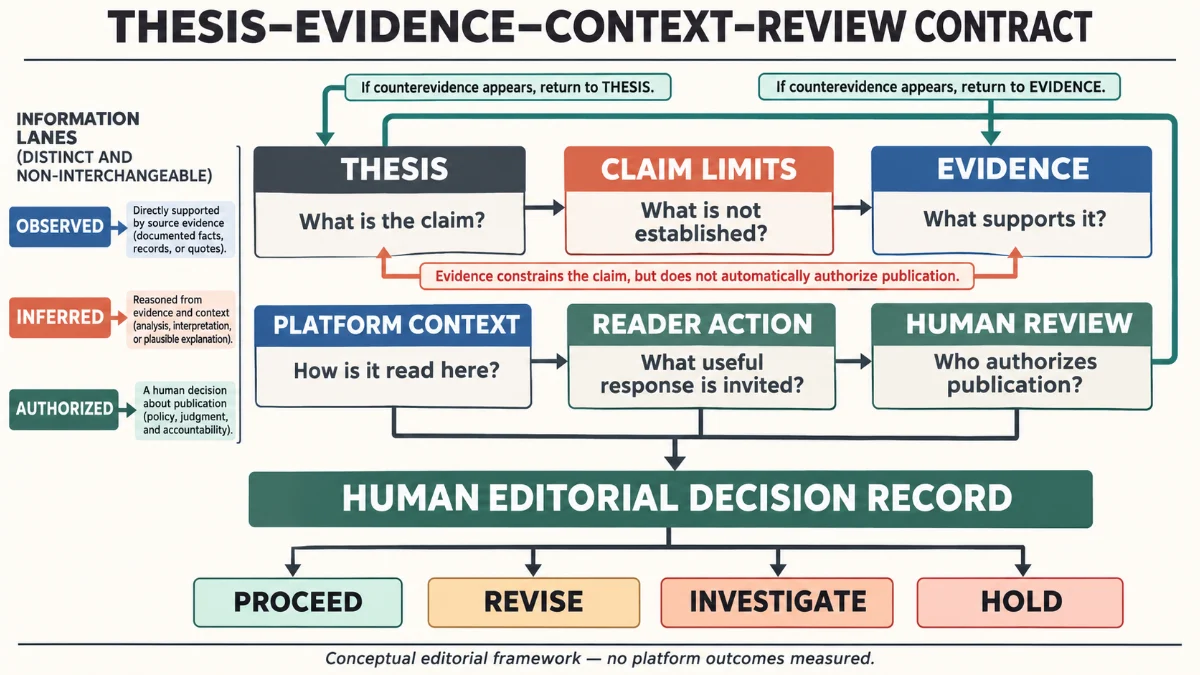
The important point for content repurposing is that the contract does not convert popularity, model-generated confidence, or the absence of a detected error into permission to publish. A human review record can conclude PROCEED, REVISE, INVESTIGATE, or HOLD. These are alternative dispositions, not a numerical score and not a demand for endless process.
Include Counterevidence in the Record
Content repurposing benefits from one uncomfortable question: “What would someone reasonably cite against this sentence?” If the source article discusses research limitations, an opposing study, an incompatible implementation environment, or an unresolved technical issue, the adaptation should not erase that. There is rarely room for every detail, but there must be enough room to avoid a false impression.
Five Ways Meaning Drifts Between Platforms
A Hook Becomes the Entire Argument
“Your content strategy is broken” may attract attention but says little. A more useful opening is “A strong post can still reach the wrong professional audience.” It names the failure condition without claiming to diagnose every reader. Content repurposing should never allow a dramatic headline to override the underlying thesis.
The Source Disappears During Compression
During content repurposing, a public report is turned into “research proves,” while its publication date, method, and population vanish. Sometimes the solution is an unobtrusive named source. Other times it is to narrow the statement so that a missing link does not leave the reader with a universal claim. For any serious quantitative result, I preserve enough context to identify what was measured and under which conditions.
A Professional Judgment Becomes an Empirical Finding
“I would require a rollback path for this class of change” is a recommendation. “Rollback paths reduce incidents by 80%” is an empirical claim requiring a specific study and defined scope. Content repurposing should not convert the first into the second to produce a more impressive slide, hook, or discussion point.
An Illustrative Story Becomes a Personal Case Study
A hypothetical system failure in content repurposing can make a technical point legible, but it must not be narrated as an incident from my own projects. The same applies to artificial intelligence writing in the first person. If the author did not conduct the test, publish the project, interview the participant, or observe the outcome, a platform-specific version cannot claim that history. “Imagine a team” is very different from “I worked with a team.”
A Platform Metric Becomes a Business Result
Views, estimated reach, saves, replies, and qualified inquiries are different observations. A Threads interaction is not a LinkedIn profile view. An X view count can include repeated exposures according to X’s public definition. Content repurposing must not hide these counting differences behind one combined “reach quality” number. Any cross-platform comparison needs explicit denominators and limitations.
Distribution Is Part of the Evidence Strategy
For content repurposing, the original article is the durable reference for a substantial research argument. A social version can be useful on its own without copying the complete bibliography into the post, but it should not become the only place where important caveats live. I maintain the original source record and make it easy to locate from the professional profile, publication hub, or the appropriate platform context.
For X, my current writing workflow often keeps external URLs out of the body of a technical long post so the argument reads as native text. That is a personal editorial choice; I do not claim that all links are penalized by a fixed platform algorithm. On LinkedIn, I may provide the article link in a separate comment when that serves the discussion, but it is a distribution choice, not evidence of a universal reach advantage. On Threads, the short sequence can invite a deeper conversation and point to the underlying piece where helpful.
Content repurposing should preserve a way back to the source when the claim needs external verification. If a post contains a critical statistic, its source should be identifiable even when the entire article is not reproduced. If a source requires a login or is no longer accessible, the limitation should be stated rather than concealed.
Measure Qualified Reach, Not Just Repetition
Three posts can triple the places where an idea appears without tripling comprehension or opportunity. That difference is central to content repurposing. I am more interested in whether the work prompts a relevant technical question, a thoughtful counterexample, repeat reading, or an informed collaboration discussion than whether the same sentence accumulated the most visible reactions.
LinkedIn reports estimated impressions and distinct members reached under its own counting rules. Threads Insights can include views, interactions, follower trends, and content discovery sources. X reports views that may count repeated exposures. These metrics are not directly comparable, and none by itself measures trust. I evaluate each channel using the observation it can actually provide, then interpret meaningful responses against the publishing objective.
| Observable signal | Useful question | Cannot establish alone | Follow-up |
|---|---|---|---|
| Impressions or views | Did the work circulate? | Comprehension or qualified intent | Check channel-specific definition |
| Relevant replies | Did readers engage with the actual claim? | Representative audience demand | Review themes, not private identities |
| Saves and shares | Was the content useful to keep or pass on? | Agreement or eventual adoption | Monitor later questions where visible |
| Profile or site exploration | Did readers seek more context? | A purchase or hiring decision | Respect attribution and consent limits |
| Qualified inquiries | Did the work connect to a real decision? | That one post caused the opportunity | Record stated context, where permitted |
In my content repurposing reviews, I do not add these categories into an invented “qualified reach” index. A smaller number of serious replies is not secretly a guaranteed success, and broad attention is not inherently bad. The purpose of the review is to understand what the publication achieved, what remains unknown, and what should change in the next iteration.
A Practical Content Repurposing Workflow
My content repurposing workflow is deliberately sequential so a strong hook never substitutes for evidence. For a substantial article or technical update, I would use the following steps:
- Confirm the source. Identify the canonical article, publication date, relevant updates, and any external studies used.
- Write the thesis. State one defensible proposition in ordinary English, then list what it does not establish.
- Mark evidence boundaries. Separate observed findings, reported claims, professional inference, and recommended actions.
- Choose the intended reader. Name the decision or question that makes the work relevant, not just a job title.
- Draft LinkedIn independently. Lead with the organizational or product decision, retaining essential constraints.
- Draft X independently. Lead with the technical failure mode or falsifiable condition; keep the central evidence visible.
- Draft Threads independently. Use a natural short sequence built for dialogue, not a copied paragraph cut into chunks.
- Audit against the ledger. Compare every material claim, scope word, number, and personal-experience statement to the source.
- Check current platform rules. Confirm actual composer limits and supported formatting at publication time.
- Publish intentionally. Choose whether all three variants are justified. Distribution is an editorial decision, not a quota.
- Record outcomes carefully. Save accessible aggregate signals and substantive themes without inventing attribution.
- Review and correct. When the source changes, update or contextualize material claims across the versions where possible.
Content repurposing can be automated partially. A tool can generate candidate outlines, flag mismatched names, and check character lengths. It cannot independently authorize a claim that the author has not supported. I keep the final approval attached to the source, the intended reader, and the risk of misunderstanding.
What Automation Can Check and What Needs Human Review
Mechanical checks in content repurposing are valuable: a script can confirm that a post stays within an editorial character cap, that a URL matches the canonical source, and that a cited number appears in the article. It can also compare a list of quoted sources and flag absent links. Those controls save attention for work that genuinely requires judgment. But token matches do not prove that a summary preserves meaning, and a language model’s reassurance that a claim is “accurate” is not independent verification.
Human review of content repurposing remains necessary for implication, tone, audience mismatch, privacy, and claim strength. For instance, a syntactically valid statement can still mislead through what it omits. A provocative question can suggest a conclusion that the article explicitly rejects. Good content repurposing treats these as release risks rather than stylistic preferences.
Do Not Turn Every Post Into a Formal Audit
Content repurposing review effort should match the consequences. A personal reflection about learning a design method may need a light factual check. A security incident summary, health claim, statistical finding, or product capability comparison deserves stronger source and context verification. That is the same risk-proportionate reasoning I apply in software reviews: the control should address the hazard, not merely create paperwork.
Three Hypothetical Editorial Decisions
Scenario A: An AI Product Reliability Article
Imagine a product manager publishes a careful analysis of an AI feature’s failure modes without running an empirical customer test. A LinkedIn version could discuss authorization responsibility, an X version could isolate the failure boundary, and a Threads sequence could invite relevant implementation experiences. All three must retain the fact that the article offers a conceptual assessment rather than a validated outcome. The content repurposing passes when readers understand that boundary.
Scenario B: A Hardware Claim With Narrow Conditions
Imagine a creator writes about external SSD performance using manufacturer documentation but does not benchmark a physical unit. A short X post might warn that a high link speed is not sustained application throughput; LinkedIn might frame the operational risk for project managers; Threads might ask how people verify backup recovery. None should invent a specific MB/s result, measured temperature, or reliability percentage. Better content repurposing can raise useful questions without pretending a test took place.
Scenario C: A Fast-Moving Security News Item
Imagine a public vulnerability announcement that affects only a subset of versions or configurations. If the LinkedIn summary says “everyone is exposed” while the original advisory provides narrower conditions, the social adaptation fails. The same applies when a patch is available but a post continues to present the issue as unmitigated. For time-sensitive content repurposing, checking the advisory’s update date is part of the editorial work, not a footnote.
These are invented teaching scenarios with no campaign data, customer records, measured outcomes, or claims about my personal deployments. Their role is to show what should and should not transfer across channels.
When Copying or Publishing Less Is the Better Choice
There are legitimate cases for publishing essentially the same short announcement across channels: a corrected service notice, an event time, or a precise public safety statement may benefit from stable wording. The point is not to manufacture difference for its own sake. When exact wording is important, editorial variation can create unnecessary risk. Content repurposing is most valuable when a substantive argument needs different context, not when every sentence needs creative reinvention.
There are also times when one strong post is enough. If a source article has a narrow audience and no meaningful entry point for another channel, forcing three versions creates more review work without clear reader benefit. I would rather publish one defensible interpretation and move on to another valuable task than optimize for a content count disconnected from qualified reach.
Final Pre-Publication Checklist
- Can I express the same thesis in one sentence across all three versions?
- Does every number, source claim, and concrete example have a real origin?
- Did I preserve study scope, platform version, jurisdiction, or other relevant conditions?
- Have I separated observation, inference, recommendation, and authorization?
- Is any hypothetical scenario labeled as hypothetical rather than lived experience?
- Are platform-specific length limits and feature eligibility current?
- Does each version give a real reader an independently useful reason to read?
- Is the tone professional and human rather than a copywriting formula?
- Would a critical domain expert recognize the same limitations in every version?
- Are source links and the canonical article discoverable where readers need them?
- Is the intended outcome qualified understanding, not merely reaction count?
- Have I allowed myself to hold publication when evidence is insufficient?
I want content repurposing to leave a cleaner trail than the original drafting process, not a trail of increasingly confident paraphrases. If one checklist item reveals a material change in meaning, revision is preferable to immediate distribution.
Frequently Asked Questions
Should I post exactly the same text on LinkedIn, X, and Threads?
Sometimes an exact notice is appropriate, but substantive professional analysis usually benefits from platform-native writing. Keep evidence and meaning stable while adapting the entry point, context, and discussion request. Content repurposing should not require artificial differences when precise wording is essential.
What is the difference between content repurposing and cross-posting?
Cross-posting usually means placing substantially the same material on several channels. Content repurposing reorganizes source material for a new use while protecting its claim integrity. The distinction is editorial rather than a guarantee of reach or ranking.
Do I have to publish every article on all three platforms?
No. Channel selection should follow the reader’s decision and the available evidence. If an article has no meaningful contribution to a platform conversation, publishing less can be a better choice.
What are the current character limits for LinkedIn, X, and Threads?
Official documentation consulted in November 2026 describes up to 3,000 characters for LinkedIn posts, 280 for ordinary X posts with eligible Premium longer-post options, and 500 for standard Threads posts with an optional longer text attachment. Account eligibility and features can change, so check the composer before publication.
Should every social post include a link to the original article?
Not necessarily in the same location or format, but the underlying source should remain traceable when it supports a consequential claim. A link placement strategy is an editorial choice, not proof of an algorithmic advantage.
Can AI generate all three versions automatically?
AI can propose drafts, check formats, and surface inconsistencies. It cannot establish whether an unverified personal claim really happened or authorize a missing study result. Human review should compare the final variants against the original evidence ledger.
How should I compare results across different platforms?
Use each platform’s documented definitions, observation windows, and available aggregate signals. Do not treat a view, an impression, a unique member reached, and a qualified inquiry as interchangeable units. A single universal engagement score is not supported by these differences.
How can I keep a personal voice without becoming inconsistent?
Keep the author’s real observations, doubts, and editorial judgments. Change examples and pacing to fit the conversation, but do not manufacture experiments or make the conclusion more certain. Consistent honesty is more valuable than identical wording.
Evidence and Methodology
This article offers a research-informed content repurposing framework. I reviewed public platform documentation on post lengths, X longer-post eligibility, Threads text attachments and Insights, and LinkedIn post analytics. I also used public engineering review guidance to demonstrate the relationship between a professional thesis and its evidence. The three platform samples are illustrative drafts; they have not been tested with real audiences and make no claim of improved reach, engagement, or conversion.
The available material supports claims about documented platform capabilities and how certain metrics are defined. It does not establish a universal publishing algorithm, an ideal posting time, a causal advantage for link placement, or a statistically validated increase in professional opportunities. The Thesis–Evidence–Context–Review Contract is my conceptual method for deciding what to publish and why. It should be challenged and refined when counterevidence appears.
Selected Primary References
- LinkedIn Help: Post and share updates — documented post-character limit and creation options.
- LinkedIn Help: Post analytics for your content — estimated reach, profile activity, and engagement definitions.
- X Help Center: About different types of posts — standard and Premium longer-post formats.
- X Help Center: View counts — counting rules and repeated exposure.
- Meta: Attach text to Threads posts — standard post and text-attachment capabilities.
- Meta: Threads Insights and discovery updates — views, interactions, follower and discovery information.
- Google Engineering Practices: Code review standard — engineering example reference.
- OWASP: Secure Code Review Cheat Sheet — engineering example reference.
Related Reading
This article extends my discussion of viral reach and audience fit by asking how the same evidence survives distribution, not merely whether the right people saw it. For a durable publication strategy, see Owned Media Strategy: Building a Durable Publication. The companion Digital Brand Strategy article addresses how proof contributes to professional trust. The working engineering example connects to Code Review: The Hidden Cost of AI-Generated Code.
Author’s Note
I do not believe every idea needs to be everywhere. I believe worthwhile ideas deserve accurate treatment wherever they are published. When I use content repurposing, I want a reader on LinkedIn, X, or Threads to encounter a distinct, useful explanation without being asked to accept a stronger claim than I could defend in the original article. If the evidence changes, the wording should change with it.