


Workstation Cost: Energy, Noise, Maintenance, and Lock-In

Marketing Attribution: Why Reported ROAS Can Mislead

If you only read one thing: A creative pipeline is not a tidy directory with final files. It is a repeatable method for connecting a creative brief to source materials, accountable changes, technical and editorial reviews, valid usage rights, delivery formats, and a recoverable release. Folder organization can support that system, but cannot replace it.
A Folder Can Be Organized and the Production Still Fail
A creative pipeline can fail even when its folders appear orderly. A creative asset can have a perfect filename, occupy the correct directory, and still be unsafe to publish. The image might use a source photograph under an incompatible license. A video might have the wrong color transform. A localized caption may not match the final edit. A designer might deliver a flattened export that looks fine but cannot be revised. These are failures of production governance, not necessarily failures of folder hygiene.
I treat a creative pipeline as a quality system because it must answer operational questions before an asset is accepted: What is the approved brief? Which sources were used? What changed? Can the change be reproduced? Who may authorize delivery? Which versions are safe to distribute? What happens if the release has to be recalled? The most useful solution is often lightweight: an explicit manifest, version rules, a few testable checks, and a clearly identified decision owner.
This is an engineering-style methodology, not a claim that a particular studio has achieved measured performance. The examples below are hypothetical. They illustrate how a small team or independent creator might structure creative work without pretending that a system of filenames provides copyright clearance, truth verification, or automatic artistic quality.
Start with the Job of the Asset
Define the delivery contract before production
The first artifact in my creative pipeline is not a mockup. A creative workflow becomes dependable when the brief is a controlled input rather than an informal message. It is a short creative specification describing audience, message, intended placement, required dimensions, supported languages, accessibility expectations, allowable source material, review owner, and delivery date. Without that record, a revision request can change the target halfway through production without anyone noticing.
A creative pipeline specification separates measurable requirements from editorial judgments. Dimensions, codec, duration, file size, color profile, and presence of a requested subtitle track can be verified. Whether a visual communicates the intended feeling remains a human assessment. A technical pass does not validate artistic intent; artistic approval does not waive an invalid license.
Record the intended outputs, not just the master
A creative pipeline must distinguish source, master and derivative. One creative master may feed a website cover, a mobile crop, a high-resolution archive, a captioned video, and a social preview. Each is a distinct deliverable with its own requirements. A creative pipeline should track the relationship among them, including which derivative was regenerated after a source change. That is more meaningful than calling every export final.
The Five Objects I Want in a Production Record
Within a creative pipeline, I use five conceptual record types: a brief, a source asset, a transformation, a review decision, and a delivery artifact. This structure resembles provenance models that distinguish entities, activities, and responsible agents. The W3C PROV overview provides a formal vocabulary for provenance; the following application is my own practical editorial adaptation, not a claim of W3C certification.
| Record | Minimum useful fields | Why it matters | Example of failure |
|---|---|---|---|
| BRIEF | Purpose, audience, approved constraints | Prevents silent scope changes | Crop no longer fits placement |
| SOURCE | Identifier, origin, license status | Makes dependencies traceable | Unlicensed stock image remains embedded |
| TRANSFORMATION | Input IDs, tool and operation, output ID | Supports reproducible revisions | Nobody knows which version was edited |
| REVIEW | Check, result, reviewer, unresolved issues | Separates observation from approval | Automated pass mistaken for release |
| DELIVERY | Intended platform, version, export specs | Keeps release and archive consistent | Old captions shipped with new video |
A creative pipeline does not need a complex database: the records can live in a simple text format for a small operation. More sophisticated production tracking software is useful when concurrency, volume, or external approval demands it. Complexity should reflect an actual coordination problem, not a desire for enterprise-looking dashboards.
Versioning Must Preserve Meaningful Change
A version is a state, not a filename decoration
Version labels should preserve useful evidence in a creative pipeline. v2 is helpful only if the team can explain what changed from v1, which inputs were used, what must be rechecked, and whether older exports remain valid. I distinguish working revisions from approved releases. A published variant should be immutable in the release record: corrections create a new version linked to the original. This prevents silently replacing evidence of what was delivered.
I prefer stable asset identifiers that do not change when a file is renamed, followed by revision identifiers for meaningful work. An export name may include a human-readable topic and platform, but the release manifest should also record a digest or another integrity identifier when practical. A checksum helps detect byte changes; it does not prove creative quality, originality, or legal permission.
Preserve a non-destructive master
Source preservation is essential when the work contains multiple editable layers, timing relationships, masks, raw media, or localization choices. A creative pipeline should preserve editable originals where necessary. A flattened file might be the correct final product, but it is often an inadequate working master. The recovery policy should specify which originals, project files, fonts, plug-ins, metadata, and external references must accompany the release archive to permit a real update.
Dependencies Are the Hidden Cost of Creative Revisions
A creative pipeline must know that a new logo affects a website hero, a presentation graphic, and a video end card. It should also know when changing a sound cue invalidates subtitle timing, when trimming footage changes editorial metadata, or when replacing an image changes the attribution requirement. These relationships form a directed dependency graph, not merely a directory tree. Dependency tracking allows the creative pipeline to identify the outputs that require renewed review.
The creative pipeline benefits from a simple rule. The strongest lightweight rule is: a material source change triggers a review of all dependent approved outputs. That need not mean blindly rerendering everything. It means identifying affected artifacts and making an accountable revalidation decision. The process becomes especially valuable when multiple platforms are involved or files are delivered to an external organization.
What Video Editorial Interchange Can and Cannot Solve
The Academy Software Foundation describes OpenTimelineIO as a format and API for exchanging editorial timing information, including clips, tracks, transitions, markers, and metadata. That is useful for communicating edits and preserving part of a creative timeline across applications.
It is not a complete representation of every pixel, effect, plug-in, color setting, license, or publishing permission in a production. For a creative pipeline that crosses tools, test the actual round trip across tools with representative timelines and rendered output. A file successfully importing does not establish frame-level equivalence, audio fidelity, or color consistency. The limitations of an interchange format should be recorded rather than hidden.
Technical Quality Gates Have to Match the Medium
A still image and an audio master should not share an undifferentiated checklist. Within a creative pipeline, for image delivery I might inspect dimensions, orientation, compression artifacts, transparency, color profile, and accessible alternative description. For video I would include frame dimensions, frame rate, codec, audio loudness requirements where specified, caption sync, motion-sensitive content, and sample playback on the target platform. For interactive media I would add keyboard, focus, screen reader, and loading behavior where applicable.
Adobe’s video export documentation describes format and color-management decisions as explicit export settings and recommends a short test render before the complete export. That is a workflow principle, not evidence that one format is universally best.
| Asset type | Automated or deterministic checks | Human review | Revalidation trigger |
|---|---|---|---|
| Editorial image | Dimensions, type, file integrity | Composition, claim, crop | Source or platform change |
| Short video | Codec, resolution, track existence | Narrative, audio, captions | New cut or localization |
| Audio | Container, sample properties | Listening in context | Remix, new voice, export |
| Presentation | Slide count, embedded media | Readability, context, licensing | Revised claims or graphics |
| Web illustration | Dimensions, file weight | Meaning, contrast, alt text | Responsive crop or text update |
A creative pipeline should prevent a green technical indicator from acting as an automatic release decision. A creative pipeline cannot rely only on technical passes: a correctly sized image can still communicate the wrong claim; a beautiful image can still lack permission to use its source material.
Creative Direction and Automated QA Serve Different Purposes
The creative pipeline uses automation for narrow, observable properties. Automated checks are good at repetitive observable conditions. They can detect a wrong extension, missing export, file dimension, absent caption file, or broken link. They are not competent by themselves to judge whether a portrait respects subject consent, whether a campaign makes an unsupported promise, or whether a design is accessible in use. Human review stays necessary, but it should be attached to an explicit question instead of an unstructured approval emoji.
I separate technical review, editorial review, rights review, and release authorization. The roles are practical creative operations checks, not automatic certificates. One person may hold several roles in a solo practice, but writing the decisions separately still prevents a single plausible-looking output from bypassing important checks.
Rights, Credit, and Permissions Are Release Dependencies
Content provenance is not the same as licensing. A correctly organized source folder does not tell us whether a photograph may be reused commercially, whether a font license allows embedding, whether a performer consented to a particular use, or whether a model-output provider imposes contractual conditions. Rights records need source-specific evidence and the context of the proposed use.
Creative Commons recommends a Title–Author–Source–License approach, known as TASL, when attributing CC-licensed material; see its attribution guidance. Not all creative materials are CC licensed, and attribution alone does not necessarily confer permission. The release ledger should contain the relevant license, usage scope, restrictions, and proof or status of approval.
Provenance Does Not Equal Permission or Truth
Content credentials and provenance metadata can help describe how an asset was created or edited. But verifying a signed record is not the same as proving factual accuracy, authorship, copyright ownership, or consent. The C2PA 2.5 technical specification describes assertions concerning actions and ingredient history, among other technical structures.
I place that information in the evidence lane of the creative pipeline. A missing manifest is not automatic evidence of deception, while a valid manifest does not authorize publication. Rights clearance and editorial accuracy remain distinct review responsibilities. This is an important boundary when generative tools enter a production process.
Localization Is a Change to Meaning, Not Just Text
A creative pipeline should treat localization as a new dependent output. A localized subtitle file may require new timing, line breaks, typography, accessible language, and legal review. A social crop can remove an essential disclaimer. A product screenshot may become obsolete when the interface changes. The pipeline must therefore track which language or channel versions inherit which decisions and which require new ones.
I would attach a per-variant checklist to the release: intended audience, translated claims, required credits, allowed crop regions, caption synchronization, and any changes to meaning. The editor should be able to identify the exact master version used to produce a derivative without assuming that identical filenames mean identical content.
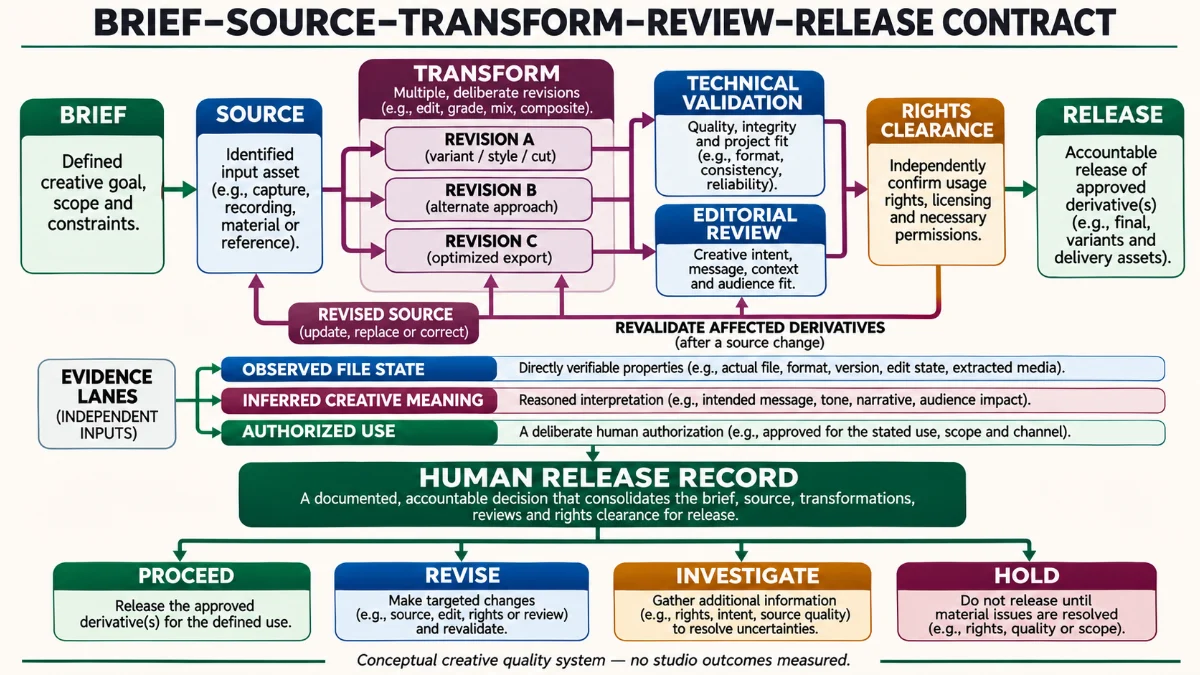
The Brief–Source–Transform–Review–Release Contract
This is my proposed creative pipeline quality contract. It is a practical operating model, not a published standard or an empirical validation. The table describes independent checks before human authorization.
| Domain | Accountable question | Evidence | Stop condition |
|---|---|---|---|
| BRIEF | Is the intended use defined? | Approved specification | Unresolved claim or placement |
| SOURCE | Can dependencies be identified? | Asset lineage and source record | Unknown essential origin |
| TRANSFORM | Can material changes be reconstructed? | Version and operation record | Missing master or broken lineage |
| TECHNICAL | Do exports meet stated specs? | File and playback checks | Failed required property |
| EDITORIAL | Does the output serve its purpose? | Named reviewer findings | Incorrect or misleading message |
| RIGHTS | Is the use permitted? | License, credit and consent evidence | Material permission unresolved |
| RELEASE | Is distribution controlled? | Delivery manifest and owner | No accountable sign-off or rollback |
This creative pipeline contract protects the difference between observed evidence, editorial inference, and authorized delivery. It does not require enterprise software. It requires that someone can trace why a particular version was sent, what was checked, and what happens when a check fails.
A Repeatable Asset Versioning Example
Hypothetical workflow, not a real measured production. A designer creates a wide website cover from an original photograph, custom illustration, licensed font, and a set of brand colors. The working master is asset-014, revision r03. A new campaign requirement changes the crop and removes a claim from the composition. The record links revision r04 to the changed brief, identifies which source layers were altered, and invalidates the old mobile crop and social preview pending review.
The designer exports two new channel-specific versions, checks their required dimensions, reviews their meaning without the removed claim, confirms the unchanged and changed license dependencies, and approves a release R2. If a stakeholder later asks for the previous version, the team can identify the original approved release and its limitations. This is a repeatable example of an asset revision, not a claim that any production team achieved measured savings.
Three Failure Scenarios Worth Planning For
A beautiful export with an inaccessible master
Hypothetical: The studio has a high-resolution flattened image but no source layers, licensed font files, or original elements. A minor requested correction becomes an expensive recreation. A master-archive gate could have surfaced the dependency before delivery.
A valid file with uncertain rights
Hypothetical: An imported image has correct dimensions and intact metadata, but its commercial-use permission cannot be established. Neither the file checksum nor a provenance statement resolves that legal question. Release remains on hold until the use is cleared or the asset is replaced.
An approved video with mismatched captions
Hypothetical: The edit changes after captions were exported. The MP4 passes a technical container check, but the caption track refers to an earlier timeline. A dependency-triggered revalidation and playback review are necessary before re-release.
Recovery Must Be Tested, Not Merely Promised
The creative pipeline is incomplete without a recoverable release. The ability to restore an old release is more than a cloud-backup icon. Can the archive retrieve the master, source dependencies, license record, exported variants, and review state? If a creative application is no longer licensed or supported, can the project still be interpreted or migrated? Such uncertainty is a real operational risk even if the output files remain readable.
A creative pipeline recovery exercise chooses an archived asset, reconstructs a permitted edit using documented materials, regenerates one derivative, and compares the result to the accepted release criteria. Without that rehearsal, the team has a backup policy rather than proven restore capability.
Scaling the Pipeline Without Bureaucracy
A creative pipeline should remain proportional to risk. I would not recommend a seven-stage approval meeting for every thumbnail. Controls should be proportional to risk. A personal exploratory sketch may require little more than source preservation and a clear status. A paid campaign with third-party music, legal claims, localized versions, and multiple publication channels warrants stronger recordkeeping and independent checks.
The same principle applies to AI-assisted creation. Generated variants can accelerate ideation, but faster generation multiplies the number of candidates awaiting selection, rights review, and export validation. The goal is not to count more files. It is to make approved, maintainable assets easier to create and safer to reuse.
Practical Rollout for a Solo Creator or Small Team
For a new creative pipeline, start with one active asset family, not an organization-wide migration. Define a stable asset ID, a one-page brief, the smallest useful lineage record, version semantics, and a short acceptance checklist. Run it on a real revision cycle. Count rework only when actual time can be observed. Record where information is repeatedly missing and automate only that recurring problem.
As the creative pipeline scales, for a larger team, add role-specific signoffs and a change-impact list. Export format support, licensing constraints, and cross-tool interoperability should be validated against actual project files, not inferred from vendor marketing. Keep a human reviewer responsible for exceptional cases and conflicts among technical, editorial, and legal requirements.
A Release Manifest Is More Useful Than a Final Folder
An effective creative pipeline needs a release manifest containing the exact asset IDs, approved versions, intended channels, export properties, review status, responsible person, and known limitations. The manifest is a release record, not the only file location. It allows a later operator to identify what was actually approved even when temporary drafts or local copies have accumulated elsewhere.
I would make one distinction explicit: the asset is the work with its history, while a release is a permitted selection of versions for a defined purpose. Release approval applies to the exact intended outputs. A release may contain one image and three responsive variants, or a video, caption track, transcript, and thumbnail. A revision to one part can make the bundle inconsistent without changing the other filenames. The manifest should record the dependency and require a selective new release.
Quality Includes Accessibility and Durable Meaning
The creative pipeline should include checks for whether its outputs make sense to the intended audience under real consumption conditions. A detailed graphic that is unreadable at a mobile article width may technically satisfy the required pixel dimensions yet fail its purpose. A video can be visually polished while important speech is inaccessible without captions, and a chart can include attractive colors while relying exclusively on hue to distinguish categories.
I do not equate an automated checklist with a completed accessibility evaluation. For an infographic, I would review legibility at the intended publication size, contrast, reading order, the presence of an accurate alternative explanation, and whether the surrounding article conveys its essential meaning. For time-based media, captions and transcripts may require separate editorial and timing checks. Accessibility belongs in acceptance criteria, not as an optional repair after public release.
Make Change Requests Traceable Without Becoming Bureaucratic
A creative pipeline does not need an approval board for every adjustment. It needs a way to distinguish a routine correction from a change to requirements, sources, rights, claims, or delivery context. A small change request can record the original requirement, proposed alteration, affected outputs, person authorizing it, and the tests to rerun.
If a client asks to alter a claim, I would not treat that request like changing padding around a logo. The claim may require new evidence and legal review. If a designer changes a background shade without altering contrast or meaning, the review can be much lighter. The quality system should be proportional to what could go wrong, and a reasonable process should make its own cost visible rather than growing indefinitely.
Evidence and Methodology
This proposed workflow synthesizes W3C PROV for provenance concepts, Academy Software Foundation OpenTimelineIO for editorial interchange scope, Creative Commons TASL guidance for relevant attribution practice, and C2PA 2.5 for technical provenance assertions. The workflow is my editorial proposal; none of those sources establishes that this exact contract improves outcomes.
Related Reading
For a related discussion of how a design language adapts across formats, see Visual Language Across Formats. This article focuses instead on quality gates, traceable revisions, and release responsibility.
Frequently Asked Questions
Is a creative pipeline the same as digital asset management?
No. Asset management can store and retrieve files. A pipeline also defines changes, dependencies, reviews, rights, and authorized releases. Software can support both, but storage does not automatically create governance.
Does version control require a code repository?
Not always. Stable identifiers and a traceable revision log can serve small teams. Git-style systems may help for text and configuration; large binary media often require other storage and tracking patterns.
Should every source have a cryptographic hash?
Not necessarily. A digest can assist integrity verification, but its cost and utility depend on the workflow. It does not establish license permission or editorial quality.
Does C2PA prove ownership?
No. Provenance claims and signatures are different from legal ownership and permission to publish. Record rights separately.
Can an AI model approve the final creative asset?
It can assist with bounded checks, but it should not automatically grant rights, approve claims, or authorize consequential publication without accountable review.
Why keep the editable master after delivery?
Because future corrections may require layers, timing information, source references, or export settings not preserved in a flattened deliverable.
How do I know whether a revision invalidates an export?
Trace source and transformation dependencies, then apply the relevant acceptance checks to affected outputs rather than assuming every derivative remains current.
How should a small creator begin?
Start with a single asset family, a documented brief, a minimal source record, one version convention, and a short release checklist. Expand only when a real failure mode justifies more process.
Key Terms
Asset lineage: recorded relationship between source, edits, and derivatives. Master: preserved editable working state. Release manifest: record of the exact approved outputs and their intended uses. Quality gate: review of a defined property before proceeding. Rights clearance: documented permission for the proposed context of use.
Author’s Note
The difficult part of creative work is not placing files in a beautiful hierarchy. It is preserving the reasoning and dependencies that let another person, or my future self, revise something safely. I consider a creative pipeline successful when it makes those responsibilities visible without slowing every ordinary edit into bureaucracy.