


Motion Design Principles: Clarity Without Visual Noise

Owned media strategy starts with a deceptively practical question: if a social platform stopped sending visitors tomorrow, would the work you published over the past year still be useful, discoverable, and connected to the people it was meant to serve? A post can attract attention for a day, but the explanation behind it may deserve a much longer life. The challenge is not to abandon distribution platforms. It is to build a publication whose value does not depend on any one of them continuing to recommend its content.
I think too much digital publishing advice begins with a calendar and ends with a dashboard. It tells professionals how often to post and which format might generate engagement, but leaves unanswered questions about ownership, archives, editorial coherence, maintenance, and the ability to recover when a distribution channel changes. A site full of disconnected articles can be nearly as fragile as a collection of short-lived social posts. The domain may belong to its publisher, yet the knowledge remains difficult to find and expensive to maintain.
My approach to owned media strategy is to treat a publication as an interconnected information asset. The article is one unit, but it depends on a durable address, a clear editorial category, trustworthy sourcing, internal relationships, a maintenance policy, and routes through which the right readers can discover it. Distribution then becomes a set of bridges into that system rather than the system’s only source of identity.
This article develops a Publication Asset Architecture Framework for independent professionals and editorial teams. It connects the publication hub, topical expertise, content archives, search discovery, and external channels, then applies the framework to a hypothetical research publication. The model is an editorial architecture proposal informed by official search guidance, web publishing documentation, and independent-web practices. It is not a claim that one publishing structure has been proved to increase traffic or revenue.
Decision Brief: Build a Publication, Not a Collection of Posts
The strategic problem: Important research is scattered among social updates, campaign pages, project descriptions, and articles that have no clear relationship to one another. Readers may encounter an individual post without finding the broader body of work, while the publisher relies on channels whose distribution rules it does not control.
The proposed method: Give substantial work a stable home, organize it through meaningful subject collections, define a content lifecycle, and connect search and external distribution to the same underlying publication.
The key trade-off: Operating an independent publication increases control over addresses, editorial structure, and archives, but it also creates responsibilities for hosting, security, accessibility, preservation, content updates, and audience development.
The evidence boundary: This article presents a reasoned architecture and illustrative decision records. It does not report measured traffic lifts, revenue changes, subscriber retention, or comparative platform performance.
Owned Media Strategy Begins With a Precise Definition of Control
The phrase owned media usually describes channels a publisher can administer directly, such as a website or an email list. It is a useful shorthand, but it becomes misleading when taken literally. A website depends on registrars, DNS, hosting providers, software, payment infrastructure, and search engines for different parts of its operation. An email address does not guarantee deliverability, and a content management system does not automatically provide an export that preserves every design and relationship.
For owned media strategy, I prefer to distinguish the elements the publisher can reasonably control from the dependencies it must manage. A registered domain and stable URL structure provide important editorial continuity. Portable source content and backups improve recovery options. Clear permissions and licensing define what the publisher may reproduce. Search and social services, by contrast, can introduce readers without giving the publisher authority over their algorithms or policies.
Control Is a Set of Capabilities, Not a Binary Label
| Asset layer | What the publisher may control | Remaining dependency or risk |
|---|---|---|
| Domain and URLs | Canonical addresses, links, redirects, and naming conventions | Domain registration, DNS availability, renewal, and migration |
| Editorial content | Original source files, corrections, taxonomy, reuse permissions | Licenses, missing sources, data integrity, and editorial maintenance |
| Publishing infrastructure | Content model, hosting choices, export and backup procedures | Provider outages, software security, portability limitations |
| Direct audience connection | Opt-in lists, available subscription or feed options | Consent, deliverability, reader choice, and service portability |
| External discovery | What to publish and how to describe it | Search indexing, recommendation algorithms, platform policies |
The framework avoids two simplistic promises: that a personal website makes a publisher completely independent, or that a large social audience gives a publisher durable control over its readers. Neither is true. Resilience improves when the publication can continue to serve its audience through more than one route and recover the materials on which its authority depends.
Owned and Rented Distribution Can Support the Same Goal
A social platform may be the best place for an idea to reach a relevant professional at a particular moment. That usefulness does not make the platform a reliable permanent archive. Equally, a well-organized website can hold years of careful work without creating meaningful reach if nobody knows why to visit. Owned media strategy needs both the durable publication and intentional distribution.
Rather than dividing channels into morally good and bad categories, I would assign them different jobs. The site stores the canonical explanation. Search helps people locate answers to their questions. Professional networks surface the thesis to communities already discussing related problems. Portfolios demonstrate selected work. Direct subscriptions or feeds, where actually available and appropriate, give interested readers another way to return.
The Publication Asset Architecture Framework
I propose a five-layer Publication Asset Architecture Framework to make publishing decisions more explicit. It is a conceptual model, not an industry standard or a measured performance system. The five layers are the publication hub, editorial taxonomy, durable archives, discoverability, and distribution bridges. Their order matters because each depends on the integrity of the material below it.
In an owned media strategy, a distribution campaign should not be the only reason an article has a title or address. The permanent source should make sense to a reader arriving six months later through search, another article, a shared link, or a direct visit. Conversely, building a beautiful archive without discoverable categories, clear links, or a reason to return does not automatically create a useful publication.
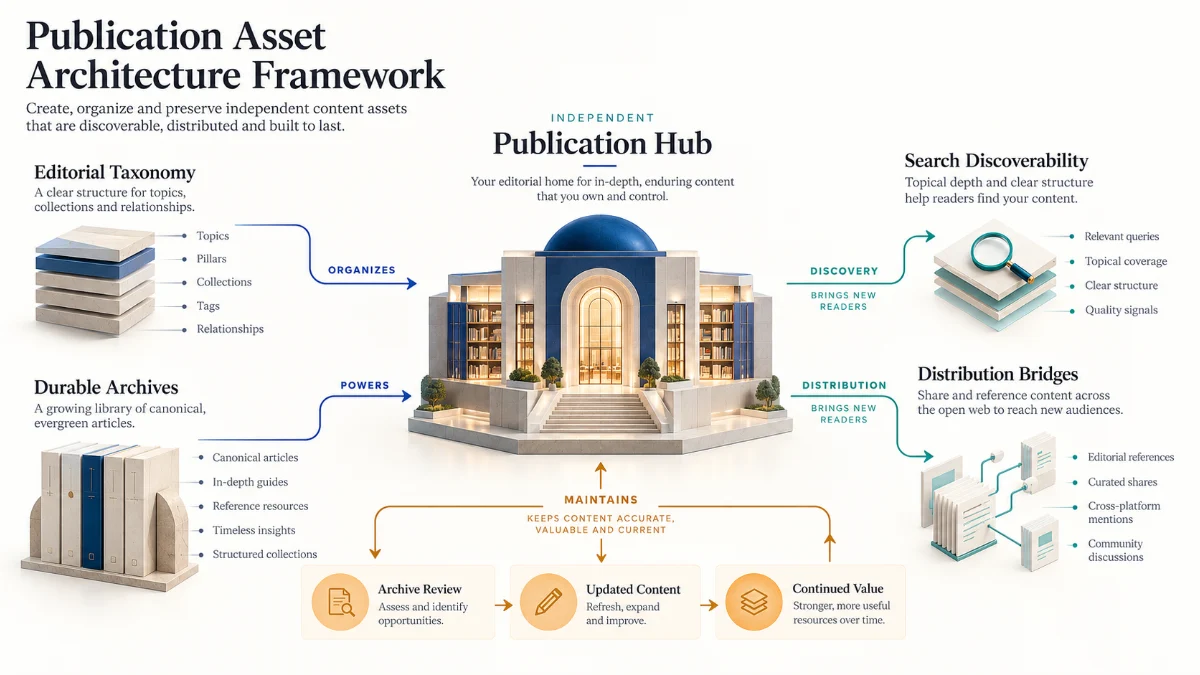
Layer One: The Publication Hub Establishes Context
A publication hub should answer what the publication covers, who it serves, and where to begin. It does not need to show every article above the fold or imitate a large news organization. Its first task is orientation. A new reader should be able to tell the difference between an enduring reference, a focused analysis, and a documented experiment if the publication uses those editorial forms.
My Articles publication hub is a relevant public example of subject-based entry points and editorial groupings. I refer to it as an illustration of the architecture being discussed, not as evidence that any particular layout has already improved search traffic or reader retention. The relevant design principle is that a hub helps readers enter a body of knowledge rather than leaving each article as an isolated destination.
Layer Two: Editorial Taxonomy Expresses Expertise
Editorial taxonomy should describe the questions a publication repeatedly investigates. Broad categories are useful when they form meaningful territories of knowledge. More specific collections can connect articles addressing related decisions. Tags may describe recurring methods or evidence types, but using them indiscriminately can produce thin archive pages and multiple routes that appear to promise the same content.
The taxonomy should come from the reader’s problem and the publisher’s genuine scope, not from a desire to create as many indexable landing pages as possible. An independent technology publication might distinguish software engineering, product decisions, AI systems, design research, and digital media because their readers seek different kinds of answers. A category should earn its existence through clarity and a real body of work.
Layer Three: Content Archives Preserve Relationships and Context
A durable archive needs more than a page that lists old posts in date order. It needs stable addresses, appropriate categories, working references, a way to identify significant corrections, and a lifecycle for material that becomes outdated. Readers may arrive at the middle of an archive without seeing its original launch announcement. The article itself must contain enough context to remain interpretable.
For owned media strategy, I would preserve both the work and the reasons for its organization. Stable source files, link records, publication dates, revision history, and a maintained navigation structure help future editors distinguish deliberate editorial choices from accidental leftovers. The Library of Congress web archiving program describes websites as ephemeral materials that can change or disappear. A personal backup is not equivalent to institutional preservation, but the underlying lesson is that born-digital publishing needs active continuity planning.
Layer Four: Search Discoverability Connects Questions to Answers
Search discoverability depends partly on whether a page answers a real question and partly on whether its content and links can be accessed and understood. Descriptive titles, coherent internal links, appropriate canonical URLs, and technically accessible pages help search systems interpret a publication. None of these measures guarantees that a page will rank or even be indexed.
Google’s people-first content guidance emphasizes original value, reliable information, and writing for an actual audience rather than producing material chiefly to manipulate rankings. I interpret that as an editorial standard as much as a search recommendation: publish work that would still be worth reading if a search engine were not sending traffic to it.
Layer Five: Distribution Bridges Bring the Right People Back to the Work
Distribution bridges translate one substantive idea into forms that suit different environments. A technical article can become a concise professional argument, a question for community discussion, a repository demonstrating a method, or a visual case study. The underlying claims should remain consistent, but the presentation need not be identical. Repeating the entire article on every platform can make the publication itself unnecessary to readers.
The independent-web concept POSSE, or Publish on your Own Site, Syndicate Elsewhere, provides a useful precedent for publishing a canonical source on a controlled domain and sharing it through external services. It does not require every social post to be a duplicate of the full article. I prefer an approach that retains the canonical reference while allowing each channel to introduce the thesis in its own useful language and format.
The Framework as an Editorial Decision Map
| Layer | Key asset | Decision to document | Failure if neglected |
|---|---|---|---|
| Publication hub | Clear subject and audience entry | What this publication exists to explain | Readers cannot navigate the larger body of work |
| Editorial taxonomy | Coherent topics and collections | Which questions belong together | Fragmented or overlapping archive destinations |
| Durable archives | Canonical material and maintenance records | What to preserve, revise, or retire | Broken context and obsolete conclusions |
| Discoverability | Readable structure and crawlable connections | How readers find authoritative answers | Important work becomes effectively invisible |
| Distribution bridges | Channel-specific introductions to the source | Where the argument belongs in conversation | Dependence on an isolated discovery moment |
The layers should be reviewed together. A new topical series may require a category adjustment, additional related-reading links, a maintenance owner, and a distribution angle. This is why I treat publication design as information architecture with editorial governance rather than a sequence of isolated content uploads.
Editorial Architecture: Make Every Article Part of a Larger Explanation
Editorial architecture is the practical arrangement of sections, categories, relationships, and navigation so that an article can be understood both alone and as part of a collection. The most common failure is an archive that grows by date but never gains structure. After enough publishing, the site contains useful information yet cannot explain how its pieces fit together.
In owned media strategy, I would establish one principal topic for each substantial article and then link to genuinely related work where the connection helps the reader. A comparison of RAG citation reliability belongs near other AI evaluation resources, while an analysis of how research findings conflict belongs near user research methods. Not every article needs to link to every category or become part of a mechanically generated cross-link grid.
Category Pages and Article Addresses Have Different Jobs
A category page introduces an area of expertise and provides routes into relevant work. An article has its own canonical address and makes a specific argument. These functions should not be confused, even when their names overlap. A publication can use an editorial landing page for a category while retaining a separate category segment inside individual article permalinks.
Google’s canonical URL guidance explains the purpose of expressing a preferred address for duplicate or substantially similar content. A canonical is a strong signal rather than a command that guarantees selection. I would make internal links consistent with the approved article URL, retain necessary redirects when addresses change, and avoid multiplying competing variants of the same explanation.
Internal Links Should Carry Reader Intent
In an owned media strategy, an internal link should answer a question raised by the surrounding paragraph. If a publication discusses a source methodology, it can link to a deeper methodological article. If it presents a case study, it can link to the relevant project with sufficient context. Adding links solely because two pages share a keyword can weaken the reader’s understanding of why the connection matters.
Google’s link best-practices documentation explains that ordinary HTML anchor links with an href are a dependable way for crawlers to discover connected pages, and that descriptive anchor text helps communicate the relationship. I would prioritize those simple links over navigation mechanisms that require complex client-side behavior to expose essential article paths.
Collections Should Become More Useful as They Grow
A collection gains value when readers can see an intellectual progression: foundational concepts, challenging decisions, evidence and methods, and practical applications. An archive that merely accumulates more cards does not necessarily improve navigation. Collections need clear boundaries and occasional editorial review to identify redundant articles, missing bridge topics, and outdated introductions.
This also changes the meaning of evergreen content. Evergreen does not mean a paragraph can remain untouched forever. It means the underlying question remains useful and the publication accepts responsibility for keeping the answer appropriately qualified, linked, and current.
Content Lifecycle: Publish, Maintain, Consolidate, or Retire
A content lifecycle is where owned media strategy becomes an ongoing editorial responsibility: it defines the decisions that happen after a piece is initially published. A one-time launch workflow may optimize for a clean release, but a publication needs a process for discovering stale claims, correcting errors, replacing dead references, and deciding when two articles should be consolidated. The work is not finished when the first social announcement has been posted.
I would assign each substantial article a maintenance profile rather than a fictional promise to refresh everything monthly. A conceptual essay may need review when its assumptions or referenced standards change. A software compatibility guide may need review when an operating system or application version changes. A legal or policy explanation may need a much tighter update trigger, especially when readers could act on its details.
Define Review Triggers Instead of Cosmetic Freshness
Google’s people-first guidance warns against changing dates to create the impression of freshness without a substantial content update. I would keep original publication dates intact, describe meaningful revisions when helpful, and avoid editing a timestamp as a distribution tactic.
| Content condition | Reasonable action | Evidence to preserve |
|---|---|---|
| Still accurate and useful | Keep published; maintain relevant connections | Original date, sources, current context |
| A material claim changes | Correct or update affected section | Nature and date of meaningful revision |
| Two pages answer the same intent | Assess consolidation and redirect needs | Preferred canonical and migration map |
| A source is no longer valid | Replace or qualify unsupported claim | Original claim, replacement evidence |
| A page cannot remain reliable | Retire, clearly archive, or redirect as appropriate | Reason, reader impact, preserved context |
WordPress includes a revision system that can compare and restore saved versions of posts. That is valuable editorial history, but revisions are not a replacement for independent backups, an off-site recovery plan, or a public explanation of important changes. Internal edit history and reader-facing transparency solve different problems.
Retirement Is Part of Preservation
Preserving everything at its original address forever is not always responsible. An outdated recommendation can harm readers even if its URL remains reachable. Conversely, deleting a useful historic explanation without any context can break references and erase a record of how an idea evolved. I would make the choice based on continuing informational value, risk, and the availability of a successor page.
For owned media strategy, this is a governance decision rather than a routine clean-up script. When a page must move, redirects can preserve a route for readers. When historic content remains relevant as a record, a visible archive notice can explain its status. When information is wrong or unsafe to rely on, correction should take precedence over preserving a reassuring appearance of continuity.
Content Ownership Requires Portability, Backups, and Recovery
Content ownership is weaker than it appears if the only usable copy of an article lives inside one proprietary editor and the publisher cannot reliably export its source, media, references, and metadata. A publication may use a commercial content system quite successfully, but resilience depends on understanding what can be transferred when that system or its hosting environment changes.
I would keep a recoverable content source and document the minimum assets needed to rebuild the publication: text, images, author information, publication dates, canonical mappings, taxonomy relationships, license records, and essential configuration. A database export without associated media files may preserve article records but not the publication experience. An image backup without post relationships can be equally incomplete.
An Export Is Not Proven Portable Until It Can Be Restored
A useful test is whether a representative article can be reconstructed in a separate environment without losing its body, references, important metadata, or working media. The exercise can reveal dependencies on templates, custom fields, plugins, embedded services, or a particular content editor. I am describing a recommended recovery rehearsal, not a restoration test carried out for this article.
In owned media strategy, backups and provider choice should serve the publication’s continuity requirements rather than become an excuse for endless infrastructure rebuilding. A modest, tested recovery procedure is usually more valuable than an elaborate resilience diagram nobody has exercised.
Direct Access Should Not Depend Entirely on Feed Algorithms
Where a publication offers a verified feed or subscription mechanism, it gives readers a way to follow material without waiting for a recommendation system to show it. RSS and Atom are examples of syndication formats; the MDN documentation for the HTML rel attribute describes how a page can indicate a feed through an alternate link with an appropriate media type.
I would never invent a feed address or claim that a subscription feature is available without checking it. The architectural principle remains useful even when a particular publication chooses to rely on searchable archives, direct bookmarks, or an opt-in newsletter instead. The reader should have more than one route back to the source if the channel relationship warrants it.
Search Discoverability: Optimize the Publication, Not the Illusion of Authority
Search discoverability depends on both editorial substance and technical access. Clear titles, descriptive headings, indexable article pages, consistent canonical addresses, and purposeful internal links help readers and crawlers understand a publication. But structured metadata cannot turn a thin or unsupported article into a credible reference, and keyword repetition cannot substitute for expertise.
For owned media strategy, I would distinguish an article that targets a stable professional question from a short post responding to a passing news event. Both can be valuable. The first may deserve a durable reference structure and periodic updates; the second may serve a timely conversation without pretending to be a comprehensive knowledge resource.
Human Value Comes Before Search Packaging
Google’s helpful-content documentation asks whether the work provides original information or analysis, serves an intended audience, and leaves readers with something useful. I would treat those as editorial review questions before deciding how to write metadata or arrange a page.
Search results can also change as query interpretation and competition evolve. A publication is more resilient when the value of an article survives those changes: a documented comparison, method, technical explanation, or justified argument can still be useful from a saved link, a portfolio page, or a colleague’s recommendation.
Sitemaps and Schema Improve Understanding, Not Guarantee Distribution
Google explains that a sitemap can help its systems discover pages but does not guarantee crawling or indexing. Likewise, Article structured data can make information about an article more explicit without guaranteeing a particular search appearance. These are valuable implementation tools precisely because they have defined roles and limits.
I would not manufacture structured-data entities for editorial concepts that are not visible or established in the publication. Canonical URLs, authorship references, article dates, and images should describe the real page. Invented ratings, artificial update dates, or unrelated rich-result features weaken the relationship between published content and machine-readable claims.
A Discovery Feed Is a Supplementary Channel, Not a Publication Plan
Google’s Discover documentation states that traffic from Discover is less predictable than visits driven by keyword-based search, and that eligibility does not guarantee appearance. That is a concrete reason not to define publishing success around whether one distribution feed sends a temporary spike.
Instead, I would evaluate how well the site serves the reader who arrives after a discovery moment. Can they understand the article’s context? Can they inspect evidence? Can they find the next relevant explanation? Can they return later through a stable address? Those questions are within the publisher’s design responsibility even when the original discovery was not.
Social Media Distribution: Use Platforms as Bridges, Not Substitute Archives
Social media distribution is essential for many independent professionals because useful work rarely reaches its intended audience merely by existing. But each network has its own conversation formats, discovery patterns, and moderation or policy constraints. A platform-native post can make a substantive idea easier to encounter; it should not be confused with durable possession of the audience relationship.
An owned media strategy benefits from adapting the same underlying thesis across channels instead of forcing identical paragraphs everywhere. A technical argument may suit X, a professional decision may suit LinkedIn, and an open-ended question may suit Threads. GitHub can make source code, examples, or documented engineering methods inspectable. Behance can provide visual context for design work. Those channels contribute different kinds of evidence and discovery, not one interchangeable engagement count.
Publish the Durable Source, Then Open the Conversation
For substantive articles, I prefer to establish the canonical source first and then produce channel-native introductions. This aligns with the IndieWeb POSSE approach without requiring automatic reposting or linking in every social format. Some social discussions work better without an external link; their role can still be to develop recognition of the idea and direct interested readers toward the publisher’s broader body of work over time.
The choice is editorial rather than mechanical. A lengthy source article should stand on its own. A short social post should offer a worthwhile insight rather than withhold all substance as clickbait. A portfolio item should demonstrate an actual artifact when one exists, not merely restate the article as a fictional project.
Give Each Channel a Job That Matches the Work
| Channel | Useful native contribution | Connection to owned publication |
|---|---|---|
| Professional interpretation and decision implications | Contextual route toward detailed research and expertise | |
| X | Technical thesis, timely discussion, concise analysis | Topic recognition and relevant research references |
| Threads | Human-centered reasoning and exploratory discussion | Conversation around the same substantive question |
| GitHub | Inspectable code, methods, examples, and documentation | Technical verification of work actually published there |
| Behance | Visual case studies and evidence of creative decisions | Design-focused entry into related written analysis |
Not every article requires a repository or case study. If a technical implementation has not been developed, creating a GitHub link would imply evidence that does not exist. If a design concept remains editorial, a Behance case study should identify it as a concept rather than a shipped client outcome. Channel variety should increase the usefulness of the body of work, not manufacture authority.
Do Not Let a Posting Calendar Dictate the Research
A publication may use scheduling for operational consistency, but the arrival of a calendar date is not evidence that a strong article is ready. I would publish substantial work when the question, research, and editorial argument justify it, and use timely developments when they genuinely intersect with that expertise. A schedule can support distribution after a piece is ready; it should not determine whether the evidence is sufficient.
The reverse is also true: a publication can fail if high-quality material is never introduced to the communities that would benefit from it. Owned media strategy needs a repeatable, low-friction way of selecting the right existing work and translating its key idea to an appropriate channel without rebuilding the entire article.
Worked Example: One Independent Publication, Several Reader Pathways
Consider a hypothetical solo specialist publishing original research about software architecture, product strategy, AI, and design. The specialist wants readers in several professional communities to discover relevant ideas without depending on one social account. This scenario is constructed for illustration; it is not a measured case study of my website or an attribution claim about real audience results.
The first decision is to create one stable publication hub with subject collections rather than separate microsites for each topic. The next is to give each research article an enduring canonical URL, a clear category, relevant internal links, and explicit source references. A third decision is to define which pages require ongoing review because they describe changing software versions, platform rules, or research standards.
Follow a Single Research Article Through the Architecture
Imagine that the specialist publishes a detailed evaluation of a retrieval-augmented generation system. The article belongs in an AI research collection, links to related evaluation methods where they actually help, and has an explicit evidence boundary identifying which tests were performed and which were proposed. Its address remains stable when the initial announcement fades.
For discovery, search systems can encounter the article through crawlable links and the site’s sitemap. A professional discussion might focus on why source citations do not prove factual support. A technical repository might be added later if a real evaluation harness is published. A visual diagram might become a design case study if the design work itself warrants that treatment. These are separate editorial deliverables tied to the same underlying claim, not proof that they have all been produced.
When the research changes, the publication updates the relevant claim and records a meaningful revision. The social posts remain historical expressions of the earlier argument, while the canonical article provides the maintained reference. The publisher should not assume every social platform will automatically update past copies or remove outdated paraphrases. That limitation belongs in the distribution plan.
The Reader’s Next Step Should Be Specific
A visitor who found the article because of citation reliability may want a comparison of retrieval metrics, a source-grounding method, or an explanation of permission boundaries. A generic list of the site’s most recent posts may not meet that need. I would choose related reading by actual intellectual connection and keep a category route available for broader exploration.
This is where owned media strategy creates cumulative value. New work can clarify or update earlier explanations, and older work can provide the background needed to understand new research. The archive becomes a connected reference system rather than a dated pile of announcements.
Measurement: Distinguish Attention, Reader Value, and Publication Resilience
A digital publishing strategy needs measurement, but no single traffic number can capture whether the publication is becoming a useful professional asset. High impressions may indicate distribution without comprehension. Long reading sessions can reflect careful engagement or user confusion. A small number of qualified readers may matter more than a large audience that never returns.
I would separate measurement into three questions. Discovery: Are relevant readers finding the material through the available routes? Usefulness: Does the material appear to meet the question that brought them there, and are there credible qualitative signals of value? Resilience: Can the site preserve and serve its important content even when one channel or provider changes?
A Publication Scorecard Without Invented Benchmarks
| Dimension | Candidate evidence | Important limitation |
|---|---|---|
| Search discovery | Indexed pages, relevant queries, organic entry paths | Search data is incomplete and affected by external systems |
| Audience relationships | Relevant inquiries, meaningful replies, return routes where measurable | Attribution across platforms can be ambiguous |
| Editorial utility | Qualified references, reader corrections, use in professional decisions | Anecdotes are informative but not population estimates |
| Archive quality | Broken-link reviews, accuracy updates, orphan-page checks | A low error count is not proof of substantive quality |
| Operational resilience | Verified backups, restore tests, export completeness | Procedures must be exercised to establish reliability |
Measurements should reflect the publication’s actual purpose. A portfolio publication may prioritize qualified collaborations and the clarity of its technical evidence. A commercial publisher may need subscription or advertising economics. A public-interest archive may prioritize long-term accessibility. Copying the same dashboard across these contexts can make very different strategies look artificially comparable.
Attribution Is Partial, Especially Across Conversations
A reader may encounter an idea on X, later search for the author’s name, and finally open a related article from a bookmarked category page. The resulting website analytics may credit search or direct navigation, not the original discussion. Another reader may share a screenshot of the argument without a trackable link. These are ordinary attribution limits, not evidence of a failing channel.
For owned media strategy, I would use available referral and campaign information where appropriate, but avoid claiming that every publication outcome can be assigned to a single post. A useful reporting narrative should combine observable data with explicit limitations, especially when deciding whether to invest more attention in a particular channel.
Real Portfolio Connections: Editorial Infrastructure and Published Expertise
My public NEWSENSE — News Publishing System project presents a publishing management system organized around news and content workflows. The published project description discusses editorial categorization, centralized management, publishing continuity, and discovery-oriented architecture. It provides an appropriate portfolio connection to the governance questions in this article without requiring me to expose private implementation details or claim unverified performance results.
The Articles area on my website demonstrates a separate, directly visible dimension of publishing: presenting research through editorial collections and subject categories. Together, the project and the publication make an important distinction for owned media strategy. A publishing system is the machinery through which material is managed; a publication is the knowledge and editorial responsibility that machinery is intended to support.
For wider context on channel economics, search, and content operations, my Digital Strategy & Growth resource covers related strategic concepts. That page describes an educational course in development; I am not presenting it as a completed independent validation study of this publication framework.
The Counterarguments: When Owning the Hub Is Not Enough
The strongest objection to an owned media strategy is practical: an independent site can consume time and money that might be better spent serving clients, conducting research, or speaking with an audience already gathered elsewhere. This is a legitimate trade-off. A person at the beginning of a career or a project with a very short lifespan may need only a modest, reliable publication home rather than an ambitious custom platform.
Another objection is audience habit. Readers often prefer the platform where they already participate, and insisting that they move to a separate site for every thought can create needless friction. I would answer this by providing genuine value natively while reserving the site for material that benefits from being maintained, referenced, or explored in depth.
There is also an infrastructure risk. A domain can expire, a hosting provider can fail, a content export can be incomplete, or a website can become difficult to maintain. Direct control increases responsibility. It is not an insurance policy against neglect. A publisher should be honest about the operating cost of that responsibility and avoid promising independence that its technical arrangements cannot deliver.
Finally, an archive can become an elaborate excuse not to distribute. Excellent taxonomy and structured metadata do not create an audience by themselves. If the right readers never encounter the work, the publication’s professional influence will remain limited. My answer is not to choose archive or distribution, but to assign each a role and measure the shortcomings of each independently.
A Lean Publication Review I Would Use Before Expanding
Before expanding an owned media strategy with another channel or editorial category, I would inspect a small sample of existing articles. Each should have a clear reader, a durable URL, an intelligible place in the taxonomy, a defensible evidence base, and a route to related work. I would also check that a new reader can reach the source without encountering an unusable page, missing media, or a navigation dead end.
Then I would trace one article through its content lifecycle: when its source information might become outdated, how that change would be detected, which assets must be backed up, and what happens if the current platform is unavailable. This exercise often produces more valuable maintenance work than creating another decorative section on the homepage.
Only after those basics would I assess additional distribution. Which communities would actually benefit from the argument? What is the smallest native presentation that provides real value there? Does a repository or case study exist to support a technical or creative claim? If not, the appropriate deliverable may be a thoughtful discussion rather than a new portfolio placeholder.
I would document the decisions but keep the system proportionate. Independent professionals do not need the bureaucracy of a large newsroom. They need sufficient editorial structure that their best work remains trustworthy, useful, and retrievable without turning publishing into an endless maintenance project.
Evidence, Methodology, and the Limits of This Framework
This article synthesizes primary documentation from Google Search Central on people-first content, crawlable links, canonicalization, sitemaps, Article markup, and Discover; the IndieWeb description of POSSE; WordPress documentation on revisions; and the Library of Congress’s explanation of web archiving. Those sources establish specific technical and editorial principles. They do not jointly validate the five-layer Publication Asset Architecture Framework as an empirical model.
The framework, comparison tables, hypothetical publication scenario, and proposed scorecard are my analytical synthesis. No subscriber dataset, platform experiment, controlled traffic comparison, or revenue analysis was conducted for this article. I do not claim that choosing a canonical website will improve rankings, that a particular social network will produce qualified readers, or that one archive structure guarantees longevity.
The framework also has scope limits. Legal ownership of content depends on contracts and jurisdiction; a website does not automatically confer all redistribution rights. Accessibility and preservation require actual testing and maintenance. Publishers operating in breaking news, regulated industries, or collaborative editorial organizations may need more explicit review, correction, and responsibility processes than the lean example described here.
Frequently Asked Questions About Durable Digital Publishing
Is owning a website enough to make a publication independent?
No. A website provides meaningful control over canonical addresses and editorial organization, but it still depends on infrastructure, software, domain registration, and readers finding it. Independence is better understood as a set of recovery, portability, and audience-connection capabilities rather than an absolute condition.
Should every social media post link back to an article?
No. Some conversations provide their full value within the social platform, and not every discussion needs a long-form source. For substantial work, a canonical article can provide the maintained reference while channel-native posts communicate a useful part of the argument. Links should be relevant and consistent with the publication’s goals, not added mechanically.
Does evergreen content mean an article should never change?
No. Evergreen refers to the continuing value of the topic, not the permanence of every claim. Articles about changing technology, standards, products, or policies may require review, correction, and transparent updates. A reliable archive preserves context while keeping important information accurate.
Do sitemaps and structured data guarantee search indexing?
No. Sitemaps help discovery and structured data clarifies certain page information, but Google does not guarantee that every eligible page will be crawled, indexed, or given a particular search presentation. Content quality, accessibility, technical configuration, and external search decisions still matter.
Is an RSS feed necessary for an owned publication?
Not in every case. A verified feed can provide a useful direct following mechanism, but accessible category pages, stable links, an opt-in newsletter, or other reader-controlled routes can also support return visits. The important point is not to claim a feed exists without confirming its real address and behavior.
How should a small publication measure success without relying on impressions?
Start with its intended purpose. For a professional research publication, useful signals may include relevant inquiries, trustworthy references, meaningful reader feedback, discovery for important questions, and the ongoing condition of its archive. Treat attribution as incomplete and avoid converting isolated anecdotes into statistically supported claims.
Conclusion: The Long-Term Asset Is the Connected Body of Work
The strongest version of owned media strategy is not a website that refuses to depend on other platforms. It is a publication that knows what each channel is for. Search helps readers discover an answer, social networks bring ideas into relevant conversations, portfolio platforms can demonstrate finished work, and the canonical publication gives those pieces a stable intellectual home.
I would judge the durability of a publication by whether its articles remain understandable outside their launch context, whether the archive helps readers move between related questions, whether important claims can be corrected without obscuring history, and whether its core assets can survive an infrastructure change. That is a much stronger ambition than treating every new post as a separate opportunity for impressions.
A publication becomes strategically valuable when its work can accumulate meaning. An article can introduce a question, another can test an assumption, a project can demonstrate an implementation, and an archive can preserve the relationships among them. Distribution creates the opportunity for discovery. Editorial architecture makes the discovery worth returning to.
Explore related analysis in the Digital Media Articles collection.
Connect and Explore My Work
I share research and perspectives on digital publishing, product strategy, software engineering, and creative systems through LinkedIn, X, and Threads. You can also explore my public technical work on GitHub and my visual portfolio on Behance.