


Web Performance Requirements: INP to Backend Latency

Human Oversight in AI: Review, Escalation, Accountability

A product roadmap can be polished, persuasive, and almost useless. It can show an impressive sequence of releases, carefully colored initiatives, and confident target dates without explaining which customer difficulty the work is supposed to resolve. When delivery is mistaken for progress, teams may complete the roadmap while the original problem remains. The problem is not that features or dates are inherently wrong. It is that a release schedule cannot, by itself, demonstrate that a product strategy is working.
Outcome-driven roadmaps offer an alternative, but the label does not solve the underlying problem. A roadmap organized around outcomes can be as vague as one organized around features. “Improve retention” tells a team little about which users are struggling, what evidence supports the diagnosis, which options remain open, or what colleagues can confidently promise. Executives need accountability. Sales and customer success teams need usable information about delivery. Engineering needs to understand dependencies and constraints. A serious roadmap has to accommodate those requirements without pretending that an untested solution is a commitment.
My approach is to treat the roadmap as a record of what the organization is trying to change, what it currently knows, what it has actually promised, and what would cause it to reconsider. I call the resulting model the Outcome–Evidence–Commitment Framework. It is a practical decision framework developed for this article, not an established industry standard or a claim that I have validated a particular commercial product’s results. The examples below are explicitly illustrative. They demonstrate how the same strategic objective can be represented with different degrees of certainty, evidence, and accountability.
Decision Brief: A Roadmap Should Reveal What Is Known
Decision: Use a roadmap to connect a meaningful product outcome to credible evidence, a bounded set of options, and the commitments that the organization has genuinely authorized.
Why this matters: A feature list can create the appearance of certainty; an outcome statement can create the appearance of strategy. Neither is sufficient unless the decision logic and uncertainty are visible.
Practical rule: Keep discovery intentions separate from delivery obligations. Name the owner of each decision, distinguish leading signals from lagging results, and publish the conditions that would trigger a review.
Limit: The roadmap tables, targets, and scenarios in this article are worked examples, not observations from an actual client, published experiment, or NEWSENSE implementation. Outcomes often have multiple causes; a roadmap cannot establish causal impact by assertion.
Feature Theater: When Delivery Activity Masquerades as Product Strategy
A feature-driven roadmap answers the easiest planning question, while outcome-driven roadmaps begin with a different one: what will the team build? Sometimes that is exactly the right question. A security requirement, a contractual integration, or the replacement of an unsupported dependency may involve a defined deliverable and a nonnegotiable deadline. But a list of deliverables becomes feature theater when its completion is treated as proof that a customer problem was solved, without checking the customer problem itself.
Imagine a reporting product whose customers struggle to complete routine reviews. Its roadmap lists a redesigned dashboard, advanced filters, an export option, and notifications. Each is plausible. None proves that the real bottleneck is the interface. The customer might lack trustworthy underlying data, an agreed approval process, or clarity about who should act. If a team ships every requested feature while the workflow remains slow, the roadmap was delivered but the intended result was not.
The distinction matters for outcome-driven roadmaps and resembles the problem described in my earlier article Problem Framing Before Product Discovery: stakeholders can communicate a proposed solution before the team has established the underlying problem. A roadmap often freezes that premature solution into a sequence of dates and then makes the organization accountable for shipping it.
Output, Outcome, and Business Impact Are Not Synonyms
Output is an artifact or capability delivered: a new approval view, revised permissions, a faster import flow. Outcome is a change in behavior or experience: users complete approvals with less rework, make fewer avoidable errors, or successfully finish an important task. Business impact concerns the broader effect: lower support cost, better retention, greater account expansion, or reduced operating risk. These levels are connected, but a team cannot simply replace one word with another.
A new onboarding checklist is an output. More customers completing a meaningful first task is a possible outcome. Improved long-term retention might be a downstream business result. That chain is a hypothesis until evidence supports it. Product outcome metrics should therefore be defined at the level where the team can observe meaningful behavior, while the larger business objective remains visible as context.
The GOV.UK guidance on service performance metrics recommends beginning with the purpose of the service, articulating the benefit, identifying hypotheses, and selecting data sources rather than choosing attractive dashboard metrics first. That is useful outside public services as well: measurement should follow the decision and user need, not the availability of a chart.
Why Organizations Keep Returning to Feature Lists
Feature lists survive because they make responsibilities look straightforward. Finance can associate a budget with a project, leadership can compare planned dates, and commercial teams can discuss named capabilities. A page of outcomes is harder to sell if nobody can explain what will actually change next month. It would be a mistake to treat those operational needs as evidence that stakeholders are resistant to modern product thinking.
I would preserve those needs while changing what the roadmap means. Delivery commitments belong in a visible, separately labeled layer. Discovery work belongs in a layer that identifies questions and proposed experiments. Product strategy alignment belongs in the outcome and decision layer. The failure is not giving stakeholders delivery detail; it is allowing delivery detail to masquerade as evidence of customer value.
Define an Outcome Before Selecting a Roadmap Format
Outcome-driven roadmaps cannot be reliable if the outcome is a slogan. “Delight customers” is difficult to challenge, while “increase engagement” can reward activity that has little value. I would start by naming a user group, a consequential task, the current difficulty, and the change that should indicate improvement. The outcome should guide choices rather than predetermine one implementation.
For an illustrative business-to-business publishing platform, consider this statement: “Help smaller editorial teams complete a quality-controlled publication cycle without repeated handoff errors.” It establishes a population, an activity, and a condition that matters. It does not require the team to build a scheduling dashboard, workflow automation, or notification center before learning why handoffs fail.
Choose a Behavioral Change, Not Five Promises
For outcome-driven roadmaps, a useful target may be the share of eligible publication tasks completed without an avoidable rework loop. That measure still requires a precise definition. What counts as an eligible task? How are rework loops recorded? Can rework be legitimate because an editor caught an important error? Could the team make the number look better by discouraging corrections? Without these questions, an apparently outcome-based target can encourage the wrong behavior.
In practice, I would state the target together with its denominator, data source, expected segment, exclusions, and guardrails. A reduction in rework should not come from suppressing quality review. An increase in publication speed should not come at the cost of accessibility, content accuracy, or editorial responsibility. A roadmap that optimizes one metric without protecting the surrounding system is not more strategic than a feature checklist.
Separate Leading and Lagging Indicators
Leading and lagging indicators belong in different parts of a product argument. An early operational signal might be the proportion of draft handoffs that include complete review metadata. A later signal might be the rate of completed publication cycles that require avoidable correction. Retention and renewal could be later business indicators. The relationship between these signals should be treated as testable, not automatically causal.
A leading signal is useful only if it plausibly precedes the result and responds to a relevant intervention. Teams sometimes relabel a convenient activity count as a leading indicator. “Number of reviews completed” might rise because teams are doing more necessary work, or because they are introducing unnecessary checkpoints. The meaning depends on context. The GOV.UK Service Standard encourages teams to define success, measure whether user needs are met, and use the results to guide improvement.
I would document one primary behavioral outcome, several diagnostic signals, and explicit guardrails rather than presenting a wall of key performance indicators. That makes roadmap conversations more focused: the group can ask which observation challenges the current plan instead of celebrating whichever line happened to move upward.
The Outcome–Evidence–Commitment Framework
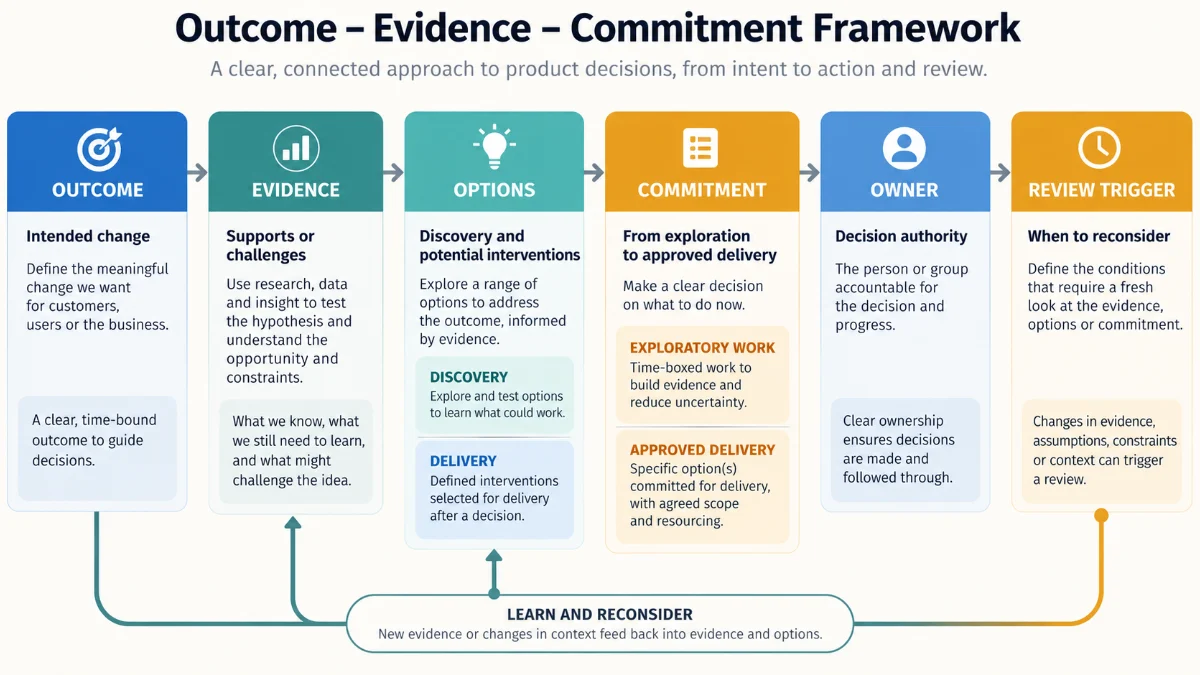
The Outcome–Evidence–Commitment Framework is my proposed structure for outcome-driven roadmaps for turning strategy into a roadmap without erasing uncertainty. It has six connected fields: the outcome, the evidence, the decision or option, the commitment state, the accountable owner, and the review trigger. These fields should fit together in one readable decision record, although the level of detail can vary for executives, product teams, and external audiences.
Outcome-driven roadmaps become operational when every major line can answer six questions. Which change do we seek? Why do we believe this is the right problem? What are we doing or learning about it? What has genuinely been promised? Who can make the next decision? What new information would change the course? A seventh field, dependencies, connects these decisions to engineering and organizational reality.
Field One: The Intended Outcome
Write the outcome as a change in a specified user’s experience or behavior. Include the time horizon and relevant business context, but avoid forcing a percentage improvement before the measurement system is credible. A hypothetical target can illustrate how a team might plan; an actual baseline and threshold must come from its own observations, sampling decisions, and risk tolerance.
Field Two: Evidence and Confidence
Record what has been observed and what remains an interpretation. For example, repeated support complaints might signal publication handoff problems, while an event log may show where tasks stop. Neither automatically explains why. Mark evidence as observed, inferred, or still missing; include the population, measurement period, and limitations. I avoid a universal numerical confidence score that falsely converts judgments into precise probabilities.
Field Three: Options and Learning Work
List options at the maturity appropriate to the evidence. Early entries might describe an opportunity or unanswered question. More mature entries can specify an experiment, prototype, or proposed solution. A completed discovery cycle may justify a particular implementation. Moving from one stage to another should follow what the team learned, not the date on a slide.
Field Four: Commitment State
Make roadmap commitments explicit. Exploring means investigating a problem or option without committing to ship. Candidate means a plausible solution is being assessed for feasibility and value. Approved for delivery means the authorized scope, resources, and conditions are defined. Committed externally means a commercial, contractual, regulatory, or other external obligation exists and must be managed accordingly. These labels are examples of a governance approach, not a universal industry taxonomy.
Field Five: Decision Rights and Ownership
Stakeholder accountability requires more than displaying a product manager’s name next to a colored bar. An outcome owner should know which measure matters and who has authority to change priorities. A discovery lead should know who resolves evidence disputes. A delivery owner should know which commitments can be renegotiated and which require escalation. Engineering, design, data, operations, support, and commercial responsibilities may overlap, but their decision rights should not be ambiguous.
Field Six: The Review Trigger
Every consequential item should say what will force reconsideration. That might be contradictory user evidence, an experiment that fails its agreed acceptance criteria, a dependency that cannot be met, a material change in support risk, or a new contractual obligation. Roadmap review triggers help keep the plan honest because they define how the organization will respond to information that does not fit its expectations.
The framework is intended to make decisions reconstructable. Someone joining the team in three months should be able to see why an initiative appeared, how the evidence changed, which promises were made, and what caused a shift in direction. The output is a smaller amount of more consequential information, not an additional weekly reporting bureaucracy.
A Worked Example: From Feature Theater to an Outcome Roadmap
Consider a hypothetical B2B publishing product whose customers experience avoidable delays when drafts move among editors, reviewers, and publishers. This is an invented planning scenario for teaching the method. The figures and workflow assumptions in the following examples are not actual NEWSENSE results or customer research.
Version A: A Feature Schedule That Hides the Hypothesis
A conventional roadmap might promise a new approval dashboard in the first quarter, automatic reminders in the second, and a detailed audit view in the third. It names deliverables and dates. What it does not establish is whether the dominant issue is missing visibility, unclear decision rights, inconsistent review criteria, or technical reliability.
| Period | Promised feature | What the roadmap omits |
|---|---|---|
| Quarter 1 | Approval dashboard | Evidence that lack of visibility causes delays |
| Quarter 2 | Automated reminders | Evidence that reminders improve completion rather than noise |
| Quarter 3 | Audit interface | Agreement about who needs the records and why |
Even if every release ships, the team cannot infer that editorial throughput or quality improved. Its dates may also create obligations for downstream teams that were never properly authorized. The problem is not that these features are poor ideas. It is that the roadmap treats untested explanations as settled requirements.
Version B: Outcome, Evidence, and Commitment
Now reframe the same initiative around an intended result: reduce avoidable publication handoff friction while preserving review quality. A proposed action becomes appropriate only when its role in that change is understood. This version is more informative because it shows what the team is studying, what it has decided, and what remains uncertain.
| Horizon | Outcome or opportunity | Current evidence | Work / commitment | Next review |
|---|---|---|---|---|
| Now | Make approval ownership understandable | Observed task handoffs need clarification; sample validity still under review | Deliver a previously approved ownership-label change; evaluate comprehension after release | Review task completion and error patterns |
| Next | Reduce unnecessary waits between review steps | Conflicting accounts of routing rules; diagnostic event data incomplete | Discovery and workflow mapping only; no solution release promised | Choose an intervention after validating the bottleneck |
| Later | Support reliable cross-team publication cycles | Strategically relevant, but causes and scope remain uncertain | Outcome direction, not a named feature or dated delivery | Reassess after current learning and operational changes |
The advantage of outcome-driven roadmaps is not simply a prettier roadmap. The content permits better decisions. A commercial stakeholder can distinguish the approved ownership-label change from the exploratory routing investigation. Engineering can see where dependency management matters. Leadership can challenge whether the evidence is adequate for a larger investment. A customer-facing team can avoid repeating an unapproved date as a promise.
What If the Feature Ships and the Outcome Does Not Change?
Suppose the approved ownership-label change is delivered correctly but follow-up research shows that users still struggle to complete approvals. This does not automatically mean the feature was poorly built. The original causal hypothesis may have been incomplete. The team should inspect whether the target population used the change, whether the metric captured the intended behavior, and whether other bottlenecks became more important.
Under this framework, the outcome remains visible while the preferred solution can change. That is a different kind of accountability from checking off completed features. The team is accountable for learning what works, reporting limitations, and deciding whether to persist, adapt, or stop. It is not entitled to declare success merely because the output was released.
Discovery vs Delivery: Two Different Kinds of Commitment
In discussions of outcome-driven roadmaps, the phrase discovery vs delivery often invites an unhelpful binary. Good product organizations need both. Discovery asks which problem deserves attention and whether a proposed response is viable, usable, valuable, and appropriate. Delivery turns an authorized choice into a reliable capability, honoring engineering, operational, and commercial obligations. Problems emerge when an untested discovery option is communicated as a delivery promise or a firm delivery requirement is disguised as optional exploration.
The Silicon Valley Product Group’s 2026 discussion of building to learn versus building to earn distinguishes output-focused project planning from outcome-oriented product discovery and execution. That is a useful framing, but it should not be interpreted as permission to avoid delivery accountability. Teams still have responsibilities to customers, contracts, security, accessibility, and maintainability.
Commit to Learning Without Pretending to Commit to a Feature
A discovery commitment can be explicit and valuable. The team might promise to resolve a specific uncertainty by conducting task observation, comparing viable routing options, and presenting a recommendation on an agreed review date. This is a commitment to a decision process and its evidence, not a promise that the favored design will ship. If discovery shows that a feature is unnecessary, the organization should consider that a useful result rather than a failure to execute the original list.
Product discovery evidence must be proportionate to risk. A low-cost, reversible interface improvement may be tested with a small prototype and clear follow-up. An irreversible permission model, a customer-facing contractual obligation, or a change affecting sensitive data needs more scrutiny. In each case, the roadmap should specify which assumptions remain open and who accepts the decision risk.
Honor Real Delivery Obligations Without Giving Them Fake Causality
Some product work is not optional. A legal obligation may require a specific change by a fixed date. An enterprise customer may have negotiated an integration milestone. A platform dependency may reach end of support. Those commitments are legitimate. They should be named as such, with accountable owners and risk flags. They do not need an invented outcome experiment to justify their existence.
At the same time, a contractual feature can still have an intended business or operational result, and the organization should understand it. The important distinction is between why work must be delivered and which outcome the delivery is expected to influence. Keeping those claims separate makes the roadmap more truthful and helps teams respond when the implementation satisfies the contract but not the broader product objective.
Use Now, Next, and Later to Show How Certainty Changes
Outcome-driven roadmaps benefit from a time horizon that represents uncertainty rather than concealing it. For outcome-driven roadmaps, the familiar Now, Next, Later structure can help, provided the organization does not silently reinterpret every column as a dated delivery commitment. Near-term work is more specific because the team has made more decisions. Later opportunities should remain directional until evidence supports a more precise plan.
In her April 2026 analysis of product roadmaps, Teresa Torres examines the trade-offs among feature, theme, outcome, and Now/Next/Later formats. Her central concern is not simply replacing one chart style with another. It is representing what teams know while preserving the information that other departments need. I agree with that problem definition and extend it here through explicit commitment states and review triggers.
Now: Specific Work With Clear Ownership
Now should contain work that is actively underway or sufficiently authorized for near-term execution. Specific deliverables and dates may be appropriate here. The team should still distinguish confirmed commitments from estimates and explain what remains risky. If a dependency threatens a release, it belongs in the same operational conversation rather than in an invisible engineering backlog.
Next: Named Opportunities, Not Implied Promises
Next is useful for opportunities under active investigation. It can contain a candidate solution, but its status must be clear. A product leader might say, “We are studying review-routing delays and will decide whether to simplify roles or automate handoffs after the next evidence review.” That tells support and commercial colleagues something meaningful without promising a feature before the team understands the cause.
Later: Strategic Direction With Explicit Reconsideration
Later should not become an infinite backlog of ideas. It should contain a small number of strategically relevant outcomes or opportunities that may warrant future investment. It needs a review horizon, not a fictional release date. If the underlying market, product economics, or customer population changes, those items should be reconsidered rather than carried forward indefinitely to preserve the appearance of stability.
As Atlassian’s agile-roadmap guidance notes, a roadmap should be shared, maintained, and linked to delivery work without becoming a static project schedule. That distinction is essential: the roadmap communicates direction, while delivery plans manage the execution detail required to honor actual commitments.
Build a Metric System That Can Challenge the Roadmap
Outcome-driven roadmaps become self-congratulatory if every initiative is allowed to define success after it ships. A more defensible approach sets the intended behavior, meaningful measures, guardrails, and data-quality requirements before the organization evaluates results. The measurement system must be capable of contradicting the roadmap’s story.
Primary Outcomes, Diagnostic Measures, and Guardrails
I would separate three measurement roles. The primary outcome describes the behavior the team hopes to improve. Diagnostic measures explain contributing steps and possible mechanisms. Guardrails identify damage the team is not willing to accept while improving the primary measure. For a publication workflow, the main outcome could concern successful completion of quality-controlled cycles; diagnostics might include ownership clarity and step-level waiting patterns; guardrails could address editorial errors and accessibility failures.
| Measurement role | Example question | Evidence needed | Failure mode |
|---|---|---|---|
| Primary outcome | Do eligible tasks complete with less avoidable rework? | Consistent task definition, reliable event capture, appropriate segmentation | Hiding legitimate corrections to improve the count |
| Leading signal | Do handoffs include the information the next person needs? | Observed completeness and user comprehension | More fields added without improving decision quality |
| Diagnostic | Where do tasks wait or return to a previous step? | Workflow events and qualitative follow-up | Assuming a timestamp alone explains causation |
| Guardrail | Does the faster flow introduce quality or access failures? | Review findings, error severity, accessibility checks | Trading an important harm for faster throughput |
A Target Is Not Credible Without a Baseline
A roadmap might display a goal such as reducing avoidable rework by 20 percent. In this article, such a number would be hypothetical, not a recommendation for every product. Before choosing a target, a team should establish the observed baseline, the period and population it covers, the variability of the metric, and the practical significance of a change. If the tracking implementation changed halfway through the period, the baseline may not be comparable.
Measurement also needs counterfactual humility. A metric improving after release does not, by itself, prove the feature caused the change. Seasonality, user mix, customer onboarding, parallel process changes, and data-quality problems can influence the result. Depending on the stakes, the team may need a controlled experiment, a phased rollout, qualitative follow-up, or a more cautious observational interpretation.
Prevent Metric Gaming Before It Starts
The more strongly a team is rewarded for moving a metric, the more important its definition becomes. If a goal rewards the number of completed onboarding flows, teams may make the flow shorter without improving meaningful adoption. If it rewards tickets closed, they may close tickets prematurely. If it rewards publication speed, they may weaken review. Outcome-driven roadmaps should make these risks visible with quality checks and complementary evidence instead of celebrating a solitary number.
Good product outcome metrics are not always perfect proxies for user value. Their usefulness depends on how explicitly their limitations are recorded and how regularly the team revisits them. A metric that was informative when a product served one customer segment may become misleading after the product expands into a different workflow.
Dependency Management Is Part of the Strategic Story
One weakness of outcome-driven roadmaps is that they can obscure the systems required to deliver an intervention. A team can be aligned around an outcome and still fail because a shared platform is unavailable, a compliance review is pending, or another department owns a critical workflow. Dependency management should therefore be visible without turning the roadmap back into a large task board.
Distinguish Blocking Dependencies From Helpful Coordination
A blocking dependency prevents a committed deliverable or decision from proceeding. A coordination dependency means another team should be informed or consulted but does not necessarily stop progress. A learning dependency means the next decision requires evidence that has not yet been collected. These distinctions matter because they imply different escalation paths. Treating every interteam relationship as a blocker can make the plan look more fragile than it is; ignoring real blockers produces the opposite illusion.
For each material dependency, I would record the dependent item, the owning party, the condition that must be satisfied, the earliest decision it affects, and the fallback if it slips. That is enough to support a responsible conversation. It is not necessary to copy an entire engineering backlog into the strategy document.
When Technical Work Supports an Outcome Indirectly
Platform reliability, access-control changes, automated testing, and observability often improve the conditions under which product outcomes can be achieved. Their effect may be indirect or delayed. I would not invent a precise customer conversion uplift for a maintenance initiative simply to make it look outcome-driven. Instead, describe the risk being reduced, the operational service level being protected, and the product work that depends on the improvement.
For architectural commitments, a decision record can complement the roadmap. My article on architecture decision records explains why documenting trade-offs and revisit triggers matters when software must remain adaptable. That reasoning also applies to dependency decisions that will outlive a single planning cycle.
Stakeholder Accountability Without a Blame Chart
Organizations sometimes try to fix weak outcome-driven roadmaps by naming one person as accountable for every outcome. That can produce a neat slide without granting the person the authority or resources needed to influence the result. Stakeholder accountability should be defined around decisions, evidence, delivery obligations, and escalation rather than a single name attached to a distant metric.
Separate Outcome Ownership From Execution Ownership
Leadership may authorize the strategic priority and acceptable investment. A product leader may own the outcome definition and trade-off discussion. Research and analytics may be responsible for evidence quality. Engineering may own feasibility, architecture, and delivery risk. Commercial teams may own external promises, while legal or security teams may hold mandatory approval rights. A small organization may assign several roles to one individual; the decision boundaries still matter.
| Decision | Primary decision owner | Required contributors | Escalation condition |
|---|---|---|---|
| Which outcome deserves investment? | Authorized product or business leader | Product, research, finance, operations | Strategic conflict or material budget change |
| Is the problem evidence sufficient? | Designated discovery decision owner | Research, analytics, product, affected users | Contradictory findings or serious sampling gaps |
| Can a solution enter delivery? | Authorized product and engineering decision makers | Design, security, operations, delivery | Unresolved feasibility or unacceptable risk |
| Can an external date be promised? | Explicitly authorized commercial / delivery owner | Engineering, legal when relevant, product | Scope uncertainty or contractual exposure |
| Should the roadmap be revised? | Roadmap decision owner | All affected decision owners | Predefined review trigger is met |
Use Reporting to Surface Decisions, Not Defend a Previous Slide
A useful roadmap update should tell stakeholders what changed in the evidence, which commitments remain valid, which risks now matter, and what decision is required. It should not force the team to maintain a green status because the original plan has not been officially edited. A changed hypothesis is not automatically poor execution; hidden changes and unacknowledged broken promises are much more damaging.
When a delivery obligation is at risk, communicate that risk early and concretely. Explain which part of the scope is affected, what the current evidence suggests, who can authorize changes, and what alternatives are available. This preserves trust more effectively than presenting a renamed initiative as if nothing meaningful changed.
Roadmap Review Triggers and a Sustainable Decision Cadence
For outcome-driven roadmaps, roadmap review triggers give teams a reason to revisit decisions before a calendar ritual becomes the only mechanism for change. A short recurring review can still be valuable, but it should focus on exceptions, evidence, and commitments rather than reformatting slides. Each roadmap item needs enough status information for an observer to understand whether action is required.
Four Kinds of Trigger Worth Recording
Evidence triggers occur when new observation weakens the original problem hypothesis. Delivery triggers occur when scope, feasibility, or dependencies threaten an approved obligation. Outcome triggers occur when a release produces little meaningful change or creates guardrail harm. Strategic triggers occur when market conditions, regulation, or product priorities alter the value of the initiative. These categories are a practical organizing device, not empirical findings.
The owner should specify what decision follows each trigger. “Review if results are bad” is too vague. “If the usability study identifies a critical ownership misunderstanding, revisit the proposed automation design before committing to the release” is actionable. It explains what would challenge the plan and what would happen next.
A Roadmap Review That Fits Into One Conversation
I would begin by asking whether the outcome remains relevant, then examine changes in the evidence and the status of genuine commitments. Only after those questions would I discuss proposed solution changes. This order reduces the tendency to defend sunk effort and helps distinguish a newly discovered problem from a delay in work that was already promised.
When changes are accepted, update the record with the date of the decision, the authorized owner, a brief explanation, and any effect on external obligations. Revision history is not administrative decoration. It makes the roadmap useful as organizational memory and reduces the need to reconstruct disputes from messages and meetings.
Five Ways an Outcome Roadmap Can Become Theater Again
Renaming Features as Outcomes
“Launch intelligent workflows” is a feature or initiative, not evidence of a user result. When teams rename deliverables with broad verbs, they can preserve the old planning behavior behind modern language. Ask which observable user or business change would make the initiative worth pursuing even if the chosen implementation changed.
Presenting a Metric Without Its Evidence Contract
A target lacking a population, denominator, baseline, or measurement approach creates false precision. Even a well-chosen metric can be unreliable if event tracking changed or relevant users were excluded. Record the data conditions needed to interpret the result, not just the percentage in a presentation.
Removing Every Date to Avoid Accountability
An outcome-led roadmap is not a license to withhold useful timing information. Delivery teams and customers have legitimate coordination needs. Dates should appear where a real commitment, material dependency, or sufficiently supported forecast exists, accompanied by its certainty and authority. The alternative to an invented promise is an honest status, not silence.
Treating Discovery as a Ceremony After Solution Selection
If the organization already announced the solution and date, later interviews may become a search for supporting quotations rather than a test of competing possibilities. Discovery should have the authority to change or reject an uncommitted option, subject to transparent business constraints. Otherwise the roadmap still rewards confirming the original plan.
Giving Responsibility Without Decision Rights
A product manager may be held responsible for an outcome but unable to alter scope, access engineering capacity, or reconsider an external promise. That mismatch makes accountability performative. Define who can authorize trade-offs, which decisions require escalation, and what the responsible person can change without obtaining permission from every stakeholder.
Applying the Logic to Publishing and Multi-Workflow Products
Products with many linked workflows make roadmap ambiguity especially costly. A publishing platform, for example, may combine authoring, reviews, scheduling, permissions, publishing, archives, and performance reporting. A request to improve one screen can affect the expectations and constraints of several other groups. That is why I would not isolate roadmap commitments from information architecture, operational ownership, and the dependencies that make a release safe.
My public NEWSENSE project overview describes a publishing-management concept that brings editorial workflow, content organization, scheduling, and performance visibility into one product architecture. I use it here as a relevant portfolio reference for the kind of cross-functional system where these planning questions arise. I am not presenting the hypothetical roadmap in this article as a documented NEWSENSE experiment, a measured improvement, or a description of private implementation details.
A related caution applies to the broader Product & Strategy Articles collection: choosing the right product problem, ranking investments, and communicating a roadmap are connected but distinct decisions. My published RICE sensitivity analysis explores why prioritization scores can change when their inputs vary. A roadmap should make those uncertainties visible rather than using a single ranking as an unquestionable instruction to ship.
How I Would Adapt the Framework for a Small Team
A small product team does not need a complex governance committee or specialized software to use outcome-driven roadmaps. One concise record per outcome can be enough: intended change, supporting observations, candidate solutions, commitment state, dependencies, decision owner, and next review. The crucial point is that each field should answer a real question. If nobody uses a field to make or explain a decision, remove it.
For a solo product owner, the benefit is not departmental alignment but disciplined separation of roles. One person may be responsible for strategy, research, design, development, and communication. That makes it even easier to confuse an appealing idea with an authorized commitment or to stop revisiting assumptions once development has started. The record provides friction at the moments where judgment matters, without demanding constant administrative overhead.
A Practical Roadmap Template and Decision Checklist
Outcome-driven roadmaps do not require a specific product management tool. They can also be described as outcome-based product roadmaps when the emphasis is on results rather than a fixed feature sequence. A well-structured document or table can be sufficient. I would keep a strategic view for readers who need the broad direction and link it to a more detailed delivery record for the teams doing the work. This avoids forcing executives to parse tasks or making engineers operate from a slide that hides dependencies.
| Field | What to record | Question it answers |
|---|---|---|
| Outcome | Audience, meaningful behavior, intended change | Why does this work matter? |
| Evidence | Observed signals, source, limitations, unresolved alternatives | What do we actually know? |
| Candidate work | Learning activities or authorized solution | What are we investigating or doing? |
| Commitment | Exploring, candidate, approved, or external obligation | What can somebody safely promise? |
| Metrics | Primary outcome, diagnostics, guardrails, baseline status | How might we recognize progress or harm? |
| Dependencies | Blocking conditions, owners, fallback | What could prevent the next decision? |
| Accountability | Decision owner and escalation rights | Who can approve a change? |
| Review trigger | Event or evidence that forces reconsideration | When should the plan change? |
Before Publishing a Roadmap, Ask These Questions
Can a reader distinguish the customer problem from the proposed solution? Does each major commitment have an authorized owner? Are proposed dates associated with genuine delivery obligations or merely convenient planning assumptions? Does the roadmap identify evidence that could challenge the preferred solution? Can the people responsible for sales, operations, and support understand what is safe to communicate? And if the next experiment fails, will the roadmap show a legitimate path to changing course?
If the answer to several of these questions is no, I would simplify and strengthen the roadmap before making it more attractive. Beautiful timelines can be useful communication tools, but appearance should follow decision quality. The point is not to remove ambition; it is to make ambition governable under uncertainty.
Evidence and Methodology: What This Analysis Can Support
This article is an evidence-informed synthesis and a proposed planning framework. It draws on published product discovery and roadmap guidance, service-measurement methods, and an explicitly hypothetical B2B workflow scenario. It does not report a controlled experiment, internal customer analytics, private product benchmarks, or verified changes in retention, revenue, productivity, or support volume.
The external references support bounded claims. Teresa Torres’s roadmap analysis informs the discussion of uncertainty, opportunity framing, and the limitations of outcome-only views. Atlassian’s roadmap guide informs the separation between strategic direction and detailed delivery planning. Marty Cagan’s product discovery discussion informs the distinction between output-oriented execution and evidence-led product work. GOV.UK’s measurement guidance informs the approach to hypotheses, meaningful measures, and combining quantitative with qualitative evidence. These sources do not jointly validate the named framework as an established method.
What Would Be Needed to Evaluate the Framework in Practice?
A responsible evaluation would select a genuine decision context, document its baseline planning artifacts, apply the framework to a new planning cycle, and follow the outcomes over time. It could examine whether stakeholders correctly distinguish commitments from exploratory work, whether important changes are traceable to evidence, whether delivery promises are revised earlier when risk appears, and whether the product measures become more decision-relevant. Those observations would still require careful interpretation because team maturity, leadership behavior, and market conditions can change at the same time.
Until such a study exists, claims of measurable effectiveness would be speculative. The framework’s contribution here is the clarity of the decision questions, the worked examples, and the conditions under which teams can challenge and revise a plan. Its practical value should be judged through use, not through invented success percentages.
Frequently Asked Questions
Should an outcome-driven roadmap contain features?
Yes, when features are the right level of detail for work that has been investigated and authorized. Near-term delivery plans often require specific scope and dates. The mistake is treating speculative future features as unquestionable strategic commitments or using their shipment as the only proof of success.
Can outcome-driven roadmaps include deadlines?
Yes. Regulatory, contractual, operational, and approved delivery obligations may have real dates. The roadmap should distinguish those commitments from forecasts and from discovery items whose solutions have not yet been selected. Removing every date can make the roadmap less useful without making it more honest.
What if the product cannot measure its outcome reliably yet?
Record that measurement gap as part of the roadmap and decide what evidence is feasible to collect. Define the intended behavior, study current workflows, and establish a baseline before announcing a precise improvement target. Do not substitute page views or activity counts merely because they are easy to retrieve.
How should sales teams use a roadmap without promising unapproved features?
Give commercial teams a view that distinguishes approved delivery work, investigated opportunities, and long-term strategic direction. State which claims can be made externally, who authorizes exceptions, and how changes will be communicated. A roadmap is not a contract unless the organization explicitly makes it one.
Who should own an outcome roadmap?
The answer depends on the organization, but the roadmap needs an authorized decision owner and clear contribution from product, engineering, research, delivery, and affected commercial or operational functions. The critical issue is not a job title; it is whether responsibility and decision authority are aligned.
Conclusion: Make the Roadmap Honest Enough to Guide Decisions
Outcome-driven roadmaps are useful when they change how an organization reasons about work, not merely how it labels columns. A genuine outcome creates a reason to act. Evidence constrains the possible explanations. Discovery keeps options open where the organization does not yet know enough. Delivery commitments make responsibility explicit where decisions have been made. Dependencies and review triggers explain how the plan can survive contact with new information.
My preference is a roadmap that can admit uncertainty without becoming evasive and can make promises without pretending the future is fully predictable. That balance is harder than producing a feature schedule, but it is more useful to the people expected to make and live with the decisions. If a roadmap cannot explain why an initiative deserves attention, what would change our minds, and which obligations are real, the problem is not its design. The problem is the decision system it represents.
For related reading, explore Problem Framing Before Product Discovery, RICE Sensitivity Analysis, and the Product & Strategy Articles collection.
Connect and Explore My Work
For further product strategy, software engineering, design, and research perspectives, connect with me on LinkedIn, X, and Threads. You can also explore my technical work on GitHub and creative projects on Behance.