


Outcome-Driven Roadmaps: Beyond Feature Theater

Human oversight in AI becomes meaningful only when a person can understand the proposed decision, question the evidence behind it, and change what happens next. A review button on an AI-generated recommendation does not establish those conditions. A reviewer who has no time, no alternative evidence, or no authority to reject the recommendation may become an additional step in automation rather than an effective safeguard.
That distinction matters as AI products move from generating suggestions to influencing operational decisions. A drafting assistant that proposes a headline, a service tool that categorizes a ticket, and an agent that can change a customer’s account status do not need identical controls. Human oversight in AI should respond to the consequences of error, the reversibility of the action, the uncertainty of the supporting evidence, and the real abilities of the people responsible for intervention. A blanket requirement to approve every output can waste attention without meaningfully reducing serious risk.
In this article, I propose a practical Risk–Authority–Review Framework for AI product teams. It connects the severity of possible harm to explicit decision rights, review thresholds, escalation routes, audit evidence, and safe stopping behavior. It draws on the voluntary NIST AI Risk Management Framework Playbook, the OECD AI Principles, the European Union’s AI Act Article 14, and practical security guidance. The framework itself is an editorial proposal, not a certified standard or the result of an unreported deployment study.
Decision Brief: Oversight Must Have Authority, Evidence, and Time
The decision: Decide which AI outputs can be used directly, which must be reviewed, which demand a second line of authority, and which actions the system must never take without an independently enforced authorization rule. Human oversight in AI must be designed at the point where a recommendation becomes a consequential action, not added as a decorative final screen.
The operating principle for human oversight in AI: Assign responsibility for assessing evidence separately from permission to execute a high-impact action. A person may be qualified to assess a case but lack the organizational authority to approve a sensitive change. Conversely, a manager may have formal authority but insufficient evidence to judge the specific AI output.
The failure to avoid in human oversight in AI: Treating an approval click, a confidence score, or a generic audit log as proof that a human exercised judgment. Each can be useful, but none establishes that an actual decision was informed, contestable, and reversible when necessary.
The practical test: If the model is wrong, can the reviewer detect the problem before harm occurs? Can the reviewer stop the action without seeking inaccessible permissions? Does the system preserve enough context for subsequent investigation? If any answer is no, the human oversight in AI workflow needs architectural work rather than another checkbox.
Why Adding a Human Reviewer Does Not Automatically Create Control
The Difference Between Review and Ceremony
Many products put a person between model output and execution and describe the resulting design as human-in-the-loop AI. Yet the reviewer may see only a fluent summary, an accept button, and a queue of cases that must be cleared quickly. When evidence is absent, time is constrained, or disagreement is implicitly punished, the review can become ceremonial. Human oversight in AI should instead be assessed through the decisions reviewers are able to make and the information available when they make them.
Consider a hypothetical operations assistant that recommends restricting a supplier account after detecting unusual activity. The model might be correct, but the cost of a mistaken restriction could include interrupted service, financial loss, and a dispute with the supplier. A reviewer needs the underlying events, policy rationale, recent exceptions, and an action that is appropriate to the level of uncertainty. Showing only “high risk” without accessible evidence substitutes the model’s judgment for the reviewer’s.
Automation Bias and the Illusion of Independent Judgment
Human oversight in AI must account for automation bias: the tendency to place excessive confidence in a recommendation because it came from an apparently competent automated system. A 2025 review in AI & SOCIETY discusses this challenge in human–AI collaboration. The appropriate response is not to assume that every person will distrust or overtrust a model. Product teams should test how interface design, workload, task experience, feedback, and the availability of independent evidence influence reliance.
One useful design technique is to make the underlying evidence visible before presenting a persuasive final recommendation, especially where doing so improves genuine scrutiny. Another is to ask reviewers to record the basis for an override or approval when the consequence warrants it. Neither tactic is universally beneficial; additional steps have a cost and must be tested for whether they improve decision quality. A system that forces arbitrary explanations for every harmless action may merely generate low-value compliance text.
A Reviewer Must Be Able to Change the Result
The essential test for human override controls is counterfactual: what changes if the reviewer disagrees? If the system cannot cancel a queued action, restore an earlier state, send the case to a specialist, or choose a safer alternative, the human may have little practical control. The intervention path should be implemented in the execution layer. A prompt saying “ask for approval” is not a reliable permission boundary when a tool can perform the action independently.
The distinction is important even for technically strong systems. Model evaluation can estimate answer quality, but the product still needs to govern the transition from answer to action. This is why oversight belongs in interaction design, service architecture, authorization, operations, and incident management at once.
Human-in-the-Loop, Human-on-the-Loop, and Explicit Control Boundaries
Human-in-the-Loop: Review Before a Consequential Action
In a human-in-the-loop pattern, the AI proposes an output or action and an authorized person decides whether it proceeds. It is useful when errors could be costly, the action is difficult to reverse, or legal and organizational rules require approval. Human oversight in AI under this pattern is only effective if the reviewer can examine context, select an alternative, and withhold approval without the action executing anyway.
Examples include approving a customer-facing statement with significant legal implications, reviewing an account restriction, or checking a sensitive data change. Not every recommendation needs the same person or the same approval depth. Repeated routine cases may be suitable for sampling and monitoring, whereas exceptional cases may require an experienced specialist with authority to stop the workflow.
Human-on-the-Loop: Supervision With Interruption Rights
In a human-on-the-loop pattern, a bounded automated process operates while a person monitors quality, trends, and exceptions and can intervene. This can be suitable for frequent, low-consequence tasks where waiting for manual approval would defeat the feature’s purpose. Human oversight in AI here depends on meaningful monitoring, detection, alert routing, intervention latency, and a technically enforced ability to pause or disable the relevant capability.
Monitoring as a form of human oversight in AI cannot be substituted for action-by-action review in every domain. An automated process may cause harm faster than an operator can notice or respond. Designers therefore need safe defaults, restricted scope, rate limits, transaction boundaries, and automatic circuit breakers rather than assuming a dashboard will always be watched.
Governance Defines Who Is Allowed to Decide
The labels above are useful operational descriptions, not official NIST categories or a comprehensive legal classification. A separate governance layer determines which use cases are authorized, which roles can approve changes, what must be logged, when a system must be suspended, and how affected users can seek correction. Human oversight in AI fails when the interface says one person is responsible but the actual system grants broader execution powers to another actor or service.
The NIST Govern playbook emphasizes differentiating the roles and responsibilities of people who oversee an AI system from those who merely use or interact with it. A review design should make that distinction operational: viewing a recommendation is not equivalent to approving it, and approval is not equivalent to possessing unrestricted system administration rights.
The Risk–Authority–Review Framework
The Risk–Authority–Review Framework is my proposed way to translate human oversight in AI into a product decision record. Instead of beginning with a generic “human review required” checkbox, the framework begins with the consequence of a wrong decision and asks which system and organizational capabilities would actually prevent or contain that consequence. It uses five linked fields: Impact, Authority, Evidence, Review Path, and Recovery.
This AI governance framework is intentionally not a universal numerical score. Teams can use risk bands for triage, but assigning arbitrary points to legal impact, fairness, reversibility, or physical safety can disguise difficult judgments as mathematical precision. Human oversight in AI should document the reasoning behind a control choice and specify where a specialist or legal assessment is necessary.
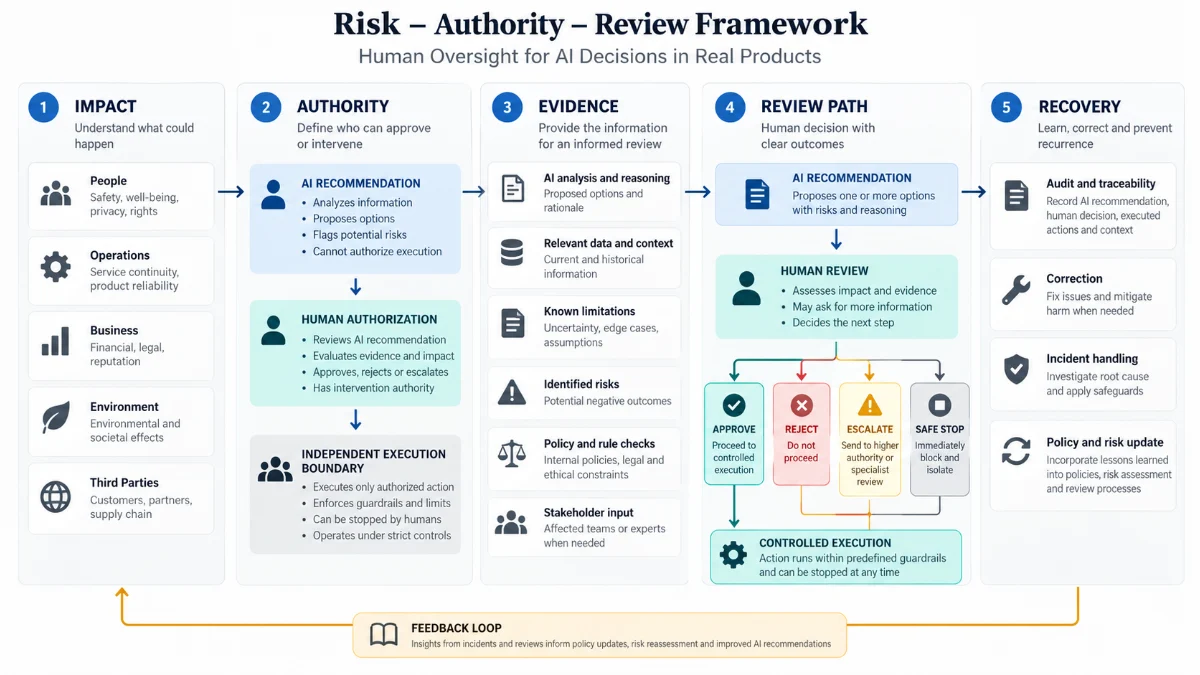
Field One: Define the Impact of an Error
Start with the worst reasonably foreseeable error within the proposed scope. Ask who could be harmed, whether the error could be detected before execution, whether effects can be reversed, and whether the same failure could affect many people at once. Consider not only average prediction quality but also rare high-severity mistakes and opportunities for misuse. Human oversight in AI should be proportionate to those consequences, not merely to the sophistication of the model.
For a draft summary that remains private and editable, simple user review may be adequate. For a decision affecting employment, access to essential services, finances, health, or fundamental rights, the review and governance requirements may be substantially more demanding, including obligations arising from applicable law. Neither example establishes a legal classification on its own; the actual intended purpose, jurisdiction, and deployment context matter.
Field Two: Map Decision and Execution Authority
Human oversight in AI requires a clear distinction between who can recommend, who can verify, who can authorize, and what technical identity executes a change. The model should not gain broad privileges simply because it can propose an action. An operator should not be able to approve outside their assigned scope just because the UI exposes a button. Policies need to be enforced on the server side, at the tools and services carrying out the operation.
For human oversight in AI, write down the accountable owner of each consequential decision, along with a delegate or backup for unavailable reviewers. Where segregation of duties matters, the person requesting an action should not automatically be allowed to approve it. Approval needs to be linked to a defined action and its current context, not to open-ended permission for a model to carry out whatever it decides next.
Field Three: Make the Evidence Inspectable
Before a reviewer makes a decision, the product should reveal the source inputs, task scope, relevant policy, model or tool limitations, and which claims have not been verified. Human oversight in AI is weakened if reviewers see only a generated conclusion without a practical way to trace its basis. Where source documents contain private information, reviewers should receive only what they are authorized to access, with appropriate redaction.
Confidence scores can inform triage when they have been evaluated and calibrated for the actual task, but a model-generated statement such as “I am 95% certain” is not automatically a measured probability of correctness. A numerical threshold must not become an excuse for suppressing review in a high-consequence context without supporting evidence.
Field Four: Choose Review and Escalation Routes
Human oversight in AI needs more than one path. An ordinary reviewer may approve, reject, edit, request evidence, or escalate; a specialized reviewer may resolve ambiguous policy or safety questions; and a designated owner may suspend the capability when systemic failure is suspected. Each route should name the role, response expectation, evidence required, and default behavior if the reviewer is unavailable.
AI escalation pathways should not mean silently retrying the same model prompt until it produces an answer that looks acceptable. If the evidence is insufficient or the action exceeds scope, the workflow should move to a human specialist, a deterministic alternative, or a safe stop. The correct fallback depends on whether delay itself creates harm; some urgent contexts need a separately authorized emergency procedure rather than simply waiting.
Field Five: Define Recovery and Traceability
A final field asks what happens after approval, execution, rejection, or error. Can the action be reversed? Can affected users contest it? Who investigates anomalies, and how is the incident linked to the original decision record? Human oversight in AI and AI incident response are not complete at the moment somebody clicks Approve. A durable control system needs appropriate post-action verification, incident handling, and change ownership.
The five fields work together. High impact with weak evidence suggests stronger controls. Strong evidence does not eliminate the need for authority. A reversible action can sometimes use a lighter review path, provided monitoring and recovery are real. Human oversight in AI is therefore a design of system states and decision rights, not a single interface component.
A Risk-Based Review Matrix for Operational AI
The following is an illustrative design matrix for risk-based human oversight, not a set of measured outcomes or universal legal thresholds. I would use it as a starting point for a team workshop, then adapt the boundaries to the product, applicable regulation, and actual harm scenarios. Human oversight in AI becomes easier to reason about when each category connects a concrete action with a clear review and intervention mechanism.
| Illustrative action | Main concern | Proposed control | Safe failure path |
|---|---|---|---|
| Draft an internal non-sensitive summary | Inaccurate language or omissions | User edits and accepts before use | Leave original source accessible |
| Suggest a support ticket category | Misrouting and delayed response | Bounded automation, sampling, correction mechanism | Queue for human triage on uncertainty |
| Recommend a supplier account restriction | Wrongful interruption or financial harm | Authorized review with source evidence | No restriction until approval; escalate disputes |
| Recommend release of sensitive information | Privacy, security, and disclosure harm | Independent access rules and qualified authorization | Block disclosure and notify designated owner |
| Detect repeated unexpected model-tool actions | Systemic misuse or cascading effects | Automatic trip limits and empowered operator | Suspend capability, preserve investigation evidence |
For human oversight in AI, a matrix is not permission to deploy. It identifies questions for product, security, legal, operations, and affected-user representatives. Human oversight in AI should be reassessed when model behavior, tool permissions, user populations, data sources, or intended purposes change. A control that was adequate for read-only recommendations may be inadequate after the product gains a write-capable integration.
Worked Example: An AI-Assisted Supplier Operations Queue
Before: One Generic Approval for Every Recommendation
Imagine a fictional B2B operations product. Its AI reads supplier messages, summarizes issues, suggests routing categories, and occasionally proposes account restrictions. In the initial design, every output receives the same green Approve button, and the operator sees a short model-generated explanation. The case queue becomes crowded because harmless summaries and consequential account actions compete for the same attention. This example is invented to demonstrate design choices; it does not describe customer data or a tested product.
This design creates two opposing failures. Harmless actions consume human time with little benefit, while serious recommendations may be approved too quickly because reviewers have learned that most queue items are routine. Human oversight in AI under these conditions has been implemented as an undifferentiated workload, not calibrated to risk.
After: Separate Suggestions, Restricted Actions, and Escalations
In a revised conceptual design, summarization remains a draft; routing may operate automatically within defined rules and with a correction mechanism; account restriction becomes a proposed action requiring an authorized reviewer. The recommendation interface presents relevant activity records, the applicable policy, contradictory evidence, and available alternatives. The execution service verifies the review decision and current permissions before committing the change. Human oversight in AI now occurs at the transition that matters.
Every review can produce one of several explicit states: approved, rejected, returned for evidence, escalated, expired, or cancelled. A rejected recommendation must not automatically reappear as an approved action under a new model response. For a delayed or unavailable reviewer, the system preserves the safe pending state unless a separate emergency rule authorizes another action. The model does not decide its own exception to that rule.
A State Transition Is Stronger Than an Approval Label
Human oversight in AI can be represented as a simple state machine: proposed → risk-checked → awaiting-review → approved/rejected/escalated → executed/closed. The transition to executed should require the appropriate authorization and an exact match to the approved action. If the proposal changes materially while waiting for review, the prior approval must not silently authorize the new version.
For example, approval of a temporary access restriction should not also authorize deleting the account, emailing unrelated parties, or exposing additional personal data. Strong boundaries make the meaning of an approval narrow and auditable. A human decision is meaningful partly because the software prevents it from being interpreted more broadly than intended.
What the Conceptual Before/After Does Not Prove
The revised design appears more defensible because its rights, evidence, and fallback conditions are explicit. That is an architectural argument, not evidence that it reduces incidents by a measured percentage. To evaluate the change, a team would need representative cases, reviewer exercises, verified outcomes, incident records, and tests of permission enforcement and fallback behavior. The before/after here clarifies the hypothesis rather than pretending a field study has occurred.
Accountability Matrix: Who Reviews, Who Authorizes, Who Responds?
For decision accountability, “a human reviewed it” is not a sufficient explanation of responsibility when a system fails. Human oversight in AI needs named functions that remain distinct even when one person holds more than one organizational role. Product ownership, technical execution, domain assessment, security response, and policy approval are connected but not interchangeable.
| Role | Responsible for | Not automatically authorized to |
|---|---|---|
| Product owner | Use-case boundaries, outcomes, escalation design, review capacity | Override security or legal restrictions |
| Domain reviewer | Check case evidence, identify errors, approve or reject in scope | Change system-wide permissions |
| Policy or compliance owner | Interpret applicable internal policy and regulatory obligations | Execute production changes without authorized controls |
| Engineering owner | Enforce states, permissions, versioning, logging, and rollback | Substitute a model score for a domain decision |
| Security or incident lead | Contain misuse, preserve evidence, coordinate response | Declare every disputed business decision resolved |
| Accountable business owner | Accept or reject residual operational risk within authority | Dismiss non-waivable legal obligations |
The organizational chart for human oversight in AI may differ. Small organizations can combine responsibilities where appropriate, but they should still identify conflicts of interest and establish separation for particularly sensitive approvals. Human oversight in AI cannot be reliably delegated to an undefined “operations team” if incidents require a particular person to make a time-sensitive decision.
Design the Review Interface for Real Judgment
Present Context, Sources, and Uncertainty Without False Precision
Effective AI review workflows should make it possible to compare the model’s recommendation with the relevant original evidence. Useful elements may include the source passage, event timeline, policy excerpt, missing information, known model limitations, prior decisions, and a clear explanation of which facts were generated or inferred. Human oversight in AI is not achieved by filling a screen with more data; the challenge is presenting enough trustworthy context to support a defensible choice.
In human oversight in AI, a reviewer should be able to distinguish verified facts from the model’s interpretation. In a retrieval-supported system, a citation is an invitation to inspect evidence, not proof that the cited source supports the claim. That distinction is developed in the related article on RAG System Design and Citation Quality. Where context cannot be accessed or verified, the interface should say so and offer an escalation or evidence-request option.
Provide Explicit Approve, Reject, Correct, and Escalate Actions
Human oversight in AI should be reflected in the available actions. If reviewers must use a general comments field to communicate rejection or cannot correct a model-generated label, the product has not supported the most basic intervention. Buttons need clear consequences: rejecting a proposal should not equal closing the case, and escalating it should not silently mark the recommendation approved.
The interface must also support keyboard navigation, meaningful status text, accessible error feedback, and confirmation for genuinely consequential actions. These are not ornamental details. An operator who cannot access the rejection control or understand whether an action executed lacks the practical capacity to intervene.
Avoid Queues That Turn Reviewers Into Rubber Stamps
Review quality depends on attention and workload. Product teams should monitor queue age, the proportion of cases requiring correction, reviewer disagreement, escalation rates, and time spent investigating different risk bands. Those observations must be interpreted carefully. Faster approval may mean a better interface, or it may mean reviewers have stopped scrutinizing recommendations. Human oversight in AI requires measuring quality alongside throughput.
Where review queues exceed operational capacity, the system should not automatically approve everything to prevent a backlog. The safe response may be to narrow automation scope, pause risky actions, add qualified reviewer capacity, or reroute non-urgent tasks. The product should surface capacity limits as operational risk, not hide them behind a success-looking dashboard.
Authority Must Be Enforced Beyond the Prompt
Model Instructions Are Not Access Control
When AI can call tools, human oversight in AI must sit behind actual authorization checks. A model instruction to “never change an account without approval” is not a substitute for a server that refuses the action without a valid approval. OWASP’s AI Agent Security Cheat Sheet emphasizes least privilege, controlled high-risk actions, and separating decision-making from execution.
Tool integrations supporting human oversight in AI should be scoped to the minimum operations required. Read-only workflows should not carry broad write credentials. High-impact actions should require fresh authorization tied to a specific actor, proposed operation, resource, and relevant constraints. The approval record should be checked where the action executes, with an expiry or cancellation behavior appropriate to its risk.
Untrusted Content Must Not Redefine Authority
An AI system can encounter untrusted content in uploaded files, support messages, retrieved pages, and tool results. Such material may attempt to alter the model’s behavior or redirect its tool use. OWASP’s discussion of excessive agency describes why overly powerful tools can amplify mistakes and manipulation. Human oversight in AI is one safeguard, but technical containment matters because a malicious instruction can reach a tool before a person sees the output.
Approvals supporting human oversight in AI should therefore describe the specific operation and not authorize a general conversational objective. Tool responses should be treated as evidence or data, not elevated into new permissions. If a workflow changes from summarizing a document to transferring data or updating external records, it needs a separate permission decision.
Design a Safe Stop Before an Emergency
Human oversight in AI includes the power to interrupt a system. A stop function should define which queued and in-progress actions can be cancelled, how partially completed operations are reconciled, and which records are preserved for investigation. A visible red button without a dependable underlying control path is not a safe stop mechanism.
Product teams should test the stop path under timeout, connectivity loss, duplicate messages, stale approvals, and partial completion. They should also confirm that stopping the model does not leave downstream systems in an inconsistent state. For consequential workflows, the operating procedure matters as much as the user interface.
Build an Audit Trail That Can Explain the Decision
Record Decision Context, Not Just Model Output
AI audit logs that store only a timestamp and the model’s final text cannot reconstruct the decision. Human oversight in AI benefits from recording what task was requested, which system and policy versions were active, what action was proposed, what evidence was available, who had approval authority, what decision occurred, and whether execution succeeded. The purpose is accountable reconstruction, not collecting unlimited personal information.
| Field | Why it matters |
|---|---|
| Case and request identifiers | Connect model recommendation, review, execution, and later correction |
| Use case, model and policy versions | Identify behavior and rules in effect at decision time |
| Proposed action and target | Distinguish advice from exact executable operation |
| Evidence references and limitations | Show what a reviewer could inspect |
| Risk band and review trigger | Explain why this route was selected |
| Reviewer role and decision | Identify authority and outcome without unnecessary personal exposure |
| Approval version and expiry | Prevent stale or broadened authorization |
| Execution receipt or cancellation | Distinguish approved from actually performed |
| Retention and access policy | Constrain sensitive log use and deletion |
Human oversight in AI is not improved by logging raw secrets, private documents, or personally identifiable data indiscriminately. Teams should apply access controls, redaction, retention limits, and appropriate integrity safeguards. Where regulations specify particular logging or recordkeeping duties, a general checklist is not a replacement for analyzing those duties.
Trace a Failure Across Recommendations and Actions
Imagine an incorrect account restriction occurs. An investigator needs to determine whether the underlying data was wrong, the model misinterpreted a fact, a reviewer approved too quickly, the authorization service failed, or a later process changed the approved action. If the system cannot distinguish these events, accountability turns into guesswork. Human oversight in AI should preserve enough structured context to identify causes without assuming that the person who clicked the last button caused the whole failure.
The OECD AI Principles connect accountability with traceability and the ability to override, repair, or safely decommission systems as appropriate. These principles support the direction of this analysis but do not dictate the exact data schema or retention period for every product.
NIST Guidance and the EU AI Act: Useful but Different Kinds of Authority
NIST AI RMF Is Voluntary Risk-Management Guidance
The NIST AI RMF Playbook offers voluntary suggestions across Govern, Map, Measure, and Manage. Its governance material covers human roles, oversight responsibilities, training, risk information, and documentation. Human oversight in AI is consistent with this guidance when teams turn responsibilities into implemented product and organizational processes; citing NIST alone does not establish that a particular system has been independently evaluated or certified.
The framework is also not a universal checklist. A product team should tailor measures to the use case, affected populations, failure severity, and organizational risk tolerance, and explicitly document which risks remain. When uncertainty is material, evaluation and operational monitoring should be used to challenge the design rather than simply affirming that the initial controls are adequate.
Article 14 Addresses Oversight for High-Risk AI Systems
The EU AI Act’s Article 14 addresses the design of human oversight for systems classified as high risk under the Regulation. It describes oversight proportionate to risk, autonomy, and context, including the ability, where appropriate, to understand limitations, interpret outputs, avoid automation bias, disregard or override outputs, and intervene or interrupt operation. Human oversight in AI outside the law’s applicable high-risk scope can still benefit from these design ideas, but it would be incorrect to assert that Article 14 makes the identical checklist mandatory for every AI product.
The legal timing also matters. As of October 28, 2026, the amended EU framework sets application dates for relevant high-risk system requirements at December 2, 2027 for stand-alone high-risk systems under Article 6(2) and Annex III, and August 2, 2028 for specified regulated-product systems under Article 6(1) and Annex I. Other AI Act provisions follow different schedules. The consolidated regulation and European Commission guidance should be reviewed for the current text, scope, and implementation timeline. This article is a design analysis, not legal advice.
Do Not Confuse a Useful Pattern With Legal Compliance
Human oversight in AI can be a good product design practice even when no particular oversight duty applies to a given feature. Conversely, adding a human reviewer does not, by itself, establish compliance with applicable data protection, discrimination, consumer, sector, or AI-specific law. The product’s intended purpose, provider and deployer roles, geographic reach, and actual operational controls all matter.
Where a system can affect rights or essential services, product and engineering leaders should involve qualified specialists. A general architecture article can explain the questions and technical controls; it cannot certify a real deployment or determine its jurisdiction-specific obligations without the underlying facts.
How to Evaluate Whether Human Review Works
Test the Reviewer, the Interface, and the Execution Boundary
Evaluating human oversight in AI requires more than measuring model accuracy. Teams should assemble representative cases, including ambiguous examples and known failure conditions, then observe whether reviewers can recognize errors, identify missing evidence, select appropriate actions, and escalate correctly. Tests should include the actual permissions and execution states, not only a screenshot of a proposed interface.
A useful test plan includes routine items, false positives, false negatives, conflicting evidence, unqualified reviewer accounts, unavailable approvers, expired approvals, altered proposals, and service outages. The expected response for each case should be specified before execution. The test should also check that a rejected or escalated action cannot be executed through a different route.
Measure Decision Quality Alongside Operational Cost
Human oversight in AI can be assessed through several complementary measures: error detection under a defined reference standard, correct escalation, time to intervention, inappropriate override frequency, queue age by risk category, unauthorized execution attempts, incident recovery effectiveness, and the reviewer effort required per decision. None of these is sufficient alone. A low escalation rate can indicate excellent model behavior or a culture in which reviewers do not challenge recommendations.
Disagreement between reviewers can reveal ambiguous policies or unclear evidence rather than individual incompetence. Where a reliable reference answer is unavailable, the team should record uncertainty and examine the reasons for disagreement. Claims about improved safety or decision quality require actual test outcomes, a stated methodology, and limitations; this article does not manufacture such measurements.
Retest Oversight When the AI System Changes
Model upgrades, prompt changes, retrieval modifications, tool permissions, interface redesigns, and new user groups can all alter review behavior. Human oversight in AI should therefore be included in regression testing and release gates. A release should not be considered safe merely because the model passes an answer-quality benchmark if the new workflow bypasses an approval boundary or degrades the evidence shown to reviewers.
For a broader view of task-specific evaluation and quality beyond answer accuracy, see AI Evaluation Beyond Accuracy. This article focuses on the narrower question of how organizations retain effective control once model outputs become operational recommendations or actions.
A Practical Implementation Checklist for Product Teams
Before releasing a feature that delegates part of an operational workflow to AI, I would ask the product and engineering owners to complete a small, reviewable decision record. Its purpose is to make the system’s promises falsifiable. Human oversight in AI should be considered incomplete if core safety claims cannot be demonstrated in a test environment.
- Define the task and boundary. State precisely what the model may recommend, what it may never execute, and which users or resources are in scope.
- Describe realistic harm scenarios. Include severe errors, affected parties, reversibility, and the possibility of repeated or manipulated inputs.
- Assign authority. Identify who can review, override, escalate, suspend, and accept residual risk. Enforce permissions independently from model text.
- Specify evidence for review. List the source material, limitations, policy context, and alternative explanations a reviewer needs.
- Define workflow states. Make approval, rejection, escalation, expiry, cancellation, and execution distinct, observable transitions.
- Implement safe defaults. Decide what happens when a reviewer is unavailable, the model is uncertain, or the tool chain fails.
- Limit tool capabilities. Prefer read-only access until write operations, permissions, and verification paths are justified.
- Capture structured audit evidence. Keep traceable decision metadata with appropriate privacy, security, and retention boundaries.
- Test adversarial and operational cases. Include prompt injection, stale approvals, role changes, network failures, and partial execution.
- Set review triggers. Revisit controls after incidents, model or tool changes, new deployment contexts, or unexpected trends in reviewer behavior.
This is a product engineering checklist, not a declaration that every item is mandated by a particular regulator. Human oversight in AI should be proportionate; a simple creative assistant and a consequential automated process may require very different amounts of control. The point is to give teams a structured explanation for the level they choose.
Evidence and Methodology: What Can Be Claimed
This article is a research-informed synthesis with a proposed operational framework and hypothetical worked example. It is based on publicly available governance, legal, security, and human–AI interaction sources. No user study, proprietary customer dataset, incident reduction experiment, or live authorization benchmark was conducted for this article. Human oversight in AI is discussed as a design responsibility with testable controls, not as a measured improvement demonstrated by the author.
The NIST Govern material supports the need for differentiated roles and documented oversight; EU AI Act Article 14 identifies specified requirements for applicable high-risk systems; OECD guidance supports accountability and traceability; OWASP supports constrained tool use and high-risk approval controls; and automation-bias research motivates examining whether reviewers rely uncritically on machine advice. These sources do not validate the named Risk–Authority–Review Framework as an established or experimentally proven standard.
To test the proposal empirically, an organization would need documented baseline workflows, representative cases, reviewer permissions, a suitable reference standard, measurable decision outcomes, and a follow-up period. The analysis should examine whether the framework detects more important mistakes without causing unacceptable delays or new access risks. Its value remains a hypothesis until those results are observed and carefully interpreted.
Frequently Asked Questions
Does every AI-generated output need human approval?
No universal rule requires the same review for every type of output. Human oversight in AI should reflect the task’s consequences, applicable requirements, and the ability to prevent or correct mistakes. Routine, reversible suggestions can often use lighter review than consequential actions, provided technical controls and appropriate monitoring exist.
Is a human-in-the-loop system automatically safe?
No. A reviewer can lack evidence, authority, time, or an effective cancellation path. Human oversight in AI must be tested through actual decision scenarios and enforcement behavior rather than inferred from the presence of an approval button.
Can a model confidence score decide when to escalate?
Only within a carefully evaluated task and risk context. A score that has not been calibrated against the relevant outcomes should not be treated as a reliable probability. Human oversight in AI should combine uncertainty indicators with failure severity, policy rules, missing evidence, and authorization boundaries.
How does oversight change when an AI agent can use tools?
Tool use creates additional action paths. The system needs least-privilege permissions, bounded operations, execution-level authorization, monitoring, and the ability to interrupt or reconcile partially completed work. Human oversight in AI must protect the action boundary, not rely only on asking the model for polite behavior.
What should an AI audit log contain?
Enough to reconstruct what was proposed, what evidence and policies were available, who could approve, what decision occurred, and what actually executed, without indiscriminate retention of sensitive data. Human oversight in AI depends on useful traceability, not unlimited collection.
Does EU AI Act Article 14 apply to all AI applications now?
No. Article 14 concerns systems within the Regulation’s high-risk scope, and applicable provisions follow phased dates as amended in 2026. Organizations should examine the current legal text and their actual use case rather than equating every AI feature with a legally defined high-risk system.
Conclusion: Real Oversight Is the Power to Change What Happens
The strongest question to ask about human oversight in AI is not whether a person appears in the diagram. It is whether that person can recognize a consequential error, understand the available evidence, and prevent or correct an inappropriate action. Human oversight in AI becomes credible when those capabilities are supported by clear authority, bounded execution, useful information, workable escalation, and a durable record of what happened.
I would rather see a narrow automated workflow with dependable constraints than an ambitious system whose safety case rests on a generic approval screen. Human judgment is valuable, but it needs an architecture that gives it meaningful effect. The purpose of the Risk–Authority–Review Framework is to make that requirement explicit and testable, while acknowledging that no one diagram can replace domain expertise, real evaluation, or applicable legal duties.
For further reading, explore AI Evaluation Beyond Accuracy, RAG System Design, and the Artificial Intelligence Articles collection. The broader AI Product Strategy & Development resource provides additional context on AI capability selection, evaluation, UX, and production responsibilities.
Connect and Explore My Work
For more perspectives on AI product design, software engineering, product strategy, and responsible implementation, connect with me on LinkedIn, X, and Threads. Explore technical work on GitHub and creative projects on Behance.