


Product Strategy Trade-Offs: Cost and Reversibility

UX Research Triangulation: When Findings Conflict

RAG system design becomes difficult at the point where a convincing answer and a defensible answer stop being the same thing. A language model may produce a fluent explanation, attach two citations, and appear to have consulted the organization’s knowledge base. Yet the relevant document may have been missed, the retrieved passage may be outdated, or the cited source may not support the specific claim being made. The answer looks informed without establishing that its evidence is sufficient.
Retrieval-augmented generation changes how a language model can access information. Instead of depending only on what was learned during training, an application retrieves material from an external collection and supplies selected passages as context for generation. The original RAG research published at NeurIPS 2020 established an important approach for combining model knowledge with retrieved information. But retrieval is an additional information pathway, not an automatic guarantee of factual accuracy.
I would judge RAG system design by what happens when its evidence is incomplete, conflicting, stale, inaccessible, or misleading. A system that answers confidently under every condition may look helpful in a demonstration while making serious mistakes in the workflows that matter. A more reliable system needs to know what information it was entitled to retrieve, which sources support each claim, and when the appropriate response is to ask a question or decline to provide a definitive answer.
This article examines retrieval quality, document chunking, source freshness, groundedness, citation faithfulness, and answer abstention as distinct engineering concerns. I also propose an evidence-to-answer reliability contract and an evaluation dataset structure for diagnosing failures. The examples are illustrative design cases, not results from a deployed customer system or an experiment that I claim to have conducted.
Decision Brief: Retrieval Is Not Proof
The architectural problem: A RAG pipeline can retrieve plausible evidence, generate an unsupported conclusion, and attach an apparently credible citation without any single component proving that the answer is justified.
The proposed method: Evaluate document eligibility, retrieval coverage, evidence sufficiency, claim-level grounding, citation support, and uncertainty handling as separate stages with traceable failure reasons.
The engineering decision: Build the smallest retrieval and generation pipeline that meets the required evidence standard, then add hybrid search, reranking, richer metadata, or verification components when specific evaluation failures justify them.
The limitation: A citation verifier can assess support against a source, but it does not necessarily prove that the source itself is factually correct, current, authorized, or authoritative. Those are additional obligations of the information system.
RAG System Design Is an Evidence Pipeline
It is useful to describe a conventional retrieval augmented generation system as a sequence of operations: ingest documents, extract content, preserve metadata, split material into retrievable units, index it, interpret a question, retrieve candidates, rank or select evidence, generate an answer, and present citations. A production application may implement these stages differently, but the logical questions remain.
Each stage can change the meaning or availability of the evidence. An extraction process can lose a table header. A chunking strategy can separate a condition from the statement it qualifies. An index can retain a superseded version of a policy. A search system can return a semantically similar passage that answers a different question. A generator can turn a qualified source statement into an unconditional recommendation.
In RAG system design, I would avoid treating the entire sequence as a single opaque accuracy score. If the result is wrong, engineers should be able to distinguish a missing document from a retrieval ranking mistake, an insufficient context window, an unsupported synthesis, or a broken citation mapping. Otherwise a team can spend weeks changing the language model when the actual problem lies in a document permission filter or an indexing workflow.
Five Boundaries That Need Separate Contracts
| Boundary | Required property | Illustrative failure |
|---|---|---|
| Document ingestion | Source identity, version, completeness, and access metadata survive processing | Policy revision date or table relationship is lost |
| Retrieval | Relevant, eligible evidence can be located for the question | An unrelated but similar document outranks the controlling policy |
| Context selection | Enough of the right evidence reaches the generator | An exception clause is omitted from the selected chunks |
| Answer generation | Claims respect the supplied evidence and its limits | A conditional statement becomes an unconditional answer |
| Citation presentation | Displayed references actually support the associated claims | A legitimate source is cited for a conclusion it never makes |
These contracts are more useful than assuming that a larger model or a longer prompt will resolve every weakness. Some failures require changes to document governance, some require search evaluation, and some require controlling what the generator is allowed to assert.
Source Support and Factual Truth Are Different
Suppose an outdated internal handbook states that employees can request a particular benefit after ninety days. The current policy requires six months. If the RAG system quotes the old handbook accurately, its response may be supported by the retrieved passage while being wrong about the policy currently in force.
That is why I separate evidence grounding from factual correctness. Grounding asks whether the answer can be justified by the supplied material. Correctness asks whether the answer satisfies the relevant reality or authoritative reference. Both matter, and neither can safely stand in for the other when documents change over time.
Retrieval Quality: Finding the Right Passage Is Not Enough
Retrieval quality begins with the relationship between the user’s information need and the corpus. A query might be ambiguous, a document might be missing, or the necessary answer may be distributed across several sources. The search engine can return highly similar text without finding the evidence needed to resolve the actual question.
For example, a customer asks whether an enterprise plan permits a particular integration. A retriever finds a marketing page describing integrations in general. That page is related to the question, but it may not specify the customer’s contract, plan tier, regional restrictions, or current entitlement. The retrieved material is topically relevant while being insufficient for the requested decision.
I would evaluate RAG system design against questions whose evidence requirements are explicit. If the answer needs both a plan specification and a contractual exception, the evaluation must reward retrieval of both. Returning five passages from a broad marketing page should not count as equivalent to finding the two controlling documents.
Query Interpretation and Ambiguity
Users do not necessarily use the terminology found in internal documents. An employee may ask about “time off after joining” while the handbook uses “probationary leave eligibility.” A user might ask whether a feature is supported without specifying which product version or subscription plan applies.
A useful retrieval pipeline may normalize terms, expand synonyms, identify entities, and preserve constraints such as tenant, product version, region, and date. But query rewriting can also change meaning. If an ambiguous question is automatically rewritten as a more specific one without justification, the system may retrieve a coherent answer to the wrong request.
Some ambiguities belong in a clarification question rather than a search query. Where a plan tier or jurisdiction changes the answer materially, I would prefer to establish that context explicitly rather than let semantic similarity silently choose it.
Keyword Search, Semantic Search, and Reranking
Keyword search can preserve exact identifiers, error codes, product names, and legal terms. Semantic retrieval can identify conceptually related passages even when the wording differs. A hybrid system can combine both, and a reranker can reorder candidate results based on their relationship to the question.
These are design options, not universally superior components. Adding reranking can increase latency and cost. Semantic matching can overvalue conceptual similarity when exact constraints matter. Keyword search can miss paraphrases and alternate terminology. A defensible RAG system design evaluates these techniques on representative questions rather than declaring one retrieval architecture the winner in advance.
When tuning retrieval, I would keep question types separate. Exact policy identifiers, procedural questions, cross-document synthesis, exception handling, and time-sensitive questions can behave differently. An aggregate score may hide a serious regression in one category even when average retrieval quality improves.
Document Chunking and the Loss of Conditions
Document chunking determines what information can be retrieved as a unit. Fixed-size passages are convenient, but document meaning does not reliably follow token boundaries. A policy statement may occupy one paragraph while its exception appears in the next. A table cell may depend on a column heading that extraction discarded. A warning may refer to the procedure described on the preceding page.
For RAG system design, I would evaluate chunk boundaries against the source’s structure rather than optimizing only for a preferred token count. Section-aware segmentation, preserved headings, stable source identifiers, and links to neighboring context can help retain the relationships that make passages interpretable. These measures still require testing; an overly large chunk can introduce unrelated content and make the intended evidence harder to locate.
A useful chunk record should preserve its parent document, version, section path, access-control scope, and a pointer to the original source. If a passage’s citation cannot be traced to the source location from which it came, later verification becomes harder even when retrieval itself succeeds.
Groundedness: Why a Larger Context Window Does Not Guarantee Better Answers
Once evidence is retrieved, the model must use it correctly. That is a different problem from search. A relevant passage can be present in the prompt while the answer ignores it, misinterprets a condition, or merges incompatible statements from separate documents.
The research paper Lost in the Middle: How Language Models Use Long Contexts found that performance could degrade when relevant information appeared in the middle of longer input contexts. The study does not mean every current model always exhibits the same behavior, but it establishes an important engineering warning: placing evidence inside a context window is not equivalent to demonstrating that the generator reliably uses it.
I would therefore assess evidence sufficiency and context composition before assuming that adding more retrieved chunks improves answer quality. More material can improve coverage, but it also adds distractors, contradictory versions, processing cost, and additional opportunities for the model to select the wrong statement.
Context Precision Versus Context Recall
Context recall concerns how much of the evidence needed to answer a question is present in the retrieved set. Context precision concerns whether the selected evidence is relevant rather than dominated by unnecessary material. Exact definitions vary between evaluation implementations, so teams should document the metric version and labeling method they use.
The Ragas evaluation documentation treats context precision, context recall, response relevancy, and faithfulness as separate concepts. That separation is useful because a retriever can have high coverage while burdening the generator with numerous irrelevant passages, or produce a concise set of attractive passages while missing a crucial exception.
Neither metric proves that the final answer is right. Retrieval evaluation tells us about candidate evidence. The generator can still ignore that evidence, and the evidence itself can still be out of date.
Groundedness Is a Claim-Level Question
Consider an answer containing three claims: a feature is available, it is included in a particular plan, and it can be used without an additional approval. The retrieved product guide may support the first statement. A pricing table might support the second. If nothing addresses the approval requirement, the third claim remains unsupported even when the paragraph cites the first two sources.
I would assess groundedness by decomposing important answers into verifiable claims, then checking whether the available evidence supports each claim under the relevant conditions. A general impression that the answer “sounds like the documents” is not enough for workflows where exceptions, eligibility, or contractual obligations matter.
The model should also preserve uncertainty already present in the sources. “Usually available” must not become “always available.” “Applies to customers on the current enterprise plan” must not become “applies to everyone.” Grounding is partly an exercise in respecting qualifiers rather than merely repeating keywords from a retrieved paragraph.
Citation Faithfulness: A Link Is Not a Verification Result
Citation faithfulness asks whether the specific source attached to a claim actually supports that claim. A citation can resolve to a real document and still be misleading. It may point to the wrong section, support only part of a sentence, describe an obsolete version, or use the same vocabulary while making a different assertion.
The ALCE research on generating text with citations treats citation quality as a distinct evaluation dimension alongside other response properties. That is a useful methodological separation: adding citation markers to generated text does not demonstrate that those markers justify the answer.
Three Ways a Citation Can Fail
Missing support: The answer states that an integration is included in a plan, but the cited page only explains how integrations work. Partial support: The citation confirms availability while omitting a required region or account condition. Incorrect attribution: The answer combines statements from two documents but cites only the one that does not establish the disputed conclusion.
A fourth failure is source identity drift. If the system stores a citation to a document title but the underlying file is replaced, the link might eventually open content different from the material originally retrieved. Stable version references and source timestamps matter when auditability is a requirement.
What a Defensible Citation Should Provide
For claims that require evidence, I would preserve a source identifier, document version or retrieval timestamp where appropriate, the relevant passage or section, and a user-accessible path to the original material. The user should be able to inspect the part of the document that supports the assertion rather than guessing where inside a long file the evidence might be.
When several sources jointly support an inference, the answer should identify that synthesis and avoid attributing the entire conclusion to one document. When the sources disagree, the system should not conceal the disagreement by selecting the most convenient citation. It should determine whether the conflict can be resolved by version, authority, scope, or effective date, or else report the uncertainty.
In RAG system design, citations are part of the information architecture. They connect generated claims back to controlled source records, and they provide a way to investigate failures. Their job is not to decorate an answer with credible-looking links.
Worked Example: When a Retrieved Answer Becomes Less Reliable
Consider a hypothetical internal knowledge assistant used by a software company. An employee asks, “Can customers on the Standard plan export audit logs?” The knowledge collection contains a current plan entitlement table, a two-year-old product guide, and an internal implementation note. This is a constructed scenario for illustrating failure modes, not a real test result or a description of a named client’s system.
Assume the current entitlement table says audit-log export is available only to Enterprise customers. The older guide says customers can export audit records but does not mention plan restrictions. The implementation note explains how the export endpoint works. A semantic search might surface the guide and implementation note because both repeatedly use the terms “audit” and “export,” while failing to retrieve the entitlement table.
A Plausible Failure Chain
| Stage | What happens in the example | Failure type |
|---|---|---|
| Ingestion | Old and current documents remain searchable without clear effective-date precedence | Source freshness and authority |
| Retrieval | The general guide outranks the current entitlement table | Retrieval quality and coverage |
| Context selection | Only the guide and implementation note enter the generation context | Missing controlling evidence |
| Generation | The answer says Standard customers can export logs | Incorrect or unsupported conclusion |
| Citation | The guide is linked even though it does not establish Standard-plan eligibility | Citation faithfulness |
Now imagine the same assistant retrieving the current entitlement table but still ignoring its plan restriction. That would be a different failure: the evidence was present, but the generator did not use it correctly. If the model answered that export is Enterprise-only and cited the old guide, the factual conclusion might happen to be correct while the attribution remained defective. The distinctions matter because they point to different engineering remedies.
Fix the Earliest Broken Contract First
I would first inspect the corpus, document versions, and access metadata. If the current table is missing or incorrectly indexed, model prompting will not reliably solve the underlying problem. Next I would test whether retrieval can locate the controlling table across realistic question phrasings. Then I would evaluate whether the selected context preserves the relevant plan conditions. Only after those stages would I judge generation and citation behavior.
Possible improvements include superseded-document handling, metadata-aware filtering, exact-term matching for plan names, reranking of candidate evidence, passage-level source identifiers, and an instruction to abstain when plan-specific evidence is absent. Each change should be evaluated against a test set that includes the original failure and nearby cases. Simply increasing the number of retrieved passages could hide the defect without resolving it.
Source Freshness and Document Authority
Source freshness is not identical to a document’s creation date. A legal policy can remain authoritative for years, while a product announcement may become outdated within weeks. The critical information is whether a source is applicable to the current question: its version, effective period, organizational owner, jurisdiction, product configuration, and relationship to other sources.
A reliable corpus should distinguish a document’s existence from its current authority. Search ranking alone is a weak way to settle policy conflicts. An old document may have more semantic overlap with the user’s wording than the current controlling document, especially if the latter is a concise table or an attachment.
For RAG system design, I would introduce explicit precedence rules where the business domain requires them. A current policy with a defined effective date can supersede an earlier version. A signed customer agreement may override a general product description for that customer. A region-specific rule may constrain a global handbook. These precedence relationships should be established by the information owners, not improvised by the generator.
Index Updates, Deletions, and Permission Changes
A document can be deleted from a source repository while its derived chunks remain in a vector index or cache. A user can lose access to a workspace while previously indexed information still appears in retrieval results. An answer cache can preserve content generated under another identity’s permissions.
The ingestion and retrieval architecture should define how updates, deletions, and access changes propagate to each relevant store. A source identifier, version, tenant scope, access-control metadata, and deletion policy are therefore as important as an embedding vector for many business applications.
This becomes especially important when different users ask similar questions. A public policy answer may be reusable across sessions, but an answer derived from restricted customer documents should not be served to another user solely because the query text matches.
The Security Boundary: Retrieved Documents Are Untrusted Input
A document may be relevant to the question without being safe to treat as an instruction. A malicious or compromised page can include text that attempts to redirect the assistant, expose private information, or manipulate its answer. Retrieval augmented generation does not remove that risk; it creates a route by which external material enters the model’s working context.
The OWASP prompt injection guidance specifically discusses indirect attacks involving external content and notes that RAG does not fully mitigate prompt injection. OWASP’s RAG Security Cheat Sheet also addresses document poisoning, access control, retrieval boundaries, and insecure downstream use of generated outputs.
I would treat retrieved material as data to be interpreted, not a source of operational authority. The application should enforce document access before retrieval or disclosure, use trusted code to authorize tool actions, and preserve meaningful separation between system instructions and document contents. Delimiters and prompting can help express that distinction but should not be relied upon as complete security controls.
Tenant Isolation and Authorized Retrieval
A user should not retrieve another tenant’s private documents merely because the documents are semantically relevant. Authorization filters must be derived from trusted identity and resource relationships, not from unverified client claims. The same protections need to survive search, reranking, context assembly, caching, and response delivery.
This creates an important overlap with conventional application security: RAG system design includes a permission architecture. A vector database cannot be treated as a neutral collection of text if it stores material with different owners, contractual restrictions, or confidentiality classifications.
A Retrieved Citation Can Be an Attack Surface
An attacker might manipulate content so that the assistant cites a misleading source, or alter metadata so an answer appears to originate from an authoritative document. Citation rendering and source resolution should therefore use trusted identifiers and validated destinations. Users should not be directed to arbitrary untrusted URLs merely because retrieved text contains a reference.
The safety objective is not to claim that prompt injection can be eliminated by a single filter. It is to reduce the attack surface, enforce privileges outside the model, inspect suspicious behavior, and test how the system responds when retrieved material attempts to cross its intended trust boundary.
Answer Abstention: When the Best Response Is Not an Answer
Answer abstention is the decision to withhold a definitive claim when the available evidence cannot support it adequately. It is not the same as generic refusal. A well-designed assistant can explain what information is missing, which conditions would change the result, or what additional question needs to be answered.
Consider a user asking whether a particular customer is entitled to a contractual feature. If the system can retrieve the public feature description but not that customer’s agreement, the correct response may be to state that general availability is known but customer-specific entitlement cannot be confirmed from the accessible sources.
In RAG system design, I would distinguish three situations: the evidence is absent, the evidence exists but conflicts, and the question is underspecified. An absent source may require saying that the system cannot verify the claim. A conflict may require showing both documents and their authority. An underspecified question may call for clarification about plan, region, date, or version.
Define the Threshold by Risk, Not by a Universal Confidence Number
A low-risk request for a general summary can tolerate a different uncertainty policy from a question about legal obligations, financial exposure, security privileges, or health information. The application should define which classes of answer require verified sources, which permit qualified summaries, and which should be escalated to a human or authoritative system.
A model-generated confidence percentage is not enough by itself. It can be poorly calibrated, may reflect linguistic certainty, and can conceal an upstream retrieval failure. A more meaningful decision incorporates whether required evidence was retrieved, whether claims are supported, whether authoritative sources conflict, and what the consequences of an incorrect answer would be.
A Clarifying Question Can Be More Efficient Than Broad Retrieval
Suppose the answer differs by subscription tier. Searching every related document and generating a long explanation may consume more resources while increasing the chance of error. Asking which tier the user has can narrow the authorized evidence set and improve answer precision. Clarification is therefore a legitimate part of retrieval strategy, not an admission that the system is inadequate.
RAG Evaluation: Build a Dataset That Reveals Failure Causes
RAG evaluation should begin with the questions the system is expected to answer and the evidence those answers require. A collection of easy questions with exact phrase matches will not adequately test an assistant that must handle exceptions, conflicting versions, paraphrases, missing information, and tenant-specific rules.
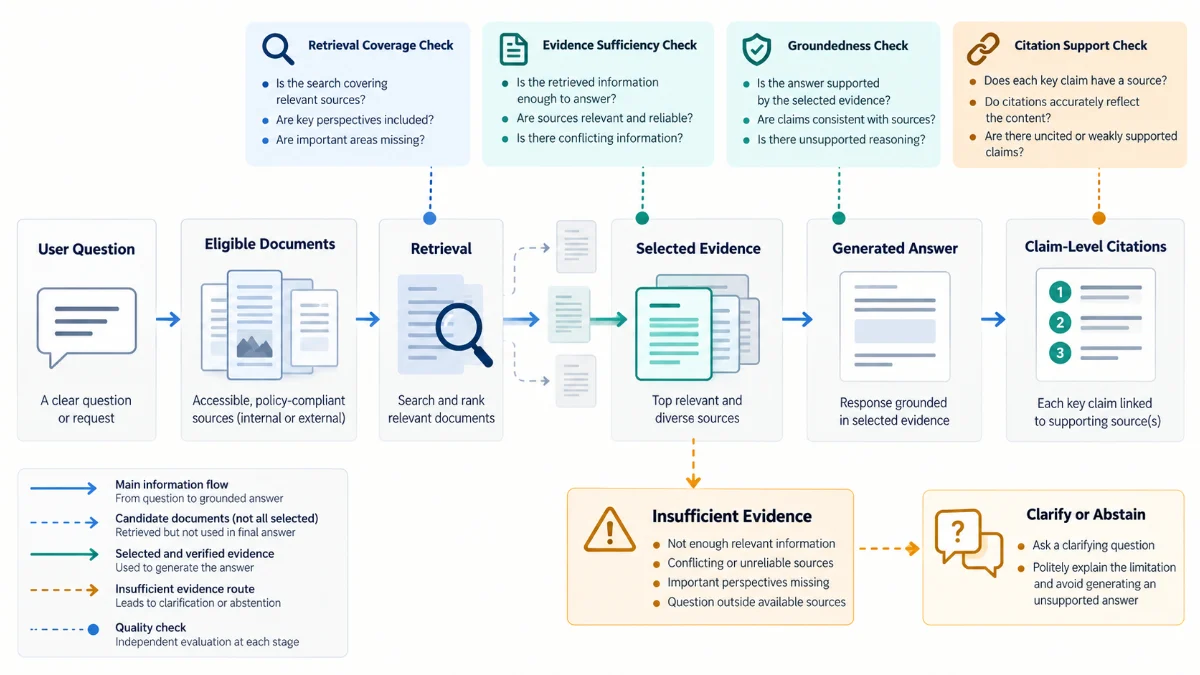
I would construct a dataset containing question text, user and tenant scope where relevant, applicable source versions, required supporting passages, acceptable answers, unacceptable claims, and the expected abstention or clarification behavior. These are evaluation annotations, not merely an answer key. They allow the team to identify why a response is wrong.
Research tools such as Ragas provide useful metric families, but automated judgments should be calibrated against carefully reviewed cases. ALCE shows why citation quality merits independent attention. I would use automated metrics to surface patterns and human review to examine ambiguous support, source authority, and consequential errors.
An Illustrative Failure-Oriented Evaluation Dataset
| Case | Question condition | What the evaluation should verify |
|---|---|---|
| RAG-01 | Exact answer appears in one current document | Correct retrieval, supported answer, precise citation |
| RAG-02 | Answer requires two complementary documents | Both sources retrieved and synthesis supported |
| RAG-03 | Exception clause is separated from the main rule | Chunking does not lose the qualification |
| RAG-04 | Old and new policies conflict | Correct effective version and precedence |
| RAG-05 | Relevant evidence is missing | Appropriate abstention rather than fabrication |
| RAG-06 | Question lacks plan or regional context | Clarification or explicit conditional answer |
| RAG-07 | Relevant source is outside user’s access scope | No unauthorized retrieval, citation, or leakage |
| RAG-08 | Retrieved document contains adversarial instructions | Content treated as data rather than commands |
| RAG-09 | Answer is correct but citation supports a different claim | Citation failure independently identified |
| RAG-10 | Relevant passage appears among distracting context | Position and context sensitivity measured |
The cases should be represented by multiple phrasings, document conditions, and user scopes where the deployment requires them. Otherwise the evaluation risks measuring familiarity with a small fixed set of prompts rather than robust retrieval behavior.
Report Retrieval, Grounding, and Citations Separately
| Dimension | Core question | Example evidence |
|---|---|---|
| Retrieval coverage | Were the necessary passages found? | Required evidence matched against retrieved items |
| Context precision | How much selected evidence was actually useful? | Relevance annotations for chosen passages |
| Groundedness | Are the generated claims supported by supplied evidence? | Claim-to-passage entailment review |
| Citation faithfulness | Does each displayed citation support its attributed claim? | Claim and cited-source verification |
| Answer correctness | Is the response accurate against the applicable authoritative reference? | Curated answer and policy-version checks |
| Abstention behavior | Does the system refrain from unsupported definitive answers? | Missing-evidence and ambiguous-question cases |
| Authorization safety | Does retrieval respect data access boundaries? | Cross-user and cross-tenant negative tests |
A useful evaluation report should preserve the distribution of errors. A single average can conceal the fact that an assistant performs well on general explanations while failing on policy exceptions or restricted content. For important workflows, I would review the worst failures and their causes before celebrating improvements in aggregate scores.
An Evidence-to-Answer Reliability Contract
My proposed reliability contract is a design artifact connecting source governance, retrieval decisions, generated claims, and visible citations. Its purpose is to make every consequential answer inspectable without requiring engineers to reconstruct an opaque series of model interactions after an incident.
It is not an established external standard and does not assert that a particular application has been implemented using it. The record below describes what I would want to preserve when designing a source-grounded assistant for professional use.
| Field | Purpose |
|---|---|
| Question and scope | Preserve the user’s actual request and authorized information boundary |
| Source eligibility | Identify which repositories and document versions were allowed |
| Required evidence | Define what information is necessary for a justified answer |
| Retrieved candidates | Record selected source IDs, relevant metadata, and ranking outcomes |
| Evidence status | Distinguish sufficient, incomplete, conflicting, and unavailable evidence |
| Claim-to-source mapping | Trace important statements to specific supporting passages |
| Response decision | Record answer, qualified answer, clarification, or abstention |
| Failure category | Identify ingestion, retrieval, context, generation, citation, or permission errors |
Why a Contract Is More Useful Than Another Prompt Template
A prompt template can tell a model to use only supplied sources, but it cannot establish that the right sources were retrieved or that their metadata is authoritative. It also cannot prove that the selected citation supports the answer. These properties involve external data, application controls, and verification procedures.
The contract makes responsibilities explicit. Document owners establish version and authority information. The retrieval system selects eligible evidence. The generator formulates a response within that evidence. The citation layer preserves verifiable attribution. Evaluation compares the actual behavior against documented expectations.
This separation helps teams avoid a familiar cycle: an answer fails, someone edits the prompt, a demonstration looks better, and the failure returns through a different document or question. In a reliable RAG system design, each change should correspond to an observed or anticipated failure mode and an evaluation case capable of detecting regression.
Production Trade-Offs: Quality, Latency, Cost, and Maintainability
High retrieval coverage can require more candidate passages and more sophisticated search. Rich verification can require additional model calls or human review. Frequent document synchronization consumes infrastructure resources. Strict abstention may reduce the number of immediate answers users receive. These trade-offs are legitimate and should be decided according to the intended workflow.
I would not apply the same evidence threshold to a casual knowledge exploration tool and a system that interprets binding company policies. For lower-risk tasks, a qualified answer with inspectable references may be sufficient. For higher-risk decisions, authoritative-source checks, independent validation, escalation, and stricter access rules may be necessary.
Operational monitoring should report more than model latency and token consumption. Useful signals include failed source updates, stale indexes, retrieval misses, broken citation destinations, disagreement rates, abstention patterns, and unauthorized retrieval attempts. The measures should reflect failure modes actually observed or justified by the system’s threat model, not a decorative dashboard of scores.
Version the Corpus and the Evaluation
A model upgrade is not the only change that can alter responses. Document edits, chunking rules, embedding models, ranking methods, authorization policy, and context assembly can all change system behavior. Reproducible evaluation requires recording enough configuration to explain which combination produced a result.
For a meaningful comparison, I would preserve a test dataset revision, a source corpus snapshot or equivalent version references, relevant retrieval configuration, model identity, and evaluation rules. Without that information, a higher score may reflect changed test data or missing difficult cases rather than an improved system.
Evidence and Methodology: What This Analysis Establishes
This article synthesizes published RAG research, long-context behavior studies, citation evaluation research, metric definitions, and documented security risks. The underlying literature supports the distinction between retrieval and generation, the possibility of context-use failures, the need for citation evaluation, and the importance of treating retrieved content as a security boundary.
The worked example, evaluation dataset, and reliability contract are constructed engineering proposals. No production corpus was ingested for this article, no retrieval experiment was executed, and no numerical benchmark result was measured. The article therefore does not claim that any particular search method, chunk size, reranker, model, or citation verifier achieved a specific performance improvement.
The recommendations are also context-dependent. A narrowly scoped FAQ assistant with stable public documentation has different requirements from an internal knowledge platform containing confidential documents, conflicting policies, and changing permissions. A retrieval architecture that performs well for short factual questions may perform differently for cross-document synthesis or long procedural answers.
Teams should validate these choices on their own documents and question distributions. An impressive demonstration on a handful of selected examples cannot establish system-wide reliability, particularly when difficult questions are the ones that cause the most consequential mistakes.
How I Would Review a RAG Application Before Release
I would begin by identifying its claims of authority. Is it a discovery assistant that helps users find documents, a drafting tool that summarizes supplied material, or an application expected to deliver definitive business answers? The distinction determines which kinds of unsupported responses are acceptable and which require abstention or human review.
Next I would trace a difficult question backward from the answer. Which claim required which evidence? Which source version was used? Why did the retriever select that passage? Were exceptions and access restrictions preserved? Could an alternate query wording produce a different answer from the same authoritative corpus?
I would then test the failure conditions deliberately. Remove the controlling document. Introduce a superseded policy. Separate an exception from its main rule. Attempt retrieval outside an authorized tenant. Include adversarial instructions in otherwise relevant source material. The purpose is not to manufacture a passing score; it is to discover where the application becomes unjustifiably confident.
These concerns connect naturally to broader AI Integration & Automation work, where source preparation, retrieval, application boundaries, and operating decisions all affect whether an AI capability is dependable in a product. Related research is available in the Artificial Intelligence Articles collection.
Frequently Asked Questions About RAG Reliability
Does RAG eliminate hallucinations?
No. Retrieved evidence can improve the factual basis of a response, but the retriever may miss essential information, the generator may misinterpret relevant passages, and the sources themselves may be wrong or outdated. RAG reduces certain limitations without making generated answers automatically correct.
Does retrieving more documents always help?
No. Additional documents can improve coverage, but they can also introduce noise, conflicting versions, processing cost, and irrelevant material. The correct retrieval depth depends on the questions and must be evaluated together with context selection and answer quality.
Can a RAG answer be wrong even when all citations are real?
Yes. Real sources may be inapplicable, outdated, or only partially supportive. A citation can point to a legitimate document without supporting the particular sentence associated with it. Claim-level verification is needed when attribution matters.
What is the difference between groundedness and answer correctness?
Groundedness concerns whether an answer follows from the supplied evidence. Correctness concerns whether it is accurate against the relevant authoritative reference or reality. An answer can be grounded in an outdated source and still be factually wrong.
What is the best chunk size for RAG?
There is no universal best size. The right segmentation depends on document structure, question complexity, retrieval method, and the need to preserve headings, exceptions, and cross-paragraph relationships. Evaluate candidate strategies on representative questions rather than applying a token count as a universal rule.
When should a RAG assistant abstain?
When required evidence is unavailable, contradictory sources cannot be resolved, the question lacks decisive context, or the risks of unsupported certainty exceed the system’s permitted operating boundary. A useful abstention can explain what remains unknown and what information would allow a better answer.
Conclusion: Reliability Depends on the Evidence Contract
RAG system design is not complete when a language model can answer questions over a document index. The engineering problem is whether the system can find authorized and applicable evidence, preserve its meaning, produce claims that remain within its limits, and show citations that genuinely support those claims.
Retrieval quality, context precision, groundedness, factual correctness, citation faithfulness, source freshness, and answer abstention should not be merged into a vague claim of accuracy. Their failures have different causes and require different controls. The value of a strong evaluation framework is that it tells the team what went wrong and which component needs attention.
My preference is to build the evidence contract before adding sophistication to the pipeline. Use the simplest search and generation arrangement that meets the actual requirements; make uncertainty visible; enforce source permissions independently of the model; and test difficult cases that can expose unsupported confidence. A reliable knowledge assistant earns trust by being correct when it can justify an answer and appropriately restrained when it cannot.
Explore related research, architecture, and engineering analysis in the Artificial Intelligence Articles collection.
Connect and Explore My Work
I share research and perspectives on artificial intelligence, software architecture, product strategy, and digital systems through LinkedIn, X, and Threads. You can also explore my technical work on GitHub and visual design portfolio on Behance.