


Virtualization Performance: Find the Real Bottleneck

GA4 Measurement Plan: Decisions Before Dashboards

Decision Brief: Design the Route Before Decorating the World
A real-time 3D scene can be visually remarkable and still be difficult to explore. The problem rarely begins with a lack of polygons, high-resolution textures, or atmospheric effects. More often, the player cannot recognize a meaningful route, distinguish a usable object from set dressing, understand what changed after an action, or return from a detour without losing their bearings. A beautiful still image can conceal those failures because a still image does not ask anyone to move, choose, recover, or wait for the next frame to render.
My approach to 3D environment design starts with a different question: What should a person be able to notice, infer, attempt, discover, and recover from while moving through this space? I would then shape the geometry, lighting, sound, visual hierarchy, and technical budget around those interactions. Visual quality matters, but only within the larger contract between an explorable world and the person using it. I call that proposed contract the Spatial Exploration Contract. It is an editorial design framework, not a standardized research instrument or the result of a completed user study.
The practical decision is to evaluate a space through six linked responsibilities: orientation, choice, interaction legibility, discovery, recovery, and runtime continuity. Each deserves its own evidence. A scene that achieves exceptional visual fidelity while failing critical navigation or frame-time requirements is not necessarily a successful interactive environment.
What Makes a Real-Time 3D Environment Explorable?
A rendered environment and an explorable environment share assets, but they are not evaluated in the same way. A rendered composition can be judged for silhouette, lighting, material response, color, and atmosphere from a fixed viewpoint. An interactive space changes as the viewer walks, turns, approaches objects, looks away, retraces a route, or takes an unexpected path. The experience depends on what remains understandable across those transitions. Real-time 3D environments are therefore temporal, spatial, and behavioral systems rather than collections of impressive views.
The Unreal Engine documentation on levels describes a level as containing the environment, usable objects, characters, lighting, and sounds with which a player may interact. I find that definition useful because it discourages treating environmental art as separate from the actions it supports. The geometry defines where movement is possible. Lighting affects where attention goes. Sounds and animation can clarify consequences. Streaming and rendering behavior determine whether those relationships survive at runtime.
Visual Fidelity Is Not the Same as Spatial Usability
Imagine an elaborate abandoned observatory. Its carved surfaces, volumetric atmosphere, and intricate mechanical details might make an impressive promotional image. Now imagine entering it without knowing which stair is accessible, whether a glowing instrument is interactive, or why three similarly decorated doorways lead to different outcomes. The scene might communicate an artistic identity while withholding basic information required for exploration. This is a hypothetical design scenario, not a description of a released game or an experiment I conducted.
In 3D environment design, spatial usability does not require every destination to have an arrow. Exploration often depends on uncertainty, curiosity, and the freedom to interpret clues. The difference is between uncertainty the designer intentionally creates and uncertainty that arises because the system fails to communicate. A puzzle can reasonably conceal its answer; a normal door should not require the player to guess whether the collision system or the artwork is authoritative. A hidden reward can be optional; a critical route should not become invisible simply because the player chose an unexpected camera angle.
The Three Promises of an Explorable Scene
I would establish three promises before placing final art assets. First, the environment gives the player enough spatial structure to form and revise a mental model. Second, its cues are truthful: an object that looks actionable behaves consistently with similar objects, and blocked routes have comprehensible limits. Third, the experience continues to function at the target frame-time and loading budget when the player exercises the freedom the environment offers. Breaking any one of these promises makes the other two less valuable.
Wayfinding Starts With Landmarks and Sightlines
Wayfinding in virtual environments is not simply about reducing the number of possible turns. It is about making location, direction, and destination relationships interpretable. A distinctive tower visible from several paths can establish a stable frame of reference. A change in architecture may indicate that the player has entered another functional district. A corridor opening toward a contrasting light source can suggest progression without displaying a persistent arrow. These are design hypotheses to test in the specific scene, not universal laws that work equally for every player or genre.
Recent research illustrates why I would resist a single landmark prescription. A 2025 study on wayfinding strategy and landmark type reports differences related to how people use local or global landmarks in a virtual task. A 2026 CHI study of virtual wayfinding also distinguishes navigation performance from spatial learning and found mixed effects across locomotion and viewpoint-transition conditions. Neither study justifies treating one visual trick as a guaranteed solution across all games; both support making player tasks and evaluation methods explicit.
Build a Hierarchy of Landmarks
For 3D environment design in a multi-route location, I would distinguish global landmarks that establish broad orientation, regional landmarks that distinguish neighborhoods or interior zones, and local cues that help with the next decision. A tall observatory dome may identify the center from a distance. A courtyard of red stone may tell the player which district they reached. A broken rail beside a specific stair can make the return route memorable. The hierarchy should help the player answer increasingly specific questions instead of filling every view with competing focal points.
Landmarks should also remain useful from plausible approach directions. A striking statue visible in a concept render might disappear behind vegetation from the normal player camera. A destination light may be hidden by weather effects or post-processing during nighttime gameplay. Review sightlines from realistic eye heights, camera fields of view, and movement speeds. A landmark only helps when the player can encounter and interpret it while performing the actual task.
Visual Information Scent for Paths and Objects
I use the idea of visual information scent as an analogy for how a player predicts what a path or object may offer. Foot traffic, repeating floor markings, a warmer light near an opening, or a visible continuation of a handrail can imply a navigable route. Distinctive handles, motion, audio feedback, or a consistent material treatment may signal interaction. The important condition is consistency between the apparent invitation and the actual behavior. If every decorative object resembles an interactive object, the player learns to distrust the environment.
There is a trade-off here. High contrast and strong framing can make one path immediately obvious, but overuse can remove the agency that exploration is intended to provide. I would reserve stronger guidance for safety-critical transitions, required progress, and early learning moments, while allowing optional discoveries to use subtler cues. This makes the design intention explicit rather than applying equal visual emphasis to every interesting asset.
Design Meaningful Player Paths, Not Just Multiple Corridors
In 3D environment design, branching geometry is not the same as meaningful choice. Two doors that lead through identical corridors to the same unchanged room may create the appearance of agency without offering a different experience. In contrast, a short route and a long exploratory route can each be valuable if they differ in information, risk, pacing, atmosphere, or reward. The paths must communicate enough about their character for the choice to be legible without spoiling every surprise.
Give Each Route a Clear Role
Before building detailed geometry, I would label a route by its purpose: critical progression, optional discovery, shortcut, scenic overlook, challenge, recovery, or return. A level can combine these purposes, but confusion emerges when the environment implies one role while providing another. For example, a broad ceremonial stair seems like an important path; if it is permanently blocked and the only progression route is an unmarked maintenance hatch, players may interpret the mismatch as a defect rather than an intentional mystery.
Meaningful player navigation also considers what the player knows when choosing. If two doors are visually indistinguishable but one causes irreversible progress, the decision may be unfair unless the game has taught the meaning of that transition. A choice can remain uncertain without being arbitrary. I would make the irreversibility, the expected difficulty, or the type of commitment available through world cues, optional inspection, or an appropriate interface prompt.
The Exploration Loop: Notice, Hypothesize, Move, Confirm
An effective exploration loop gives players a reason to look, a hypothesis to test, an action to perform, and feedback from the environment. A distant bridge might attract attention. Nearby markings suggest a route toward it. The path contains a revealing vantage point. Arriving at the bridge confirms the player’s reading of the scene and reveals another possibility. The loop then begins again, now with improved spatial knowledge. The pleasure comes partly from building a model of the place, not merely collecting the next object.
To evaluate a loop, I would ask whether the player can explain why a route was chosen, whether the cues remain available under normal motion, and whether feedback confirms an interpretation without excessive delay. This matters because a successful interaction may still feel accidental. Reaching the destination by chance is different from understanding how the space works. Both outcomes can be recorded, but they should not be conflated.
Environmental Storytelling Should Support, Not Obscure, Navigation
Environmental storytelling can communicate history through placement, material wear, traces of previous activity, and relationships between spaces. A repaired wall suggests a past failure. A sequence of abandoned tools may suggest a hurried departure. Architecture may show who once controlled a building and how it changed. These details are valuable because they invite interpretation without requiring an exposition screen. Their value weakens, however, when their visual complexity makes interactive objects or route boundaries unreadable.
I would treat narrative assets as participants in a visual hierarchy rather than exempting them from it. Some props are required for navigation, some establish context, and some reward careful attention. If every prop receives equal texture contrast, animation, glow, and audio emphasis, the hierarchy collapses. A player’s attention becomes the constrained resource, not just graphics memory. Art direction therefore needs to decide what can remain quiet so that meaningful information can stand out.
Use Narrative Clues at Decision Points
Consider a hypothetical museum wing where the player must determine which mechanical gallery has power. Instead of a floating objective arrow, the scene might show a continuous cable, a sequence of lamps, and evidence of maintenance along the correct route. The clues serve both story and orientation. They suggest how the space operates, invite a reasoned choice, and provide a way to confirm the result. But the designer should still test whether the cues are visible and distinct under normal camera movement, display conditions, and player attention.
Sound can reinforce those relationships without becoming the sole channel for critical information. A humming generator may draw attention toward a powered room, while a visible vibration, lit indicator, or other visual change communicates the same essential state. The Xbox Accessibility Guideline on objective clarity recommends giving players access to understandable goals and optional guidance, especially in complex environments. This is compatible with subtle environmental narrative when the game preserves a recoverable route to the needed information.
Make Interaction Affordances Consistent
In 3D environment design, a believable prop does not automatically provide a believable interaction. A button may be easy to identify in one location because it uses a distinct shape, yet invisible elsewhere because the same control was placed among dozens of unrelated glowing elements. Similarly, a climbable ledge may be recognizable at one scale and ambiguous at another. I would write an interaction affordances vocabulary that describes what players can reliably infer from materials, silhouettes, animation, placement, and response.
For example, if mechanical panels that can be opened always use a specific handle configuration and motion response, new instances should respect that pattern unless the change serves an explicit gameplay purpose. A false affordance is not always wrong; games can use deception intentionally. But accidental inconsistencies raise the cost of understanding the world and can encourage indiscriminate clicking rather than careful observation.
Feedback Must Confirm Action and State
When a player activates an object, the environment should answer a practical question: Did the action register, and what changed? The answer may involve animation, illumination, movement, sound, haptics, or a brief interface state. The response needs to be distinguishable from ambient decoration. A lever that moves but produces no observable consequence may leave the player unsure whether it failed, succeeded remotely, or needs to be activated again. That ambiguity becomes especially damaging when the next route depends on the state change.
I would also test the negative path. If a door is locked, is the obstacle understandable? If the required key is absent, does the environment distinguish that condition from an unresponsive input? If a climb fails because the angle is unsupported, does the player receive feedback without a confusing camera jump? Building these cases into the level early prevents later decorative polish from masking broken state communication.
The Spatial Exploration Contract: A Practical Review Framework
The Spatial Exploration Contract is my proposed review framework for 3D environment design. It combines navigational intent, visible cues, interaction semantics, optional discovery, recovery support, and technical delivery in one decision record. It is not a scoring formula, a validated usability instrument, or a claim about any specific shipped game. Its purpose is to force the design team to state which observable conditions would make an environment work for its intended player tasks.
The framework is deliberately not a single averaged quality score. A scene should not be able to compensate for an inaccessible mandatory route by earning extra points for material fidelity. Nor should a stable average frame rate conceal a severe hitch at the one doorway that every player must cross. Critical failures remain visible as separate conditions, even when the overall environment looks convincing.
Six Dimensions, Six Different Questions
| Dimension | Player-facing question | Evidence to collect | Failure to watch for |
|---|---|---|---|
| Orientation | Where am I in relation to recognizable places? | First-person landmark recognition and route explanation | Distinctive landmarks disappear from actual viewpoints |
| Choice | What are the plausible paths and their commitments? | Decision-point observations and branch interpretation | Choices appear arbitrary or irreversible without warning |
| Interaction | What can I use, and what changed afterward? | Affordance recognition, action feedback, failure-state checks | Decorative and actionable objects look equivalent |
| Discovery | Is curiosity rewarded without hiding essential progress? | Optional-route discovery, meaningful returns, missed cues | Secrets replace mandatory instructions |
| Recovery | Can I reorient, backtrack, or request help? | Wrong-turn recovery, objective review, alternative cues | A lost player has no low-friction way to recover |
| Runtime continuity | Does the world remain responsive across exploration paths? | Frame-time traces, streaming transitions, target-device runs | Hitches or late geometry reveal during required traversal |
How I Would Apply the Contract
I would begin with one target task, not a broad statement that a level should feel immersive. For instance: “From the entrance, locate the control room, activate the bridge, explore one optional observation deck, then return to the exit.” That sentence identifies the starting context, mandatory transition, optional branch, and return requirement. Each dimension in the table can then be evaluated against the same task rather than discussed as a vague artistic preference.
Next, I would record the expected route and a plausible alternate route. For each decision point, I would identify the cue the player is expected to notice, the interpretation the cue supports, the action that follows, and a possible failure. The goal is to create an evidence trail that a designer, technical artist, developer, and researcher can inspect together. When a problem appears, they can disagree about the remedy while agreeing on what behavior needs to change.
Illustrative Route Audit: An Observatory Level
| Point | Intended player question | Proposed cue | Testable risk | Recovery aid |
|---|---|---|---|---|
| Arrival terrace | Which structure is the destination? | Visible dome above the entry axis | Dome obscured at common camera angles | Map silhouette or repeat landmark |
| Forked courtyard | Which path continues the main task? | Cable route and a change in ground material | Optional route receives stronger emphasis | Readable objective summary |
| Generator room | Was the mechanism activated? | Moving indicator plus localized light change | Only audio signals the success state | Persistent visible state indicator |
| Observation deck | Is this a reward or required progress? | Distinct overlook and optional object | Player expects an unmarked mandatory interaction | View toward known return landmark |
| Return passage | Can I find the exit again? | Reappearing dome silhouette and corridor rhythm | One-way streaming or collision blocks backtracking | Alternative return route and objective review |
The entries above are design assumptions, not findings. A real assessment would observe people encountering the environment without a designer supplying the intended interpretation. I would record cases where the cues were noticed but misunderstood separately from cases where the cues were never seen. Those failures require different design responses: clearer meaning in the first case and improved visual exposure in the second.
Frame-Time Budget Is Part of Level Design
A strong 3D environment design still fails if its interactive feedback arrives unpredictably or the camera stutters while the player is trying to interpret a route. In 3D environment design, a consistent frame-time budget matters because navigation depends on temporal continuity. A delay during a rapid camera turn can make an exit harder to track; late streaming may cause a landmark or interactive object to appear after the player has already passed the relevant decision point. This is why I would discuss performance during blockout, not only after the art pass.
Unity’s profiling guidance recommends reasoning in milliseconds rather than relying only on average frames per second. The arithmetic is simple: a nominal 60-fps target corresponds to approximately 16.67 milliseconds per frame, and 30 fps to approximately 33.33 milliseconds. Those are theoretical frame intervals, not measured performance values from any environment described here. Actual frame delivery depends on the engine, platform, synchronization, and workload.
Budget the Scene by Behavior, Not by Asset Count Alone
Performance constraints can include CPU gameplay work, render-thread overhead, GPU shading, overdraw, memory residency, asset streaming, animation, lighting, and effects. A single polygon-count budget cannot describe all of them. Two scenes with similar triangle totals may exhibit very different behavior if one uses expensive transparency, complex lighting, heavy materials, or repeated asset loading. Likewise, a high-resolution vista that performs well while stationary may stutter when the camera crosses into a streaming zone.
I would map technical risks against the routes that players are encouraged to take. Which transition loads the next area? Which overlook exposes the most distant geometry? Which interactive object adds animation, light, audio, and state changes in the same frame? Which shortcut causes a rapid camera or visibility change? The expensive moments may be spatially localized. A benchmark performed in a quiet spawn area can miss the scene’s true interactive bottleneck.
Use Engine Profilers to Locate the Constraint
For Unreal Engine, Unreal Insights and the profiling tools support inspection of CPU, GPU, memory, and other runtime behavior; the stat unit command exposes frame, game, draw, and GPU timing. For Unity, the Profiler documentation explains how frame timing and modules can be inspected. Each tool requires platform and build-context judgment; editor profiling overhead and development builds can differ from representative player experience.
Importantly, I would not simply add reported CPU and GPU times and call the sum the delivered frame time. Work may overlap, synchronize, or wait on other stages. The relevant diagnosis depends on the engine’s frame pipeline and the trace. A spike in GPU time suggests a different intervention than an asset-loading stall or long main-thread task. Optimize the measured constraint, then rerun the same player route to determine whether the useful interaction actually improved.
Optimization Must Preserve the Player’s Spatial Model
Performance work in 3D environment design can improve numerical metrics while harming the experience it was intended to protect. If a landmark is removed to reduce scene complexity, the player may lose an orientation cue. If aggressive level of detail switching changes a silhouette abruptly, a recognizable destination may become ambiguous. If dense fog conceals far geometry to reduce rendering cost, the artist may unintentionally remove the one distant reference that helped players choose a route. The right question is not only what can be rendered more cheaply, but what information must survive the optimization.
Level of Detail and Occlusion Are Conditional Tools
Occlusion culling avoids work for objects hidden behind other objects, but it is not automatically beneficial in every scene. Unity’s documentation on occlusion culling notes that the technique carries costs and is most useful under specific conditions, including appropriate geometry and rendering bottlenecks. Pipeline and version differences matter; the precise setup should follow the documentation for the engine version in use.
Unreal Engine’s World Partition manages large environments through partitioning and distance-based streaming, while its hierarchical LOD system can display proxy geometry for unloaded distant areas. These are capabilities, not guarantees. Cell sizes, streaming sources, proxies, memory limits, and asset authoring influence the outcome. I would not activate a complex world-management system merely because a scene uses 3D geometry; it must solve an actual scale or workflow problem.
Preserve Cue Identity Across Performance States
I would identify a small set of navigation-critical cues and review them at every relevant LOD, lighting state, and streaming transition. Does the tower remain distinguishable when simplified? Can the player still recognize a doorway after reducing material detail? Does a distant route remain legible when volumetric effects are scaled back? Does a necessary object appear before the player has committed to a turn? This is a practical version of a visual asset budget: spend detail where it supports both artistic identity and the player’s decisions.
The same principle applies to camera movement and interaction. If an interactive object uses an expensive shader, the first response to activation may need a lightweight visible state while the richer effect completes. If a vista causes a performance hitch, it might require an adjusted reveal sequence rather than removing the view entirely. Optimization should be discussed as a design trade-off with measurable conditions, not as an isolated graphics-cleanup task.
Exploration Needs Accessible Recovery and Adjustable Guidance
Some forms of 3D environment design intentionally invite disorientation. That does not remove the responsibility to distinguish deliberate challenge from avoidable barriers. Players differ in spatial memory, visual perception, motor control, attention, and tolerance for repeated navigation. Complex scenes should make it possible to resume a task after an interruption and to recover from a wrong turn without losing all progress. The goal is not to prescribe one level of assistance to everyone.
Microsoft’s Xbox Accessibility Guideline 109 recommends clear objectives, the ability to review progress, and options for hints or directional assistance. The collaborative Game Accessibility Guidelines similarly emphasize reminders that are accessible on demand or when useful. I interpret these as tools for protecting player agency: a player who can request orientation support retains the ability to explore rather than being forced to guess.
Different Players Need Different Navigation Supports
A robust design can combine environment-first orientation with optional compass, map, objective recap, waypoint, route history, or replayable hint. Critical information should not rely exclusively on color, sound, or a fleeting particle effect. The assistance can be configurable so that players who enjoy minimal guidance keep it, while others can obtain the extra clarity they need. Designers should test these combinations with appropriate participants rather than claiming complete accessibility based on a checklist.
I would distinguish a navigation failure from a purposeful puzzle. If a player cannot solve a designed riddle, the challenge may be functioning as intended. If a player cannot locate the room that contains the riddle because the level provides no stable landmarks, an unrelated barrier may be preventing them from engaging with the intended challenge. Both are observed behaviors; their interpretation depends on the documented design goal and research evidence.
How to Evaluate a Level Without Inventing User-Study Results
The framework becomes useful only when it can be challenged. I would start with a small representative scene and a reproducible task sequence rather than an elaborate open world. Define a target platform, input method, build version, graphics configuration, and camera conditions. Then choose a few meaningful journeys: the intended main path, an optional detour, and a wrong-turn recovery. If the route itself cannot be reliably replayed, performance comparisons will be difficult to interpret.
A Two-Layer Test Protocol
The first layer is navigation playtesting. Participants receive a goal without being told the designer’s intended cues. Observers note which landmarks are named, where a player hesitates, which objects they attempt to use, whether an optional route is recognized as optional, and whether they can return after a detour. Completion alone is not sufficient: a player may finish by guessing, consulting an external guide, or repeatedly searching unrelated corridors. Observations should capture reasons where participants can explain them without being led.
The second layer is technical profiling under the same route conditions. Record frame-time distributions, visible hitches, streaming events, and relevant resource bottlenecks on the target build. If a visual or lighting change is proposed as an optimization, compare the same sequence before and after with one controlled change at a time. Profiled performance and player understanding should remain separate evidence streams until a legitimate connection is established.
| Question | Observation or measurement | Interpretation boundary |
|---|---|---|
| Can players locate the destination? | Route completion, detours, cue recognition, task context | Completion does not prove route understanding |
| Can players identify actionable objects? | Attempted interactions, missed affordances, state feedback | Misclick counts alone do not explain the cause |
| Is optional exploration meaningful? | Optional branches entered, discovery explanation, return behavior | Discovery rate depends on the specific player task |
| Can players recover? | Reorientation attempts, support use, successful return | Required hints may signal a separate navigation issue |
| Does runtime remain stable? | Target-build frame times and streaming events by route segment | Editor FPS is not representative shipping performance |
| Did optimization preserve legibility? | Matched-route cue recognition and profiler traces | Faster rendering does not establish better exploration |
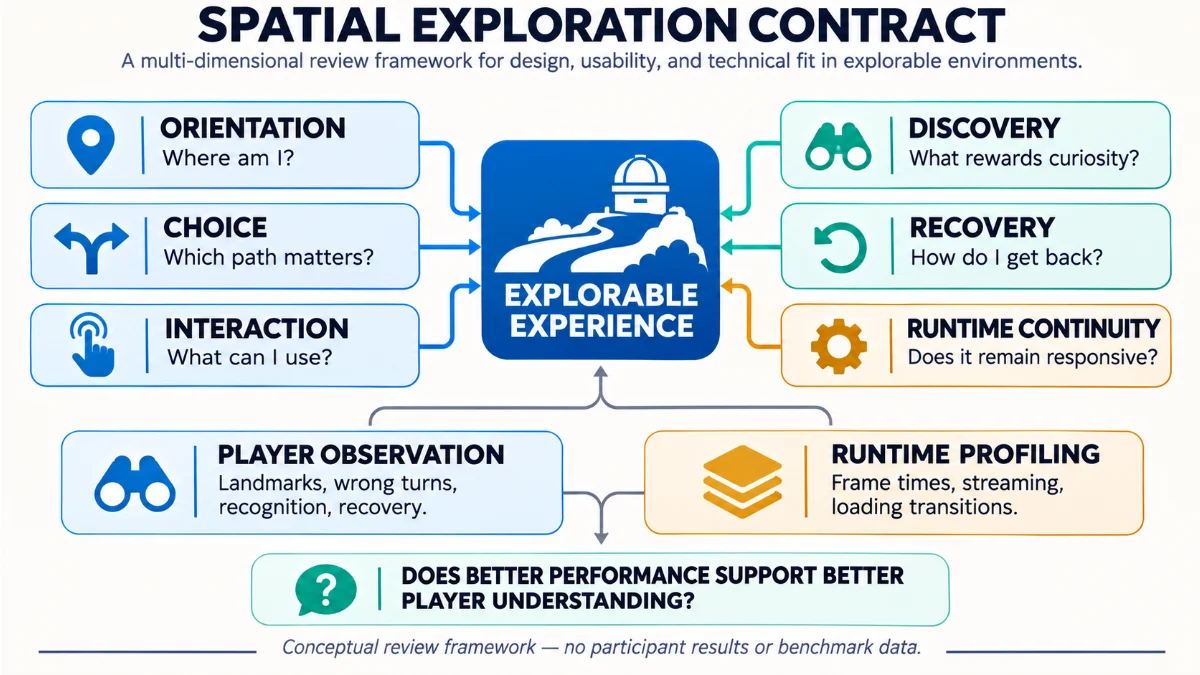
What a Small Evaluation Can and Cannot Establish
A limited formative study may reveal severe navigation problems and useful hypotheses, but it cannot automatically establish population-wide success rates or prove that one art style is universally easier to navigate. Results depend on prior game experience, visual capabilities, control familiarity, display characteristics, the assigned goal, and the environment being tested. I would report participants and conditions only after a real study had occurred. Until then, this remains a research design rather than a “From the Lab” result.
Likewise, a frame-time trace demonstrates behavior for a defined workload and configuration, not all hardware and every possible player action. Changes in target device, quality settings, engine version, or streaming strategy may alter the outcome. Good evidence should make those boundaries visible. This is more valuable than claiming an optimized level based on one convenient screenshot of an FPS counter.
A Production Sequence That Protects Both Exploration and Quality
My 3D environment design process would start with a spatial brief: what the player wants, which paths should be possible, which landmarks matter, where optional discovery adds value, and which failures must be recoverable. A graybox or blockout can test those relationships before final materials introduce visual noise. This prevents expensive environment art from becoming a substitute for spatial design. The blockout should also include approximate sightline volumes, likely streaming boundaries, and the interactive states needed for the critical route.
Once the spatial structure is intelligible, the art pass should strengthen the already defined hierarchy. Lighting can emphasize transitions, materials can distinguish functional zones, props can convey history, and sound can reinforce location and state. At each pass, review whether decorative detail makes the intended path clearer or merely makes the image denser. A route map, a first-person video, and a playable build reveal different kinds of problems; none should be treated as the whole truth on its own.
Treat Late Visual Changes as Interaction Changes
During 3D environment design, moving a large structure, changing fog density, replacing a landmark mesh, or modifying collision can affect navigation even when the change is categorized as visual polish. Similarly, a new particle effect may create a frame-time spike at a mandatory decision point. I would link these changes to the route and cue records rather than reviewing them only as asset diffs. This is especially important when multiple specialists work on layout, art, lighting, audio, and optimization.
For a small team or a solo project, the same discipline can be lightweight. A short decision record can state the intended player effect, current evidence, possible alternative explanation, and the test that will verify the change. The goal is not bureaucracy; it is avoiding a late revision that improves a portfolio screenshot while quietly degrading the actual experience.
Trade-Offs: When Less Guidance or More Detail Is Defensible
It would be too simple to argue that every successful environment must maximize route clarity. Survival horror may deliberately use limited visibility and uncertain routes. An open-world exploration experience may reward players for constructing their own map. An architectural installation may favor atmosphere over explicit objectives. In those settings, uncertainty can be an important design material. My criterion is whether the uncertainty serves a stated experience and whether players have a fair opportunity to understand and respond to it.
High visual fidelity can also be the primary purpose of a scene, especially in visualization, cinematic experiences, and art demonstrations. That is valid when the experience is honestly framed as a visual presentation. The claim changes when a scene is marketed as interactively explorable. Once player agency is part of the promise, camera behavior, environmental legibility, feedback, and runtime stability become core quality dimensions rather than optional extras.
Finally, optimization involves trade-offs. Occlusion techniques consume processing or memory; more streaming boundaries can introduce hitches; aggressive LOD transitions can harm landmark continuity; reduced effects can weaken atmosphere. There is no universal setting that resolves these constraints. The appropriate choice depends on measured bottlenecks, target hardware, creative intent, and the routes players actually take.
The Questions I Would Ask Before Shipping an Explorable Scene
Before approving a 3D environment design for an explorable scene, I would ask the team to demonstrate a complete task from a first-person camera on the target device. Can the player identify their location, locate at least one meaningful path, interpret a required interaction, understand its consequence, investigate an optional route, and return without designer intervention? If not, which precise cue or system boundary failed? The answer should name an observable behavior, not simply say that the level needs more polish.
I would then review the same route under technical constraints. Are the essential landmarks resident before they are needed? Do loading transitions occur outside critical decision moments? Does the target build retain consistent response during camera turns, object activation, and return traversal? Are accessibility options and objective reminders available where the design requires them? Those questions connect creative direction, UX research, engineering, and production decisions without collapsing them into one subjective aesthetic verdict.
For related thinking about visual systems, I have written about adapting a visual language across formats. That article concerns consistency across media; the argument here is more specific to spatial meaning and player behavior. You can also browse the Digital Creation Articles collection for other work on creative systems.
Conclusion: The Best View Is Not Always the Best Experience
I would rather ship a visually coherent environment that allows players to notice, choose, act, discover, and recover than an elaborate scene that succeeds only from the camera angle selected for its promotional image. This does not make aesthetics secondary. It gives aesthetic decisions a stronger purpose: their details should deepen the world while supporting the player’s ability to understand and interact with it.
For me, the most useful measure of 3D environment design is not the quantity of detail or a single frame-rate average. It is whether the space fulfills its intended exploratory promise on the hardware and under the conditions for which it was designed. The Spatial Exploration Contract makes that promise discussable and testable. Actual proof would still require a real build, observed player behavior, and reproducible technical evidence.
Frequently Asked Questions
What makes 3D environment design support exploration?
It gives players recognizable spatial references, meaningful choices, interpretable interactions, understandable state changes, and a way to recover from getting lost. The amount of guidance should match the genre and intended challenge. Real evaluation requires observing players navigating the actual scene rather than inferring usability from screenshots.
Should every explorable scene use a minimap or waypoints?
No. Some experiences benefit from learning landmarks without persistent markers. However, the ability to review objectives, request hints, or recover orientation can help players who need additional support. The design question is which forms of assistance are appropriate, optional, and available when needed.
Do LOD and occlusion culling always improve performance?
No. These tools have setup, CPU, memory, quality, or streaming trade-offs. Their effectiveness depends on scene geometry, rendering pipeline, target hardware, and the actual bottleneck. Profile before and after, and check that important visual cues remain recognizable when detail changes.
How is environmental storytelling different from navigation design?
Environmental storytelling communicates context and narrative through the world. Navigation design helps players understand where they are, what they can attempt, and where actions may lead. Both can use the same visual or auditory cues, but narrative detail should not accidentally obscure essential paths or interactions.
What should a small studio test before polishing an environment?
Test a blockout with one representative task, a branching route, a recoverable mistake, and a few functional interactions. Record what players notice and misunderstand, and profile frame time along the same route on a defined target build. These formative checks help determine which expensive artistic decisions are worth pursuing.
Follow My Work
I share work and technical perspectives across LinkedIn, X, Threads, GitHub, and Behance. These channels cover different aspects of software, product thinking, UX, and digital creation.