


Security Hardening Without Breaking Site Operations

AI Coding Speed vs. Engineering Quality: Where Work Moves

Decision Brief: The Best AI Feature May Be the One You Do Not Build
A product team can assemble a persuasive AI feature demo in an afternoon and still have no credible explanation for why that AI feature belongs in the product. The AI feature demo may generate fluent answers, classify a few examples correctly, or move through a workflow without a visible error. None of those observations establishes that users need the behavior, that another method would perform worse, or that the business can support the consequences of a wrong result. When I evaluate an AI feature, I begin with the product decision, not the model.
The practical question is narrower than whether AI is powerful. What task is the user trying to complete? Which parts of the task demand interpretation, and which parts require exact rules? What failure can the user recognize and correct? If a deterministic alternative already gives a dependable answer with low latency and limited data exposure, the burden of evidence belongs to the proposed AI feature. Conversely, dismissing AI because it is probabilistic can forfeit genuine value in language, accessibility, discovery, or information-synthesis tasks. Both defaults can be expensive.
My recommendation is a comparative decision record. Put the existing process, a simpler software baseline, and an appropriately bounded AI feature next to one another. Evaluate the same representative tasks, the same constraints, and the same user outcomes. Require independently checked evidence before a broader release. The option that wins a demonstration is not automatically the option authorized for production.
Decision: Start with the least complex solution that satisfies the user’s actual need, while remaining willing to adopt AI when it demonstrates additional value under acceptable risk. Boundary: This is a proposed product assessment method, not a validated scoring instrument, completed experiment, or substitute for legal and domain review.
The Fundamental Mistake: Solving for Technology Before the User
A feature request is not a user problem
“Add an AI feature” is an implementation request. “Help me understand why my invoice changed” is a user problem. The first selects a technology before the team has defined what the AI feature must accomplish. The second leaves room for clearer billing data, search, rules-driven explanations, human support, or an AI feature that synthesizes unfamiliar cases. That distinction determines what evidence could justify the investment.
Suppose users routinely ask why a scheduled payment failed. They may need one reliable error explanation and the next permitted action. A mapping from verified status codes to accessible guidance can outperform an unconstrained language model because the data and actions are defined. If users instead need to compare several changing unstructured policy documents, language assistance could improve comprehension. These are different jobs despite both being called “support.” An AI feature hypothesis belongs to the second job only if a fair comparison demonstrates its incremental value.
The Google People + AI Guidebook begins with user needs and asks whether AI has a unique strength for the problem. I apply that challenge to each proposed AI feature. If the product specification cannot state what the AI approach uniquely enables or materially simplifies, novelty does not count as sufficient value.
Define a user outcome before choosing a model
A credible requirement describes the task, environment, expected result, and consequence of failure. “Generate a good response” is not yet an outcome. “Help an account holder identify the verified reason for a rejected payment without revealing unnecessary personal data” is testable, although meaningful acceptance criteria still depend on research and risk tolerance.
A conversational interface can be excellent for exploratory questions, yet unnecessary when a user knows which setting to change. In an AI feature assessment, the question is whether conversation reduces real task difficulty for the population the product serves. The interface is a means, not the deliverable. An AI feature should be selected according to the task, not the popularity of the chat metaphor.
Ask what the user must be able to trust
Trust depends on consequence. A rough draft may tolerate occasional awkward wording because a user edits it. An eligibility answer affecting money or access requires stronger verification. If the system proposes copy for review, its authority is fundamentally different from a system that publishes the same copy automatically. I would record that distinction before granting a model the ability to act.
The Baseline Ladder: Four Solutions for One Job
Baseline zero: the current workflow
The first comparator is often missing from an AI feature proposal: what happens if the team builds nothing? That baseline may include a manual process, an existing support channel, or a search interface. It may be flawed; it is simply the reference against which improvement is tested. Comparing two AI models without comparing the existing experience cannot establish incremental product value.
A baseline should include user frustration, accessibility, support workload, and the consequences of delay. If a manual step is a serious barrier, automation may help even when it is not cheaper. If the existing workflow is straightforward, an AI feature could make it harder by introducing another unpredictable route.
Baseline one: deterministic software
Deterministic software uses specified rules, validation, calculations, templates, and application state. It is not automatically correct; rules can be incomplete and source data can be wrong. But its behavior is generally easier to reproduce and inspect under a fixed specification. I prefer this route for authoritative eligibility rules, arithmetic, explicit permissions, structured filters, and tasks with exact acceptance criteria.
For example, a discount entitlement should normally be enforced by the application, not inferred from fluent prose. A model could explain the policy in ordinary language, but the deterministic layer retains the binding decision. This creates an attractive AI feature hybrid: an AI feature augments understanding without obtaining the right to change the underlying rule.
Baseline two: traditional ML or a specialized model
Not every task that benefits from AI requires a generative model. Classification, forecasting, and anomaly detection may suit traditional statistical methods or specialized models. Google’s guidance on generative versus traditional AI describes different strengths for these categories and emphasizes selection based on the task.
A classifier is not automatically safe or fair. It requires representative validation, monitoring, and a clear definition of error. Still, for a structured prediction with a fixed set of outputs, an open-ended generator can introduce unnecessary behavioral complexity. The objective is appropriate fit, not loyalty to a particular technology. An AI feature proposal must explain why a fixed-output classifier cannot meet the same need.
Baseline three: bounded generative AI
Generative AI earns its place when varied language, synthesis across unstructured sources, drafting, or ambiguity handling creates distinct user value. The model’s capability may justify its added review and operating burden. The word bounded matters: permitted data, source scope, output type, tool access, and execution authority should be specified independently of the model’s preferences.
A system that drafts an explanation using verified records differs from an AI feature that can alter those records. A useful AI feature may occupy one step inside a deterministic workflow rather than replacing the whole workflow. Design should preserve the difference between a recommendation and an authorized action. An AI feature that crosses that boundary needs explicit controls.
| Solution lane | Strong candidate task | Required evidence | Failure to test |
|---|---|---|---|
| Existing or manual route | Rare, nuanced exceptions | Current task success and burden | Delay, inconsistency, inaccessible support |
| Deterministic logic | Exact rules, permissions, calculations | Verified requirements and regression tests | Missing cases, stale rules, incorrect inputs |
| Traditional ML | Defined classification or forecasting | Relevant labeled data and monitoring | Drift, unfair errors, data gaps |
| Bounded generative AI | Language variation and synthesis | Task evaluation and human review | Unsupported claims, leakage, unsafe actions |
This is a decision aid, not a ranking. An intentional hybrid can outperform both a fully manual process and an unnecessarily autonomous system.
User Value Must Survive an Honest Comparison
Measure task completion rather than demo applause
I would begin by naming the user behaviors expected to improve. Can the person understand the result, perform the next legitimate step, recover from mistakes, and finish without avoidable assistance? An AI feature demonstration often measures output quality from the creator’s perspective. The actual product outcome may be quite different.
Compare alternatives under equivalent conditions. If the model sees handpicked examples while the existing interface faces messy real inputs, the experiment is biased. Both options need realistic ambiguity, missing data, interruptions, accessibility constraints, and difficult edge cases. The review should state precisely which conditions were included and what remains untested.
Perceived usefulness is not the same as proven improvement
A participant can say that generated advice feels clearer even when it contains an incorrect step. That reaction is useful feedback, but not evidence of safe task completion. Conversely, an AI feature may be technically accurate and still impose a verification burden users cannot reasonably carry. I treat understanding, task outcome, error recognition, and confidence calibration as separate observations.
Delight and convenience matter. The problem appears when a pleasant interface shifts hidden work from the provider to the user. If the customer must double-check every important suggestion, the supposed productivity gain may disappear. The evaluation should count that human work instead of calling it free oversight.
Test a plausible simpler redesign
If the existing process requires ten navigation steps, a redesigned form may be the appropriate comparator, not a new chatbot. If the biggest issue is poor source data, fixing retrieval and documentation might deliver most of the value. If users repeat the same questions, curated guidance could be more predictable. An AI feature should not compensate indefinitely for a broken information architecture without first testing a smaller repair.
Model Uncertainty Becomes a Product Responsibility
Fluent language can conceal missing evidence
A model can generate a coherent answer that is incomplete or unsupported. In creative drafting, the user might notice and edit it. In policy, finance, or access-related guidance, a plausible error can change behavior. The NIST Generative AI Profile identifies risks relevant to these contexts, including confabulation and privacy; it does not give a universal failure rate for every product.
An AI feature specification should distinguish tolerable errors, errors requiring qualification, questions that should trigger abstention, and actions that cannot be delegated. “The model is mostly right” is not sufficient where the rare wrong answer has a severe consequence. Frequency, severity, detectability, and reversibility matter together.
Repeat representative cases instead of trusting one run
One successful answer proves that a particular acceptable answer was possible under those conditions. It does not establish reliability across different phrasing, users, context documents, or model versions. The AWS evaluation guidance explains why variable model behavior requires a repeatable evaluation loop.
Capture the input class, source version, prompt and model configuration, adjudication method, and failure type for relevant tests. An automated evaluator can assist triage, but when outcomes matter, an appropriate independent reviewer must still examine the evidence. A model confidently scoring its own answer is not equivalent to independent validation.
Abstention is a valid product behavior
A useful AI feature can say, “The available information does not support that conclusion.” It may ask a narrow follow-up, show the verified record, or route the user to human support. The product should design that pathway deliberately. Forcing a conversational answer in every situation confuses fluid interaction with useful assistance.
The interface should also distinguish retrieved evidence from an interpretation, a recommendation from a decision, and a drafted action from an executed one. Users deserve a reliable mental model of what the product has and has not done.
Latency, Cost, and the Invisible Work Around the Model
Measure the whole task, not tokens per second
Workflow integration matters as much as model selection. A production AI feature can require authentication, retrieval, filtering, inference, citation checks, tool execution, human approval, and a state update. Streaming a partial response may improve perceived responsiveness without completing the user’s job. A responsive system should communicate when information is provisional rather than displaying a draft as the final outcome.
AWS’s production architecture guidance treats latency, caching, model sizing, and cost modeling as interconnected design concerns. It does not establish any specific model performance for this article. Inference latency and network overhead should be measured against the user’s full task, not only a token stream. The appropriate requirement should be derived from the actual user context, including slower devices and accessibility needs.
Cost per verified successful task
An API charge can be a small fraction of the true cost. A credible total cost of ownership model includes internal labor and ongoing obligations. Include retrieval and storage, telemetry, evaluation, support, corrections, moderation, model upgrades, incident response, and the time employees or customers spend checking answers. The appropriate denominator is useful tasks completed under agreed quality and safety conditions, not generated messages. An AI feature that causes extensive rework should not claim success solely because it returned an answer.
One conceptual measure is total incremental operating cost divided by independently verified successful tasks during a defined window. The numerator and denominator need explicit definitions, and the resulting value cannot replace judgments about accessibility, societal impacts, or severe harms. This is a design metric, not a universal formula for authorizing AI.
The model becomes a managed dependency
Even a fully hosted AI feature creates obligations around version changes, availability, rate limits, fallback, retention, and regression testing. A vendor may change model behavior while the product’s expected output remains stable. Without a change control process, the team relies on a component that evolves outside its own release schedule.
Fallback design must be part of the initial release plan. If the model becomes unavailable, can the customer continue through a simpler flow? Can a draft remain visibly incomplete? Can the application stop without changing account state? A convincing proof of concept is unfinished until the product can answer those questions.
Privacy, Security, and Action Boundaries
Minimize data before selecting the model architecture
A proposed AI feature may require private customer information, internal knowledge, or records containing third-party data. Before choosing a vendor or deployment model, I would ask what information is genuinely necessary. Can the same task be performed with structured fields, local processing, redaction, aggregation, or a deterministic answer? A strong data minimization decision can make an otherwise promising feature unnecessary, or it can define a safer scope.
The NIST AI RMF describes privacy as part of system-level risk assessment, not merely a policy footer. A consent box does not solve unjustified collection or indefinite retention. The privacy risk should be documented with the exact data flows and retention conditions. The implementation needs enforceable data boundaries, access checks, deletion paths, and a clear explanation of where sensitive inputs travel.
Source text is not an instruction authority
When a model reads customer messages, retrieved pages, or documents, that material may contain instructions aimed at the model. The OWASP Top 10 for LLM Applications identifies prompt injection and sensitive-information disclosure among the relevant risks. A product needs architecture that treats retrieved text as untrusted data rather than as a command channel.
This issue matters even when the AI feature appears read-only. An unsafe response can still expose private information, recommend a harmful operation, or create a misleading summary. Input and output controls should operate outside the model where possible, with tests that include adversarial and accidental failure cases.
A suggestion must not grant permission to act
The OWASP Excessive Agency guidance distinguishes the risks of excessive functionality, permissions, and autonomy. I would use that distinction to limit an AI feature to the smallest necessary tools, scopes, and actions. A model capable of drafting a refund explanation should not automatically inherit refund authorization.
For consequential changes, the trusted application layer should validate the user’s identity, permissions, business rules, and explicit confirmation. Those checks should not depend on the wording of a model’s recommendation. High-impact actions need a defined human or policy authority, not an inference that a confident response implies consent.
Three Worked Scenarios: Different Tasks, Different Decisions
Scenario A: account eligibility with explicit rules
Imagine a subscription product in which customers want to know whether an account qualifies for a particular benefit. The conditions are contractual and the required attributes already exist in structured data. This is a hypothetical example, not a report from a measured product. The primary job is to apply an exact rule consistently, explain the result, and offer an appeal route when the records are wrong.
I would start with a deterministic entitlement service and a clear explanation. It can expose the source policy, the evaluated fields, and the permitted next step. An AI feature might be tested later to translate dense policy language into an easier summary, with every important assertion linked to the authoritative rule. The model must never be the source of entitlement, because that would move binding authority into a probabilistic output without a product requirement to justify it.
An honest assessment would test stale records, contradictory inputs, accessibility, and error messages before celebrating fewer clicks. A clear rule engine can still fail if its input data is unreliable. The important lesson is that an AI feature should not be credited with solving a problem that proper data governance could solve more directly.
Scenario B: understanding unfamiliar, unstructured material
Now consider an internal knowledge product where users must combine several lengthy, permitted source documents to understand how a procedure has changed. The documents are written differently, updated at different times, and contain explicit exceptions. A fixed FAQ may cover routine questions but struggle with unfamiliar combinations. A bounded AI feature that retrieves approved documents and proposes a cited synthesis may create genuine value.
I would still test it against ordinary search, structured document navigation, and an improved knowledge taxonomy. The important evidence would be whether users find the right source, identify exceptions, and make fewer unsupported conclusions. Citations should be inspectable and tied to exact relevant text. If the system cannot substantiate a claim, it should say so instead of smoothing over the gap.
The architecture should treat the documents as untrusted content, prevent tools from exceeding read-only permissions, and separate summarization from policy approval. Here an AI feature may justify a limited pilot because the complexity is linguistic and the user remains able to inspect source evidence. That does not authorize it to issue a final legal or compliance ruling.
Scenario C: automated restriction of a customer account
Imagine an operations group proposing a model that identifies suspicious activity and automatically freezes customer access. This is another hypothetical example. The possible value is faster response to misuse. But the potential negative impact includes lost access, mistaken accusations, support escalation, and unequal error distribution across groups. A polished model demonstration cannot settle those trade-offs.
I would investigate whether a transparent rule-based trigger, supervised review queue, or specialized risk model can identify cases for human evaluation without finalizing the restriction. The team would need a legitimate basis for the data, an appeal route, a defensible evidence process, and authority over the final action. If those conditions are missing, the appropriate decision may be hold, even if an AI feature seems technically capable.
| Hypothetical user job | Simpler baseline | Potential AI contribution | Product decision to investigate |
|---|---|---|---|
| Apply known benefit rules | Rules engine and clear explanation | Plain-language explanation only | Prefer deterministic authority |
| Synthesize unfamiliar source documents | Better search and navigation | Cited drafting under review | Pilot bounded assistance if evidence supports value |
| Flag suspicious account activity | Explicit triggers and review queue | Support case prioritization | Hold automated restriction pending governance and testing |
These are illustrations of how a decision can differ across use cases. They contain no customer measurements, benchmark claims, or accounts of real deployments.
The Value–Baseline–Risk–Authority Decision Map
Seven non-interchangeable domains
I use a seven-domain Value–Baseline–Risk–Authority Decision Map to make an AI feature proposal auditable. The domains deliberately resist a single numeric score. A strong demonstration does not cancel a privacy violation. Low cost does not compensate for absent authorization. An impressive user reaction cannot establish that severe failures are acceptable.
| Domain | Question to answer | Evidence or artifact | Decision boundary |
|---|---|---|---|
| USER VALUE | What task improves, and for whom? | Task outcomes and observed user burden | No implementation before a defined problem |
| SIMPLE BASELINE | What simpler route was fairly compared? | Existing flow, rules, search, or specialized method | No “AI advantage” without a comparator |
| EVIDENCE | How does performance vary across realistic cases? | Reviewed examples, negatives, repeats, limitations | Demo success is not general validity |
| RISK | What harms, privacy exposures, and failure costs exist? | Impact analysis, data map, threat model | Material risks require mitigation or hold |
| OPERATIONS | Can latency, cost, support, and fallback be sustained? | End-to-end service and cost plan | No release based only on token pricing |
| AUTHORITY | Who can approve action or accept residual risk? | Role permissions, policy boundaries, approval record | Model output never grants its own authority |
| REVIEW | What evidence would reverse the decision? | Evaluation triggers, rollback and appeal routes | Decision remains revisable |
The first domain defines what counts as value. The second provides a real counterfactual. Evidence and risk constrain claims about the proposed AI feature. Operations identifies the obligations created after launch. Authority states who can make a consequential choice. Review makes every decision provisional in light of new facts. These functions inform one another but do not collapse into a formula.
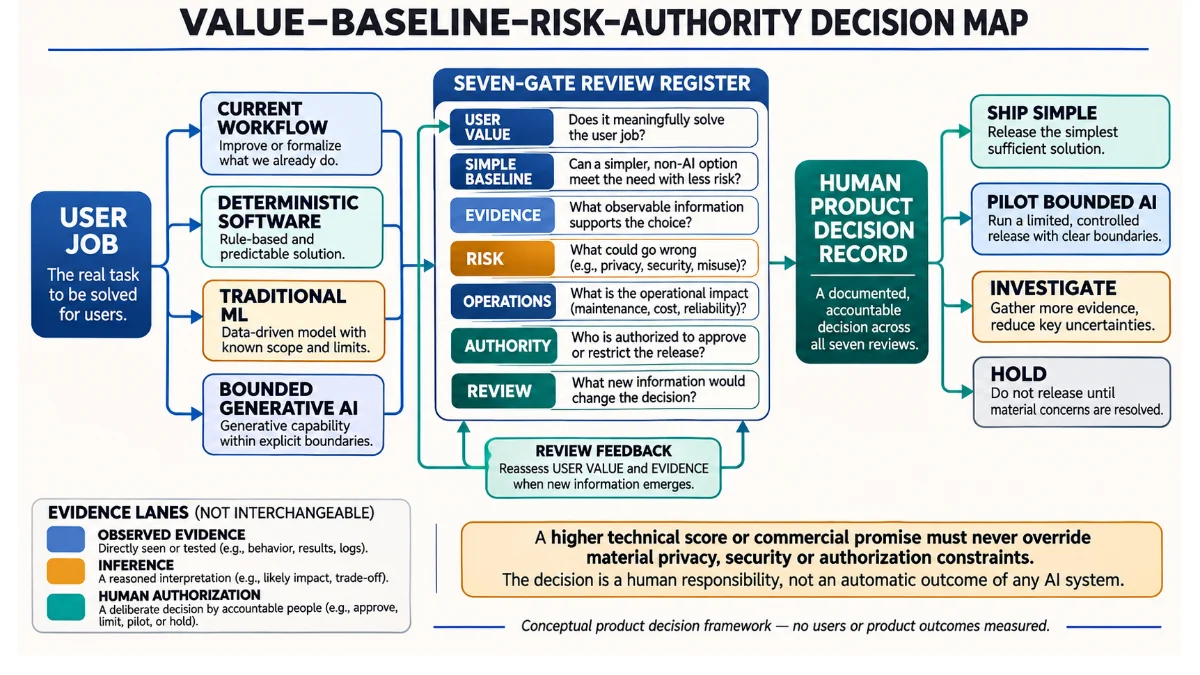
The decision map is designed for cross-functional use. Product leadership can articulate customer and business value. Engineering can inspect architecture and reliability. Security and privacy specialists can identify boundaries. Design and research can verify whether the experience is intelligible. The final accountable owner should be named rather than assumed. That is a governance proposal, not a claim that every organization must use one identical hierarchy.
Four dispositions, not a grade
The decision map leads to SHIP SIMPLE, PILOT BOUNDED AI, INVESTIGATE, or HOLD. Ship simple when a low-complexity alternative meets the need. Pilot bounded AI when comparative evidence supports incremental value and controllable risk. Investigate when the uncertainty is material but answerable through further research. Hold when necessary conditions for lawful, safe, or authorized operation are absent.
These are context-sensitive decisions rather than rankings of engineering ambition. A team can return from a pilot to a deterministic implementation after discovering that maintenance cost exceeds user benefit. That is not a failed innovation program; it is a corrected product decision.
A useful decision record is short enough to revisit
A practical record includes the user job, candidates considered, evidence scope, known counterevidence, privacy and security constraints, allowed actions, responsible owner, release conditions, fallback, and next review trigger. Attach source artifacts rather than embedding unverified statistics in the summary. The record should be readable during an incident, not only during a funding presentation.
Designing an Evaluation That Could Change Your Mind
Establish a shared test set before tuning the prototype
I would define the evaluation dataset, then assemble representative tasks and failure cases before selecting the winning architecture. Include routine requests, ambiguous phrasing, incomplete context, uncommon user segments, and requests the system should refuse. Protect sensitive records and document the data’s origin. For a comparison involving an AI feature, both the AI feature path and the simpler baseline must answer the same task under compatible conditions.
Some outcomes can be checked against authoritative system state. Others require domain judgment or user observation. Keep those categories distinct. A factual answer can be correct but unusable; a fast interaction can be pleasant but incomplete. I would record the reviewer and criteria for each claim rather than describing a result as independently verified when it was self-rated.
Define failure classes and escalation rules
Error recovery deserves its own test cases. A useful taxonomy separates unsupported assertions, wrong retrieval, policy violations, unauthorized action attempts, privacy exposure, inaccessible interaction, and ordinary usability friction. Their consequences differ. A team can tolerate a draft requiring stylistic changes while prohibiting suggestions that falsely promise a financial entitlement.
For each failure class, specify who investigates, what gets logged safely, what triggers a release stop, and how affected users regain control. There is no universal acceptable error percentage for every AI feature. The evaluation threshold should be set using the actual consequence and the organization’s approved risk tolerance before testing begins, not after attractive results arrive.
Include the less interesting days
Performance evaluations need to account for peak traffic, missing upstream services, model timeouts, version changes, and staff availability. A demo assembled with a small curated dataset does not cover those conditions. I also want to know whether users are given a usable non-AI route when the model is offline. A feature that helps only when everything works has limited resilience.
| Evaluation dimension | Practical observation | Evidence boundary |
|---|---|---|
| User task outcome | Successful completion under defined conditions | Do not infer population-wide improvement from a small convenience sample |
| Answer support | Correct linkage to authoritative facts or sources | A citation-like string is not proof of source correctness |
| Harm and reversibility | Severity, detection, and recovery path | A high average quality cannot waive a severe failure |
| Total interaction time | End-to-end task completion including review | First visible token is not completed work |
| Data exposure | Required fields, permissions, retention, transfer | Policy text does not replace technical enforcement |
| Ongoing operation | Failure modes, fallback, support and maintenance | Prototype success does not establish production readiness |
An AI feature should be compared against these dimensions and the baseline, with observed data clearly separated from assumptions. If a domain remains unmeasured, the report should say not evaluated rather than silently implying a pass.
Ownership and the Right to Say No
Assign decision authority before the release meeting
Product leaders should own the value case; engineering owns implementation integrity; security, privacy, legal, and relevant domain experts may control non-negotiable boundaries. The exact distribution varies by organization. What matters is documenting who can authorize deployment, what constraints they cannot waive, and who is accountable when behavior changes. An AI feature without a named operating owner can become an orphaned dependency.
This connects to my decision rights analysis: a product manager cannot solve a structural authority gap by writing a more detailed feature specification. An AI capability often crosses product, security, data, and operations boundaries at once. The decision needs to acknowledge those dependencies early.
Do not confuse review theater with independent control
A confirmation dialog is not meaningful oversight if it hides the consequence or appears after an irreversible action. Effective human oversight must give the reviewer sufficient information, a genuine chance to reject, and authority that is enforced in code. For critical operations, the application should not treat “the model recommended it” as a valid authorization token.
When the model supports users with information, the interface should communicate source scope, uncertainty, and any actions already taken. My separate AI interface trust analysis examines that distinction from the user experience side. A feature with robust internal controls can still be unsafe when users cannot understand its limitations.
Establish review triggers after launch
The decision record should name the conditions requiring reevaluation: a change in model version, source quality, incident pattern, data permissions, response times, unit economics, or user task outcomes. An AI feature release is a controlled beginning of operational responsibility, not the end of evaluation. The NIST AI RMF Core organizes ongoing governance through Govern, Map, Measure, and Manage functions. I use its lifecycle perspective without claiming that my decision map is an official NIST certification method.
How I Would Run a Small, Responsible Pilot
Start where users retain the steering wheel
The strongest early candidate is often a narrow, reviewable task. For example, test a summary that cites approved documents rather than an AI feature agent that edits system records. Limit the pilot to suitable contexts, log only necessary information, and maintain the baseline workflow. The user’s choice to continue without the AI feature should remain available when that is practical.
Pilot success should be defined before the team sees the results. User comprehension, verified task completion, serious error incidence, total handling time, and recovery performance may be relevant. Not every metric needs to be a numeric target in an exploratory study; however, uncertainty and research limitations must be recorded explicitly.
Expand authority slower than capability
An AI feature may demonstrate high-quality summaries before anyone has established that it should execute actions. Treat those milestones separately. More accurate prose is not evidence that the system deserves write permissions. Every expanded tool scope requires its own threat model, permission review, and tests for accidental or malicious instructions.
Where possible, let the deterministic application validate proposed actions and enforce policy. The safer design often lets an AI feature suggest, while a separately controlled service checks whether the suggestion is allowed. That division is useful even if the team chooses a larger or more capable AI feature model later.
Be prepared to remove the model
A pilot can reveal that improved search or a clearer interface delivers most of the benefit. The team should be willing to remove the generative component or reduce it to optional assistance. Reversibility is an investment in sound product judgment, not evidence that the original idea was foolish.
A Few Questions I Ask Before Signing Off
I would not ask the product team to prove that AI can do the task. I would ask them to show why it is the best authorized way to meet the need. Who gets value, and what happens to people who do not? Can we reproduce the comparison with a simpler implementation? Which failures are visible to users? What data leaves the controlled boundary? Who approves an action? How does the product behave when the AI feature is unavailable? Which observation would make us withdraw the rollout?
Those questions are deliberately more demanding than a prototype presentation. They also give genuinely valuable AI opportunities a fair hearing. Instead of rejecting AI categorically, they establish the conditions in which the added complexity earns its place.
Frequently Asked Questions
Should every new product include an AI feature?
No. An AI feature should address a defined user need better than feasible alternatives under the relevant cost, reliability, privacy, and safety constraints. A traditional interface or rules-based system may be more appropriate for a task with exact requirements. Novelty alone is not user value.
When is deterministic software preferable to generative AI?
Prefer deterministic logic when the product needs precise arithmetic, fixed eligibility rules, explicit permissions, or other behavior with an authoritative specification. AI may still help explain the result without controlling the binding decision. Test the actual task rather than making a universal technology claim.
Can a traditional machine-learning model replace an LLM?
Sometimes. Defined classification, prediction, and anomaly detection may suit specialized or traditional ML methods. They also need representative data, error analysis, and monitoring. The right choice depends on the output required, available evidence, and the operational setting.
How should a team calculate the cost of an AI feature?
Count more than model usage: retrieval, hosting, monitoring, evaluation, integration, support, corrections, incidents, and maintenance matter. Relate total incremental cost to verified successful user tasks where practical. Treat the result as one input to a broader product decision, not a universal approval formula.
Does human review make an AI feature safe?
Not automatically. Review must be informed, genuinely capable of rejection, and supported by application-level permissions. A confirmation button cannot compensate for hidden consequences, bad evidence, or irreversible behavior. Test the reviewer’s ability to recognize and correct failures.
What if the model gives different answers to the same question?
Investigate whether variation is acceptable for the task and evaluate repeated runs across relevant inputs. A brainstorming feature can permit broad variation; a policy explanation may require strict grounding and abstention. Version, source, and evaluation records should be retained under the organization’s data policy.
When should an AI pilot be stopped?
Stop or hold when material risks cannot be controlled, the necessary authority is missing, privacy conditions are unmet, or the evidence does not support the claimed benefit. Some uncertainty can justify more research. It should not be disguised as a successful launch decision.
Can a hybrid approach be better than either extreme?
Yes. A model can draft or interpret while rules-based services validate identity, access, data constraints, and transactions. Hybrid design can preserve useful language flexibility without giving the model unbounded authority. It still requires evaluation of both the components and their interaction.
Evidence, Methodology, and Limits
This article is an analytical product-design framework grounded in public primary guidance. No customer participants were recruited; no production model, vendor, account, or AI feature was benchmarked; and the three scenarios are hypothetical. The decision map is a proposed method, not a formally validated scoring system, official NIST implementation, or claim of regulatory compliance. The suggestions need adaptation to each product’s context and lawful obligations.
The distinction matters because even a thoughtful product review can turn into false certainty. I can recommend questions, comparison lanes, and proof requirements without claiming outcomes that have not been measured. The strongest practical contribution is a decision process that makes unsupported assumptions visible.
Selected primary sources
- NIST AI RMF 1.0 Core: Govern, Map, Measure, Manage — risk management functions and decision context.
- NIST Generative AI Profile — contextual generative AI risks and governance considerations.
- Google People + AI Guidebook: User Needs — identifying needs and unique AI value.
- Google Cloud: Generative AI or Traditional AI — task-based model selection and alternatives.
- AWS: Preproduction Architecture for Generative AI — latency, operating costs, and production planning.
- AWS: Evaluation Loops for Generative AI — repeated, versioned evaluation.
- OWASP Top 10 for LLM Applications — prompt injection, disclosure, and other security risks.
- OWASP LLM06: Excessive Agency — limiting functionality, permissions, and autonomy.
If You Only Read One Thing
Do not ask whether a model can perform the task. Ask whether an AI feature produces more verified user value than the simplest credible alternative, under the privacy, latency, cost, safety, accessibility, and authorization conditions the product must satisfy. Require a clear owner and a reversible release decision. If those conditions are not established, the appropriate answer is not always “build faster.” Sometimes it is “ship the simpler solution,” “test a narrower version,” or “do not ship yet.”
Author’s Note
I approach AI through product strategy, treating it as a product capability that should earn its place through evidence and responsible boundaries. My preferred design is not invariably the least sophisticated one. It is the one whose value, limitations, authority, and ongoing obligations I can explain to users and the people who must operate the product.