


Content Repurposing: One Thesis Across Three Platforms

AI Feature or Simpler Software? A Value-and-Risk Test

If You Only Read One Thing
Security hardening is successful only when protective controls address a defined threat without silently destroying the legitimate behavior those controls were meant to protect. Blocking an attack path while breaking authentication, content publishing, form delivery, customer access, or recovery is not an acceptable trade that can be hidden behind a green security status. I treat protection and operational continuity as two sets of requirements that must be tested together.
A stricter setting is not automatically a safer system. A protective rule may be effective against one malicious pattern and still misclassify a valid request. A new cache policy may reduce load and accidentally expose information across sessions. A restriction on an administrative endpoint may block unauthorized requests but also interrupt an approved integration. The consequences depend on the actual product, its dependencies, and the route through which a user performs a task.
This article provides a practical security hardening method for people responsible for operating a production website or web application. It is an architectural analysis, not a report of a penetration test or a claim that a particular production environment achieved a measured reduction in risk. Where I use examples, they are explicitly hypothetical and should be replaced by the operator’s own evidence.
The Mistake: Treating More Blocks as Better Security
A dashboard can show that many requests were rejected. That count does not tell an operator whether the blocked traffic was malicious, whether a real customer was prevented from completing a form, or whether a privileged workflow was interrupted. Security hardening needs a threat hypothesis, not a celebration of blocked requests. A policy that creates excessive false positives can erode both availability and the team’s willingness to retain the protection.
The OWASP Core Rule Set documentation describes the practical problem directly: generic detection rules lack knowledge of a specific application’s behavior. It recommends targeted tuning rather than casually modifying shared rule files. That is a useful operating principle even when the product uses a different rule engine: explain what was blocked, determine why, and narrowly correct the misclassification without weakening unrelated protections. See the CRS guidance on false positives and tuning.
I would not evaluate a security hardening change by asking only whether an attack-shaped request is denied. I would also ask whether the ordinary version of the same workflow still succeeds, whether a suspicious but ambiguous request produces a reviewable event, and whether recovery remains available if a configuration error is introduced.
Define the Protected Product Before Defining the Protection
Before choosing a firewall condition, rate limit, permission restriction, or cache rule, identify the transactions that justify keeping the application online. They may include reading public content, submitting a contact form, signing in, editing a protected record, processing a purchase, uploading an asset, receiving an integration callback, or performing a privileged recovery action. These are not equivalent in consequence or authorization requirements.
A useful security hardening inventory records the initiating actor, authentication state, endpoints involved, external dependencies, expected success condition, sensitive data involved, and the method for confirming success. The inventory must cover background jobs and server-to-server requests, not just what a human sees in a browser. Otherwise a change can pass a homepage smoke test while damaging scheduled processing or legitimate automated access.
| Workflow | Legitimate success condition | Security boundary | Failure signal |
|---|---|---|---|
| Public article | Readable response with correct access policy | Public route and caching | Incorrect denial, broken resources, or wrong cache behavior |
| Contact request | Valid submission reaches intended processing | Abuse prevention and input validation | Challenge loop, rejection, missing confirmation, or delivery failure |
| Authenticated edit | Authorized user saves and sees the right state | Authentication, session, role permission | Unexpected sign-out, denied save, stale or cross-user content |
| Service callback | Verified external event is processed once | Signature, origin, timing, and replay policy | Unexplained rejection, duplicate processing, or missed event |
| Administrative recovery | Approved operator regains control safely | Strong authorization and audit | No access path, unlogged exception, or uncontrolled bypass |
The table is a design template, not a statement that these workflows exist on every site. Security hardening should begin with a smaller, accurate inventory rather than a longer list of imaginary features.
Threat Models Must Include Operational Failure
For security hardening, a conventional threat model asks what an attacker can do, what assets matter, and where trust boundaries lie. I add an operational failure question: what ordinary activity might this protective control interrupt? For example, an overly broad restriction on an interface may reject malicious enumeration but also reject a legitimate integration. A security hardening decision becomes more precise when the control’s intended coverage and its operational failure mode are documented together.
I organize the analysis into four questions. What unauthorized behavior are we preventing? Where is the enforcement point: edge, application, identity service, or storage layer? How will a real allowed request be distinguished from an abusive request? What independent observation could reveal that the control failed in either direction? These questions prevent the phrase “defense in depth” from becoming an excuse for stacking unrelated controls with overlapping failure modes.
The OWASP Application Security Verification Standard 5.0 is useful as a structured reference for application security requirements. It does not, by itself, authorize a particular rule configuration for a particular production product. The operator still needs product context and evidence. Security hardening cannot be outsourced to a checklist without an accountable review of consequences.
Where Protective Layers Commonly Collide
Security hardening for a public web product may involve several independent enforcement layers: network controls, edge request filtering, application authorization, abuse prevention, session handling, caching, and hosting restrictions. Each layer can be useful. The interaction between them is where an apparently sensible security hardening change often causes trouble.
An edge system can block a request before the application has a chance to return a useful error; an application-level challenge can be cached inappropriately; a content-delivery layer can obscure whether the origin accepted the action. A failed response may therefore be caused by different systems depending on the route, session, and request properties. Diagnosing it requires an event trail rather than guessing which protection is responsible.
Identity, Authentication, and Session Continuity
In security hardening, authentication is not one request. It is a sequence of credential submission, verification, session creation, possible additional verification, navigation, timeouts, state transitions, and sign-out. A rule that allows the first screen can still disrupt a later step. During security hardening, test success and failure paths for each relevant role. An unauthorized actor must remain denied; an authorized actor must retain intended capabilities after the new control is applied.
Keep role permission checks in the application even when an upstream filter rejects suspicious requests. Request filtering is not a substitute for authorization. Test predictable denial behavior for invalid sessions and role violations, without exposing implementation detail or inadvertently granting elevated access after an exception.
Content Submission, Forms, and Uploads
A security hardening policy must accommodate the fact that real users submit punctuation, code samples, international text, embedded links, and uncommon field combinations. A generic detection rule may classify some legitimate inputs as hostile. Security hardening should retain validation in the application while also examining false positives in boundary rules. The test corpus should contain realistic, privacy-safe examples and deliberately invalid cases, not only one uncomplicated test sentence.
A successful browser animation is not proof that a message was delivered or stored correctly. Verify the downstream action using the relevant authorized logs, delivery confirmation, or application state. If a user challenge is involved, check keyboard access, error recovery, repeat attempts, and expected session behavior. Making a form unusable is an operational regression even if abuse attempts decline.
APIs, Automation, and Scheduled Processing
Security hardening must account for machine-to-machine clients, which often differ from browsers: they may not execute interactive challenges, may use signed requests, and may have stable retry behavior. A universal browser challenge can therefore disable a valid integration. Security hardening should apply mechanisms appropriate to each actor: strong credentials, request signatures where supported, scoped permissions, replay protection, clear rate limits, and auditable failures. Do not create a general exception for all automated traffic simply because a particular callback failed.
Test idempotency and retry paths. An integration that receives a temporary denial and repeats work might duplicate an action unless the application enforces the relevant invariant. A recovery runbook should identify which failures can be retried and which require review.
Caching and Personal Data
For security hardening, caching is a performance feature with security consequences. A cached public document and a response containing session-specific information must not be treated identically. Security hardening therefore includes verifying access boundaries and cache behavior after authorization changes, not only inspecting headers on the public homepage.
Test public and authenticated sessions separately. Verify that personalized information is never served to a different user, sensitive responses are handled appropriately, and cache invalidation does not create confusing stale states. A faster response with the wrong content is a failed product result regardless of the network latency improvement.
False Positives Are a Product Incident, Not a Reason to Disable Everything
When a valid request is rejected during security hardening, there is a strong temptation to disable the entire protective rule group. That may restore service and expand exposure at the same time. A better security hardening response identifies the precise rule, request field, path, method, and traffic context involved, then chooses the smallest justified change. The OWASP CRS tuning guide documents exclusion approaches with different scopes and consequences.
Narrow tuning can still introduce risk. Excluding a field from inspection because it regularly triggers a rule should happen only after understanding whether that field can carry an attack relevant to the application. A false positive is evidence of misclassification; it is not proof that the input is harmless in all contexts. Security hardening requires an operator to document both the restored workflow and the remaining attack coverage.
A disciplined investigation records a timestamp, a safe request identifier, the affected business action, the enforcement point, the rule or policy decision, and the outcome of an independent functional test. Avoid copying raw sensitive request bodies into tickets or public diagnostics. If the incident cannot be reproduced safely, record the uncertainty rather than announcing a definitive root cause.
Observe Security Events and User Outcomes Together
During security hardening, security logs and availability logs answer different questions. A denial log may establish that a control fired; an application event may establish that a task failed; a delivery or transaction record may establish whether the intended action completed. Security hardening becomes operationally responsible when those sources can be correlated without turning sensitive user information into unrestricted log data.
The OWASP Logging Cheat Sheet emphasizes application-specific security events, consistent event fields, protection of sensitive data, and verification that logging itself does not disrupt operations. I would build an intentionally small event vocabulary and attach an interaction identifier where feasible, with access restrictions and retention defined before collecting more detail.
| Observation | What it can support | What it cannot establish alone |
|---|---|---|
| Edge blocked request | A policy made a deny decision | That the request was malicious or that all attacks are stopped |
| Application authorization denial | A role or permission boundary rejected an action | That no bypass exists elsewhere |
| Successful form acknowledgment | The application accepted a stage of the request | That downstream delivery or processing completed |
| Completed workflow check | A specified user task worked in this test | That all user environments are unaffected |
| Restore exercise | A particular recovery procedure worked under test conditions | That future recovery will always succeed |
Do not collapse these observations into one invented security score. Security hardening needs separate decisions for effectiveness, user impact, and recoverability. An aggregate number could hide a catastrophic failure in one critical flow behind many successful low-risk checks.
The Protection–Continuity–Evidence–Recovery Contract
For security hardening, I use a conceptual contract to structure the final release decision. It is deliberately not a standard certification or a mathematical formula. Each domain has its own evidence requirement and an explicit human owner. The name is useful because it makes the trade-offs visible before a production configuration is changed.
| Review domain | Required question | Acceptable evidence example | Blocking uncertainty |
|---|---|---|---|
| THREAT | What specific abuse is addressed? | Threat scenario and affected boundary | No defined unwanted behavior |
| PROTECTION | Does the control enforce the intended boundary? | Approved negative tests and policy traces | Only dashboard block counts |
| CONTINUITY | Do legitimate critical tasks still work? | Role-based end-to-end test results | Untested forms, sessions, or integrations |
| OBSERVABILITY | Can failures be attributed safely? | Correlated, privacy-safe events | No usable attribution path |
| RECOVERY | Can the change be reversed without unsafe access? | Scoped rollback and restore rehearsal | No verified return path |
| AUTHORITY | Who can approve, pause, or stop release? | Recorded owner and decision | Conflicting or absent responsibility |
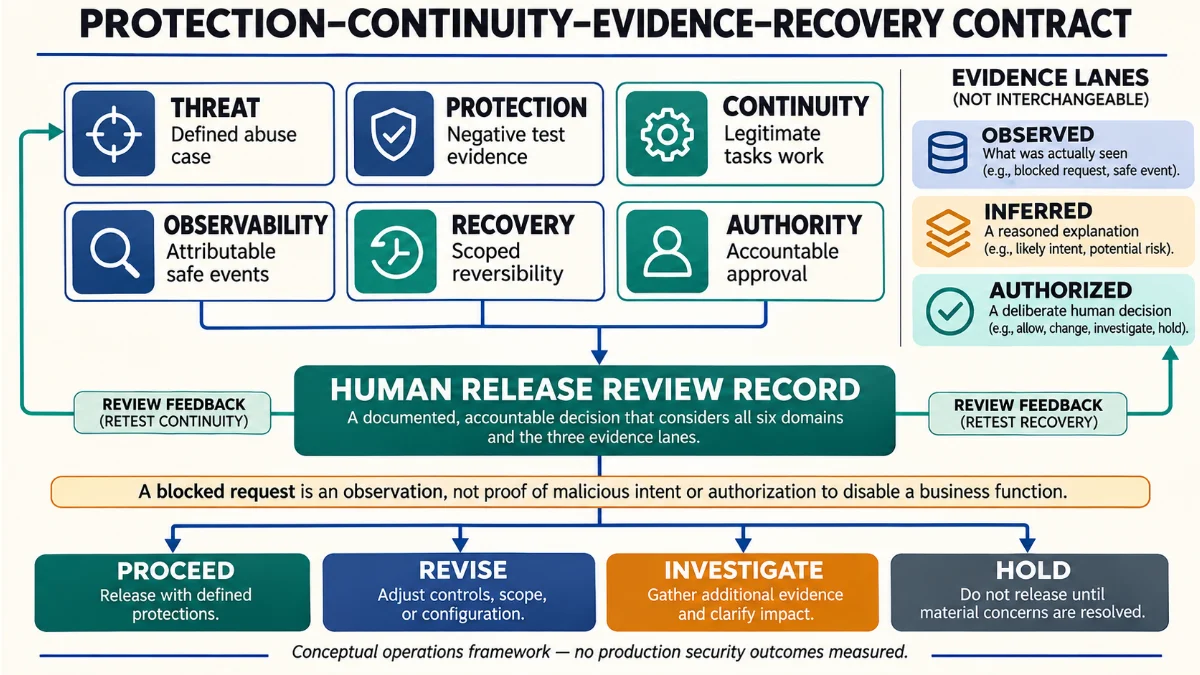
The important property of this security hardening contract is that a favorable result in PROTECTION does not cancel a failure in CONTINUITY or RECOVERY. It also separates the authority to propose a change from the authority to accept its consequences. A control can be technically sound and still be inappropriate for deployment until an integration or fallback path is ready.
There are four valid dispositions: PROCEED when required evidence is sufficient and constraints are met; REVISE when a smaller change would reduce disruption; INVESTIGATE when cause or coverage remains uncertain; and HOLD when the action would introduce unacceptable risk or no reliable recovery exists. These are qualitative decisions, not labels derived from fabricated scores.
Stage Changes as Releases, Not Emergency Configuration Clicks
Security hardening changes should be deployed with the same discipline as application changes. Google SRE’s canarying releases guidance describes partial, time-limited deployments and evaluation before broader rollout. Not every small website supports traffic-based canaries, but the governing idea still applies: constrain initial exposure, observe the intended signals, and preserve a way to revert.
For a smaller environment, security hardening can follow a sequence of inventory, baseline capture, staging validation when available, narrow initial enforcement, targeted smoke tests, monitoring, and documented completion. If the control cannot be staged, reduce the change’s scope and choose a period when a responsible operator can examine failures and restore service. The fact that a change is labeled “security” should not exempt it from release controls.
I would maintain a change record with the threat being addressed, original configuration, precise changed setting, approval, test cases, expected effect, rollback instructions, and post-change review outcome. Repeated manual changes without such a record produce a configuration history that no operator can confidently reconstruct after an incident.
Security hardening also intersects with engineering review. My related article Code Review: The Hidden Cost of AI-Generated Code examines why test evidence, ownership, and release readiness must remain visible even when an implementation is produced quickly. Here, I apply that accountability to security rules and production workflows.
A Functional Test Matrix That Includes Denials
Security hardening tests need both positive and negative cases. A legitimate logged-in user should be able to save the authorized resource. A user without the role should be denied that resource. The application should still handle invalid input safely and show useful error states. Tests must distinguish planned denials from the accidental loss of legitimate access.
| Test situation | Expected permitted outcome | Expected blocked outcome | Follow-up if unexpected |
|---|---|---|---|
| Public page and assets | Public content loads without inappropriate challenge | Restricted content remains private | Check routing and cache policy |
| Login and protected action | Authorized role completes full journey | Invalid session or role is rejected | Inspect session and access control logs |
| Form with realistic inputs | Valid submission reaches processing state | Abusive or invalid input is handled safely | Inspect exact policy match and downstream state |
| Integration callback | Signed, authorized event is processed as designed | Invalid signature or replay is rejected | Check validation, retry, and idempotency |
| Administrative recovery | Approved operator uses controlled recovery | Unapproved request is denied and recorded | Review emergency access governance |
| Search crawler access | Intended public content remains available | Private or disallowed content is not exposed | Compare HTTP response and indexing intent |
The test matrix is a proposed procedure, not the report of a completed test campaign. Each actual deployment needs its own timestamped results and environment details. Security hardening does not justify inventing a PASS label for a check that was never run.
Search Visibility Has a Security Boundary Too
Public pages need to remain discoverable during security hardening when that is the product’s intent. A restrictive edge rule that mistakenly rejects legitimate search crawler requests can create a reach problem unrelated to content quality. Google Search Central’s technical requirements explain the importance of crawler access and successful content responses. Security hardening must distinguish publicly intended resources from administrative or private resources.
Avoid a blanket allowance for any client that claims to be a crawler; user-agent text is not a sufficient identity check. Use supported verification methods and appropriate controls. Conversely, never expose a private interface simply because a crawler asks for it. Test the status codes, redirects, page availability, and access policy that the application is supposed to have.
A site can be secure enough to serve public information while remaining deliberately inaccessible for its protected operations. The important question is not whether every automated agent gets a successful response; it is whether legitimate access matches the product’s actual access policy.
Rollback Must Be a Safe Operation
In security hardening, a rollback plan that says “turn off security until the site works” is incomplete. It may restore functionality by removing safeguards unrelated to the immediate failure. Security hardening needs a scoped recovery path: identify the changed component, preserve the previous known-good configuration, reverse only the relevant change, retest the intended workflow, and verify that other controls remain active.
A fast rollback is not always safe. If the change responded to a known active exploitation path, reversing it could reopen a serious vulnerability. The right answer may be an alternative mitigation, a temporary restricted workflow, maintenance mode for a narrow function, or an incident response decision. This is precisely why security, product, and operational owners should agree on stop conditions before enforcement.
NIST’s SP 800-61 Revision 3 frames incident response within broader cybersecurity risk management, including preparation, detection, response, and recovery. I use that as a management reference rather than presenting this article as a substitute for incident response planning or a formal audit.
Three Hypothetical Decisions
Scenario A: A Protection Rule Blocks a Legitimate Contact Form
Assume a hypothetical contact form accepts detailed technical inquiries. After a new rule is introduced, submissions containing certain markup-like characters fail, while short plain-text messages still work. The dashboard reports blocked requests. That report does not prove the form is being attacked. The operator can reproduce the issue with privacy-safe test content, identify the enforcing condition, and verify whether a narrowly scoped adjustment restores the valid submission without permitting unsafe payloads.
My decision would be INVESTIGATE until the affected request and rule can be attributed. If a constrained exception restores the legitimate workflow while negative tests still pass, REVISE may be justified. Security hardening should not be accepted or abandoned on the basis of a single red or green dashboard counter.
Scenario B: An API Restriction Interrupts Scheduled Work
Assume a hypothetical content service has a signed server-to-server callback. A universal interactive challenge begins rejecting those calls. Disabling all automated filtering would be a broad response to a narrow problem. The better approach is to confirm the callback’s identity model, authorization boundary, and replay handling, then apply a policy appropriate to machine requests. If that cannot be established, the rollout should be held rather than silently allowing an unauthenticated route.
This example illustrates why security hardening must classify user journeys before policy changes. Human browser traffic and verified service integrations should not be forced through one interaction model merely because both use HTTP.
Scenario C: Stronger Restrictions Break the Emergency Recovery Route
Assume a hypothetical administrative restriction blocks the operator’s normal account after a configuration mistake. An untested bypass or shared emergency secret could create a second vulnerability. A documented recovery path should use independent identity checks, limited scope, logging, and post-incident review. The outcome is not automatically PROCEED because the protected route is harder to reach; a system without controlled recovery is fragile.
These cases are design exercises only. No production downtime, compromise, restored transactions, or measured mitigation success is claimed.
Security Logging Without Collecting Everyone’s Secrets
More telemetry during security hardening does not automatically mean better defense. A request trace can contain authentication tokens, form content, personal data, or details of internal infrastructure. Security hardening should define collection necessity, safe redaction, retention, access controls, and incident-use conditions before deploying extensive logging.
The OWASP logging guidance specifically warns against collecting secrets and excessive sensitive information. I prefer limited, structured event metadata sufficient to reconstruct policy decisions without storing entire user payloads by default. Logs also require protection against tampering and operational overload; a logging subsystem that fills shared storage or leaks credentials becomes part of the threat.
Treat activity from other trust zones as untrusted evidence. An event label asserting that a request was “malicious” should be understood as a detector’s conclusion, not independent proof of the requester’s intent. Security hardening decisions improve when the record preserves the original observation and the reviewer documents the inference separately.
When Stronger Protection Becomes the Wrong Investment
Not every additional security hardening rule offers meaningful risk reduction. Some controls duplicate enforcement without improving coverage, create fragile dependencies, or introduce maintenance work disproportionate to the threat. Security hardening should consider change frequency, dependency ownership, on-call capacity, and the consequences of a mistaken denial. A solo operator has a different ability to monitor complex policy layers than a staffed operations group.
I would prioritize controls that protect high-impact boundaries: authentication, privileged actions, untrusted input handling, sensitive data access, backups, recovery, and verified patching. I would be more skeptical of a configuration whose only claimed benefit is that a dashboard looks more restrictive. The objective is reliable risk reduction, not maximum configuration density.
Some constraints are not negotiable. A serious known exposure should not be ignored because implementing a safe fix is inconvenient. But “security is important” is not a sufficient release plan. It is a reason to invest in proper compensating controls, maintenance windows, communication, and recovery capacity.
A Practical One-Operator Change Protocol
For a small operation, a security hardening process must be lightweight enough to repeat. Before a security hardening change, I would record the threat, affected workflows, the intended policy, the known-good state, a rollback route, and tests for both authorized and unauthorized behavior. During rollout, I would change one meaningful layer at a time when feasible and keep a timestamped record of the exact change.
After rollout, I would verify the core journeys, inspect errors and denials, and check the downstream result of form submissions and integrations. I would retain a short review note specifying what passed, what could not be tested, and what triggered a decision to proceed, revise, investigate, or hold. An unknown is not a pass; it remains a decision constraint.
The minimum routine is therefore more disciplined than a list of hardening toggles, yet less expensive than a ceremonial audit for every small change. It also supports future maintenance because another reviewer can reconstruct why a rule exists and what might break if it changes.
Stop Conditions That Should Override a Green Dashboard
I would pause or roll back a security hardening change when a privileged user loses legitimate access without an approved recovery route, a form stops delivering valid submissions, an integration unexpectedly stops processing, sensitive content becomes accessible across sessions, important public content is erroneously denied, or the logs no longer provide trustworthy attribution. These are product outcomes, not minor cosmetic defects.
A change may also need to stop when no one can explain the rule’s risk trade-off, when rollback instructions have not been tested for a high-impact policy, or when an exception would remove a critical control across unrelated paths. Security hardening should have explicit authority boundaries so a commercial preference cannot casually waive a material safety, legal, or privacy constraint.
The precise severity and release disposition depend on the product and threat context. The list is an operational starting point, not an automatic universal scoring model.
Frequently Asked Questions
Does a higher security score mean my site is safer?
Not necessarily. A security hardening score may indicate that certain checks passed, but it may not capture threat exposure, business logic, false positives, incident readiness, or the effect on real user tasks. Security hardening must be judged against the actual product and its intended operations.
Should I disable a firewall rule after a false positive?
For responsible security hardening, first identify the matched condition and verify that the request is legitimate. Prefer the narrowest defensible tuning with documented regression tests. Broadly disabling a rule category can restore the task while removing unrelated protection.
Can an edge firewall replace application authorization?
No. Application authorization must enforce access boundaries even if requests pass upstream filtering. Security hardening uses layers with distinct responsibilities, not one powerful control that excuses missing checks elsewhere.
Why test forms when applying infrastructure protections?
Forms combine untrusted input, validation, challenges, sessions, and downstream processing. A rule can block valid input or interrupt delivery without a visible homepage failure. An end-to-end form test detects operational regressions that a request count cannot.
What is the difference between a backup and rollback?
Rollback reverses a change to a known-good configuration or release; backup and restore recover data or system state after loss or corruption. Both may be necessary, and neither is automatically a substitute for the other. Recovery planning depends on actual failure scenarios.
Should known search crawlers bypass every security rule?
No. Public content should remain accessible as intended, but crawler claims are not sufficient proof of identity and must not grant access to protected resources. Test crawler access and private boundaries separately.
Does adding more logs improve security?
Only when security hardening logs contain appropriate, protected, reviewable evidence. Excessive logs can expose secrets, create storage pressure, and make important signals harder to find. Log design is part of security hardening, not an afterthought.
Can I publish a security case study without disclosing my exact stack?
Yes, if the published claims remain supportable. A conceptual architecture, reproducible evaluation method, clearly labeled hypothetical examples, and links to primary standards can provide technical value without exposing private deployment details or pretending that an undisclosed measurement occurred.
Evidence, Methodology, and Limitations
This article is an evidence-informed operational framework. I compared official guidance for application verification, request-filter false positives, secure logging, staged releases, incident response, and crawler access. I did not conduct a new penetration test, benchmark, participant study, or independent production audit for this article. Proposed tables and examples are conceptual unless a future revision attaches real, dated evidence and a defined environment.
The relevant primary references are OWASP ASVS 5.0, OWASP CRS tuning, OWASP Logging Cheat Sheet, Google SRE on canary releases, NIST SP 800-61 Rev. 3, and Google Search technical requirements. Each has its own scope. None certifies this article’s conceptual contract or the configuration of an unnamed site.
Closing: Security Is a Maintained Product Capability
Security hardening is not completed when a rule is enabled. It succeeds when the rule reduces an understood risk, legitimate tasks continue to function, failures can be interpreted, and recovery remains within accountable control. The useful question after release is not only “What did we block?” It is also “What still works, what might have changed unintentionally, and how would we know?”
That is the standard I would use for approving a consequential protective change. A dependable system should be difficult to abuse without becoming difficult to operate responsibly.
Author’s Note: This analysis is written for engineering and product operators who need to reconcile protective controls with live service behavior. It does not disclose private implementation details, claim results from an undisclosed test, or replace specialist security assessment.