


Sustained Performance: Beyond Peak Benchmarks

SEO and AI Search Visibility Without GEO Myths
Sound Is a Behavior, Not an Ornament
A sound can confirm an action before someone has time to look at the screen. It can suggest that a space is safe, that a process is progressing, or that something has changed outside the visible area. It can also interrupt a sentence, mask a warning, and make an otherwise usable product exhausting. The difference in sound design is rarely explained by whether the sound is beautiful in isolation. It comes from the relationship between what the person is doing, what the sound communicates, and when the system chooses to play it.
I approach interactive sound design as a product behavior that happens to be audible. A designer is not merely selecting a sound file. They are specifying an event, a meaning, a playback rule, an attention cost, and a fallback when sound is unavailable. That is equally relevant to a mobile confirmation tone, a game-world warning, a creative application, or a narrative installation. The artistic sound design decisions are real, but so are the interface contracts.
My central distinction is between functional sound cues, which help people interpret or act on the system, and expressive sound, which establishes atmosphere, continuity, and emotional context. The two can reinforce each other; they should not be treated as interchangeable. A dramatic sound effect may make a scene memorable but still fail as feedback. A highly noticeable alert may communicate urgency while actively damaging a user’s concentration. The sound design question is not how to add more sound. It is how to make sound worth the attention it asks for.
Two Sound Contracts: Functional Feedback and Narrative Meaning
Functional Sound Has a Verifiable Job
Auditory feedback is useful when it resolves a specific uncertainty: Did the command register? Did a process finish? Did a timer expire? Did the application reject a dangerous action? If a sound conveys no new information, does not reinforce a meaningful state, and is not a deliberate part of the experience, its justification deserves scrutiny. Reassurance and discoverability can be legitimate goals, but they should be named rather than assumed.
The meaning of a sound design cue depends on context. A soft completion tone works differently if the user initiated an export and moved to another application than if the same sound appears after every keystroke. The second case turns a potentially useful confirmation into repetitive interference. In interactive sound design, event frequency matters as much as the waveform. A cue appropriate once per task may be inappropriate once per field or every time a background process polls a service.
Expressive Sound Does Not Need to Pretend to Be an Alert
Narrative sound design works through continuity, expectation, contrast, rhythm, and silence. A persistent low-frequency atmosphere can imply scale or isolation; a shift in reverberation can imply that a character has entered a different environment. These are creative hypotheses about interpretation, not guaranteed emotional reactions. Culture, listening equipment, genre familiarity, hearing differences, and prior experience all change what a person hears in a sound.
Expressive sound design may still communicate gameplay or interface state. The useful boundary is not “game versus app” or “music versus interface.” It is whether the sound is required to understand or complete a task. Once a cue carries necessary information, I treat it as part of the functional system even if it is composed musically or blended into an environment. This shifts the responsibility from aesthetics alone to accuracy, timing, and accessibility.
Earcons and Auditory Icons Are Different Design Strategies
Some sound cues are symbolic patterns whose meaning people learn, often called earcons. Others rely on familiar causal associations, often called auditory icons: a paper-like rustle for moving a document, for example. William Gaver’s foundational research on auditory icons argues for drawing on how listeners infer events in the world rather than treating every sound as an arbitrary signal. That conceptual distinction still helps me ask a practical question: will this cue make sense without prior training, or are we expecting the user to memorize a vocabulary?
Neither sound design strategy is automatically superior. A literal sound may be familiar but misleading across languages, cultures, or product metaphors. A carefully designed abstract motif can remain consistent across a large application, but recognition will depend on learning and repeated exposure. The test is not whether the designer can explain the cue. It is whether the intended listener can interpret it in the actual task environment.
Design the Meaning Before Designing the Timbre
I would begin an audio brief with an event-to-meaning contract, not a folder of candidate sounds. Every cue needs a trigger, an intended interpretation, an urgency level, a repeat policy, and a non-audio equivalent where the information is important. Those fields make a review possible even when two stakeholders disagree about aesthetics. They also prevent a familiar production failure: the same “success” sound is reused for operations that have very different consequences.
Consider a hypothetical professional editing application. Saving a draft, publishing a file, completing a background render, and deleting an asset should not all share identical feedback. Saving may need unobtrusive confirmation. Publishing may require a persistent visual state, because a brief chime cannot carry the whole meaning of what happened. A background render may justify an optional notification if the user has switched tasks. Destructive deletion requires clear confirmation and recovery behavior; a sound cannot substitute for those controls.
An Audio Hierarchy Is an Attention Hierarchy
An audio hierarchy ranks signals by their functional importance rather than their production polish. I distinguish critical action or safety information, task-state confirmation, contextual guidance, narrative transitions, and atmosphere. A critical cue should not have to compete with louder music, but the correct solution may be to reduce competing layers rather than increase the warning’s peak level. Similarly, not every state change deserves a new sound. Sometimes preserving quiet is the most legible feedback.
Signal identity should also consider possible overlap. A rising three-note motif for completion and a slightly faster rising three-note motif for failure may look different on a timeline yet remain hard to tell apart on small speakers or amid traffic noise. Contrast can be created through rhythm, duration, spectral character, spatial placement, and context—not just volume or pitch. No single dimension is reliably available to everyone.
A Cue Library Needs Semantics, Not Only Asset Names
A filename such as success_final_v7.wav says little about when a cue should play. I prefer a specification that can survive replacement of the audio asset: render.complete.background, intended as optional completion feedback when a user is not already looking at the finished result. The playback policy is part of the definition. If a later designer swaps in a richer sound, the permission to interrupt the listener does not expand automatically.
This sound design separation is particularly valuable when a product supports several platforms. An interaction may call for an audible cue on a headset, a visual notification on desktop, and haptic feedback on a wearable. The product event stays the same while its presentation adapts. It becomes easier to evaluate behavior without pretending that one mixed audio file can represent the entire user experience.
Timing, Repetition, and the Cost of Attention
Audio Latency Changes What a Cue Appears to Confirm
Audio latency matters because a sound arriving too late may feel attached to the wrong event. A button click followed by delayed confirmation can imply that the first action failed, encouraging repeated input. In games, a late cue may misrepresent collision timing or undermine rhythmic interaction. The acceptable delay depends on the task and the relation between audio, visual feedback, and physical action; there is no universal millisecond threshold I can defend for every product.
Sound design timing should be considered across the complete path: user action, event dispatch, state confirmation, asset availability, audio engine scheduling, buffer output, and hardware playback. A low-latency asset cannot compensate for an application that triggers the wrong event, and a correctly scheduled sound cannot repair misleading visual state. I would therefore review audio timing together with the product’s state machine, rather than let the audio team inherit every interaction delay as a mixing problem.
One Helpful Cue Can Become a Thousand Interruptions
In sound design, repetition is another form of timing. A cue that occurs ten times during an intensive session imposes a different listening burden from the same cue heard once. Background sync, repeated validation errors, fast inventory changes, and menu traversal can generate bursts of sound events. An implementation should consider cooldowns, event coalescing, priority queues, and silence rules. These are product design decisions, not merely optimizations for sound playback.
For example, if eight files finish exporting within the same brief interval, I would consider presenting one aggregate completion state instead of eight nearly overlapping chimes. If three low-priority reminders arrive during a critical warning, they should not all insist on the foreground. These are illustrative design choices that require task-specific validation. Their value is that they give the system a way to manage attention under load.
Silence Can Be an Intentional State
An intentional sound design choice to omit a cue can communicate continuity: the system is working as expected, the environment is stable, or a repeated action does not require acknowledgment. However, silence cannot replace necessary feedback when users might reasonably question whether something happened. My preference is to state explicitly which events deserve audible acknowledgement and which must remain silent. That makes omission a design decision rather than an accident of production scope.
Dynamic Mixing Is More Than Turning the Volume Down
People often respond to a cluttered mix by lowering every channel. This reduces loudness but does not necessarily restore meaning. The competing signals remain simultaneous; important frequencies may still mask each other; the timing is still wrong. Effective sound design through dynamic mixing addresses playback priority, active context, overlapping events, and the relationship among dialogue, UI feedback, music, and environmental sound.
Audio Ducking Should Serve a Defined Priority
Audio ducking temporarily lowers one or more audio layers to make room for a higher-priority event, such as speech. It is a useful mechanism, but a product should specify which bus is reduced, by how much, what triggers the change, and how quickly the mix returns. Aggressive ducking on every tiny interface cue can create audible pumping and make the background seem unstable. Conversely, ducking music while leaving a competing ambient effect untouched may not improve speech intelligibility.
Epic’s Unreal Engine audio documentation describes sound classes, sound mixes, ducking, and parameter modulation as separate control mechanisms. The specific engine is not the principle I want readers to copy; the general lesson is that audio assets, mix groups, and runtime policies need separate ownership. The sound design asset says what may be heard. The playback system decides when, in what mix, and under which conditions it is heard.
Adaptive Audio Depends on Product State
Adaptive audio changes according to interaction or narrative state: exploration, danger, pause, dialog, success, failure, or user preferences. These sound design transitions should be driven by explicit state changes where possible. If two systems disagree about whether a dialog has begun, one may start speech while another continues high-intensity music. This is an orchestration defect, not a complaint about taste.
When sound layers transition, designers need to consider attack and release behavior, crossfades, re-trigger rules, interruption recovery, and what happens after an app enters the background. Epic’s audio modulation reference provides concrete examples of parameters and mix-stage timing. In a smaller product, a simpler event-and-state contract may be sufficient. The point is to model the behavior before adding a complex audio toolchain that the product cannot maintain.
Platform Audio Expectations Are Part of the Design
Apple’s Human Interface Guidelines for playing audio discuss silent mode, output routing, interruptions, mixing with other applications, and expected volume behavior. These are reminders that a sound design experience does not exist in isolation. The user may be listening to a podcast, take a call, disconnect headphones, or change the device to silent mode. A design that sounds excellent in a studio session can still feel broken if it ignores the operating system’s audio conventions.
On the web, autoplay deserves additional caution. MDN explains how audible autoplay can be blocked by browsers and why playback should be coordinated with user interaction. For ordinary product experiences, I would default to user-initiated sound instead of treating autoplay permission as a challenge to work around.
Narrative Sound Design: Atmosphere Without Narrative Overreach
Interactive worlds use sound design to suggest scale, time, danger, intimacy, memory, or change. A sound can connect two scenes before the camera reveals their relationship. A recurring motif can make a later event feel familiar. An abrupt loss of ambience can make the same visual environment seem unstable. Yet sound is not a universal emotional instruction. The association that feels ominous to a designer may be neutral, confusing, or even comforting to someone else.
Foreground, Background, and the Right to Remain Unnoticed
I divide expressive material into foreground narrative events, active environmental cues, and continuous ambience. Foreground events usually seek conscious attention; environmental cues help situate the listener; ambience supports continuity without requiring constant interpretation. The sound design mix can move an element between these roles, but it should do so for a reason. Raising the ambience to make a scene “feel more cinematic” risks obscuring the one dialogue line or interactive warning that the audience needs.
Spatial audio can support localization and presence when the playback environment and implementation make it effective. But spatial placement is not a sufficient alternative to visible information, and stereo panning is not a substitute for testing across headphones, laptop speakers, assistive listening configurations, and mono output. I would describe a spatial location as an enhancement unless the design has an accessible equivalent for information that depends on direction.
A Branching Story Needs a Branching Listening Plan
Linear video can mix every event against a known sequence. Interactive experiences cannot always predict the user’s path. Dialogue might begin before the preceding ambience transition ends. A player may revisit a location, interrupt a scene, or trigger two narrative systems at once. Good interactive sound design needs conditions for entry, exit, interruption, resumption, and repeated visits—not just a timeline of attractive transitions.
Consider a hypothetical exploration game in which a safe area becomes threatening. A change in tonal texture may begin before the visual threat appears. That supports anticipation, but it should not promise a danger that gameplay never delivers. If the cue is necessary for a player’s response, it also needs a visual or otherwise perceivable alternative. Narrative tension and functional fairness must be evaluated together.
Sound Accessibility Is Part of the Interaction Contract
Sound accessibility is not just a mute button. It includes whether information survives without sound, whether important speech remains intelligible, whether audio plays unexpectedly, and whether users can separate functional cues from expressive layers. Someone may be deaf or hard of hearing, using a screen reader, working in a shared office, listening on low-quality speakers, or simply choosing silence. Their reasons differ, but the design must not make essential actions ambiguous when audio is absent.
What WCAG Actually Requires—and What It Does Not
Under WCAG 2.2 Success Criterion 1.4.2 (Level A), audio that plays automatically for more than three seconds requires a mechanism to pause or stop it, or independently control its volume. That is a specific condition, not a blanket prohibition on all short sounds. Still, I consider nonessential autoplay a poor default even where this particular threshold is not triggered.
WCAG 2.2 Success Criterion 1.4.7 (Level AAA) concerns certain prerecorded speech-focused audio-only content and background sound. It describes alternatives such as no background sound, user-controlled background sound, or a defined level difference. The requirement is not a universal mixing target for every game or interface. It is useful evidence that speech intelligibility and background interference deserve explicit consideration.
The broader accessibility principle is that important instructions must not depend on a single sensory channel. WCAG 2.2 SC 1.3.3 explicitly addresses instructions that rely only on sensory characteristics, including sound. For prerecorded audio-only media, SC 1.2.1 requires an appropriate alternative when its conditions apply. These criteria have distinct scopes; they should not be flattened into one fictional rule that every sound needs a caption.
Design a Sound-Off Experience First
I would validate the sound-off experience before fine-tuning optional effects. Can a user identify a failed upload from visible status and accessible text? Can a player recognize necessary danger information without headphones? Does a narrative scene retain its essential meaning through subtitles, captions, visual context, or alternative cues? A sound-off pass exposes which audio decisions are actually carrying information that the rest of the product forgot to express.
Separating settings can help: effects, dialogue, music, ambience, and sometimes notification categories need independent control when the product merits that complexity. Users should not have to silence dialogue to escape repetitive UI clicks. For a simple web application, one clear sound preference and comprehensive visual state handling may be preferable to five poorly implemented sliders. The correct granularity depends on the listening tasks.
Avoid Conflicts With Assistive Technology
A nonessential background tone should not fight for attention with a screen reader speaking a critical status message. Adding a loud sound to an existing alert may duplicate rather than improve communication. I would examine screen-reader behavior, focus changes, visible status, and sound together, including whether the cue plays once or repeats unnecessarily after updates. Audio accessibility cannot be certified solely by inspecting a mix waveform or checking an automated accessibility report.
A Listening Priority Matrix for Product and Narrative Decisions
To make sound decisions reviewable, I use a proposed Listening Priority Matrix. It is an editorial decision framework, not a validated psychometric scale or an industry standard. Its purpose is to connect four questions before a sound asset is approved: What state changed? What should the listener understand or feel? How much attention may this event claim? What happens if the sound cannot be heard?
| Event | Primary meaning | Playback policy | Non-audio equivalent | Review risk |
|---|---|---|---|---|
| Draft saved | Current work is preserved | Usually silent or a restrained, optional cue | Persistent saved state or timestamp | Excessive repetition |
| Export completed | Background task finished | Optional single notification; suppress duplicates | Completion status and accessible notification | Incorrect timing or repeated cues |
| Destructive action blocked | Action did not proceed | High-priority cue only if context warrants it | Visible error, clear cause, recovery action | Misleading success semantics |
| Conversation begins in a game | Dialogue has priority | Lower conflicting ambience or music when needed | Subtitles and dialogue presentation | Speech masking |
| Environmental transition | Atmosphere or location has changed | Crossfade based on narrative state | Environmental context where needed | Ambiguous or distracting transitions |
The table intentionally does not assign arbitrary numerical urgency scores. A “high priority” sound is not automatically loud; the goal is intelligibility and appropriate interruption. Likewise, a low-priority cue may be valuable if it operates without distracting the user. The matrix should be revised when observed behavior conflicts with its assumptions. If a sound is repeatedly mistaken for a warning, the correct response is to change the design, not redefine the test until the cue appears successful.
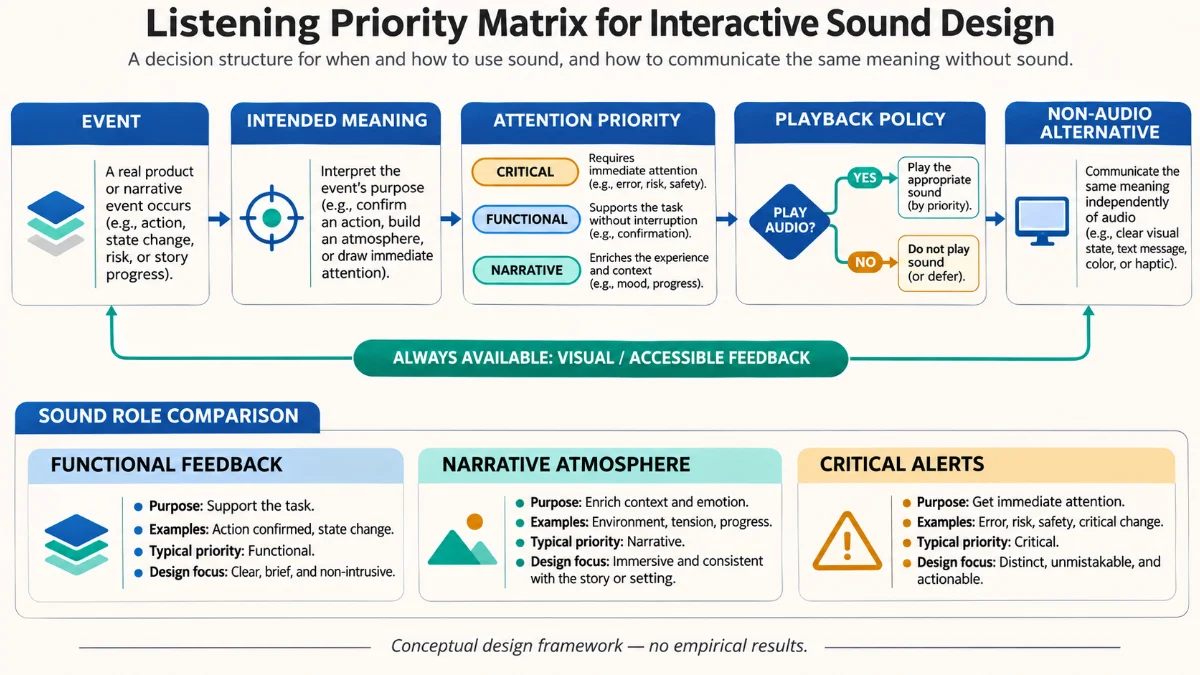
The Four Questions I Would Use in a Review
- Meaning: What exact state or narrative condition does the sound represent, and could listeners interpret it differently?
- Attention: Is the cue immediate, deferrable, optional, or suppressible when a higher-priority activity is underway?
- Behavior: What triggers, repeats, interrupts, fades, resumes, or cancels playback?
- Fallback: How is the essential meaning preserved when sound is muted, unavailable, delayed, or masked?
I would not approve an important sound solely because the team likes the sample. I would want the event contract and these four answers. The artistic review remains meaningful, but it happens inside an interaction design that can be examined and corrected.
The Audio Event Contract: A Small Engineering Architecture
An interactive sound system benefits from a clear sequence: a product or game state changes, the event is evaluated against a playback policy, the mixer allocates attention among active layers, and the output is delivered through the platform. The sound design architecture should not put business logic inside an audio file name or assume every UI component can directly trigger arbitrary sound. The aim is not to build a large audio middleware layer for a small app. It is to preserve predictable behavior as the number of cues grows.
Event, Policy, Mix, Output
I would define a sound event separately from its rendering. A successful action might emit a semantic event with task context; the policy decides whether sound is permitted under the current user preference, notification rate, focus state, and priority. If approved, the mixer chooses an asset and applies level, spatial treatment, and interruption rules. If declined, the underlying product event still completes and its visual or programmatic status still exists.
In an engine, this may map to state machines, sound classes, buses, and parameter modulation. In a web product, it may be much simpler. The HTML audio element provides user-facing playback controls for actual audio assets, but a browser’s autoplay policy and a product’s accessible status messaging remain separate concerns. A cue that fails to play must never leave a save, error, or authorization outcome uncommunicated.
Log State and Suppression, Not Just Playback
During development, I would log which event requested a cue, whether playback was allowed or suppressed, what priority was active, and whether conflicting layers were adjusted. These are diagnostic observations, not user-facing metrics to collect indiscriminately. The objective is to investigate defects such as alerts that trigger twice, dialogue that resumes after the scene has ended, or ambient layers that remain ducked. Logs must respect product privacy boundaries; the event structure should avoid unnecessary personal information.
For performance, the system also needs a policy for missing assets, device changes, and rapid repeated events. Nothing in that sound design architecture requires a designer to surrender control of the sound. It simply gives creative intent an operational form, so the behavior survives implementation changes and remains open to testing.
A Multichannel Demonstration Plan—Not a Completed Experiment
The editorial database for this topic calls for a multichannel demonstration plan. I have not produced or tested such a demo for this article, so I will describe what a useful demonstration would require rather than claim that I built one. A small authorized prototype could use the same short interaction sequence with separate dialogue, effects, interface, music, and ambience buses. The purpose would be to compare behavior under controlled conditions, not to claim universal listening preferences.
One Scenario, Several Listening Conditions
The hypothetical scenario is a creative application rendering an export while a short tutorial voiceover plays. A background completion event arrives during speech, followed by a user-triggered warning. The prototype would first present all layers at fixed levels, then apply a deliberate priority policy, and finally run with functional sounds disabled but visible and accessible status preserved. The order of presentation should be counterbalanced if testing with participants, because a fixed order creates learning effects.
| Condition | Audio behavior | Question |
|---|---|---|
| A. Fixed mix | All layers play with predetermined static levels | Which events compete for attention? |
| B. Priority-aware mix | Speech takes precedence; lower-priority notifications may be deferred or combined | Can listeners identify important events without losing speech? |
| C. Sound disabled | Optional sound effects and ambience are off; visual/programmatic status remains | Can the tasks still be completed and interpreted? |
If participants are involved, their consent, hearing and device considerations, test environment, tasks, order, and recording permissions must be documented. I would not compare two versions by asking only which sounds “feel premium.” More informative measures might include missed critical events, incorrect status interpretation, repeated actions after delayed feedback, perceived intrusion, and task completion. Each has limits; for instance, a short controlled test cannot establish long-term annoyance during weeks of use.
What Would Make the Demonstration Reproducible?
The project would need an event timeline, licensed or original audio assets, separated bus exports, mix rules, exact prototype version, playback conditions, and a record of user preferences. A screen recording alone may not preserve the spatial and dynamic qualities of the listening setup. If the test compares listening devices, device type and output level must be documented. Until those assets and logs exist, the planned demo is a research design rather than a portfolio result.
How I Would Evaluate Interactive Sound Design
Test Interpretation Before Measuring Preference
I would first ask participants to identify what occurred after hearing a cue in the intended context, then compare the interpretation with the event it was meant to communicate. A pleasant sound that regularly implies the wrong state needs revision. Context matters: an isolated audio identification exercise can help inspect recognizability, but it is not equivalent to playing the sound while reading, editing, navigating, or responding to a game event.
Measure Interruption in the Task, Not Only in the Mix
An audio mix can be objectively characterized by levels, timing, and spectral properties, but those measurements do not by themselves prove that a person maintained attention. The meaningful design question is whether the cue helped or disrupted task performance. I would look for repeated clicks, missed messages, delayed responses, and reported distraction, with task-specific criteria agreed before looking at outcomes. If no credible measurement setup is available, I would state an expert hypothesis and avoid pretending it has been verified.
Evaluate Across Contexts and Devices
A studio headset is one listening condition. A laptop on a desk, a phone speaker, a mono output device, and a silent-mode workflow can produce very different experiences. Some low-frequency ambience may effectively disappear on small speakers, and overlapping signals may become harder to distinguish. I would inspect the same interaction sequence across representative devices and access needs rather than extrapolate from one controlled playback session.
Accessibility Validation Is Behavioral
Accessible sound design should not depend on a user hearing a success or error cue. In an actual sound design audit, I would check keyboard navigation, screen-reader announcements, status persistence, readable captions or alternatives where required, and whether disabling sounds changes the outcome of the task. A checklist and a waveform cannot establish conformance for an application that has not been tested in its real interface.
Trade-Offs That Sound Designers Should Not Hide
Richness Versus Legibility
Layered textures can build a convincing world but reduce the contrast between meaningful events. More sound design layers are not always better. If a scene already includes speech, movement, music, and multiple environmental sources, the next sound may have to replace or suppress something rather than add another layer. The designer’s obligation is to protect the message, not to maximize simultaneous material.
Consistency Versus Context Sensitivity
Consistent sound design cues are easier to learn, but identical playback rules across every mode can become irritating. A completion sound may be useful while someone works elsewhere and unnecessary when the resulting state is directly in view. The sound identity can remain consistent while the system adapts whether it plays, how often, and at what relative level. That distinction prevents “consistency” from becoming an excuse for repetition.
Expressive Freedom Versus Operational Reliability
Experimental sound can create surprise and emotion, but functional status needs predictable semantics. An unpredictable sound design alert may be artistically engaging and professionally unacceptable in a workflow that controls financial, administrative, or destructive actions. I would separate expressive variation from state integrity. Randomization can vary a texture without changing what the user should understand.
Adaptive Systems Versus Maintenance Cost
Dynamic buses, sidechains, middleware events, and procedural sound can all be justified in rich experiences. Complex sound design systems also create configuration, debugging, performance, versioning, and testing obligations. A small application may need only a handful of cues and a sound preference. A complex game may require sophisticated state-driven mixing. The system should be no more complex than the listening problem it solves.
A Practical Sound Design Review Before Release
Before signing off on an interactive sound design experience, I would inspect the product rather than just the exported assets. I would confirm the meaning of each high-value cue, review whether repetition is bounded, test transitions while several events compete, and examine whether the interface remains understandable when sound is disabled. I would also check that audio respects platform behavior around silent mode, competing media, interruptions, and playback permission. None of these tests requires an elaborate listening laboratory to reveal obvious design problems, although formal claims about effectiveness require an appropriate research method.
My release decision would revolve around five questions: Are the important states still clear? Can lower-priority sound step aside? Does the runtime play only what the context permits? Are sound-off users able to complete essential actions? Can the team explain and reproduce what happened when playback goes wrong? If the answer to one of these is no, I would correct the interaction before polishing another layer of ambience.
Frequently Asked Questions
What is the difference between sound design and interactive sound design?
Sound design creates and organizes audible material for an experience. Interactive sound design adds rules for how that material responds to user actions, system events, narrative states, device conditions, and preferences. The same sound asset may play differently depending on context, or not play at all. For an interactive product, that behavior is part of the design.
Should every interaction have auditory feedback?
No. Auditory feedback should earn its place through information value, reassurance, or a deliberate expressive role. High-frequency interactions, background housekeeping, and redundant state changes often benefit from silence. Important outcomes still need visible or otherwise accessible communication, regardless of whether a sound plays.
Does audio ducking fix masking and poor sound accessibility?
No. Ducking can improve the relationship among overlapping layers when it has appropriate triggers and timing. It cannot correct ambiguous cue meanings, delayed events, missing visual alternatives, or an environment that is difficult to hear. It should be treated as one mechanism in a broader audio behavior policy.
How can teams evaluate sound without a finished game or product?
They can define an event contract, use a small authorized prototype, compare clearly described listening conditions, and test comprehension or interruption on representative tasks. Early tests support iteration, but results cannot be generalized beyond the sample and setup. A proposed demo without conducted sessions should be labeled a research plan, not a proven outcome.
Is background music automatically an accessibility failure?
Not automatically. The relevant WCAG success criteria are conditional and differ by media type and conformance level. For example, automatically playing audio longer than three seconds invokes the controls described in SC 1.4.2, while SC 1.4.7 addresses particular prerecorded speech-focused audio-only content at Level AAA. Independent of formal conformance, unexpected or intrusive audio can still harm usability.
Design What the Listener Can Understand, Not Just What They Can Hear
Good interactive sound design is an agreement among creative intent, product state, and human attention. Functional cues should communicate reliably; expressive layers should support meaning without claiming a permanent place in the foreground; dynamic playback rules should preserve priorities; and essential information must survive when audio does not. These are not constraints that make sound less creative. They allow an expressive decision to remain meaningful once the user takes control of the experience.
The principle I would carry into a new project is simple: define the meaning, design the timing, choose the sound, and validate the result in context. If an audio element cannot justify its attention cost, I would rather remove it than make it louder. The strongest sound design is not necessarily the one the listener notices most. It is the one that helps the experience make sense.
More From the Author
Explore related design and production topics in the Digital Creation Articles collection. My published Visual Language Across Formats article examines a parallel problem: preserving creative identity while adapting its expression to different media. Explore the broader Articles publication for work across products, design, and engineering.
Follow my work on LinkedIn, X, Threads, GitHub, and Behance.