

AI Art Direction: Six-Brief Visual Consistency Study

content hub
Decision Brief: What the Content Hub Audit Established
I wanted to answer a question that content teams often compress into a single dashboard number: is a new English editorial system becoming discoverable by the people it was designed to serve? An indexed page, a search impression, a click, a relevant query, an engaged visit, and a useful downstream action answer six different questions. If I merge them, I can make progress appear larger than the evidence warrants. If I keep them apart, I can decide which part of the publishing system deserves attention.
For this content hub audit, I examined a frozen set of 66 English editorial URLs on November 9, 2026: the main Articles hub, seven category landing pages, and 58 category-prefixed articles. I reconciled four Search Console export archives covering August 8 through November 7, 2026, in Pacific Time. The unfiltered Pages table returned performance rows for 38 of the 66 URLs, adding up to 659 reported impressions and 18 clicks. That is a measurable sign of search exposure for this group. It is not a current indexing census, proof of query alignment, or evidence of qualified business outcomes.
The most actionable technical observation was not a ranking metric at all. One Digital Media category card on the Articles hub pointed to a short route that redirected three times and eventually reached a Digital Growth expertise page, while the intended Digital Media editorial landing existed elsewhere. I would fix that link relationship before trying to explain a visibility trend with a grand theory about search algorithms. A reader can verify a destination; neither a conversion forecast nor a causal ranking story is necessary to justify the correction.
| Evidence layer | Observed | What it does not prove |
|---|---|---|
| Live public eligibility | 66 scoped URLs returned HTTP 200, self-declared canonicals and no observed noindex | Google’s current selected canonical or index status |
| Page search exposure | 38 returned page rows, totaling 659 impressions | That all 38 remain indexed or that 28 other URLs have zero visibility |
| Page search clicks | 18 clicks across 12 URLs | Engaged sessions, qualified leads, or conversions |
| Query and intent | Three page-filtered exports with impressions but no disclosed query rows | Which specific searches generated those impressions |
| Causal impact | A sitewide change over two 28-day windows | That launching the English content hub caused that change |
If you only read one thing: a content hub can show real page-level impressions before the research team can identify the exact searches involved, confirm the present index state of every URL, or measure engaged organic entry. The responsible conclusion is not that the audit failed. It is that those outcomes require separate evidence.
The Research Question and the Evidence Contract
The working question was which structures in a newly developed English content hub had begun earning qualified search exposure. The word qualified creates a demanding measurement obligation. A search impression says that a result was shown according to Search Console’s counting rules; it does not tell me whether the searcher was a software engineer, product leader, potential client, or someone seeking an unrelated definition. A click identifies search activity, not satisfaction with the landing page. A valuable outcome requires analytics or event evidence that the provided files did not contain.
Four different kinds of proof
I use four evidence labels throughout this content hub audit. Publicly observed means an HTTP response, link, canonical, sitemap entry, or other page output captured by the technical crawl. GSC-reported means a value in the user-supplied Search Console CSV exports. Documented means a definition from Google Search Central or Search Console documentation. Inferred means my interpretation of a combination of those observations. Each label answers a different question, and none can silently take the place of another.
Google explains the distinction between property-level and page-level aggregation in its Search performance reporting guide. Its data discrepancy guidance also documents row limits, hidden query data and reporting delays. Those rules matter because the apparent contradictions in the exported tables are not a reason to choose whichever total looks most impressive.
Why I did not calculate an indexing rate
In this content hub audit, every URL in the frozen cohort was publicly reachable during the November 9 crawl, declared itself canonical, and appeared in a relevant sitemap. Those are technical signals that can help search engines discover and interpret a page. Google’s own canonical selection documentation explains that the final canonical is selected by Google. Current indexed-version evidence requires a specific Search Console inspection or comparable Google record, not an assumption made from the site’s HTML.
Therefore the statement “38 out of 66 URLs have Search Console page rows” is supported. The statement “38 out of 66 URLs are indexed today” is not. Likewise, the 28 URLs absent from the returned Pages table cannot be labeled failed pages without further investigation. Some may be new, some may have undisclosed or otherwise omitted data, and some may be unindexed. The current export does not distinguish those possibilities.
Test Environment: The Frozen November 9 Snapshot
I froze the research cohort rather than letting the denominator shift every time a new article appeared. The audit ID was DM-08-20261109-131f2b28d406. The public data collection was a bounded, rate-limited crawl of live site pages, robots directives, sitemaps, category entries, selected archive paths and related URLs. The resulting 102-URL inventory includes 101 HTTP observations and one robots-disallowed reference that was not fetched. The 66 editorial URLs are a defined subset, not an exhaustive inventory of the whole domain.
| Dimension | Recorded scope |
|---|---|
| Snapshot | November 9, 2026; individual public checks timestamped |
| Frozen editorial cohort | 1 Articles hub + 7 category landings + 58 articles = 66 URLs |
| Performance exports | 4 genuine Google Search Console Web CSV archives |
| Performance dates | August 8–November 7, 2026, inclusive; 92 daily rows (Pacific Time) |
| Search Console property | HTTPS www URL-prefix, identified from export filenames and URLs; no live authenticated property inventory |
| URL-level Google indexing | Not available through a live Page Indexing or URL Inspection record |
| Behavioral analytics | No authorized GA4 landing sessions, engaged sessions or key events |
| Study readiness | Limited partial empirical audit, with real public and page-performance observations |
The freeze includes URLs under /artificial-intelligence/, /software-development/, /product-strategy/, /ux-ui-design/, /technology-hardware/, /digital-creation/ and /digital-media/. Category landing pages instead use distinct addresses such as Digital Media Articles. This separation matters: a taxonomy-shaped archive can have a different purpose, robot directive and reader experience from a designed editorial landing page.
Reproducible does not mean permanently current
The release package provides a URL list hash, raw-export fingerprints, a source register, derived CSV tables and verification scripts. I independently checked the four supplied ZIP SHA-256 hashes against the freeze, then recomputed the main chart, Pages and Queries totals. A later change to the live website does not retroactively change what this dated public capture saw. Conversely, the capture should not be presented as a live diagnosis months later without a new crawl.
Thirty-one of the 58 articles had a returned page-performance row, but publication-age comparison was not uniform. The public inventory found publication declarations for 49 articles; nine dates were missing, and six articles were dated after the November 7 performance cutoff. Comparing those URLs as though they had all been exposed to search for the same number of days would bias the result.
How I Joined the Pages Table to the Editorial Cohort
For this content hub audit, the safest join key was an exact URL rather than a title, topic, or fuzzy similarity score. I preserved the scheme, hostname, path, trailing slash and query string while comparing the normalized frozen URLs with entries in Search Console’s exported Pages tab. A historical page renamed or redirected into another category did not get silently moved into the current cohort. Those choices make the arithmetic less glamorous but more auditable.
Public inspection and first-page link coverage
The public capture inspected each category landing and its corresponding archive-shaped path. It extracted links in the main content region, noted HTTP status and redirects, and recorded canonical and robots directives from the returned responses. Because this is one dated capture of publicly served content, it describes the site’s exposed structure at that moment. It cannot tell me which links Googlebot traversed or whether an earlier version of the site had a different navigation graph.
Search performance without mixing dimensions
I treated the chart, Pages, Queries, Countries, Devices and Search Appearance tabs as separately grouped views. The overall chart reports property totals over time. The Pages table reports URL-grouped performance. The Queries table shows disclosed search terms, which may omit anonymized or other low-volume records. I used the Pages export to sum the frozen cohort and the daily chart only for property-wide comparisons. Combining the denominators or subtracting one table’s total from another as though they were the same counting system would mislead the reader.
Three other ZIP archives were filtered to one exact page apiece: the Articles hub, an AI interface article, and a software architecture article. Each supplied 92 daily records and a single Page row. Their empty Queries tables are an important negative observation about disclosure, not evidence that no one searched for the topics.
What the Search Console Exports Actually Say
The unfiltered chart used for the content hub audit reported 208 clicks and 13,872 impressions over the 92 days. Its Pages table reported 276 clicks and 16,725 impressions across 227 returned URLs. Its Queries table disclosed 695 query rows totaling 40 clicks and 7,378 impressions. All three figures are genuine within their respective exported dimensions, and none should replace the other. The 695 figure is based on CSV records, not physical text lines: quoted query text can contain embedded line breaks.
| Search Console view | Returned units | Clicks | Impressions | Interpretation |
|---|---|---|---|---|
| Property chart | 92 days | 208 | 13,872 | Property-wide time series |
| Pages table | 227 URLs | 276 | 16,725 | Page-level aggregation; not interchangeable with property chart |
| Queries table | 695 disclosed query rows | 40 | 7,378 | Visible query subset; not a complete reconstruction of searches |
For a technical reader, the difference is not an arithmetic bug. Google can count repeated results from one property differently when aggregating by site rather than by page, and it suppresses some query information for privacy. Its official data aggregation explanation and query-dimension limitations describe these boundaries. I would keep every original dimension visible instead of publishing a single unsupported traffic total.
A small controlled look at three exact pages
| Page | Clicks | Impressions | Disclosed query rows |
|---|---|---|---|
| Articles hub | 5 | 32 | 0 |
| AI interface | 0 | 43 | 0 |
| Monolith | 2 | 30 | 0 |
These three filtered pages had different levels of reported activity, including real clicks for two of them, yet all three returned header-only Queries CSVs. A model could invent phrases that sound plausible for each article and call them search intent. I would not do that. Without a genuine joined query–page record, we cannot establish which terms produced the exposure or how well those terms matched the page’s purpose.
The Content Hub’s Observed Search Footprint
After joining the current 66 URLs to the Pages export, the result was 38 matching rows with 659 impressions and 18 clicks. Breaking this content hub evidence apart is more useful than reporting one combined ratio. The Articles hub itself had 5 clicks and 32 impressions. Six of seven dedicated category landings appeared with 3 clicks and 67 impressions. Thirty-one of 58 article pages appeared with 10 clicks and 560 impressions. The remaining 28 cohort URLs had no returned Pages row—not a proven zero and certainly not a measured indexing failure.
| URL group | Observed / total | Clicks | Impressions |
|---|---|---|---|
| Articles discovery hub | 1 / 1 | 5 | 32 |
| Dedicated category landings | 6 / 7 | 3 | 67 |
| Individual English articles | 31 / 58 | 10 | 560 |
| All frozen URLs | 38 / 66 | 18 | 659 |
Even the cohort-level CTR, about 2.73% when calculated from 18 divided by 659, is a rate only for the returned page rows and their page aggregation basis. It does not measure the chance that a newly published article will attract a qualified reader. The rows reflect different topics, positions, ages, and query distributions. Some of the most recent posts could not have contributed a full period of observation.
The seven article categories were not equal experimental groups
Within the 58-article subset, category-level returned rows showed 105 impressions for UX & UI Design, 99 for Product & Strategy, 94 for Software Development, 85 for Artificial Intelligence, 83 for Digital Creation, 57 for Digital Media, and 37 for Technology & Hardware. Software Development recorded five clicks in returned article rows; Digital Creation recorded three; UX & UI Design and Digital Media each recorded one. Other categories recorded zero in those returned rows. I treat this as descriptive search exposure, not a league table of quality.
| Editorial category | Articles | Returned rows | Impressions | Clicks |
|---|---|---|---|---|
| Artificial Intelligence | 8 | 3 | 85 | 0 |
| Software Development | 8 | 4 | 94 | 5 |
| Product & Strategy | 9 | 5 | 99 | 0 |
| UX & UI Design | 9 | 6 | 105 | 1 |
| Technology & Hardware | 9 | 3 | 37 | 0 |
| Digital Creation | 8 | 5 | 83 | 3 |
| Digital Media | 7 | 5 | 57 | 1 |
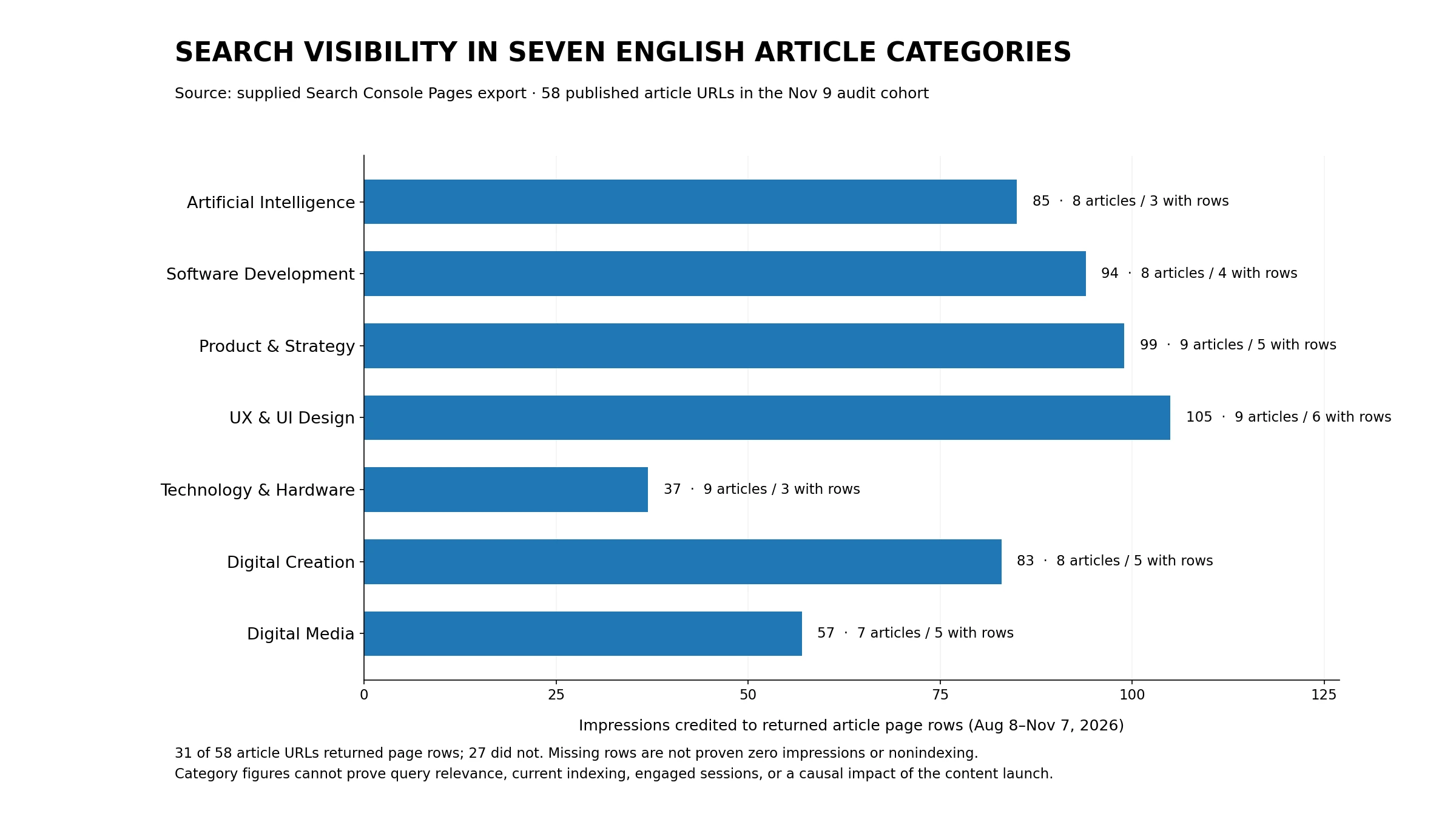
An important counterexample is publication timing. A category with eight older articles is not equivalent to a category with nine articles where several appeared very recently. The sitewide demand for an existing technical term may also exceed demand for a newly defined framework. These rows cannot identify whether one category template, one internal linking style, or one article format caused higher exposure. That would require matched age windows, relevant controls, reliable query data, and stronger attribution.
The Navigation Issue a Search Dashboard Would Miss
At the November 9 content hub capture, the global navigation linked directly to seven dedicated *-articles/ category landing pages. The main Articles hub, however, used seven short archive-shaped category-card targets. Six of those targets served an HTTP 200 page with noindex, follow. The Digital Media card followed three 301 redirects before ending at a Digital Growth expertise destination rather than the dedicated Digital Media editorial landing page. That is a verifiable reader-path mismatch, regardless of ranking impact.
An archive is not necessarily the content hub’s intended entry page
I distinguish an archive that organizes existing posts from a designed category landing that introduces a topic and links to relevant articles. Choosing to noindex a duplicate or secondary discovery archive can be intentional. The existence of six noindex archive responses is not proof that the content hub was incorrectly excluded from Google. All seven dedicated landing URLs had different roles, and the frozen core pages lacked a noindex directive in the public capture.
The Digital Media mismatch deserves correction because a visitor choosing the category should reach the destination promised by the label. My preferred implementation would link the card directly to the intended category landing, then confirm the destination, breadcrumb and related navigation in a new dated capture. I would not attribute any subsequent search impression change to that fix alone. The audit did not track a controlled before/after ranking effect.
Three pagination variants and one redirecting alias
Three checked page-two query variants for Product & Strategy, Technology & Hardware, and UX & UI Design returned HTTP 200 while declaring the base landing as canonical. Two of those variants exposed an additional category article link in the inspected content; the UX variant did not reveal another one in that scope. This is a reason to review content access and canonical policy together, but not a sufficient reason to declare an indexing defect. All frozen articles were also separately listed in XML sitemaps.
One older article URL, /software-development/vm-resources/, had five historical impressions in the Pages export and redirected during the November 9 crawl to /technology-hardware/vm-resources/. Both the historical row and the present redirect can be true. Search Console may attribute data to canonical URLs under rules that differ from the site’s latest redirect configuration. The timestamp of the migration was not established, so I kept the old alias outside the current 66-URL denominator.
Crawl Signals: What the XML Sitemaps and Canonicals Show
All 66 core URLs returned 200 responses, declared English, self-canonicalized, were allowed by the observed robots rules, and appeared in the appropriate post or page sitemap. That combination is encouraging technical eligibility evidence, but it is only one layer. The XML sitemap index had five child maps; three editorially relevant maps contained 89 post, 45 page and 10 category entries in the captured output. Fifty-eight of the post URLs belonged to the English article cohort.
The content hub crawl also found that the robots file included an additional sitemap declaration pointing to an llms.txt endpoint whose observed output resembled Markdown rather than a valid XML sitemap or a plain-text URL list. Google’s supported sitemap formats distinguish XML, RSS/Atom, and plain-text lists of URLs. The extra declaration is therefore worth reviewing for semantic correctness. It does not mean the separate XML sitemap index was broken, and this audit had no authorized Google Sitemaps report showing how that secondary declaration was processed.
Structured data and linking are not direct visibility metrics
All 58 sampled article pages included BlogPosting and BreadcrumbList types in the captured markup. Within the tagged article region, 39 pages linked to another URL in the frozen article cohort, while 19 had no such link detected by that parser. The latter count is not a whole-site orphan-page analysis. Navigation, related-content blocks outside the parsed region, and sitemaps can provide additional paths. It is a bounded measure of visible contextual interlinking within the article body region.
For a growing content hub, the better question is whether an internal link helps someone continue an actual research task. I would review a sparse article against a small set of genuinely related articles instead of automatically inserting an arbitrary number of links. Link relevance and reader purpose matter more than the raw presence of a hyperlink.
Search Intent: The Data We Cannot Reconstruct
The unfiltered Queries tab contained 695 disclosed search terms. Its totals were substantially below the property chart, and it was not joined to the Pages dimension. That means we cannot distribute those terms among the 66 article URLs by making assumptions about wording. Even if a term looked like an article title, the export alone would not establish that the corresponding article received the impression. Google’s documentation notes that anonymization and row limits can hide query detail even where page-level data exist.
A nonempty page report with an empty query report
The Articles hub’s filtered export showed 32 impressions and five clicks; the AI interface article showed 43 impressions and no clicks; the monolith article showed 30 impressions and two clicks. Every one of their filtered Queries tables was empty. This is a particularly useful reminder about the boundary of measurement. Zero disclosed query rows is not zero real searches, and it is not evidence of good or bad intent alignment.
For a future study, I would classify each actual returned query–page pair as highly aligned, partially aligned, adjacent, misaligned or ambiguous after reading the destination page. The critical input is a genuine joint row or page-filtered disclosed query, not a keyword suggestion model. Until then, the content hub audit can describe which pages received reported exposure but cannot describe the people or information needs responsible for it.
Qualified Entry Is a Ladder, Not a Single KPI
I use a four-tier framework because the phrase qualified traffic is often stretched beyond what the instrumentation supports. The first tier is a relevant query–page search impression. The second is a click associated with a cohort page or an aligned query–page pair, clearly labeling which criterion was observed. The third is a real engaged organic landing session measured through an analytics property. The fourth is a defined valuable downstream action supported by actual event data. These are not alternative names for the same measurement.
| Tier | Required signal | November 9 finding |
|---|---|---|
| 1 · Intent-aligned exposure | Real disclosed matching query–page record and impression | Unknown for 66/66 URLs; no joined query–page evidence |
| 2 · Page-associated search click | Search Console click credited to a relevant cohort URL | 12 URLs with clicks, 26 returned rows with no clicks; 28 missing rows |
| 3 · Engaged organic entry | Real attributed organic landing session meeting an explicit engagement definition | Unavailable; no authorized GA4 records |
| 4 · Valuable action | Real key event connected to a qualified session | Unavailable; no recorded event or attribution data |
There were 18 reported clicks credited to cohort pages. That supports the page-associated portion of Tier 2, but it does not establish query relevance for the clickers. I would not call them 18 qualified leads or 18 engaged visits. The absence of GA4 records is a data-access boundary, not proof that people left immediately or took no useful action. Google’s Traffic acquisition report and engagement definitions describe additional measurement requirements that this study could not meet.
A Sitewide Increase Cannot Be Credited to the English Hub
Across the earliest 28 fully observed days of the export, August 8–September 4 in Pacific Time, the overall site recorded 2,726 impressions and 25 clicks. During the latest conservative 28 days, October 9–November 5, it recorded 6,495 impressions and 86 clicks. Both periods came from the same unfiltered property chart. Their change is observable and worth tracking; its cause is not isolated. The final two exported days were excluded from the matched-window comparison as a conservative precaution because recent Search Console dates may be preliminary.
| Pacific Time window | Scope | Impressions | Clicks |
|---|---|---|---|
| Aug 8–Sep 4, 2026 | Whole HTTPS www property | 2,726 | 25 |
| Oct 9–Nov 5, 2026 | Whole HTTPS www property | 6,495 | 86 |
Multiple variables changed during this period: publishing volume and article age, possible internal navigation, demand for existing older content, competition, geographic composition and Google’s own indexing and serving decisions. The export includes legacy pages, tools and other parts of the domain, not just the English Articles program. A valid content hub causal claim would require a much more deliberate design and reliable time-resolved cohort data, not simply an upward chart.
The international shift is not measurable from these property totals alone
The property Countries tab reported 9,369 impressions and 190 clicks for Türkiye, 1,569 impressions and three clicks for the United States, and 319 impressions and two clicks for the UK-labeled row. Those are property-wide geographic values with no direct join to the new English URLs. They do not reveal users’ professional roles, query language, intent, or whether they reached the new editorial hub. I would not interpret them as an English-market conversion rate or treat all US/UK impressions as qualified prospects.
Before and After: What This Audit Changes in Decision-Making
Before applying the evidence contract, it would be easy to read the 38 returned URLs as an index coverage rate, read 659 impressions as qualified discovery, and credit the entire property’s late-period growth to the editorial launch. After applying the contract, those statements become more precise. The URL cohort is fixed. The Pages rows are reported search exposure. The live crawl describes current public eligibility. Query alignment and engaged sessions are missing measurements. The category-card mismatch is an actionable navigation issue regardless of its unknown SEO effect.
| Overstated claim | Supported replacement |
|---|---|
| “38 pages are indexed.” | “38 of 66 frozen URLs returned Search Console Pages rows during the reporting period.” |
| “The hub generated 659 qualified impressions.” | “The frozen URLs were credited with 659 page-level impressions; query alignment is unknown.” |
| “The new English program drove site growth.” | “The overall property recorded higher impressions and clicks between two selected windows; causality is untested.” |
| “The Digital Media redirect damaged rankings.” | “One hub category card ended at a different destination after three redirects; search impact was not measured.” |
| “No query rows means no search interest.” | “The three filtered exports disclosed no queries despite recording page impressions.” |
What I Would Investigate and Fix Next
1. Align category cards and their destination promises
I would correct the Digital Media category card to target its dedicated editorial landing URL directly, then inspect all seven cards for consistency with the global navigation. The acceptance condition is a user-facing route that matches its category label and avoids unnecessary redirects. This is a navigation integrity task first. Its success should not be defined by a speculative instant ranking uplift.
2. Establish current indexed-version records for a bounded sample
I would use authorized URL Inspection evidence for a purposeful sample: the Articles hub, all seven category landings, selected article pages with returned impressions, selected pages with missing performance rows, and the moved article alias. The sampled Google-selected canonical, indexed status and last crawl information should stay attached to its own observation date. Google’s URL Inspection API describes indexed-version checks and does not substitute for a live HTML test.
3. Retrieve genuine query–page combinations
The next search intent audit should retrieve page-filtered queries using an authorized interface or Search Analytics API with explicit time ranges, paging and truncation notes. If individual page queries remain hidden, I would publish the visibility result without an intent verdict. Keyword strings are hypotheses until the measurement source ties them to the page in question.
4. Measure qualified landing sessions without merging sources
If a correctly configured analytics property and consent-compliant tracking records become available, I would record Google organic landing sessions, engagement criteria and relevant actions independently. I would also check tracking coverage, time zones and channel rules. Search Console clicks and analytics sessions are not one-to-one counts; their discrepancy is a measurement question rather than something to hide with a conversion formula.
5. Keep publication-age and content changes in the ledger
A useful longitudinal content hub review needs stable URL cohorts and dated release events. I would record article publication and revision dates, link-architecture changes, sitemap changes and genuine index inspections in a versioned history. A 28-day result should only be compared after the page has actually been eligible for an equivalent 28-day window, with exclusions and reporting lag disclosed.
Evidence, Limitations, and Reproduction
The raw evidence consisted of four user-provided Search Console CSV ZIPs, an observed public crawl, the frozen URL list, and supporting research outputs. The four ZIP fingerprints matched the frozen input register; their daily chart, page and query counts were recomputed independently. The research package also includes claim-to-source mappings, a cohort comparison, technical audit tables and Python verification scripts. Private raw query exports need not be republished simply to make a public interpretation understandable. A responsible release can show aggregate results and a reproducible procedure while minimizing unrelated search data.
Threats to validity
This content hub audit is an observational, time-bounded study. There was no randomized holdout, complete historical technical baseline, live Google Page Indexing access, GA4 session data, or verified query–page alignment. Public responses can be served from an edge cache and can change after collection. The Search Console export may withhold data, and its aggregation varies by dimension. Some articles were too new to contribute a full measurement window. Category groups were not randomly assigned, and impressions are influenced by demand and search presentation as well as editorial choices. These limits prevent a quantified causal estimate or broad claim about audience quality.
A repeatable seven-step review
- Choose a cutoff date and define the exact Articles hub, category and article URLs to include.
- Save each public HTTP response’s status, redirect chain, canonical, robots signal, sitemap presence and observation time.
- Export Search Console Web data with an explicit property, search type, date window and active filters; preserve each original ZIP.
- Compute hashes before parsing and compare tab totals on their own aggregation bases.
- Join only exact normalized page URLs to the frozen cohort; retain unmatched historical aliases separately.
- Keep URL-level index states, query–page evidence, clicks, sessions and downstream actions in different columns.
- Publish a new dated revision with changed URLs and methods documented, rather than rewriting the original audit as if it were a continuous live measurement.
The supplied audit package provides scripts for public capture, export processing, intent review and verification. These are starting points for replication, not authority to crawl unrelated sites or access private Search Console accounts. The original 92-day data do not establish the behavior of this content hub after November 9, 2026.
Quick Summary
- The November 9 frozen cohort contained 66 URLs: one hub, seven category landings and 58 English articles.
- Thirty-eight URLs appeared in the August 8–November 7 Search Console Pages export, with 659 impressions and 18 clicks on that page-aggregation basis.
- Twenty-eight missing page rows are not proven zero traffic or nonindexed pages.
- Three exact-page exports had impressions but no disclosed query rows, preventing a query–intent conclusion for those samples.
- A Digital Media card followed three redirects to a destination different from the intended category landing during the capture.
- Sitewide property growth, current Google index status and actual engaged organic entry remain separate questions.
Knowledge Check: Can You Separate the Evidence?
A page returns HTTP 200 and self-canonicalizes. Is it currently indexed by Google?A page has 43 Search Console impressions and its filtered Queries CSV is empty. Did it receive no search queries?If the property chart rises between two periods, can the English content hub claim the increase?
Frequently Asked Questions
Does an impression mean a content hub page is indexed?
A Search Console impression is evidence that a result was displayed according to the report’s attribution rules during its date range. It is not an independently refreshed audit of every URL’s present Google index state. The report can credit a canonical URL whose state or redirect has changed by the time a later crawl runs.
Why can a published article have no row in the Pages export?
A missing returned row can reflect short publication age, no credited visible activity, reporting and row limits, attribution to another canonical, or other unknown causes. The export does not distinguish all of them. Treat the result as missing observation rather than silently assigning zero or nonindexed status.
Why can a Search Console page show impressions without visible queries?
Search Console hides some query information to protect privacy and applies internal data limits. Page-level metrics and query-level disclosure are separate. The three exact-page ZIPs in this study demonstrate that a nonempty performance view can coexist with a header-only Queries table.
Can I compare CTR across the seven content categories?
You can calculate descriptive rates from returned rows on the same aggregation basis, but that is not a controlled test of category quality. Article age, ranking position, search intent, snippet appearance and small denominators can change the rate substantially. Avoid choosing the apparent winner from sparse groups.
Should every category archive be indexable?
Not necessarily. A discovery archive may intentionally remain noindex when a distinct editorial category landing is the preferred search entry page. Evaluate the page purpose, duplication, internal navigation and declared canonical first. A noindex archive is not automatically a site error.
What would make a search entry genuinely qualified?
At minimum, define the information need and show a real query–page relationship. Stronger qualification requires a consent-compliant organic landing session, engagement or a useful action recorded in an authorized analytics system. An impression alone is insufficient, and a click alone does not establish satisfaction.
Does declaring llms.txt as a sitemap improve Google indexing?
No such improvement was measured here. The observed Markdown-like endpoint did not match the documented XML or plain-text sitemap formats, while the separate XML sitemap resolved correctly. The right check is format validity and actual Search Console processing evidence, not an unsupported indexing benefit.
How often should an English content hub audit be repeated?
Choose a cadence that can capture publication age and meaningful technical changes, rather than looking for daily proof of success. Preserve stable cohort IDs, dated exports, reporting cutoffs, inspection samples and any corrections. A repeat with comparable periods tells a more useful story than a constantly changing denominator.
Key Terms
Indexing eligibilityPublic technical conditions compatible with discovery and indexing, not confirmation that Google has indexed the URL.Selected canonicalThe version Google chooses to consolidate duplicates; this may differ from the site’s declared canonical.ImpressionA Search Console record of a search result being shown under its counting and aggregation rules.Query suppressionOmission of some query details for privacy or data-serving reasons.Qualified entryA search arrival judged relevant under an explicit evidentiary definition; it requires more than a URL impression.Frozen cohortA defined, hashed list of URLs used as the denominator for a dated comparison.
Conclusion: Measure the Boundary Before Celebrating the Trend
The result of this content hub audit is not a sweeping victory story or an indexing alarm. The English editorial program has real, measured page-level search exposure, a clear published information architecture, and at least one specific category navigation defect worth correcting. It also has important open measurement questions. We do not yet know the exact queries associated with the sampled page impressions, the current Google index state of all 66 URLs, or whether a search click became an engaged and useful visit.
In my view, a credible content hub strategy begins when a team can say exactly what was observed, preserve the record, and decline to overclaim the rest. I would rather fix an incorrect category link, document a missing query dimension and run the next properly controlled snapshot than promise that publishing more pages will automatically create qualified demand. The evidence is modest; the method is reusable.
Related Reading and Further Work
For the editorial system behind this study, visit the Articles hub and the Digital Media category. For complementary methods, see AI Search, GA4 Measurement Planning, and Marketing Attribution. They address other layers of search, measurement and causal inference; their claims should not be substituted for missing data in this audit.
Useful external definitions include Google’s Search Console discrepancy guidance, its Page Indexing report explanation, and the URL Inspection API reference.
Author’s Note and Update History
I approach search measurement through the same lens I use for software, products and research: define the observable system, state the limits, and preserve the work needed to challenge the conclusion. This publication is an evidence-bounded review of my English editorial architecture, not a case study of client conversions. You can follow related engineering and content work on GitHub, LinkedIn, and X.
Research snapshot: November 9, 2026. Search Console cutoff: November 7, 2026, Pacific Time. Editorial update policy: Re-run future audits against new frozen inputs and identify the new revision rather than rewriting this historical dataset. This note does not state the publication date of the article.