


Idempotency Under Failure: Six RabbitMQ Tests

AI Evals: 72 Runs Expose Citation and Grounding Failures

A product team can run a discovery sprint, collect more evidence, and still make the wrong decision if its ranking was never tied to a specific question. I find that the revealing moment is not when a problem rises to the top. It is when we can explain precisely what made it rise, what competing evidence remains, and which change in assumptions would reverse the choice.
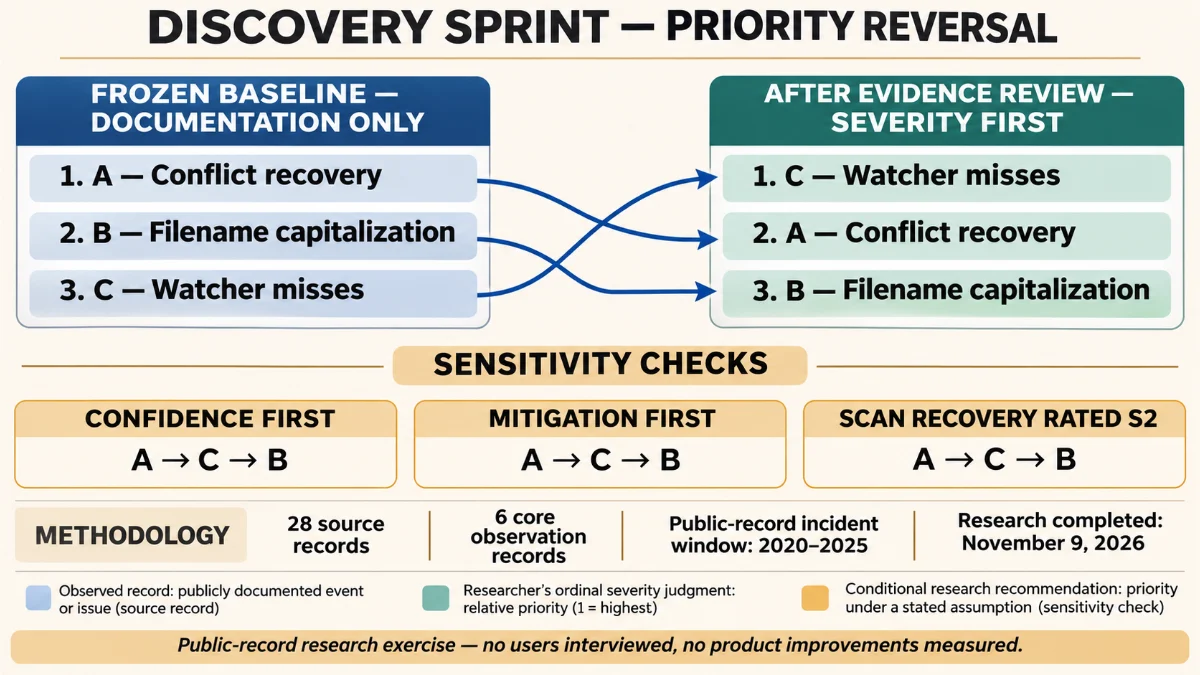
For this case, I examined a documented, independently executed public-record discovery exercise concerning Syncthing, an open-source continuous file synchronization product. The discovery sprint question was deliberately narrow: which of three failures in an established desktop send-and-receive folder deserved the first follow-up investigation? The exercise froze an initial ranking based on documentation, then examined 28 distinct source records from original reports, project discussions, release records, and technical documentation. Under its predefined severity-first rule, the leading problem changed. Under three reasonable alternative assumptions, the original leader returned.
This is a study of an evidence-based prioritization decision, not a live test of Syncthing, a user interview program, or an experiment showing that a product improvement worked. That boundary is central to the value of the result. A useful lean discovery sprint should improve the quality of the next decision without pretending that research has answered questions it did not measure.
Decision Brief: One Priority Changed, Not the Product Roadmap
Decision: Allocate the first follow-up discovery slot among conflict-copy recovery, filename capitalization conflicts, and missed filesystem watcher events in an existing desktop synchronization workflow.
Observed research result: The frozen order was conflict recovery, capitalization, and watcher misses. Reviewing the eligible evidence with the same severity-first rule produced watcher misses, conflict recovery, and capitalization.
Strongest limitation: Reordering the same graded evidence by confidence or mitigation ease returned conflict recovery to first. The study therefore supports a conditional research priority, not a universal claim about which issue affects the most users or creates the greatest business loss.
What I would authorize: A current-version replication and diagnostic investigation of watcher-driven freshness, not an immediate engineering commitment to rebuild the synchronization engine.
What This Discovery Sprint Actually Had to Decide
Many product discovery discussions begin with features or broad questions about customer needs. Here, the proposed investment was more modest: one unit of additional investigation. The workflow was a folder already shared between desktop peers, where someone changes a file and expects the intended version to become available at the expected path on another device. The discovery sprint decision did not cover initial setup, transfer throughput, mobile-only failures, generic network problems, or a platform’s entire product strategy.
In this discovery sprint, that constraint matters because the three candidates interfere with different stages of the same outcome. A conflict copy creates recovery work after divergent content is detected. A case-insensitive receiver may be unable to represent two otherwise distinct names. A failed filesystem watcher can leave a legitimate local edit undiscovered until a later scan, other event, or restart. They are comparable as obstacles to completing the defined workflow, although their mechanisms, feasible mitigations, and severity are not interchangeable.
Three Competing Product Problems
| ID | Problem | Consequence relevant to this decision |
|---|---|---|
| A | Divergent edits and conflict-copy recovery | A person may need to locate, compare, and reconcile different versions of a logical file. |
| B | Filename capitalization conflicts | A receiving filesystem may reject or mishandle a path when two names differ only by case; a case-only rename requires separate analysis. |
| C | Missed filesystem watcher events | A changed file may remain stale on a peer until the source discovers the edit through a subsequent scan or other recovery path. |
The official synchronization guide provides the mechanical background. It distinguishes filesystem notifications from periodic full scans, explains that divergent versions can generate conflict copies, and documents why case-insensitive filesystems need protective handling. These facts establish plausible failure modes. They do not, by themselves, establish which problem deserves attention first.
That is the first transferable lesson of this discovery sprint: define the decision boundary before selecting the evidence. Without it, a large volume of unrelated issues can appear more persuasive than a smaller set of incidents that actually matter to the intended outcome.
A Frozen Baseline Before the Full Evidence Review
The independent researcher considered Syncthing and Rclone as potential public-record cases. Rclone’s bisync documentation describes a bidirectional workflow based on successive invocations across storage backends. Syncthing offered a cleaner comparison of continuous local change detection, conflicts, and path representation within one workflow. Rclone was not scored against the Syncthing candidates.
The discovery sprint baseline was produced on November 9, 2026 using only the first-party synchronization guide and the three defined categories. Individual incident threads, implementation records, and release notes were not opened or graded before the baseline was saved. Search-result snippets had nevertheless exposed some symptoms during reconnaissance; the source log acknowledges this imperfect separation. The file was preserved at 12:43:00 Europe/Istanbul time, and the recorded SHA-256 digest matched when the evidence package was checked. This is a documented local sequence, not independently notarized evidence or a blinded study.
That distinction matters. A discovery sprint needs an explicit ‘before’ state if it claims a priority reversal. Retrospectively reconstructing what the researcher supposedly believed is especially risky once the final evidence is already visible. A frozen discovery sprint record does not eliminate all bias, but it makes the direction of the comparison auditable.
The Ordinal Rule, Not a Weighted Score
For the discovery sprint, the researcher predefined an ordering: severity first, then evidence of recurrence, strategic relevance, confidence, and finally lower implementation dependency when comparable grades were available. An otherwise tied pair could be ordered provisionally by fewer required operating conditions; unresolved ties would remain tied. Each judgment used named ordinal categories rather than fabricated percentages or a numerical confidence model.
| Dimension | Definitions in the study | Interpretive limit |
|---|---|---|
| Severity: S1–S3 | S1: bounded latency or friction with routine recovery. S2: material path-level failure or manual recovery. S3: repeated or sustained workflow disruption under supported conditions, or substantiated unrecoverable loss. | S3 does not itself mean permanent loss occurred. |
| Recurrence: R0–R2 | R0: no eligible field incident. R1: one or attribution-limited clusters. R2: two apparently independent case clusters. | Counts describe the sampled evidence, not population prevalence. |
| Relevance: T1–T2 | T1: mainly ancillary. T2: directly affects intended file, path, or useful timing. | Relevance is defined for this specific workflow. |
| Confidence: E1–E3 | E1: speculative or contradicted. E2: documented or plausible but materially limited. E3: corroborated mechanism and separable observations for a scoped consequence. | These are research judgments, not calibrated probabilities. |
| Dependency: D1–D3 / DU | D1: localized or existing mitigation. D2: material platform or safety constraints. D3: substantially unclear. DU: not assessed. | Mitigation dependency is not an engineering effort estimate. |
With documentation alone, problem A and problem B both received S2, R0, T2, E2, and unassessed dependency. A won the provisional tie-break because B additionally requires the filesystem to treat capitalization variants as equivalent. Problem C started at S1, R0, T2, E2 with dependency unassessed. The frozen queue was therefore A, B, C. At this stage no eligible individual incident had yet earned recurrence credit.
It is tempting to call that initial queue an intuition. More precisely, it was a documented analytical judgment based on a narrow first-pass evidence set. No Syncthing employee, customer, or product executive was represented as having made or approved it. In a responsible discovery sprint, whose decision a ranking represents is part of the method, not a footnote.
Product Discovery Research: What the 28 Records Actually Represent
The discovery sprint’s full review drew from original GitHub issues, first-person posts in the Syncthing community forum, first-party documentation, release notes, and an implementation dependency record. The incident eligibility window was January 1, 2020 through December 31, 2025. The dated, retained in-window entries began in June 2020 and ended in August 2025. A linked August 2026 reproduction was retained only as post-window context and was not allowed to affect the ranking.
The discovery sprint research register contained 28 distinct records: 10 associated with divergent edits, seven with capitalization, 10 with watcher misses, and one common guide. By source type, these were 12 forum records, eight GitHub issues or feature requests, five documentation pages, two releases, and one merged dependency pull request. Only six rows were classified as core observations for the study’s main evidence coding. Those six do not represent six research participants; they are a selected subset of publicly documented records.
The discovery sprint used purposeful sampling, not a random or representative sample. A relevant report needed a concrete observation, consequence, diagnostic detail, or useful contradiction. An eligible technical record needed to clarify a mechanism, constraint, recovery path, or fix. Repeated comments, duplicate requests, and linked changes did not become independent incidents merely by appearing at different URLs. Several drive-root watcher threads were conservatively treated as one case family, and a pair of capitalization reproductions were treated as potentially dependent.
Why More Issues Are Not Automatically More User Evidence
Issue trackers systematically overrepresent people who notice, diagnose, and publicly describe unusual failures. They usually lack a denominator: how many users never experienced the condition, silently recovered, or chose not to report it? A reaction count is not an incident count, and a large collection of requests is not verified product reach. A discovery sprint that promotes issue frequency to market prevalence without an exposure measure has changed the claim, not improved the evidence.
The discovery sprint also separated records outside the chosen workflow. Initial synchronization, one-way setups, mobile-specific behavior, wrapper-only defects, and transfer failures without an isolated watcher mechanism could clarify context but did not automatically count toward recurrence. This particularly affected the capitalization candidate: historical technical reproduction and release documentation established that problems can occur, while eligible independent reports for ordinary desktop send-and-receive operation were sparse within the selected sample.
The product discovery process depends on two layers of evidence: what was actually documented and what can reasonably be inferred for this narrowly defined comparison. For a discovery sprint, the same public record can be strong evidence that an issue was reported and weak evidence about how commonly it occurs today.
What Changed After the Evidence Review
The primary discovery sprint result is a recorded change in the researcher’s queue. The ordinal method remained the same. What changed were the supported grades after examining the incidents and their limits.
| Problem | Frozen baseline | Revised order | Decisive interpretation |
|---|---|---|---|
| A — Conflict recovery | 1 · S2 R0 T2 E2 DU | 2 · S2 R2 T2 E3 D1 | Independent reports strengthened the case for actual discovery and reconciliation work, but the harm remained bounded to recovery rather than proved permanent loss. |
| B — Capitalization | 2 · S2 R0 T2 E2 DU | 3 · S2 R0 T2 E2 D2 | A credible filesystem safety constraint remained, but qualifying recurrence evidence within this specific scope was thin. |
| C — Watcher misses | 3 · S1 R0 T2 E2 DU | 1 · S3 R2 T2 E2 D2 | Named configurations supported repeated disruption of timely propagation beyond ordinary event batching. |
In this discovery sprint, the most dramatic movement was C, from third to first. The strongest grading change was its severity assessment, from S1 to S3. That is not a measurement of prevalence or a claim that an entire synchronization system remained permanently broken. It is the researcher’s assessment of the disruption described in specific historical setups. The discovery sprint decision prioritizes the next investigation when timely freshness is the objective.
Why Watcher Misses Rose to First
Syncthing detects changes through filesystem notifications and periodic scans, and its documentation recommends retaining scanning as a fallback. The guide also describes expected watcher batching. A modest delay under that mechanism is not the same as a watcher that no longer detects future eligible modifications. The discovery sprint separated those possibilities before assigning severity.
One Windows drive-root issue describes files becoming visible after a rescan, with additional discussion in March 2025 about a shorter interval when a workaround did not reliably restore desired behavior. A separate 2021 Windows forum thread describes a reproducer involving replacing or renaming a watched directory. The reporter stated that manual rescanning could detect modifications while watching failed to resume for subsequent changes until a restart. These are particular reports and configurations, not generalized findings for every modern installation.
A Windows junction issue described scheduled or manual scans recovering discovery of changes, which reinforces the need to distinguish slow fallback from loss of watcher-driven immediacy. A Linux subtree reproduction supplied a related mechanism but also had scope and storage-context uncertainties. The later August 2026 duplicate report was explicitly outside the scored incident window and did not establish the current shipping state of a fix.
One account of a delay exceeding eight hours involved periodic scans being disabled. Presenting that experience as Syncthing’s standard scan interval would be a methodological error. The official guide describes routine scanning as a backstop, and configuration changes can alter both latency and resource consumption. The severe grade represents the selected cases where the expected timely workflow needed repeated or disruptive intervention, not a claim that default configurations reliably behave the same way.
Why Conflict Recovery Remained a Serious Alternative
Conflict copies are not automatically data loss. The official guide explains that divergent contents can produce a preserved copy, which is then treated as an ordinary file for propagation. That protection can still leave people with difficult recovery work. A 2022 feature request describes a user running a nightly conflict-file search to become aware of copies; a 2025 forum discussion describes uncertainty about finding and resolving copies across three computers.
Those accounts support a meaningful recovery burden in more than one setup and raise recurrence and confidence grades for problem A. They do not establish the original edit histories, how typical the burden is, or an irreversible loss rate. Other reports describe plausible contributors, including permissions behavior and system metadata. A conflict-copy artifact alone cannot tell a researcher exactly why it appeared.
This distinction matters for product prioritization: a visible symptom may identify the user’s recovery job without proving a single root cause. A near-term follow-up could investigate whether conflict copies are discoverable and understandable across clients. That narrower mitigation was graded D1; it does not imply that building an integrated conflict browser would be cheap or that an interface can resolve divergent versions on the user’s behalf.
Why Capitalization Stayed Third Without Becoming Unimportant
Filesystems differ in whether names that vary only in capitalization refer to distinct paths. Syncthing’s case-sensitivity documentation explains why a receiver may reject a colliding name rather than risk unsafe overwriting. A 2020 issue reproduced a case-only rename conflict after an ignore sequence, whereas a different reproduction described a transient problem followed by convergence. The v1.10.0 release notes document particular fixes; they do not make all future name collisions impossible.
The discovery sprint evidence for this case was old, concentrated around the safety rollout, and often outside the exact established-folder send-and-receive scenario being graded. The resulting R0 means the selected review did not identify sufficient qualifying independent field incidents. It does not mean capitalization problems never occur or that their product importance is negligible. This is precisely the kind of distinction that an honest discovery sprint must preserve.
Sensitivity Analysis: The Priority Reversal Was Not Universal
If I publish only the severity-first order, the reader sees a seemingly decisive product discovery result. The more important part is how easily that decision changes when a defensible alternative objective takes precedence. The first two alternatives were specified in the frozen method; the final one stress-tested the pivotal severity judgment after review.
| Decision emphasis | Resulting order | Reason |
|---|---|---|
| Severity first | C → A → B | Watcher disruption received S3, ahead of the two S2 problems. |
| Evidence confidence first | A → C → B | Conflict recovery had E3 for the scoped recovery burden; watcher outcomes remained E2. |
| Ease of mitigation first | A → C → B | The narrowly scoped conflict-discovery mitigation received D1; the others received D2. |
| Treat scan recovery as bounded impact | A → C → B | Reducing C from S3 to S2 lets A lead through stronger confidence after other grades tie. |
This discovery sprint did not recalibrate a weighted score to create the outcome. Under the alternative priorities, the ranking changed because the order of already stated criteria changed, or because one explicitly identified severity judgment was tested. That is a stronger research contribution than a single table with a winner, because it shows decision makers what they must believe for the top recommendation to be valid.
The strongest counterargument to this discovery sprint is operational: the most disruptive watcher cases are historical and configuration-dependent, and periodic scans can eventually recover changes when enabled. If eventual convergence is sufficient for the target workflow, C’s severity may reasonably fall. Conflict recovery is different: finding and reconciling preserved copies can remain a manual job after synchronization succeeds. In that interpretation A is a more defensible first investigation.
A discovery sprint should therefore return not just a priority but an explicit conditional sentence: investigate watcher-driven freshness first if timely propagation is the relevant product promise and the named failures are credible enough to justify verification. If the business objective values recovery clarity over freshness, the recommendation may change without any contradiction in the evidence.
From Problem Prioritization to an Authorized Next Test
The discovery sprint did not authorize a feature, fix, or roadmap slot. It identified the most useful next question under a specified decision rule. I would turn the result into a current-version compatibility and reliability study, using controlled local files and preserving the separation between the source observing a change and peers receiving it.
A Controlled Follow-Up for Watcher-Driven Freshness
- Record the current Syncthing version, operating systems, filesystem types, folder modes, scan intervals, watcher settings, and whether periodic rescans are enabled.
- Establish a control on an ordinary local subfolder with no symlinks, junctions, or network mounts. Record event-detection and indexing timestamps where supported.
- Repeat a bounded set of changes on drive roots, replaced directories, junctions, or other explicitly supported configurations only when they are safe and relevant. Keep each condition separate.
- Distinguish three outcomes: the local edit was indexed promptly, it was detected only by a later scan, or watcher operation failed to resume for subsequent edits.
- Measure time to discovery separately from time to propagation. Do not label a network transfer problem as a watcher miss.
- Repeat trials with automatic scanning enabled under documented settings. Capture both successful convergence and failed recovery, including the resource and freshness tradeoffs.
- Compare current behavior with the historical record. If the old conditions do not reproduce, downgrade the urgency rather than treating the experiment as a failed narrative.
Only after that test would I ask how many relevant customers use the affected configurations, what timeliness they require, and whether a feasible mitigation changes their experience enough to justify investment. Even a successful technical reproduction does not establish commercial priority without that context. This distinction complements the broader treatment of experimental boundaries in MVP Experiments: Testing Risk Before Building Features.
A Decision Record I Would Carry Into the Next Review
| Field | Recorded decision |
|---|---|
| Research objective | Determine whether current desktop configurations can silently lose watcher-driven freshness beyond expected batching. |
| Provisional priority | C before A and B under severity-first assumptions. |
| Evidence basis | Purposeful public-record sample and independently preserved baseline; no representative user telemetry. |
| Next authorization | Reproduction and impact investigation only; no implementation commitment. |
| Counterevidence | Successful automatic scan recovery, old-version cases, and greater confidence in conflict-copy recovery burden. |
| Review trigger | Current-release tests demonstrate rapid recovery, failed reproduction under relevant configurations, or materially different user-value requirements. |
| Alternative | Move A first when recovery clarity or confidence is the leading objective. |
A discovery sprint decision record is not a substitute for clear decision rights. It specifies what the evidence supports and who should determine the next allocation of capacity. For a broader account of how authority, constraints, and review triggers fit together, see Decision Rights: Why Product Managers Cannot Fix the System. The present exercise does not claim that Syncthing’s maintainers adopted any part of this proposed follow-up.
Research Validity, Evidence, and Methodological Limits
Here is the precise provenance of the discovery sprint findings. On November 9, 2026, an independent research workflow collected and coded public Syncthing evidence with read-only access. It saved a documentation-only baseline before the individual source review, applied one explicit ordinal rule before and after, and recorded three sensitivity outcomes. The source package contains a claim register, 28-row evidence register, three-row prioritization table, preserved baseline, research report, and a detailed source log. These are underlying work artifacts rather than invented customer analytics or a public experimental dataset hosted on this site.
Internal consistency checks covered unique source identifiers, URLs, date windows, source relationships, grade orderings, and the baseline digest. Those checks do not turn subjective severity judgments into independently validated measurements. The exercise was conducted by one researcher and had no second blinded coder. Selection relied on searchable, English-heavy public reports. Versions, platforms, configurations, and incident descriptions were uneven. Some available records referred to the same underlying case or technical fix and were correctly excluded from separate recurrence credit.
The study did not interview participants, survey customers, access private product telemetry, replicate bugs in a running installation, inspect confidential company plans, implement changes, or measure post-fix outcomes. It cannot determine current incident rates, business value, reach, actual customer demand, or the current-release status of every historical defect. The August 2026 linked report was contextual only, and subsequent issue activity was not evidence that a fix had shipped.
These discovery sprint limitations matter because the primary positive finding is narrow but real: under the same predefined severity-first rule, newly reviewed evidence changed one researcher’s first investigation priority from A to C. Alternative assumptions made A lead again. For this discovery sprint, the methodological success is transparency about that conditional result, not a claim of statistical significance, universal priority, or causality.
How Another Researcher Could Reproduce the Analysis
Start with one defined desktop send-and-receive workflow and the same three failure categories. Freeze an initial assessment from the Syncthing synchronization guide before opening case reports. Preserve the assessment file and a digest. Then retrieve source records from the public issue tracker and project forum, restrict qualifying incidents to January 2020 through December 2025, and document all excluded or dependent reports. Code severity, eligible independent recurrence, strategic relevance, confidence, and scoped dependency using the definitions above. Reapply the severity-first rule, then run confidence-first and mitigation-first alternatives plus the S3-to-S2 watcher-recovery stress test.
The discovery sprint result may not reproduce exactly if records are edited, search visibility changes, different eligibility decisions are made, or another researcher grades severity differently. That would not automatically invalidate the exercise; it would reveal which premises or judgments must be inspected. A genuinely auditable discovery sprint welcomes that possibility.
What Product Leaders Can Take From a Small Discovery Sprint
First, define the discovery sprint decision unit. Choosing one question to investigate is not the same as approving one feature to build. A team may have enough evidence to choose its next research activity while still lacking the incidence, customer impact, feasibility, and cost data needed for delivery. This distinction prevents discovery outputs from being promoted into commitments without a new review.
Second, preserve the before state. If nobody writes down the initial assumptions and ranking before reading additional evidence, a changed priority can become a persuasive but unverifiable story. The baseline should record what was known, what was excluded, how ties were treated, and the exact rule used. That approach also protects against the temptation to rewrite the starting position after seeing an appealing result.
Third, grade claims rather than simply counting artifacts. A report that contains a user’s detailed recovery problem can be strong support for a scoped consequence. The same report may provide almost no evidence about population frequency, causal origin, or present-day reach. A framework that tracks those as distinct claims can generate more disciplined product prioritization than a spreadsheet filled with apparently precise confidence percentages.
Fourth, prioritize counterevidence as deliberately as confirming evidence. In this case, routine scanning, transient capitalization mismatches, version-specific fixes, permissions explanations, and preserved conflict copies all complicated the simple narrative. That friction is productive. It is the difference between a discovery sprint that selects the evidence most likely to win an argument and one that tests the strongest alternative explanations.
Finally, a discovery sprint should write the reversal conditions into the decision. The important output is not just that C led in the primary queue. It is that C’s lead rests on timeliness and a severity judgment that can be challenged by successful fallback. The alternative A becomes more compelling when we prioritize confidence, ease of improving discovery and recovery, or eventual convergence. The adjacent question of opportunity cost and reversible commitments is explored in Product Strategy Trade-Offs: Cost and Reversibility.
For me, an evidence-based discovery sprint succeeds when a second decision maker can understand the recommended action, the competing argument, the limits of what was observed, and the event that should reopen the decision. A discovery sprint ranking alone cannot do that work.
Frequently Asked Questions About Discovery Sprints
How is a discovery sprint different from a product development sprint?
A discovery sprint is organized around reducing a consequential uncertainty. Its output may be a clearer problem definition, a rejected hypothesis, a validated constraint, or a recommendation for the next experiment. A development sprint is normally organized around delivering or improving an implementation. The two can overlap operationally, but a research priority does not automatically authorize a feature or guarantee a business outcome.
Can a discovery sprint use public issue reports instead of interviews?
Yes, for questions that public records can answer. Such records can reveal reported symptoms, diagnostic conditions, requests, and counterexamples. They usually cannot provide representative prevalence, unreported user needs, purchase intent, or the causal effects of a new solution. The PS-08 study is a public-record discovery exercise, not a substitute for direct research with a defined user population.
Why did the ranking change if the method stayed the same?
The full review supplied specific incident evidence that the initial documentation-only assessment lacked. In particular, watcher failures under named conditions justified a higher severity grade for the workflow being evaluated. The rank calculation was ordinal, with severity first, so that change moved the watcher problem to the first investigation slot. Other plausible priorities returned conflict recovery to first.
Would a numerical framework such as RICE be more reliable?
Not automatically. RICE can support decisions when reach, impact, confidence, and effort estimates have defensible definitions and useful underlying data. In this case the public record contained no trustworthy denominator for reach and no measured development effort. Assigning numerical values would have introduced apparent precision without resolving those gaps. A transparent ordinal method was more suitable for the available evidence.
What would justify building a solution after this discovery sprint?
A current-version replication of the suspected failure, evidence that the affected workflow matters to a defined group, realistic mitigation and maintenance tradeoffs, and authorization from the responsible product and engineering owners. The research performed here chose a follow-up investigation. It did not verify that a particular repair improves outcomes or that the case should displace the product’s other commitments.
Does a changed priority prove the discovery sprint was successful?
No. A changed queue can result from a biased sample, subjective grading, or a revised decision objective. The stronger discovery sprint standard is whether the sequence was preserved, the source trail is legitimate, the competing evidence is visible, and the conclusion is limited to what was tested. An unchanged ranking would also have been a valid result if it survived the same scrutiny.
Conclusion: Discovery Should Make Priorities Contestable
The PS-08 discovery sprint changed the first follow-up question from conflict-copy recovery to watcher-driven freshness under a severity-first rule. It did not determine Syncthing’s most common issue, validate the effects of a solution, or decide the maintainers’ roadmap. The six core observation records sat within a wider set of 28 sources that included explanations, fixes, dependencies, contradictions, and context. That distinction kept the evidence from being mistaken for a sample of users.
The most consequential finding is that three sensible sensitivity checks reversed the reversal. That is not a weakness to conceal. It tells a product leader exactly where additional research can create value: does timeliness matter more than recovery clarity in the target workflow, and do current configurations reproduce the historical watcher failures? I would use the next discovery sprint to test those propositions, not to defend an ordinal table after its assumptions have changed.
Product discovery earns its place in strategy when it changes not merely what we prefer, but what we can responsibly claim, question, and authorize. A defensible priority is one that remains open to better evidence.